PRESENTATION USER GUIDE AN OVERVIEW: Canadas Emerging Indigenous - - PDF document

presentation user guide
SMART_READER_LITE
LIVE PREVIEW

PRESENTATION USER GUIDE AN OVERVIEW: Canadas Emerging Indigenous - - PDF document

PRESENTATION USER GUIDE AN OVERVIEW: Canadas Emerging Indigenous Rights Framework: A Critical Analysis A A Spe Special Rep epor ort by the e Yel Yellow owhead ead Institut ute, e, Jun une e 2018 2018 TITLE SLIDE The Yellowhead


slide-1
SLIDE 1

1

PRESENTATION USER GUIDE AN OVERVIEW: Canada’s Emerging Indigenous Rights Framework: A Critical Analysis

A A Spe Special Rep epor

  • rt by the

e Yel Yellow

  • whead

ead Institut ute, e, Jun une e 2018 2018

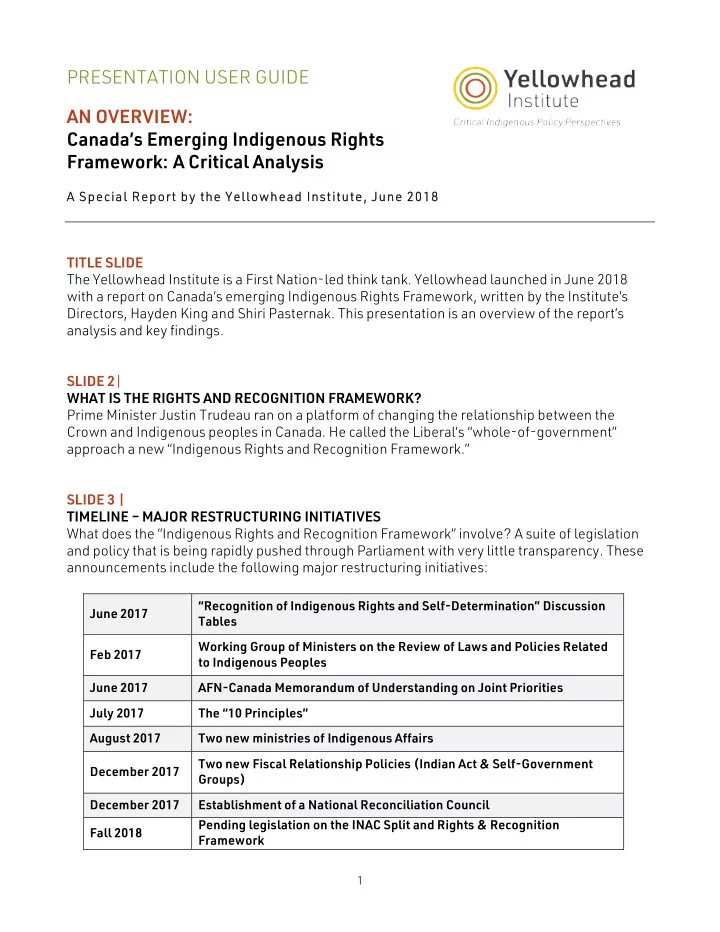
TITLE SLIDE The Yellowhead Institute is a First Nation-led think tank. Yellowhead launched in June 2018 with a report on Canada’s emerging Indigenous Rights Framework, written by the Institute’s Directors, Hayden King and Shiri Pasternak. This presentation is an overview of the report’s analysis and key findings. SLIDE 2| WHAT IS THE RIGHTS AND RECOGNITION FRAMEWORK? Prime Minister Justin Trudeau ran on a platform of changing the relationship between the Crown and Indigenous peoples in Canada. He called the Liberal’s “whole-of-government” approach a new “Indigenous Rights and Recognition Framework.” SLIDE 3 | TIMELINE – MAJOR RESTRUCTURING INITIATIVES What does the “Indigenous Rights and Recognition Framework” involve? A suite of legislation and policy that is being rapidly pushed through Parliament with very little transparency. These announcements include the following major restructuring initiatives:

June 2017 “Recognition of Indigenous Rights and Self-Determination” Discussion Tables Feb 2017 Working Group of Ministers on the Review of Laws and Policies Related to Indigenous Peoples June 2017 AFN-Canada Memorandum of Understanding on Joint Priorities July 2017 The “10 Principles” August 2017 Two new ministries of Indigenous Affairs December 2017 Two new Fiscal Relationship Policies (Indian Act & Self-Government Groups) December 2017 Establishment of a National Reconciliation Council Fall 2018 Pending legislation on the INAC Split and Rights & Recognition Framework

slide-2
SLIDE 2

2 SLIDE 4 | FIVE SERIOUS CONCERNS While there are positive elements in some of the changes being proposed, there must also be serious concern for the way the status quo is maintained in this “new” Framework.

  • 1. Though Canada uses the language of “self-determination” to describe the objective of

the Rights Framework, this concept does not include any meaningful recognition of Indigenous jurisdiction over lands, territories, and resources outside of the reserves;

  • 2. The Framework does not address the spirit and intent of the historic treaties or the
  • utstanding title question on non-treaty lands, but rather addresses the injustice of land

dispossession through incremental and sectoral approaches of restitution;

  • 3. The Framework maintains Canada’s supremacy within Confederation, seeking to

subsume Indigenous rights into the federal and provincial heads of power;

  • 4. The Framework does not open an adequate process for nation-to-nation discussions

because much of the high-level negotiations are happening between the federal government and the Assembly of First Nations;

  • 5. The Framework does not lay out a process for consultations with First Nations people,

rejecting out of hand any constitutional talks, and there has been little transparency from the federal government on key components of the Framework. SLIDE 5 | TRANSITIONING FROM THE INDIAN ACT TO THE RIGHTS FRAMEWORK Here is a model of how the Framework will work. The goal of the Indigenous Rights and Recognition Framework is to transition Indian Act bands

  • ut of the Indian Act.

This transition out of the Indian Act has been a federal concern since the White Paper was introduced in 1969 by Pierre Elliot Trudeau. It proposed the dismantling of the department of Indian Affairs, the end of Indian “status,” the transformation of reserve lands into private property, and the gradual termination of treaties and rights for First Nation people. Due to its aggressive assimilationist vision for a post-Indian Act world, it was vigorously defeated by First Nations. The federal government has since taken a more incremental approach to proposing exit strategies from the Indian Act. The Comprehensive Land Claims and Inherent Right to Self- Government policy transition Indigenous groups into agreements that remove them from the Indian Act. This transition has also transpired through legislative reform beginning in the late 1990s with the “Kamloops Amendments” that gave First Nations increased powers of taxation and other financial tools and the First Nations Land Management Act (FNLMA) that created

  • pt-out mechanisms from the Indian Act land management provisions.
slide-3
SLIDE 3

3 Now Canada is offered a greater range of options to opt-out of the Indian Act. But what comes after, according to this plan? There appears to be a desire to move all Indian Act bands out of the Indian Act – whether signatories to historic treaties or those living on non-treaty, “title” lands. The plan also seems to expedite current negotiation tables on land and self-government, where Indigenous nations and bands transition their status as collective rights-holders with territorial authority into “re-constituted nations” responsible for service delivery to their populations. New processes introduced to encourage the transition out of the Indian Act into self-government frameworks include: § an emphasis on financial transparency and accountability through a 10-year grant model, with significant investment in capacity building and training towards these ends; § a growing number of “exploratory tables”–now called the “rights and recognition” tables – that are experimenting with sectoral approaches to conflict through MOUs and framework agreements; § and, basing changes to the self-government and land claims policy on precedents like B.C.’s self-government legislation bill S-212 (this legislation ultimately did not become law). SLIDE 6 | AN OVERVIEW OF CANADA’S INDIGENOUS RIGHTS FRAMEWORK TAKE TAKE-AWAY POINTS AWAY POINTS The Indigenous Rights and Recognition Framework, though complex, is also relevant in its

  • goals. It is complex and multi-faceted but it coheres around Liberal interpretations of First

Nation “self-government” and “self-determination.” SLIDE 7 | GOALS OF THE RIGHTS PLAN § To increase and expedite the number of modern treaties and self-government agreements; § To maintain status quo of the 1995 Inherent Right policy, incorporating more flexible mechanisms, such as incremental and sectoral agreements; § To maintain policies that do not deal directly with the authority of Indigenous nations to exercise full jurisdiction, ownership, and control over their lands on a territorial basis; § To support the “reconstitution of nations,” which appear to be aggregated service- delivery populations, with no additional jurisdictional authority off-reserve;

slide-4
SLIDE 4

4 § To domesticate UNDRIP by watering down the free, prior, and consent articles; § To build fiscal capacity within First Nations to transition all Indian Act bands into self- government agreements, rather than to expand the land base and deal honourably First Nations as economic rights-holders. SLIDE 8 | A CRITICAL ANALYSIS PART 1: RELATIONSHIP REFORM § An overview of the changes to the machinery of government to facilitate the new relationship PART 2: POLICY REFORM § An overview of existing and emerging policy on “reconstituting nations” PART 3: LEGISLATIVE REFORM § An overview of pending legislative reform and the “pre-conditions” for Indigenous Rights SLIDE 9 | PART ONE: RELATIONSHIP REFORM NATION NATION-TO TO-NATION RELATIONSHIP NATION RELATIONSHIP

  • Principles respecting the Government of Canada's relationship with Indigenous peoples,

aka, “the 10 Principles” released by the Department of Justice will form the basis for all future negotiations.

  • Emphasizes the supremacy of Canadian constitutional framework and reveals little

structural change.

  • Threatens Aboriginal rights by stating Canada will only “aim” to implement FPIC &

reasserting Canada’s rights of infringement. SLIDE 10 | PART ONE: RELATIONSHIP REFORM NATION NATION-TO TO-NATION RELATIONSHIP NATION RELATIONSHIP

  • AFN-Canada Memorandum of Understanding on Joint Priorities lays the groundwork for

decision-making on key policy issues;

  • Consultation and implementation of the Framework is happening through AFN, which is

acting as the “nation” in the nation-to-nation relationship, despite not being a “rights- holding” body;

  • The process cuts out Indigenous nations, as well as First Nation bands and many

grassroots people.

slide-5
SLIDE 5

5 SLIDE 11| PART 1 – RELATIONSHIP REFORM NATION NATION-TO TO-NATION RELATIONSHIP NATION RELATIONSHIP

  • INAC split into CIRNA (Crown Indigenous Relations and Northern Affairs) and DISC

(Department of Indigenous Services) in August 2017, creating confusion around divisions of jurisdiction.

  • DISC goal of devolution of services to First Nations raises question as to whether First

Nations are delivering programs for Canada or taking over program areas on their own terms with independent funding.

  • CIRNA goal of devolution of governance to “re-constituted nations” raises questions

about First Nation constitutional rights, the future status of treaties, and potential shifts in federal fiduciary responsibilities and the role of the provinces. SLIDE 12 | PART 2: POLICY REFORM “RECONSTITUTING NATIONS”

  • “Re-constituting Nations” is a vague process that forms the centrepiece of Liberal

promises of recognition, but important precedents exist in legislation and reports in the BC context.

  • B.C. Bill S-212, designed by current Justice Minister Jody Wilson-Raybould emphasized

constitution development with authority to legislate reserve-based affairs, and establishing a process for amalgamating bands

  • Key to this process is a national prioritization of Comprehensive Community planning to

“build capacity” and accountability in a municipal-style governance model. SLIDE 13 | PART 2: POLICY REFORM INCREASED FINANCIAL INDEPENDENCE WITHIN STATUS QUO INCREASED FINANCIAL INDEPENDENCE WITHIN STATUS QUO

  • The New Fiscal Relationship for Indian Act bands builds greater independence into the

policy for some bands and repeals two of the worst initiatives - third party management and the Transparency Act.

  • However, the focus on capacity building to the detriment of restructuring the fiscal

relationship around treaty and title obligations stalls real transformative progress.

  • The 10-year grant model is a welcome change, however it is dependent on an

accountability certification from the First Nation Financial Institutions and does not actually address underfunding.

slide-6
SLIDE 6

6 SLIDE 13 | PART 2: POLICY REFORM FISCAL CHANGES FOR SELF FISCAL CHANGES FOR SELF-GOVERNING FIRST NATIONS GOVERNING FIRST NATIONS

  • The New Fiscal Relationship for bands under the self-government policy is meant to

better address expenditure needs of groups and also to provide greater access to other revenues, with the long-term goal of largely self-funded groups.

  • We can expect increased support to “close gaps” and capacity building upfront to ease

the transition to taxation, OSR funded service delivery, less long-term funding from Canada.

  • Modern treaty and self-government signatories may also see debt forgiveness

measures and/or repayment for debts incurred through negotiation. SLIDE 15 | PART 2: POLICY REFORM MODERN TREATY MAP SLIDE 16 | PART 2: POLICY REFORM

  • The “Rights and Recognition Tables” were first introduced as “exploratory tables” in

2016 - now there are over 60 tables involving 320 communities and negotiating groups have been named, but little information exists on nature of talks;

  • The process has been secretive; negotiating parties are not title-holders, but mostly

PTOs, tribal councils, and advocacy organizations; treaties are being reinterpreted at tables in a sectoral approach; funding incentives may deter groups for making broader territorial claims; a vast number of tables appear to be out-of-court settlements for

  • ngoing disputes with the Crown.

SLIDE 17 | PART 3: LEGISLATIVE REFORM “DECOLONIZING CANADIAN LAW” “DECOLONIZING CANADIAN LAW” In 2016, a cabinet committee to “decolonize” Canada’s laws was announced. This committee includes Ministers of Justice, Indigenous Affairs (both), Natural Resources, Environment and Climate, Transportation, Fisheries and Oceans, and Families, Children and Social Development. This work extends beyond this committee. In many of Cabinet’s Ministerial mandate letters, a process of reform was instructed to each: the Minister of the Environment and Climate Change was directed to review the CEAA; the Minister of Natural Resources was directed to review the National Energy Board (NEB) and its enabling statutes; the Minister of Fisheries was directed to review the Fisheries Act; and finally, the Minister of Transport was directed to review the

slide-7
SLIDE 7

7 federal navigation legislation. (It should be added that these reviews were taking place regardless of the urge to decolonize and there is a matter of convenience here).

  • The current government is among the most active in the history of the Canadian

government on Indigenous issues

  • 3 bills already passed, one senate bill, 6 private members bills, 2 government bills

affecting First Nations (Bill C-68/69), and 4 government bills specific to Indigenous issues to come (including INAC split, rights and recognition framework, and an Indigenous languages act)

  • The “decolonization” process has not been collaborative however, with almost no

Indigenous representation on the ‘decolonizing law’ committee, no prior consultation on the INAC split, and no mention of UNDRIP in new environmental legislation, despite repeated demands from Indigenous peoples for FPIC. SLIDE 18 | LEGISLATION ON INDIGENOUS ISSUES This infographic illustrates just how active the current parliament is when it comes to legislative changes impacting Indigenous peoples. SLIDE 19 | PENDING LEGISLATION SEE HANDOUT SEE HANDOUT All the pending legislation by the Liberal government. To read the full report, please visit: www.yellowheadinstitute.org

slide-8
SLIDE 8

LEGISLATION RECEIVING ROYAL ASSENT Bill S-208 National Seal Products Day Act May 2017 Private member’s bill (LPC) C-17 An Act to amend the Yukon Environmental and Socio-economic Assessment Act December 2017 Government bill S-2 An Act to amend the Indian Act in response to Superior Court

  • f Quebec decision in Descheneaux c. Canada

December 2017 Senate bill INTRODUCED LEGISLATION S-212 Aboriginal Languages of Canada Act December 2015 Senate bill (LPC) C-262 United Nations Declaration on the Rights of Indigenous Peoples Act April 2016 Private member’s bill (NDP) C-318 An Act to establish Indian Residential School Reconciliation and Memorial Day October 2016 Private member’s bill (LPC) C-332 United Nations Declaration on the Rights of Indigenous Peoples Reporting Act December 2016 Private member’s bill (LPC) C-369 National Indigenous Peoples Day October 2017 Private member’s bill (NDP) C-386 An Act to establish Orange Shirt Day November 2017 Private member’s bill (LPC) C-391 Aboriginal Cultural Property Repatriation Act February 2018 Private member’s bill (LPC) C-68 An Act to amend the Fisheries Act and other Acts in consequence February 2018 Government bill C-69 An Act to enact the Impact Assessment Act and the Canadian Energy Regulator Act, to amend the Navigation Protection Act February 2018 Government bill PROPOSED LEGISLATION An Act to Establish the Ministry of Crown – Indigenous Relations and Northern Afgairs (CINRA) Proposed for 2018 Government bill An Act to Establish the Department of Indigenous Services Canada (DISC) Proposed for 2018 Government bill Indigenous Languages Act Proposed for Fall 2018 Government bill An Act to Establish an Indigenous Rights, Recognition and Implementation Framework Implementation Proposed for Fall 2019 Government bill

Pending Legislation

*For the purposes of this table, “Legislation Receiving Royal Assent” means bills that have or will soon become law. “Introduced legislation” means bills working their way through Parliament. Some of these may never become law, the private member’s bills in particular. Proposed legislation are bills the federal government has announced for

  • introduction. This table does not include modern treaty specifjc legislation.

This chart is from the report, Canada’s Emerging Indigenous Rights Framework: A Critical Analysis by the Yellowhead Institute, released on June 5, 2018.