Presenter Profile Born in Paris, France, in 1957 Graduated from - - PowerPoint PPT Presentation

presenter profile
SMART_READER_LITE
LIVE PREVIEW

Presenter Profile Born in Paris, France, in 1957 Graduated from - - PowerPoint PPT Presentation

conference & convention enabling the next generation of networks & services Presenter Profile Born in Paris, France, in 1957 Graduated from Mc Gill University in Montral, Canada after studying optical components using


slide-1
SLIDE 1

enabling the next generation of networks & services

conference & convention

Presenter Profile

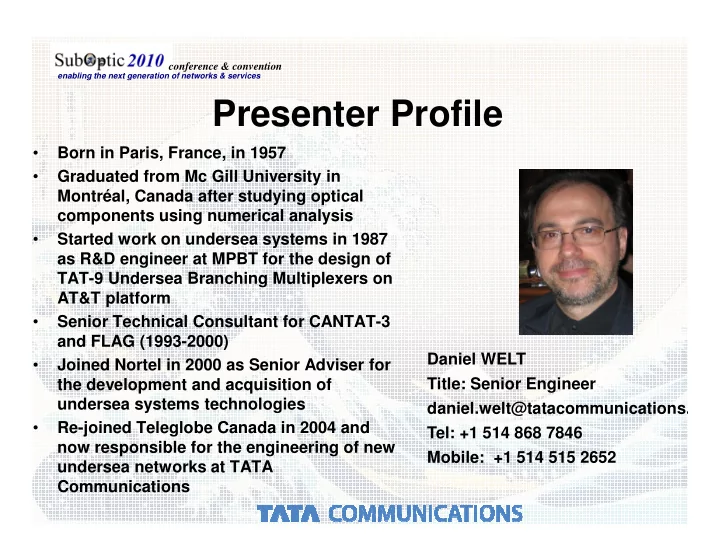
  • Born in Paris, France, in 1957
  • Graduated from Mc Gill University in

Montréal, Canada after studying optical components using numerical analysis

  • Started work on undersea systems in 1987

as R&D engineer at MPBT for the design of TAT-9 Undersea Branching Multiplexers on

Place picture here

TAT-9 Undersea Branching Multiplexers on AT&T platform

  • Senior Technical Consultant for CANTAT-3

and FLAG (1993-2000)

  • Joined Nortel in 2000 as Senior Adviser for

the development and acquisition of undersea systems technologies

  • Re-joined Teleglobe Canada in 2004 and

now responsible for the engineering of new undersea networks at TATA Communications Daniel WELT Title: Senior Engineer daniel.welt@tatacommunications. Tel: +1 514 868 7846 Mobile: +1 514 515 2652

slide-2
SLIDE 2

enabling the next generation of networks & services

conference & convention

The case for Undersea OADM Branching Units with Bandwidth Re-use A CARRIER PERSPECTIVE

Daniel Welt

slide-3
SLIDE 3

enabling the next generation of networks & services

conference & convention

INTRODUCTION

The purpose of this presentation is to demonstrate that undersea networks need “true” OADM functionality, and this functionality needs to reside in the undersea branching unit. In the context of that presentation, “true” means with context of that presentation, “true” means with wavelength re-use This is the vision of a User. TATA Communications is a carrier and not an equipment supplier, the objective is to set principles and justify requirements, not engineer a solution

slide-4
SLIDE 4

enabling the next generation of networks & services

conference & convention

Observation no. 1: There are 4 good reasons to deploy true “wet” OADM solutions

1. The tolerance of traffic to branch cuts is improved: only the traffic to and from the branch is affected 3. Round trip delay is minimized 4. Transit through intermediate stations is eliminated, simplifying administration 2. Bandwidth is re-used and the overall capacity is increased

slide-5
SLIDE 5

enabling the next generation of networks & services

conference & convention

Observation no. 2: “true” undersea OADM functionality is feasible

All what are needed are optical filters, technology already

Blocking Filter

RE-USE TRUNK TRUNK

technology already used and qualified, well known by Suppliers. They need no power and use very little space

ADD

NEW

“Privacy” Filter (Optional)

DROP

ADD/DROP SITE

slide-6
SLIDE 6

enabling the next generation of networks & services

conference & convention

Illustration

1. The tolerance of traffic to branch cuts is improved: only the traffic to and from the branch is affected branch is affected

slide-7
SLIDE 7

enabling the next generation of networks & services

conference & convention

OADM CASE STUDY: Topologies

CLASSIC

T1 T2 T3 T4 T5 T6 T7

BU1 BU2 BU3 BU4 BU5 1 2 3 4 5 6 7 8 9 10 11

M : Deep N : Shallow

2FP Traffic Paths from node 1 to node 5, (primary and restoration)

OADM

T1 T2 T3 T4 T5 T6 T7

OADM BU1 OADM BU2 OADM BU3 OADM BU4 OADM BU5

1 2 3 4 5 6 7 8 9 10 11

M : Deep N : Shallow

slide-8
SLIDE 8

enabling the next generation of networks & services

conference & convention

OADM CASE STUDY: Parameters

  • Length of deep water sections (sections 3, 5, 7

and 9): 1,000 km each

  • Length of branch sections (sections 1, 2, 4, 6, 8,

10 and 11): 200 km (in shallow water) 10 and 11): 200 km (in shallow water)

  • Probability of fibre cut in deep water: 0.025 per

100 km per year

  • Probability of fibre cut in shallow water: 0.25 per

100 km per year

  • Repair time: 10 days
slide-9
SLIDE 9

enabling the next generation of networks & services

conference & convention

OADM CASE STUDY: DOWN TIME

slide-10
SLIDE 10

enabling the next generation of networks & services

conference & convention

OADM CASE STUDY: SIMULTANEOUS FAULTS

HISTOGRAM

500 600 700 800 900

uency

With OADM 100 200 300 400 500 1 2 3 4

Number of Faults at a Given Time

Freque

With OADM No OADM

Probability distribution for the occurrence of simultaneous failures in 10 years for DLS T1 to T5, with and without OADM, simulated

slide-11
SLIDE 11

enabling the next generation of networks & services

conference & convention

Illustration

2. Bandwidth is re-used and the overall capacity is increased capacity is increased

slide-12
SLIDE 12

enabling the next generation of networks & services

conference & convention

Spectrum Slices

slide-13
SLIDE 13

enabling the next generation of networks & services

conference & convention

OADM: Comparing with and without bandwidth re-use: number of DLSs versus number of spectrum slices, 1 FP

The number of spectrum slices is the maximum number of DLSs to be supported on a segment, typically in the middle of the system. There are DLSs that do NOT occupy the same part of the fibre, for example all DLSs from one node to its adjacent node Number of DLSs = N*(N-1)/2, N is the number of nodes

slide-14
SLIDE 14

enabling the next generation of networks & services

conference & convention

OADM: Comparing with and without bandwidth re-use; impact of guard bands

RE-USE GAIN versus GUARD BAND

60% 80% 100%

  • 60%
  • 40%
  • 20%

0% 20% 40%

2 3 4 5 6 7 8

Number of Nodes % GAIN

With guard band 3% Ideal With guard band 5%

Gain = total bandwidth (re-use)/total BW (no re-use)

slide-15
SLIDE 15

enabling the next generation of networks & services

conference & convention

OADM: Sharing OADM with bandwidth re-use

  • n several fibre pairs to maximize capacity

OADM with bandwidth bandwidth re-use always wins

slide-16
SLIDE 16

enabling the next generation of networks & services

conference & convention

“True” OADM: Solve the Problem

The undersea telecommunications “community” should put aside traditional Supplier differences and define an optical architecture for a “universal” OADM undersea network. To do so, a standard sub-band architecture should be defined and agreed in order for all future systems to be able to support optimized OADM traffic if so chose the Customers.

slide-17
SLIDE 17

enabling the next generation of networks & services

conference & convention

OADM: The “simple” solution and why it is not good enough

TRUNK TRUNK Capacity is wasted Channels are broadcasted to all sites

ADD DROP

ADD/DROP SITE Capacity is wasted This spectrum slice is reserved

slide-18
SLIDE 18

enabling the next generation of networks & services

conference & convention

OADM: The “simple” solution and why it is not good enough (2)

noise noise

Without filtering and equalization, “added” traffic may be lost

noise

ADD DROP

repeaters

slide-19
SLIDE 19

enabling the next generation of networks & services

conference & convention

OADM: A “repeater” friendly optical block for an “active” branching unit

Blocking Filter

splitter coupler

EDFA/ Noise source ADD DROP Bandpass Filter EDFA/ Noise source Bandpass “privacy” Filter (Optional)

slide-20
SLIDE 20

enabling the next generation of networks & services

conference & convention

OADM: Trunk Fault Handling of the “active” BU

Blocking Filter

splitter coupler

EDFA/ Noise source ADD DROP Bandpass Filter EDFA/ Noise source Bandpass “privacy” Filter (Optional)

noise NEW

slide-21
SLIDE 21

enabling the next generation of networks & services

conference & convention

OADM: Branch Fault Handling of the “active” BU

Blocking Filter

splitter coupler

EDFA/ Noise source ADD DROP Bandpass Filter EDFA/ Noise source Bandpass “privacy” Filter (Optional)

noise NEW

slide-22
SLIDE 22

enabling the next generation of networks & services

conference & convention

CONCLUSION

  • This presentation illustrated the simple principles

that support the architecture of undersea systems based on OADM technology with bandwidth re-use

  • Although these principles may appear simplistic to

some, they are often ignored at the time of system some, they are often ignored at the time of system design and the equipment offered by suppliers do not always satisfy all the requirements

  • The net gains in system availability, total capacity,

latency and elimination of unnecessary transit should justify the modest developments required to establish industry standard “true” OADM capabilities in undersea systems

slide-23
SLIDE 23

enabling the next generation of networks & services

conference & convention

THANK YOU THANK YOU