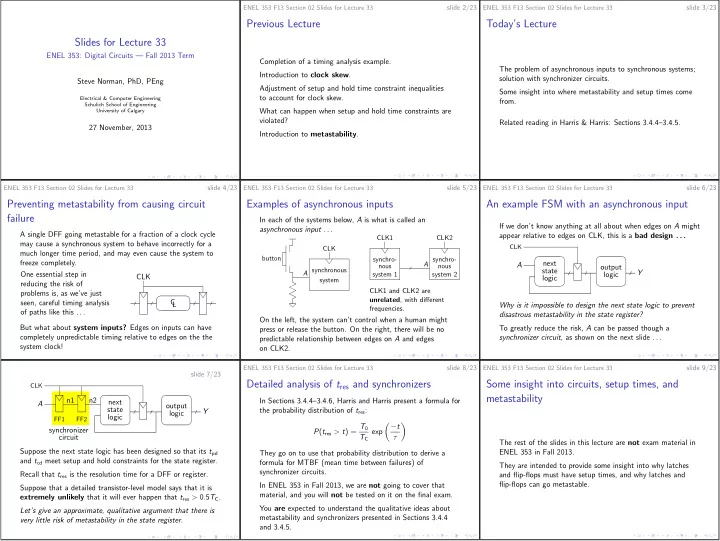

SLIDE 1
Slides for Lecture 33
ENEL 353: Digital Circuits — Fall 2013 Term Steve Norman, PhD, PEng Electrical & Computer Engineering Schulich School of Engineering University of Calgary 27 November, 2013 ENEL 353 F13 Section 02 Slides for Lecture 33 slide 2/23Previous Lecture
Completion of a timing analysis example. Introduction to clock skew. Adjustment of setup and hold time constraint inequalities to account for clock skew. What can happen when setup and hold time constraints are violated? Introduction to metastability. ENEL 353 F13 Section 02 Slides for Lecture 33 slide 3/23Today’s Lecture
The problem of asynchronous inputs to synchronous systems; solution with synchronizer circuits. Some insight into where metastability and setup times come from. Related reading in Harris & Harris: Sections 3.4.4–3.4.5. ENEL 353 F13 Section 02 Slides for Lecture 33 slide 4/23Preventing metastability from causing circuit failure
A single DFF going metastable for a fraction of a clock cycle may cause a synchronous system to behave incorrectly for a much longer time period, and may even cause the system to freeze completely. One essential step in reducing the risk of problems is, as we’ve just seen, careful timing analysis- f paths like this . . .
Examples of asynchronous inputs
In each of the systems below, A is what is called an asynchronous input . . . button A synchronous system CLK A CLK1 system 1 CLK2 system 2 synchro- nous synchro- nous CLK1 and CLK2 are unrelated, with different frequencies. On the left, the system can’t control when a human might press or release the button. On the right, there will be no predictable relationship between edges on A and edges- n CLK2.
An example FSM with an asynchronous input
If we don’t know anything at all about when edges on A might appear relative to edges on CLK, this is a bad design . . . next state logic- utput
- utput
Detailed analysis of tres and synchronizers
In Sections 3.4.4–3.4.6, Harris and Harris present a formula for the probability distribution of tres: P(tres > t) = T0 TC exp −t τ- They go on to use that probability distribution to derive a
Some insight into circuits, setup times, and metastability
The rest of the slides in this lecture are not exam material in ENEL 353 in Fall 2013. They are intended to provide some insight into why latches and flip-flops must have setup times, and why latches and flip-flops can go metastable.