Primary angle closure (PAC) Ying Han, MD, PhD Associate Professor - - PowerPoint PPT Presentation

primary angle closure pac
SMART_READER_LITE
LIVE PREVIEW

Primary angle closure (PAC) Ying Han, MD, PhD Associate Professor - - PowerPoint PPT Presentation

12/2/2016 Primary angle closure (PAC) Ying Han, MD, PhD Associate Professor of Ophthalmology Glaucoma Service, UCSF Pathogenesis: Pathogenesis Pupillary block and anterior lens movement Angle crowding Most common cause Plateau


slide-1
SLIDE 1

12/2/2016 1

Ying Han, MD, PhD Associate Professor of Ophthalmology Glaucoma Service, UCSF

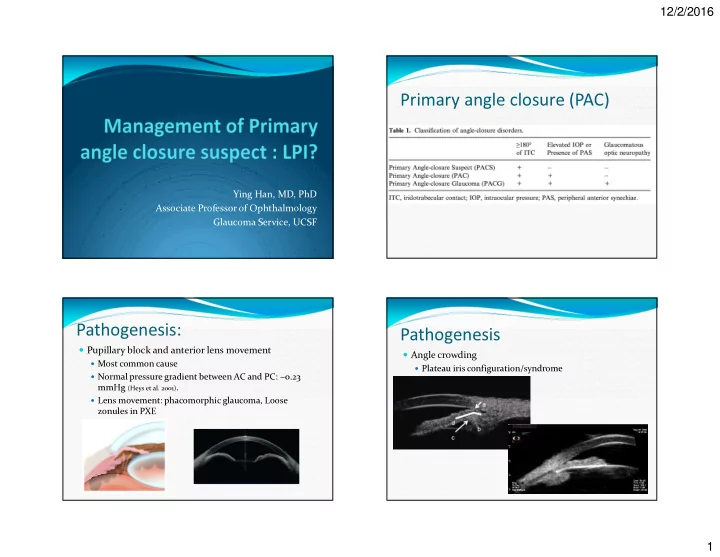
Primary angle closure (PAC) Pathogenesis:

Pupillary block and anterior lens movement

Most common cause Normal pressure gradient between AC and PC: ~0.23

mmHg (Heys et al. 2001).

Lens movement: phacomorphic glaucoma, Loose

zonules in PXE

Pathogenesis

Angle crowding

Plateau iris configuration/syndrome

slide-2
SLIDE 2

12/2/2016 2

Risk factors

Age:

prevalence of PACG: 0.02% for 40–49 years old Prevalence: 0.95% for those > 70 years old (Day et al. 2012)

Gender:

women is approximately 3 times higher than in men

(Foster et al. 1996, 2000; Quigley & Broman 2006)

Ethnicity: Asian Refractive error: hyperopia is common Family history and Genetic predisposition

Diagnosis - Gonioscopy

most important diagnostic method

Diagnosis - OCT

Anterior segment OCT: Visante swept-source OCT:

reproducible, quantifiable information on angle structure

across 360 deg

possible to differentiate appositional from PAS by varying

lighting conditions

Diagnosis - UBM

Has better view beyond iris: plateau iris

ciliary body cysts ciliary body tumors ciliary effusions

slide-3
SLIDE 3

12/2/2016 3

Goal of laser peripheral iridotomy (LPI)

To reduce the risk of acute attacks To reduce the risk of PAC/PACG To lower intraocular pressure (IOP)

Natural history (PACS)

Untreated eye:

PACS to PAC varies from 13 to 35%

Among 129 mostly European-derived subjects, with 6 years

followed up (mean = 2.7 years), 13% were converted to PAC, 6% developed acute attack. (Wilensky JT, 1997)

In an India population, 22% (11/48) were converted to PAC in 5

years (Thomas 2003)

In Eskimos, 35% (7/20) were converted 10 years

Natural history (PACS)

Treated eye:

In an India population: 0% (0/27) progressed from PACS

to PAC or PACG over an average 4-year follow-up (Pandav et

  • al. 2007 )

In Vietnamese: 22% (53/239) progressed to PAC over 10

years (Peng et al. 2011).

ZAP trial

Zhongshan Angle Closure Prevention Trial

Aims to clarify the value of LPI as a preventative

measure in PACS.

Compares LPI versus no treatment across 870 patients

with PACS

Follow up: 3 years for signs of increased IOP, formation

  • f synechiae, and instances of acute angle closure
slide-4
SLIDE 4

12/2/2016 4

Angle width of treated eyes increased markedly after

LPI, remained stable for 6 months, and then decreased significantly by 18 months after LPI. Untreated eyes experienced a more consistent and rapid decrease in angle width over the same time period.

The annual rate of change in angle width was equivalent

to 1.2°/year (95% confidence interval [CI], 0.8–1.6) in treated eyes and 1.6°/year (95% CI, 1.3–2.0) in untreated eyes (P<0.001).

Complications of LPI

Spaeth et al reported visual symptoms after LPI in 9%

  • f eyes with completely covered LPI, in 26% with

partially covered LPI, and 17.5% with fully exposed LPIs.

Hyphema, inflammation, endothelial cells injury,

cataract

Neither visual acuity nor straylight score differed between the treated and untreated eyes among all treated persons, nor among those with LPI partially or totally uncovered. Prevalence of subjective glare did not differ significantly between participants with totally covered LPI (6.61%), partially covered LPI (11.6%), or totally uncovered LPI (9.43%).

LPI is safe regarding measures of straylight and visual

symptoms.

It provides strong evidence that LPI for narrow angles

would be unlikely to result in important medium-term visual disability (18 months follow-up).

slide-5
SLIDE 5

12/2/2016 5

Special population

Medication is required that may provoke pupillary block The patient has symptoms suggestive of intermittent angle closure The patient's health status or occupation/avocation makes it difficult to access immediate ophthalmic care The patient is poorly compliant with follow-up The contralateral eye of the eye with acute attack The patients with positive provocative tests

Cataract extraction

Important treatment for patients with PACS and cataract The role of clear lens extraction is not clear for patients with PACS

Thank you Treatment for early PAC

clear-lens extraction showed greater efficacy and was more cost-effective than laser peripheral iridotomy, and should be considered as an option for first-line treatment.

slide-6
SLIDE 6

12/2/2016 6

Treatment for late PAC and PACG

cataract extraction +/- glaucoma surgery

Treatment for late PAC and

Early PAC: cataract extraction treating PACG. Results have been promising, with

most studies demonstrating that extraction has been beneficial in low- ering IOP and reducing reliance on glaucoma medication postoperatively

Decrease degree of PAS Tarongoy et al. 2009; Liu et al. 2011; Shams & Foster

2012)

One comparison of phaco- emulsification and

trabeculectomy demonstrated comparable long-term IOP control between the methods; trabeculectomy

Cataract Removal

but had an increased rate of postoper- ative

complications (Liu et al. 2011). Another showed improved IOP in the trabeculectomy group but noted that 60% of trabeculectomy patients subse- quently required cataract extraction (Tarongoy et al. 2009; Tham et al. 2013).

The Shams and Foster study observed that IOP

reduction after lens extraction was comparable in patients with and without prior LPI (2012). Studies of acute angle closure have also compared the benefit of cataract extrac- tion versus LPI as a primary treatment; they found that patients who underwent

Primary angle closure glaucoma

PACG is estimated to affect ~26% of the glaucoma

population

PACG is responsible for ~ 50% the cases of glaucoma-

related blindness in the world (Quigley 1996; Quigley & Broman

2006).

slide-7
SLIDE 7

12/2/2016 7

Cataract Removal

The above results have favoured cases of advanced

disease and have often been conducted in eyes with clinically signif- icant cataracts. It is unclear whether

  • r not early phacoemulsification and IOL

implantation will be beneficial for patients with mild cases of PACG. Lim- ited research exists on the subject

  • f clear lens extraction in PACG treatment, but an
  • ngoing study by the Effectiveness in Angle-closure

Glaucoma of Lens Extraction (EAGLE) study group is currently investigating this question (Azuara-Blanco et

  • al. 2011). In recent years, lens extraction has become a

promising surgical interven- tion for reducing IOP and decreasing the degree of PAS in the eye, with 65% of

Across studies, disease progres- sion post-LPI is

greater in eyes with a higher degree of PAS, iridotrabecular contact in more than one quadrant and more significantly elevated IOP prep- rocedure. Accordingly, these are the eyes most likely to need subsequent treatment (He et al. 2007; Pandav et al. 2007; Peng et al. 2011; Rao et al. 2013a,b).

ECP

Endoscopic cyclophotocoagulation (ECP) is another

promising technique, which uses a fibre-optic cable to deliver laser energy to the ciliary processes using a video monitor. This procedure may be beneficial for patients with PACG or plateau iris, either in combi- nation with cataract surgery or as a separate procedure. Unlike the other ciliodestructive procedures, ECP may change the plateau configuration and open the angle.