
SLIDE 1
print culture History of Information September 17, 2007 overview - - PowerPoint PPT Presentation
print culture History of Information September 17, 2007 overview codex coda Eisenstein vs Trithemius Gutenberg & print European exceptionalism? a matter of timing? problems of inheritance HofI Introduction - 2 pre-print changes The
HofI Introduction -
2
HofI Introduction -
The late medieval book differs more from its early medieval predecessors than it does from the printed books of our own
take for granted --analytical tables of contents, text disposed into books, chapters, and paragraphs, and accompanied by footnotes and index--
scribes, and rubricators of the thirteenth, fourteenth, and fifteenth centuries.
Concepts of Ordinatio and Compilatio on the Development of the Book"
3
Karla Nielsen
HofI Introduction -
Morning overtook Shahrazad, and she lapsed into silence. Then her sister Dinzarad said to her, "Sister, what an entertaining story!" Shahrazad replied, "What is this compared with what I shall tell you tomorrow night if I stay alive!?"
4
HofI Introduction -
Front page to Amadis
example of gothic font associated with novels
references the look of a page in a manuscript)
5
HofI Introduction -
Front page to the Hypnerotomachia polyphilii (Aldine edition, early 16th century; example of classical/humanist script; font likely designed with references to Roman letter cutting in stone)
6
I wanted only to offer it to you plain and bare, unadorned by a prologue or the endless catalogue
are usually placed at the beginnings of books. For I can tell you that although it cost me some effort to compose, none seemed greater than composing the preface you are now reading. I picked up my pen many times to write it, and many times I put it down again because I did not know what to write; and once, when I was baffled, with the paper in front of me, the pen behind my ear, my elbow propped on the writing table, and my cheek resting in my hand, pondering what I would say, a friend of mine, a man who is witty and wise, unexpectedly came in and seeing me so perplexed asked the reason, and I hid nothing form him and said I was thinking about the prologue I had to write for the history of Don Quixote, and the problem was that I did not want to write it yet did not want to bring to light the deeds of so noble a knight without one. Miguel de Cervantes, trans. Edith Grossman
HofI Introduction -
8
"To conceive this right--call for pen and ink--here's paper ready to your hand.----Sit down, Sir, paint her to your own mind--as you like your mistress as you can--as unlike your wife as your conscience will let you--'tis all
please but your
it."
HofI Introduction -
"an unacknowledged revolution"
9
HofI Introduction -
"Trithemius somewhat illogically compare the
written word on parchment which would last
paper which would have a shorter life span. The possible use of paper ... by copyists,
went unmentioned.... Whether he was genuinely worried about an increased use of paper ... is an open question. ... He used
could almost be called the Sponheim Abbey Press".
10
HofI Introduction -
"different texts ... were also being brought closer together for individual readers" "the clerk['s] richer, more varied literary diet than had been provided by the scribe" "sedentary scholars less apt to be engrossed by a single text" "knowledge explosion" "combinatorial intellectual activity"
11
HofI Introduction -
"a purification of Christian sources" "the more standardized the type ... the more compelling the sense of an idiosyncratic personal self" "the printer seems to have taken over where the clerical scribe left off. But in doing so he greatly amplified and augmented older themes" "rationalizing, codifying, and cataloguing data" "from the corrupted copy to the improved edition" "fixity and cumulative change"
12
HofI Introduction -
"classical revival" "Christendom disrupted" "nature transformed"
13
HofI Introduction -
14
HofI Introduction -
15
HofI Introduction -
born Mainz 1438: exile, Strasbourg partners: Riffe, Dritzehn, Helman 1438, December: Dritzehn dies "4 pieces to be destroyed" 1439: Dritzehn's heirs sue
1450: back in Mainz creditor Johannes Fust employee Peter Schöffer ally Cardinal Nicholas of Cusa
16
HofI Introduction -
1454: Cyprus Indulgence 1455: 42-line bible the Cardinal's connections? 1455: Fust sues, wins new partnership of Fust & Schöffer Mainz psalter
17
7
HofI Introduction -
1454: Cyprus Indulgence 1455: 42-line bible the Cardinal's connections? 1455: Fust sues, wins new partnership of Fust & Schöffer Mainz psalter
17
7
HofI Introduction -
1454: Cyprus Indulgence 1455: 42-line bible the Cardinal's connections? 1455: Fust sues, wins new partnership of Fust & Schöffer Mainz psalter
17
7
HofI Introduction -
1454: Cyprus Indulgence 1455: 42-line bible the Cardinal's connections? 1455: Fust sues, wins new partnership of Fust & Schöffer Mainz psalter
17
7
HofI Introduction -
18
HofI Introduction -
renaissance reformation scientific revolution capitalism
19
HofI Introduction -
20
Letterae indulgentiarum, 1455
HofI Introduction -
21
HofI Introduction -
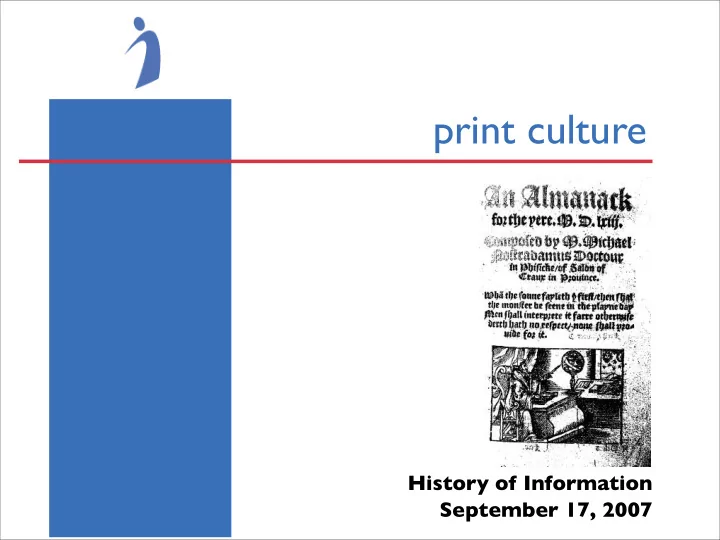
"for three-and-a-half centuries, the Almanack has been the most popular book in the English language" 1492-1600, probably 600 published Bosanquet, English Printed Almanacks and Prognostications, 1917 400,000 a year William St Clair, The Reading Nation, 2005
Mother Shipton Nostradamus
22
HofI Introduction -
RAND, "printing & the internet"
"The idea of reducing 'printing and publishing' to the Western case alone is not upheld by anyone. On the other hand there are differences between xylography and letter press printing (as there are between alphabetic and ideographic languages). ... two quite different duplicative technologies."
23
HofI Introduction -
700 ce: Xylography earliest printed scrolls 972: 130,000 page Tripitaka 1041-1049: clay type playing cards on the Silk Road
24
HofI Introduction -
"three families of publishers (Liu, Yu, and Xiong) of Jianyang ... wrote, edited, printed, and sold books for over six hundred years ... (mid -eleventh through late seventeenth centuries")... The area was already noted for its flourishing paper trade" "in the Northern Song in the eleventh century ... tehre were some thirty printing centers ... and some two hundred in the Southern Song" (twelfth century)"
Lucille Chia, Printing for Profit 2002
25
HofI Introduction -
700 ce: xylography 918-1392: Koryo Dynasty three methods of publishing transcription, xylography, typography transcription: Royal library; practice xylography: Buddhist temples typography: civil service 1087: Tripitaka Koreana (xylography)
Steven Wonsuk Kang, "The printing press in Korea", 2000
26
HofI Introduction -
27
HofI Introduction -
28
HofI Introduction -
28
HofI Introduction -
28
HofI Introduction -
"There is a material explanation for the fact that printing developed in Europe in the 15th century rather than in the Far East, even though the principle on which it is based had been known in the Orient long before. European writing was based
abstract symbols. This simplifies the problems involved in developing techniques for the use of movable type manufactured in series. Chinese handwriting, with its vast number of ideograms requiring some 80,000 symbols, lends itself only poorly to the requirements of a typography. Partly for this reason, the unquestionably advanced Oriental civilization, of which the richness of their writing was evidence, underwent a slowing down of its evolution in comparison with the formerly more backward Western civilizations."
29
HofI Introduction -
1446: King Sejong establishes Jungeumchung for Hangul alphabet Hangul used to publish ancestral poems, pronunciation guides, Confucian morals, ....
"Printing in the Chosun dynasty was developed by the government because the government was the only institution that could afford to develop printing technology."
30
HofI Introduction -
"[E]ither the Germanes borrowed this Invention from the Chineses, or at leastwise the Chineses had the practise & vse of it long before them. George Hakewill, An Apology of the Power,1627 "Whether the Germans first borrowed this Invention from the Chineses, or whether amongst the Germans (who undoubtedly lay best claim to it) Iohn Gutenberg the Knight of Mentz, or Iohn Fust a Moguntine, was the first Inventor thereof, it matters not." Robert Heath, Paradoxical Assertions, 1659
31
HofI Introduction -
"Book-sellers follow their owne judgment in printing the antient Authors according to such Text as they found extant ... Errors repeate & multiply in every Edition".
32
HofI Introduction -
"Martin Luther's German translation of scripture was actually beaten into print by its first piracy." Johns, The Nature of the Book, 1998
33
HofI Introduction -
"[Shakespeare's] first folio [1623] ... boasted some six hundred different typefaces along with nonuniform spelling and punctuation, erratic divisions and arrangements, mispaging, and irregular proofreading. No two copies were identical. "
34
HofI Introduction -
"donations of Constantine" "false decretals"
"Historical criticism became a Protestant weapon, and documents were used as missiles." James Thompson, "The Age of Mabillon",
1942
35
HofI Introduction -
"a certain band of fellows existed, some centuries ago, who had undertaken the task of concocting ancient history as we now have it, there being at that time none in existence; ... they had as aids the works of Cicero, Pliny, the Georgics
genuine monuments out of the whole of Latin antiquity" Grafton, "The Antiquary as Pariah", 1999
36
HofI Introduction -
"the Reformation era ... bringing to light thousands of documents .. hitherto inaccessible and
new historical research ... Mabillon .... Montfaucon".
37
HofI Introduction -
Paperbroche Acta Sanctorum 1675
"The Benedictine order ... regarded Paperbroche's work as ... an attack on their property rights"
38
HofI Introduction -
"Mabillon frankly admitted that the authenticity of a charter could not be proved by any metaphysical or a priori argument; a decision could be reached
whole series of different indications -- the material used, the seal, the signature, the grammar and orthography, the modes of address, the plausibility of the dating, the intrinsic consistency of the whole document". David Knowles
39
HofI Introduction -
the charter of La Tour d'Auvergne
"skilfully forged [using Mabillon s principles] by a sublibrarian who ended his days in the Bastille"
40
HofI Introduction -
revolution(s)? what did & did not come before? what happened? what came after? technology, practices, & institutions (un)reliability
41