SLIDE 1 Priority Queues, Heaps, Graphs, and Sets
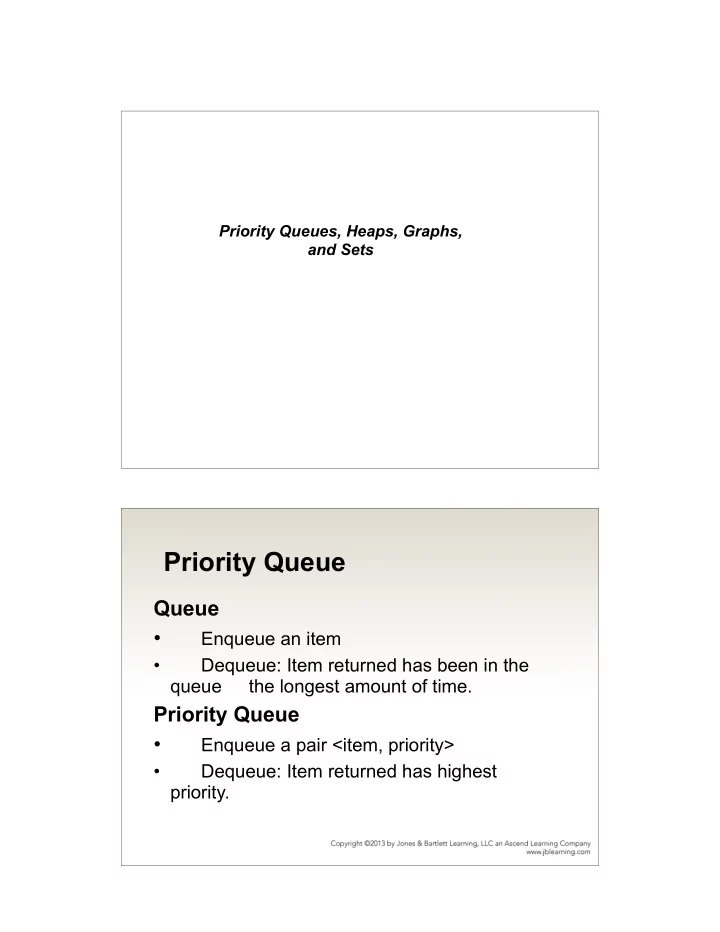
Priority Queue
Queue
- Enqueue an item
- Dequeue: Item returned has been in the
queue the longest amount of time.
Priority Queue
- Enqueue a pair <item, priority>
- Dequeue: Item returned has highest
priority.
SLIDE 2 Priority Queue: application layer
- A priority queue is an ADT with the property
that only the highest-priority element can be accessed at any time.
- Server systems use priority queue to manage
jobs/requests
- priority: can be based upon users
importance, or based upon deadline, …
- Some graph algorithms: Dijkstra algorithm,
Spanning Tree algorithm use it too.
ADT Priority Queue Operations
Transformers
– MakeEmpty – Enqueue – Dequeue
Observers
– IsEmpty – IsFull
change state
SLIDE 3 Implementation Level
- There are many ways to implement a priority queue
– An unsorted List- – dequeue: requires searching through entire list, O(N) – enqueue: constant time – An Array-Based Sorted List – Enqueue: O(N) – dequeue: constant time O(1) – A linked structure based Sorted List – enqueue: O(N) – dequeue: constant time O(1) – N: The number of elements in the queue
Implementation Level (cont’d)
- There are many ways to implement a priority queue
– A Binary Search Tree- – enqueue? – dequeue? – A Heap: – enqueue and dequeue: both O(log2N) steps , – even in the worst case!
SLIDE 4 A full tree: a binary tree in which each node has 0 or two children. A complete binary tree: a binary tree in which every level, except possibly the last, is completely filled, and all nodes are as far left as possible.
Filled? yes filled? yes, at most 2 nodes at level 1 filled? no, maximally 4 nodes, only 3.
A complete binary tree: a binary tree in which every level, except possibly the last, is completely filled, and all nodes are as far left as possible. Can you draw a complete binary tree with 5 nodes? with 10 nodes? Note that the shape of the tree is completely decided!
SLIDE 5
What is a Heap?
A heap is a binary tree that satisfies these special SHAPE and ORDER properties:
– Its shape must be a complete binary tree. – For each node in the heap, the value stored in that node is greater than or equal to the value in each of its children.
Are these Both Heaps?
C A T
treePtr
50
20
18 30 10
SLIDE 6
Is this a Heap?
70 60 40 30 12 8 10 tree
Where is the Largest Element in a Heap Always Found?
70 60 40 30 12 8 tree
SLIDE 7 Numbering Nodes Left to Right by Level:
70 60 1 40 3 30 4 12 2 8 5 tree
And store tree nodes in array, using the numbering as array Indexes
70 60 1 40 3 30 4 12 2 8 5 tree
[ 0 ] [ 1 ] [ 2 ] [ 3 ] [ 4 ] [ 5 ] [ 6 ] 70 60 12 40 30 8 tree.nodes
SLIDE 8 And store tree nodes in array, using the numbering as array Indexes
70 60 1 40 3 30 4 12 2 8 5 tree
[ 0 ] [ 1 ] [ 2 ] [ 3 ] [ 4 ] [ 5 ] [ 6 ] 70 60 12 40 30 8 tree.nodes
Notice: the relation between a node’s numbering with that of its parent, that of its left child and right child?
Use an array to store a complete binary tree
tree elements stored in by level, from left to right:
13 3 4 10 23 31 100 32 0 1 2 3 4 5 6 7 Can you draw the complete binary tree? Can you find the parent of node 5? (without drawing the tree?) Where are the left child of node 2, right child?
SLIDE 9
// HEAP SPECIFICATION // Assumes ItemType is either a built-in simple data // type or a class with overloaded relational operators. template< class ItemType > struct HeapType { void ReheapDown (int root , int bottom ) ; void ReheapUp (int root, int bottom ) ; ItemType* elements; //ARRAY to be allocated dynamically int numElements ; };
HeapDown
SLIDE 10 9-12
ReheapDown
// IMPLEMENTATION OF RECURSIVE HEAP MEMBER FUNCTIONS template< class ItemType > void HeapType<ItemType>::ReheapDown ( int root, int bottom ) // Pre: root is the index of the node that may violate the // heap order property // Post: Heap order property is restored between root and bottom { int maxChild ; int rightChild ; int leftChild ; leftChild = root * 2 + 1 ; rightChild = root * 2 + 2 ;
ReheapDown (cont)
if ( leftChild <= bottom ) // ReheapDown continued { if ( leftChild == bottom ) maxChild = leftChld; else { if (elements [ leftChild ] <= elements [ rightChild ] ) maxChild = rightChild; else maxChild = leftChild; } if ( elements [ root ] < elements [ maxChild ] ) { Swap ( elements [ root ] , elements [ maxChild ] ); ReheapDown ( maxChild, bottom ) ; } } }
SLIDE 11 HeapUp
// IMPLEMENTATION continued template< class ItemType > void HeapType<ItemType>::ReheapUp ( int root, int bottom ) // Pre: bottom is the index of the node that may violate the heap // order property. The order property is satisfied from root to // next-to-last node. // Post: Heap order property is restored between root and bottom { int parent ; if ( bottom > root ) { parent = ( bottom - 1 ) / 2; if ( elements [ parent ] < elements [ bottom ] ) { Swap ( elements [ parent ], elements [ bottom ] ); ReheapUp ( root, parent ); } } }
SLIDE 12 Class PQType Declaration
class FullPQ(){}; class EmptyPQ(){}; template<class ItemType> class PQType { public: PQType(int); ~PQType(); void MakeEmpty(); bool IsEmpty() const; bool IsFull() const; void Enqueue(ItemType newItem); void Dequeue(ItemType& item); private: int length; HeapType<ItemType> items; int maxItems; };
Class PQType Function Definitions
template<class ItemType> PQType<ItemType>::PQType(int max) { maxItems = max; items.elements = new ItemType[max]; length = 0; } template<class ItemType> void PQType<ItemType>::MakeEmpty() { length = 0; } template<class ItemType> PQType<ItemType>::~PQType() { delete [] items.elements; }
SLIDE 13
Class PQType Function Definitions
Dequeue
Set item to root element from queue Move last leaf element into root position Decrement length items.ReheapDown(0, length-1)
Enqueue
Increment length Put newItem in next available position items.ReheapUp(0, length-1)
Code for Dequeue
template<class ItemType> void PQType<ItemType>::Dequeue(ItemType& item) { if (length == 0) throw EmptyPQ(); else { item = items.elements[0]; items.elements[0] = items.elements[length-1]; length--; items.ReheapDown(0, length-1); } }
SLIDE 14
Code for Enqueue
template<class ItemType> void PQType<ItemType>::Enqueue(ItemType newItem) { if (length == maxItems) throw FullPQ(); else { length++; items.elements[length-1] = newItem; items.ReheapUp(0, length-1); } }
Comparison of Priority Queue Implementations
Enqueue Dequeue Heap O(log2N) O(log2N) Linked List O(N) O(N) Binary Search Tree Balanced O(log2N) O(log2N) Skewed O(N) O(N)
SLIDE 15 Definitions
- Graph: A data structure that consists of a set of
models and a set of edges that relate the nodes to each other
- Vertex: A node in a graph
- Edge (arc): A pair of vertices representing a
connection between two nodes in a graph
- Undirected graph: A graph in which the edges
have no direction
- Directed graph (digraph): A graph in which each
edge is directed from one vertex to another (or the same) vertex
Formally
- a graph G is defined as follows:
G = (V,E) where V(G) is a finite, nonempty set of vertices E(G) is a set of edges (written as pairs of vertices)
SLIDE 16
An undirected graph A directed graph
SLIDE 17 A directed graph More Definitions
- Adjacent vertices: Two vertices in a graph
that are connected by an edge
- Path: A sequence of vertices that connects
two nodes in a graph
- Complete graph: A graph in which every
vertex is directly connected to every other vertex
- Weighted graph: A graph in which each edge
carries a value
SLIDE 18
Two complete graphs A weighted graph
SLIDE 19 Definitions
- Depth-first search algorithm: Visit all the nodes
in a branch to its deepest point before moving up
- Breadth-first search algorithm: Visit all the nodes on
- ne level before going to the next level
- Single-source shortest-path algorithm: An algorithm
that displays the shortest path from a designated starting node to every other node in the graph
Depth First Search: Follow Down
SLIDE 20
Depth First Uses Stack Breadth First: Follow Across
SLIDE 21
Breadth First Uses Queue Single Source Shortest Path
SLIDE 22 Single Source Shortest Path
- What does “shortest” mean?
- What data structure should you use?
Array-Based Implementation
- Adjacency Matrix: for a graph with N
nodes, and N by N table that shows the existence (and weights) of all edges in the graph
SLIDE 23 Adjacency Matrix for Flight Connections
Linked Implementation
- Adjacency List: A linked list that
identifies all the vertices to which a particular vertex is connected; each vertex has its own adjacency list
SLIDE 24
Adjacency List Representation of Graphs
ADT Set Definitions
Base type: The type of the items in the set Cardinality: The number of items in a set Cardinality of the base type: The number of items in the base type Union of two sets: A set made up of all the items in either sets Intersection of two sets: A set made up of all the items in both sets Difference of two sets: A set made up of all the items in the first set that are not in the second set
SLIDE 25 Beware: At the Logical Level
- Sets can not contain duplicates. Storing an
item that is already in the set does not change the set.
- If an item is not in a set, deleting that item
from the set does not change the set.
Implementing Sets
Explicit implementation (Bit vector) Each item in the base type has a representation in each instance of a set. The representation is either true (item is in the set) or false (item is not in the set). Space is proportional to the cardinality of the base type. Algorithms use Boolean operations.
SLIDE 26
Implementing Sets (cont.)
Implicit implementation (List) The items in an instance of a set are on a list that represents the set. Those items that are not on the list are not in the set. Space is proportional to the cardinality of the set instance. Algorithms use ADT List operations.
Explain:
If sets are not ordered, why is the SortedList ADT a better choice as the implementation structure for the implicit representation?