Private Information Retrieval over ICN Christian Tschudin - - PowerPoint PPT Presentation

private information retrieval over icn
SMART_READER_LITE
LIVE PREVIEW

Private Information Retrieval over ICN Christian Tschudin - - PowerPoint PPT Presentation

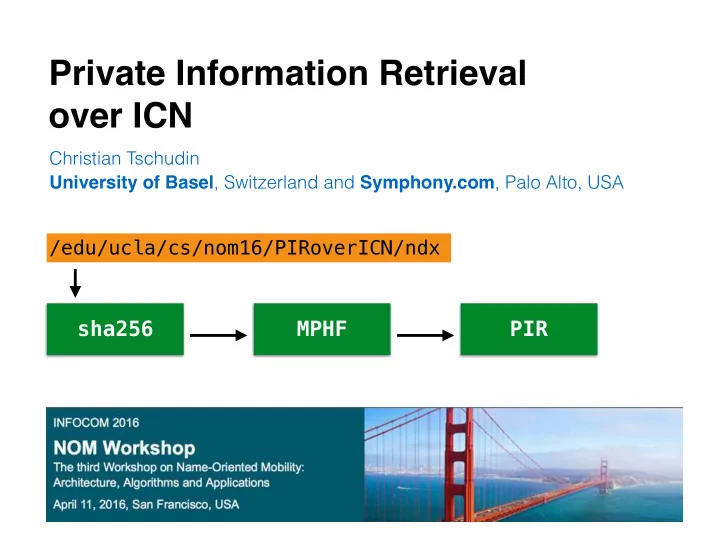
Private Information Retrieval over ICN Christian Tschudin University of Basel , Switzerland and Symphony.com , Palo Alto, USA /edu/ucla/cs/nom16/PIRoverICN/ndx sha256 MPHF PIR Overview How to lookup secrets over public NDN?


slide-1
SLIDE 1

Private Information Retrieval


  • ver ICN

/edu/ucla/cs/nom16/PIRoverICN/ndx

sha256 MPHF PIR

Christian Tschudin
 University of Basel, Switzerland and Symphony.com, Palo Alto, USA
slide-2
SLIDE 2

Overview


How to lookup secrets over public NDN?

  • Named Data Networking

  • from packets to data structures
  • Security and Privacy


… in many forms

  • Private Information Retrieval over ICN

  • a practical protocol
  • Outlook: going SSL-less

  • the challenge to secure data structures

/edu/ucla/cs/nom16/PIRoverICN/ndx

sha256 MPHF PIR

slide-3
SLIDE 3

From Packets to Services

  • NDN: usually introduced as Interest/Data packet exchange
  • Here is another viewpoint:

  • Interest pkt = DB query

  • Data pkt = DB reply —> lookup(name)

  • DNS as a first NDN incarnation
  • Agenda becomes: “The network is the database”

What “things” does such a network store, if not packets?

slide-4
SLIDE 4

From Packets to Data Structures

  • Van’s name hierarchy


envisaged “collections”

  • Recent, more explicit forms:


manifests and catalogs


  • no “discovery”/selectors

  • can combine elements from different namespace sub-trees

  • FLIC (File-Like ICN Collection) another example à la UNIX index node
  • Essential operation on such collections:

  • lookup by (entry) name —> how can this be made “private”?
slide-5
SLIDE 5

Privacy in NDN

Signed content envisaged from the beginning, but not enough:
 Privacy must be supported, enabled, even enforced …

  • Privacy has many forms:

  • content privacy (confidentiality as in classical encryption)

  • intent privacy (encrypted names such that only locator is in the clear)

  • lookup privacy (topic of this talk)

  • transport privacy (MIX nets, TOR)

  • execution privacy (host does not learn anything about algo and result)
slide-6
SLIDE 6

Private Index Lookup


(and how to retro-fit in into NDN)

Inside-out sequence of presentation:

  • use “private information retrieval”

  • needs a position index
  • use Minimal Perfect Hash Functions

  • maps 256 bits to position 0..N-1
  • use SHA256 to normalize names

  • for classic NDN names

  • but also “self-certifying names” (e.g.


content- or representation-access)

/edu/ucla/cs/nom16/PIRoICN/ndx sha256 MPHF PIR {nameless} The_Content

slide-7
SLIDE 7

Private Information Retrieval (PIR)

  • PIR proposed in 1998

  • by Chor, Goldreich, Kushilevitz and Sudan

  • trivial solution (undesired): download full table

  • non-trivial solutions exist!
  • Practical PIR:

  • information theoretic PIR

  • relies on two or more


non-colluding servers


  • cloaked queries

  • servers do a GS(2) matrix mult

  • client can undo cloaking

k servers 1 q k client a 1 a k n b ... a L l 1 a L k q

slide-8
SLIDE 8

Minimal Perfect Hash Fcts (MPHF)

  • Looping over a DB’s entries does not scale (to billions, pragmatically)
  • Replace “forall i in DB { if (i.key==key) return i; }”


with “return DB[key2pos(key)]”

  • Minimal perfect hash functions:

  • no collisions

  • no holes (map N keys to 0…N-1)
  • How to find a MPHF?

  • several probabilistic algorithms available (since 1993)

  • MPHF size “a few bits per entry”

  • as key we will use the SHA256 of a NDN name … see again the workflow
slide-9
SLIDE 9

A Named-Data Protocol for PIR

  • Publisher has DB L

  • computes mphf

  • sends it with L to two


non-colluding servers


  • Client

  • downloads mphf

  • cloaks the query

  • requests PIR lookup twice

  • combines results

L and mphf PIR_lookup1(pos) PIR_lookup2(pos) publisher done get(mphf) mphf pos=mphf(h) lookup(h) d1 d2 init(loc1,loc2) d=combine(d1,d2) d PIR2 PIR1 app client lib

OK? No: the two queries (and replies) must be encrypted!

slide-10
SLIDE 10

Private Index Lookup (PIL)

PIL a useful primitive in NDN

  • Private walking of the hierarchical namespace


dir1 = private_lookup(“/edu/ucla/cs“ + hash(“.”)); // locator
 dir2 = private_lookup(“/edu/ucla/cs“ + hash(dir1 + "nom16"));
 dir3 = private_lookup(“/edu/ucla/cs“ + hash(dir2 + "venue"));

  • FLIC traversing
  • Other data structures:


linked lists, (data structure) trees, …

slide-11
SLIDE 11

Going SSL-less

  • Static names still in use today:

  • store data (incl keys) in encrypted form


and run trusted operations in edge devices

  • This is what NDNfit does (private fitness data),


what Symphony does in the cloud (private messaging)

  • Long run: untrusted net (as a DB, transport endpoint, computing)


SSL means you trust that endpoint - can we avoid this?
 —> from passive storage to PIR servers, and other forms of
 name rewriting (never request the same hash value twice)

waiting for homomorphic encryption…

slide-12
SLIDE 12

Conclusions

  • Search privacy: “how to lookup secrets over public NDN”
  • We demonstrate PIR over ICN: specially crafted NDN names
  • PIR is realistic for NDN (and small tables) today,

  • more involved for large data structures (files, trees,


linked lists, graphs), potentially we loose some privacy

  • Beyond SSL: secure the data structures, not single pkt flows

  • need to exploit research results in “structured encryption”