Probability distribution of interest is { p i } = Pr { X = i } . - - PDF document

probability distribution of interest is p i pr x i assume
SMART_READER_LITE
LIVE PREVIEW

Probability distribution of interest is { p i } = Pr { X = i } . - - PDF document

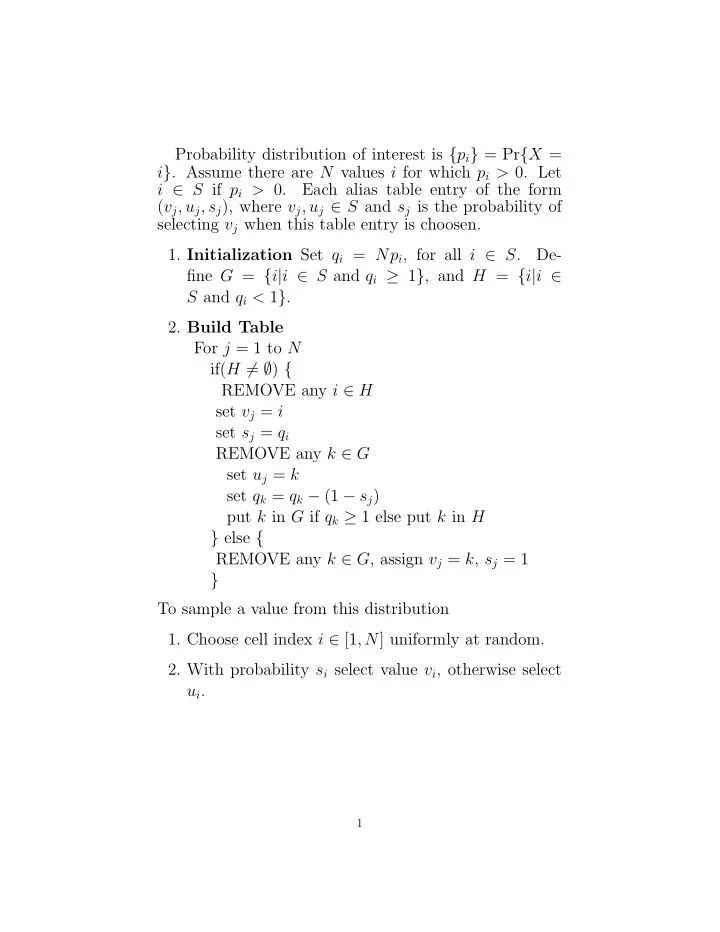
Probability distribution of interest is { p i } = Pr { X = i } . Assume there are N values i for which p i > 0. Let i S if p i > 0. Each alias table entry of the form ( v j , u j , s j ), where v j , u j S and s j is the probability


slide-1
SLIDE 1

Probability distribution of interest is {pi} = Pr{X = i}. Assume there are N values i for which pi > 0. Let i ∈ S if pi > 0. Each alias table entry of the form (vj, uj, sj), where vj, uj ∈ S and sj is the probability of selecting vj when this table entry is choosen.

  • 1. Initialization Set qi = Npi, for all i ∈ S.

De- fine G = {i|i ∈ S and qi ≥ 1}, and H = {i|i ∈ S and qi < 1}.

  • 2. Build Table

For j = 1 to N if(H = ∅) { REMOVE any i ∈ H set vj = i set sj = qi REMOVE any k ∈ G set uj = k set qk = qk − (1 − sj) put k in G if qk ≥ 1 else put k in H } else { REMOVE any k ∈ G, assign vj = k, sj = 1 } To sample a value from this distribution

  • 1. Choose cell index i ∈ [1, N] uniformly at random.
  • 2. With probability si select value vi, otherwise select

ui.

1

slide-2
SLIDE 2

Example : p2 = 0.4, p6 = 0.1, p8 = 0.2, p9 = 0.3. The table below illustrates the state of the algorithm after each

  • step. The initial state is

value probability q Set index v u s 2 0.4 1.6 G

  • 6

0.1 0.4 H 1

  • 8

0.2 0.8 H 2

  • 9

0.3 1.2 G 3

  • For j = 1 we choose 2 ∈ G and 6 ∈ H. Assign v1 = 6, u1 = 2,

s1 = 0.4, reassign q2 = 1.6 − (1 − 0.4) = 1.0, return 2 to G: value probability q Set index v u s 2 0.4 1.0 G 1 6 2 0.4 6 0.1 — — 2

  • 8

0.2 0.8 H 3

  • 9

0.3 1.2 G 4

  • For j = 2 we choose 8 ∈ H and 9 ∈ G. Assign v2 = 8, u2 = 9,

s2 = 0.8, reassign q9 = 1.2 − (1 − 0.8) = 1.0, return 9 to G: value probability q Set index v u s 2 0.4 1.0 G 1 6 2 0.4 6 0.1 — — 2 8 9 0.8 8 0.2 — — 3

  • 9

0.3 1.0 G 4

  • H is empty so we choose 2 ∈ G, assign v3 = 2, s3 = 1.0.

H is empty so we choose 9 ∈ G, assign v4 = 9, s4 = 1.0.

2

slide-3
SLIDE 3

value probability q Set index v u s 2 0.4 — — 1 6 2 0.4 6 0.1 — — 2 8 9 0.8 8 0.2 – - — 3 2

  • 1.0

9 0.3 — — 4 9

  • 1.0

Reconstructing the probabilities, if X samples from this distri- bution, then

  • X = 2 if EITHER cell 1 is selected and then u1 is selected

OR cell 3 selected and then v3 is selected. This happens with probability (1/4) ∗ (1 − 0.4) + (1/4) ∗ 1 = 0.4.

  • X = 6 if cell 1 is selected and then v1 is selected. This happens

with probability (1/4) ∗ 0.4 = 0.1.

  • X = 8 if cell 2 is selected and then v2 is selected. This happens

with probability (1/4) ∗ 0.8 = 0.2.

  • X = 9 if EITHER cell 2 is selected and then u2 is selected

OR cell 4 selected and then v4 is selected. This happens with probability (1/4) ∗ (1 − 0.8) + (1/4) ∗ 1 = 0.3.

3