Probability: Terminology and Examples 18.05 Spring 2014 January 1, - - PowerPoint PPT Presentation

probability terminology and examples 18 05 spring 2014
SMART_READER_LITE
LIVE PREVIEW

Probability: Terminology and Examples 18.05 Spring 2014 January 1, - - PowerPoint PPT Presentation

Probability: Terminology and Examples 18.05 Spring 2014 January 1, 2017 1 / 29 Board Question Deck of 52 cards 13 ranks : 2, 3, . . . , 9, 10, J, Q, K, A 4 suits : , , , , Poker hands Consists of 5 cards A one-pair hand


slide-1
SLIDE 1

Probability: Terminology and Examples 18.05 Spring 2014

January 1, 2017 1 / 29
slide-2
SLIDE 2

Board Question

Deck of 52 cards 13 ranks: 2, 3, . . . , 9, 10, J, Q, K, A 4 suits: ♥, ♠, ♦, ♣, Poker hands Consists of 5 cards A one-pair hand consists of two cards having one rank and the remaining three cards having three other ranks Example: {2♥, 2♠, 5♥, 8♣, K♦} Question (a) How many different 5 card hands have exactly one pair? Hint: practice with how many 2 card hands have exactly one pair. Hint for hint: use the rule of product. (b) What is the probability of getting a one pair poker hand?

January 1, 2017 2 / 29

slide-3
SLIDE 3

Answer to board question

We can do this two ways as combinations or permutations. The keys are:

  • 1. be consistent
  • 2. break the problem into a sequence of actions and use the rule of

product. Note, there are many ways to organize this. We will break it into very small steps in order to make the process clear. Combinations approach a) Count the number of one-pair hands, where the order they are dealt doesn’t matter. Action 1. Choose the rank of the pair: 13 different ranks, choosing 1, so

  • 13 ways to do this.

1

Action 2. Choose 2 cards from this rank: 4 cards in a rank, choosing 2, so

  • 4 ways to do this.

2

Action 3. Choose the 3 cards of different ranks: 12 remaining ranks, so

  • 12

3

ways to do this. (Continued on next slide.)

January 1, 2017 3 / 29

slide-4
SLIDE 4

Combination solution continued

Action 4. Choose 1 card from each of these ranks: 4 cards in each rank so

  • 3

4 1

ways to do this. answer: (Using the rule of product.) 13 4 12 · · · 43 = 1098240 1 2 3 b) To compute the probability we have to stay consistent and count

  • combinations. To make a 5 card hand we choose 5 cards out of 52, so

there are 52 = 2598960 5 possible hands. Since each hand is equally likely the probability of a

  • ne-pair hand is

1098240/2598960 = 0.42257. On the next slide we redo this problem using permutations.

January 1, 2017 4 / 29

slide-5
SLIDE 5

Permutation approach

This approach is a little trickier. We include it to show that there is usually more than one way to count something. a) Count the number of one-pair hands, where we keep track of the order they are dealt. Action 1. (This one is tricky.) Choose the positions in the hand that will

  • 5

hold the pair: 5 different positions, so 2 ways to do this. Action 2. Put a card in the first position of the pair: 52 cards, so 52 ways to do this. Action 3. Put a card in the second position of the pair: since this has to match the first card, there are only 3 ways to do this. Action 4. Put a card in the first open slot: this can’t match the pair so there are 48 ways to do this. Action 5. Put a card in the next open slot: this can’t match the pair or the previous card, so there 44 ways to do this. Action 6. Put a card in the last open slot: there are 40 ways to do this. (Continued on next slide.)

January 1, 2017 5 / 29

slide-6
SLIDE 6

Permutation approach continued

answer: (Using the rule of product.) 5 · 52 · 3 · 48 · 44 · 40 = 131788800 2 ways to deal a one-pair hand where we keep track of order. b) There are

52P5 = 52 · 51 · 50 · 49 · 48 = 311875200

five card hands where order is important. Thus, the probability of a one-pair hand is 131788800/311875200 = 0.42257. (Both approaches give the same answer.)

January 1, 2017 6 / 29

slide-7
SLIDE 7

Clicker Test

Set your clicker channel to 41. Do you have your clicker with you? No = 0 Yes = 1

January 1, 2017 7 / 29

slide-8
SLIDE 8

Probability Cast Introduced so far Experiment: a repeatable procedure Sample space: set of all possible outcomes S (or Ω). Event: a subset of the sample space. Probability function, P(ω): gives the probability for each outcome ω ∈ S

  • 1. Probability is between 0 and 1
  • 2. Total probability of all possible outcomes is 1.

January 1, 2017 8 / 29

slide-9
SLIDE 9

Example (from the reading) Experiment: toss a fair coin, report heads or tails. Sample space: Ω = {H, T }. Probability function: P(H) = .5, P(T ) = .5. Use tables:

Outcomes H T Probability 1/2 1/2

(Tables can really help in complicated examples)

January 1, 2017 9 / 29

slide-10
SLIDE 10

Discrete sample space Discrete = listable Examples: {a, b, c, d} (finite) {0, 1, 2, . . . } (infinite)

January 1, 2017 10 / 29

slide-11
SLIDE 11

Events Events are sets: Can describe in words Can describe in notation Can describe with Venn diagrams Experiment: toss a coin 3 times. Event: You get 2 or more heads = { HHH, HHT, HTH, THH}

January 1, 2017 11 / 29

slide-12
SLIDE 12

CQ: Events, sets and words Experiment: toss a coin 3 times. Which of following equals the event “exactly two heads”? A = {THH, HTH, HHT , HHH} B = {THH, HTH, HHT } C = {HTH, THH} (1) A (2) B (3) C (4) A or B

answer: : 2) B. The event “exactly two heads” determines a unique subset, containing all

  • utcomes that have exactly two heads.

January 1, 2017 12 / 29

slide-13
SLIDE 13

CQ: Events, sets and words Experiment: toss a coin 3 times. Which of the following describes the event {THH, HTH, HHT }? (1) “exactly one head” (2) “exactly one tail” (3) “at most one tail” (4) none of the above

answer: (2) “exactly one tail” Notice that the same event E ⊂ Ω may be described in words in multiple ways (“exactly 2 heads” and “exactly 1 tail”).

January 1, 2017 13 / 29

slide-14
SLIDE 14

CQ: Events, sets and words Experiment: toss a coin 3 times. The events “exactly 2 heads” and “exactly 2 tails” are disjoint. (1) True (2) False

answer: True: {THH, HTH, HHT } ∩ {TTH, THT , HTT } = ∅.

January 1, 2017 14 / 29

slide-15
SLIDE 15

CQ: Events, sets and words Experiment: toss a coin 3 times. The event “at least 2 heads” implies the event “exactly two heads”. (1) True (2) False

  • False. It’s the other way around:

{THH, HTH, HHT } ⊂ {THH, HTH, HHT , HHH}.

January 1, 2017 15 / 29

slide-16
SLIDE 16

Probability rules in mathematical notation Sample space: S = {ω1, ω2, . . . , ωn} Outcome: ω ∈ S Probability between 0 and 1: 0 ≤ P(ω) ≤ 1

n

Total probability is 1: P(ωj ) = 1, P(ω) = 1

j=1 ω∈S

Event A: P(A) = P(ω)

ω∈A

January 1, 2017 16 / 29

slide-17
SLIDE 17

Probability and set operations on events Events A, L, R Rule 1. Complements: P(Ac ) = 1 − P(A). Rule 2. Disjoint events: If L and R are disjoint then P(L ∪ R) = P(L) + P(R). Rule 3. Inclusion-exclusion principle: For any L and R: P(L ∪ R) = P(L) + P(R) − P(L ∩ R).

A Ac Ω = A ∪ Ac, no overlap L R L ∪ R, no overlap L R L ∪ R, overlap = L ∩ R

January 1, 2017 17 / 29

slide-18
SLIDE 18

Table question Class has 50 students 20 male (M), 25 brown-eyed (B) For a randomly chosen student what is the range of possible values for p = P(M ∪ B)? (a) p ≤ .4 (b) .4 ≤ p ≤ .5 (c) .4 ≤ p ≤ .9 (d) .5 ≤ p ≤ .9 (e) .5 ≤ p

answer: (d) .5 ≤ p ≤ .9 Explanation on next slide.

January 1, 2017 18 / 29

slide-19
SLIDE 19

Solution to CQ

The easy way to answer this is that A ∪ B has a minumum of 25 members (when all males are brown-eyed) and a maximum of 45 members (when no males have brown-eyes). So, the probability ranges from .5 to .9 Thinking about it in terms of the inclusion-exclusion principle we have P(M ∪ B) = P(M) + P(B) − P(M ∩ B) = .9 − P(M ∩ B). So the maximum possible value of P(M ∪ B) happens if M and B are disjoint, so P(M ∩ B) = 0. The minimum happens when M ⊂ B, so P(M ∩ B) = P(M) = .4.

January 1, 2017 19 / 29

slide-20
SLIDE 20

Table Question Experiment:

  • 1. Your table should make 9 rolls of a 20-sided die (one

each if the table is full).

  • 2. Check if all rolls at your table are distinct.

Repeat the experiment five times and record the results. For this experiment, how would you define the sample space, probability function, and event? Compute the true probability that all rolls (in one trial) are distinct and compare with your experimental result.

answer: 1 − (20 · 19 · · · 13 · 12)/(209) = 0.881. (The explanation is on the next frame.)

January 1, 2017 20 / 29

slide-21
SLIDE 21

Board Question Solution

For the sample space S we will take all sequences of 9 numbers between 1 and 20. (We are assuming there are 9 people at table.) We find the size of S using the rule of product. There are 20 ways to choose the first number in the sequence, followed by 20 ways to choose the second, etc. Thus, |S| = 209 . It is sometimes easier to calculate the probability of an event indirectly by calculating the probability of the complement and using the formula P(A) = 1 − P(Ac ). In our case, A is the event ‘there is a match’, so Ac is the event ‘there is no match’. We can use the rule of product to compute |Ac | as follows. There are 20 ways to choose the first number, then 19 ways to choose the second, etc. down to 12 ways to choose the ninth number. Thus, we have |Ac | = 20 · 19 · 18 · 17 · 16 · 15 · 14 · 13 · 12 That is |Ac | = 20P9. Putting this all together 20 · 19 · 18 · 17 · 16 · 15 · 14 · 13 · 12 P(A) = 1 − P(Ac ) = 1 − = .881 209

January 1, 2017 21 / 29

slide-22
SLIDE 22

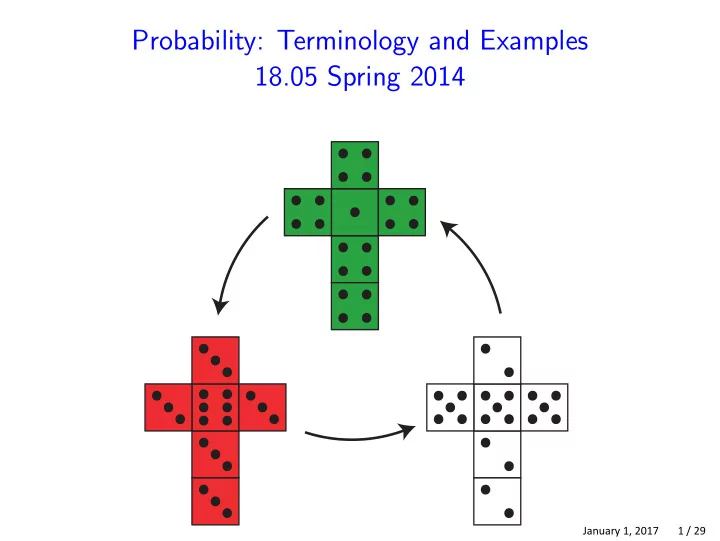
Jon’s dice Jon has three six-sided dice with unusual numbering. A game consists of two players each choosing a die. They roll once and the highest number wins. Which die would you choose?

January 1, 2017 22 / 29

slide-23
SLIDE 23

Board Question

  • 1. Make probability tables for the red and which dice.
  • 2. Make a probability table for the product sample space of red and

white.

  • 3. Compute the probability that red beats white.
  • 4. Pair up with another group. Have one group compare red vs.

green and the other compare green vs. red. Based on the three comparisons rank the dice from best to worst.

January 1, 2017 23 / 29

slide-24
SLIDE 24

Computations for solution

Red die White die Green die Outcomes 3 6 2 5 1 4 Probability 5/6 1/6 3/6 3/6 1/6 5/6 The 2 × 2 tables show pairs of dice. Each entry is the probability of seeing the pair of numbers corresponding to that entry. The color gives the winning die for that pair of numbers. (We use black instead of white when the white die wins.) Wh 2 ite 5 Gr 1 een 4 Red 3 6 15/36 3/36 15/36 3/36 5/36 1/36 25/36 5/36 Green 1 4 3/36 15/36 3/36 15/36

January 1, 2017 24 / 29

slide-25
SLIDE 25

Answer to board question continued

Wh 2 ite 5 Gr 1 een 4 Red 3 6 15/36 3/36 15/36 3/36 5/36 1/36 25/36 5/36 Green 1 4 3/36 15/36 3/36 15/36 The three comparisons are: P(red beats white) = 21/36 = 7/12 P(white beats green) = 21/36 = 7/12 P(green beats red) = 25/36 Thus: red is better than white is better than green is better than red. There is no best die: the property of being ‘better than’ is non-transitive.

January 1, 2017 25 / 29

slide-26
SLIDE 26

Concept Question Lucky Larry has a coin that you’re quite sure is not fair. He will flip the coin twice It’s your job to bet whether the outcomes will be the same (HH, TT) or different (HT, TH). Which should you choose?

  • 1. Same
  • 2. Different
  • 3. It doesn’t matter, same and different are equally likely

January 1, 2017 26 / 29

slide-27
SLIDE 27

Board Question Lucky Larry has a coin that you’re quite sure is not fair. He will flip the coin twice It’s your job to bet whether the outcomes will be the same (HH, TT) or different (HT, TH). Which should you choose?

  • 1. Same
  • 2. Different
  • 3. Doesn’t matter

Question: Let p be the probability of heads and use probability to answer the question. (If you don’t see the symbolic algebra try p = .2, p=.5)

January 1, 2017 27 / 29

slide-28
SLIDE 28

Solution

answer: 1. Same (same is more likely than different) The key bit of arithmetic is that if a = b then

2

(a − b)2 > 0 ⇔ a + b2 > 2ab. To keep the notation cleaner, let’s use P(T ) = (1 − p) = q. Since the flips are independent (we’ll discuss this next week) the probabilities multiply. This gives the following 2 × 2 table. second flip H T first flip H p2 pq T qp q2 So, P(same) = p2 + q2 and P(diff) = 2pq. Since the coin is unfair we know p Now we use our key bit of arithmetic to say = q.

2 2

p + q > 2pq ⇒ P(same) > P(different). QED

January 1, 2017 28 / 29

slide-29
SLIDE 29

MIT OpenCourseWare https://ocw.mit.edu

18.05 Introduction to Probability and Statistics

Spring 2014 For information about citing these materials or our Terms of Use, visit: https://ocw.mit.edu/terms.