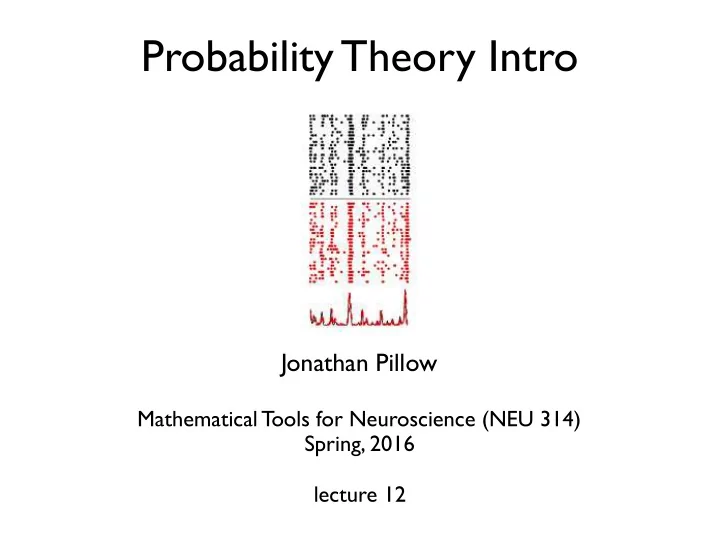
SLIDE 1
Probability Theory Intro
Jonathan Pillow
Mathematical Tools for Neuroscience (NEU 314) Spring, 2016 lecture 12
SLIDE 2 neural coding problem
spike trains stimuli
- what is the probabilistic relationship
between stimuli and spike trains?
SLIDE 3 spike trains
- what is the probabilistic relationship
between stimuli and spike trains?
neural coding problem
stimuli
“codebook”
SLIDE 4 “encoding”
?
neural coding problem
novel stimulus
(Alex Piet, Cosyne 2016)
“codebook”
SLIDE 5 ?
“decoding” Bayes’ Rule: “who was that”?
neural coding problem
posterior likelihood prior
“codebook”
SLIDE 6 Goals for today
- basics of probability
- probability vs. statistics
- continuous & discrete distributions
- joint distributions
- marginalization
- conditionalization
- Bayes’ rule (prior, likelihood, posterior)
SLIDE 7 parameter samples model
distribution”
- “events”
- “random variables”
SLIDE 8 parameter samples
parameter space sample space
distribution”
- “events”
- “random variables”
model
SLIDE 9 parameter samples
parameter space sample space examples
distribution”
- “events”
- “random variables”
model
X = “H” or “T”
mean spike rate
SLIDE 10 parameter samples
parameter space sample space
distribution”
- “events”
- “random variables”
model
X ∈ positive reals mean reaction time
examples
SLIDE 11
parameter samples
parameter space sample space
Probability vs. Statistics
model
coin flipping probability T, T, H, T, H, T, T, T, T, ….
?
SLIDE 12
parameter samples
parameter space sample space
Probability vs. Statistics
model
statistics T, T, H, T, H, T, T, T, T, H, T, H, T, H, H, T, T “inverse probability”
?
SLIDE 13 discrete probability distribution
takes finite (or countably infinite) number of values, eg
function (pmf): positive and sum to 1:
SLIDE 14 continuous probability distribution
takes values in a continuous space, e.g.,
function (pdf): positive and integrates to 1:
SLIDE 15 some friendly neighborhood probability distributions
P(k; n, p) = ⇤n k ⌅ pk(1 − p)n−k
binomial P(k; λ) = λk k! e−λ Poisson Bernoulli Discrete
coin flipping sum of n coin flips sum of n coin flips with P(heads)=λ/n, in limit n→∞
SLIDE 16 ⇤ ⌅ P(x; µ, σ) = 1 √ 2πσ exp (x − u)2 2σ2 ⇥
P(xn; µ, Λ) = 1 (2π)
n 2 |Λ| 1 2 exp
2(x − µ)T Λ−1(x − µ)
⇥
Gaussian multivariate Gaussian exponential Continuous
some friendly neighborhood probability distributions
P(x; a) = aeax
SLIDE 17 joint distribution
−3 −2 −1 1 2 3 −3 −2 −1 1 2 3
SLIDE 18 marginalization (“integration”)
−3 −2 −1 1 2 3 −3 −2 −1 1 2 3
SLIDE 19 marginalization (“integration”)
−3 −2 −1 1 2 3 −3 −2 −1 1 2 3
SLIDE 20 conditionalization (“slicing”)
−3 −2 −1 1 2 3 −3 −2 −1 1 2 3
1 2 3
(“joint divided by marginal”)