Probate Strategies When Non-Resident/Non-Citizen Decedents Own U.S. - - PowerPoint PPT Presentation

probate strategies when non resident non citizen
SMART_READER_LITE
LIVE PREVIEW

Probate Strategies When Non-Resident/Non-Citizen Decedents Own U.S. - - PowerPoint PPT Presentation

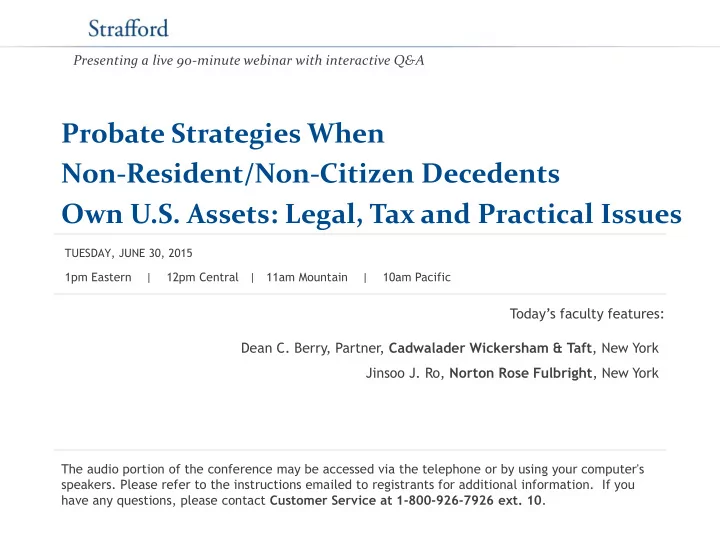
Presenting a live 90-minute webinar with interactive Q&A Probate Strategies When Non-Resident/Non-Citizen Decedents Own U.S. Assets: Legal, Tax and Practical Issues TUESDAY, JUNE 30, 2015 1pm Eastern | 12pm Central | 11am Mountain


slide-1
SLIDE 1

The audio portion of the conference may be accessed via the telephone or by using your computer's

  • speakers. Please refer to the instructions emailed to registrants for additional information. If you

have any questions, please contact Customer Service at 1-800-926-7926 ext. 10.

Presenting a live 90-minute webinar with interactive Q&A

Probate Strategies When Non-Resident/Non-Citizen Decedents Own U.S. Assets: Legal, Tax and Practical Issues

Today’s faculty features:

1pm Eastern | 12pm Central | 11am Mountain | 10am Pacific TUESDAY, JUNE 30, 2015

Dean C. Berry, Partner, Cadwalader Wickersham & Taft, New York Jinsoo J. Ro, Norton Rose Fulbright, New York

slide-2
SLIDE 2

Tips for Optimal Quality

Sound Quality If you are listening via your computer speakers, please note that the quality

  • f your sound will vary depending on the speed and quality of your internet

connection. If the sound quality is not satisfactory, you may listen via the phone: dial 1-866-961-9091 and enter your PIN when prompted. Otherwise, please send us a chat or e-mail sound@straffordpub.com immediately so we can address the problem. If you dialed in and have any difficulties during the call, press *0 for assistance. Viewing Quality To maximize your screen, press the F11 key on your keyboard. To exit full screen, press the F11 key again.

FOR LIVE EVENT ONLY

slide-3
SLIDE 3

Continuing Education Credits

In order for us to process your continuing education credit, you must confirm your participation in this webinar by completing and submitting the Attendance Affirmation/Evaluation after the webinar. A link to the Attendance Affirmation/Evaluation will be in the thank you email that you will receive immediately following the program. For additional information about CLE credit processing call us at 1-800-926-7926

  • ext. 35.

FOR LIVE EVENT ONLY

slide-4
SLIDE 4

Program Materials

If you have not printed the conference materials for this program, please complete the following steps:

  • Click on the ^ symbol next to “Conference Materials” in the middle of the left-

hand column on your screen.

  • Click on the tab labeled “Handouts” that appears, and there you will see a

PDF of the slides for today's program.

  • Double click on the PDF and a separate page will open.
  • Print the slides by clicking on the printer icon.

FOR LIVE EVENT ONLY

slide-5
SLIDE 5

Cadwalader, Wickersham & Taft LLP 5

Topics

  • Probate and Nonprobate Procedures for Non-US Decedents
  • US Federal Estate Taxation of US Situs Assets
  • US Federal Estate Tax Collection Procedures
slide-6
SLIDE 6

Cadwalader, Wickersham & Taft LLP 6

SECTION 1 PROBATE AND NONPROBATE PROCEDURES FOR NON-US DECEDENTS

slide-7
SLIDE 7

Cadwalader, Wickersham & Taft LLP 7

Example #1

  • Mr. X died in 2015 as a Dutch citizen and domiciliary
  • Surviving heirs are a wife and two adult children, all Dutch

and non-US

  • Dutch Will leaves entire estate to wife and appoints her

executor

  • At death Mr. X owned a New York brokerage account with a

$1 million US stock portfolio

slide-8
SLIDE 8

Cadwalader, Wickersham & Taft LLP 8

Alternative #1  Ancillary Probate of Dutch Will in New York

  • Requirement of original probate in Netherlands (§ 1602 of

NY Surrogate’s Court Procedure Act (SCPA))

  • Application made by Dutch executor or other person

charged with administering estate (SCPA § 1604)

  • Need for NY resident as designated or co-ancillary executor

(SCPA §§ 707(1)(c) and 1608(4))

  • Need for authentication of Dutch legal documents (SCPA

§ 1614)

  • After payment of claims, balance of NY probate estate is

payable to Dutch executor to be dealt with according to Dutch inheritance law (SCPA § 1610)

slide-9
SLIDE 9

Cadwalader, Wickersham & Taft LLP 9

Alternative #2  Original Probate of Dutch Will in New York

  • Possible (SCPA § 1605) but rare
  • NY allows original probate in multiple jurisdictions in limited

circumstances (SCPA § 1605(2))

slide-10
SLIDE 10

Cadwalader, Wickersham & Taft LLP 10

Alternative #3  Original Probate of American Will

  • Mr. X executes a NY Will for US assets and a Dutch Will for

all other assets

  • NY courts have discretion to accept a nonresident’s Will for
  • riginal probate where there are probate assets in NY and

will usually do so (SCPA § 1605(1))

  • Application made by executor named in US Will
  • If designated executor is a nondomiciliary alien of NY, will

need a NY resident as co-executor (SCPA § 707(1)(c))

slide-11
SLIDE 11

Cadwalader, Wickersham & Taft LLP 11

Alternative #3  Original Probate of American Will (cont’d)

  • Use of American Will raises choice of law issues regarding,

among other issues, the applicable law governing testamentary dispositions

  • In general, the disposition of:

– Real property is determined by law of land’s situs (§ 3-5.1(b)(1) of the NY Estates, Powers and Trusts Law (EPTL)) – Personal property is generally determined by law of decedent’s domicile at death (EPTL § 3-5.1(b)(2))

  • However, if Mr. X’s American Will provides that NY law shall

apply to the disposition of his estate, then NY courts will apply NY law to assets situated in New York (EPTL § 3-5.1(h))

slide-12
SLIDE 12

Cadwalader, Wickersham & Taft LLP 12

Matter of Renard, 56 N.Y.2d 973 (1982)

  • French citizen and resident, who had previously been a NY

resident, executed a Will in Paris leaving New York assets to a friend and charity, and requesting that the Will be probated in NY and that NY law apply

  • Decedent’s son, French/US citizen and California resident,
  • bjected and claimed 50% of NY estate as his entitlement

under French law of forced heirship

  • NYS Court of Appeals upheld decisions of lower courts that

rejected son’s claim on grounds that EPTL § 3-5.1(h) allows a nonresident decedent to elect NY law to govern the disposition of NY assets

slide-13
SLIDE 13

Cadwalader, Wickersham & Taft LLP 13

Limits on Application of New York Law to Nonresident Decedents

  • Surviving spouse’s right of election (see, e.g., Matter of

Clark, 21 N.Y.2d 478 (1978))

  • Surviving spouse’s interest in community property
slide-14
SLIDE 14

Cadwalader, Wickersham & Taft LLP 14

Alternatives to Probate

  • Nonprobate transfers

– Gifts – Joint ownership – Beneficiary designations – Pay on death accounts

  • Corporation or LLC for US assets

– LLC membership is an intangible personal property interest; disposition is governed by law of decedent’s domicile at death

  • Revocable trust for US assets

– New York allows a nonresident settlor to elect that a trust be governed by New York law – NY law will then apply to (i) real and personal property situated in NY and (ii) personal property wherever located if trust has a NY trustee (EPTL § 7-1.10)

slide-15
SLIDE 15

Cadwalader, Wickersham & Taft LLP 15

Marital Property Issues

  • Who is a surviving “spouse?”
  • Community property issues
slide-16
SLIDE 16

Cadwalader, Wickersham & Taft LLP 16

SECTION 2 US FEDERAL ESTATE TAXATION OF US SITUS ASSETS

slide-17
SLIDE 17

Cadwalader, Wickersham & Taft LLP 17

Basic Rules Applicable to US and Non-US Persons

  • The application of US transfer tax rules generally depends
  • n whether the transferor is a US citizen or US resident on

the one hand (“US Persons”), or a non-US citizen who is also a non-US resident on the other hand (“Non-US Persons”)

slide-18
SLIDE 18

Cadwalader, Wickersham & Taft LLP 18

US Transfer Tax Definition of Resident

  • A resident for transfer tax purposes is one who is domiciled

in the United States – Domicile is acquired by living in a country, even for a brief period of time, with no definite present intention of moving at a later time (Treas. Reg. § 20.0-1(b)(1) (estate tax) and § 25.2501-1(b) (gift tax))

  • A resident individual for all other purposes is determined

under IRC § 7701(b) – Substantial Presence Test – Green Card Test – First Year Election

slide-19
SLIDE 19

Cadwalader, Wickersham & Taft LLP 19

US Transfer Tax Rules Applicable to US Persons

  • US Persons are generally subject to US Federal estate, gift

and GST tax on taxable transfers of property, wherever located, at a 40% rate

  • US Persons are generally entitled to an exemption from

each transfer tax. The gift and estate tax exemptions are

  • unified. In 2015, the maximum exemption for each

transferor is $5,430,000 for Federal estate, gift and GST tax purposes

  • All US Persons can:

– make annual exclusion gifts ($14,000 in 2015) – elect to use portability and – split gifts

slide-20
SLIDE 20

Cadwalader, Wickersham & Taft LLP 20

US Transfer Tax Rules Applicable to Non-US Persons

Estate Tax

  • Non-US Persons are subject to US estate tax on assets situated in the US
  • Non-US Persons have a $13,000 credit (which equates to a $60,000 exemption)

from US estate tax; however US estate tax treaties may provide a greater exemption Gift Tax

  • Non-US Persons are subject to US gift tax on gifts of real and tangible

property situated in the United States – Unless the donor expatriated, intangible property given by a non-US resident is not subject to the gift tax – The IRS takes the position that Treasury bills located in the United States are tangible assets (PLR 8138103) – Annual exclusion for gifts ($14,000 in 2015) is allowed, but gift-splitting is not allowed

slide-21
SLIDE 21

Cadwalader, Wickersham & Taft LLP 21

US Transfer Tax Rules Applicable to Non-US Persons (cont’d)

Generation Skipping Transfer Tax

  • Determined under estate and gift tax principles
  • Although the Regulations provide that Non-US Persons are

entitled to an exemption of $1 million, the GST exemption for nonresidents is the same as for residents and citizens under IRC § 2631

slide-22
SLIDE 22

Cadwalader, Wickersham & Taft LLP 22

Special US Estate and Gift Tax Rules Applicable to Non-US Citizen Spouses

Estate Tax

  • The estate of a decedent (regardless of whether a resident or non-

resident) is allowed an unlimited marital deduction for assets passing to a US citizen spouse

  • No such deduction is allowed for transfers to a non-US citizen

spouse unless the assets are transferred to a qualified domestic trust (“QDOT”) Gift Tax

  • Gifts to US citizen spouses are entitled to an unlimited marital

deduction

  • No such deduction is allowed for gifts to a non-U.S. citizen spouse
  • However, larger annual exclusion gifts can be made to non-citizen

spouses than to non-spouses ($147,000 in 2015)

slide-23
SLIDE 23

Cadwalader, Wickersham & Taft LLP 23

Filing Considerations

Form 706-NA

  • $60,000 threshold (US assets)
  • Usual deadlines (9 months, with 6 month extension)
  • Alternate valuation

Federal Transfer Certificates

slide-24
SLIDE 24

Cadwalader, Wickersham & Taft LLP 24

Situs Rules

Section 2104: Property situated in the US

  • Real Property
  • Tangible Personal Property
  • Intangible Property

– Corporations – Partnerships?

slide-25
SLIDE 25

Cadwalader, Wickersham & Taft LLP 25

US Bilateral Estate and Gift Tax Treaties

  • Estate and gift tax treaties are designed to avoid double

taxation of transfers: – when an individual is a citizen or resident of one country but owns, or is transferring, property located in another country – when an individual is resident of multiple countries under local laws

  • A treaty generally will permit each country to tax property

located within its borders, and also may allow an increased credit or exemption to a Non-US Person

slide-26
SLIDE 26

Cadwalader, Wickersham & Taft LLP 26

US Bilateral Estate and Gift Tax Treaties (cont’d)

  • Australia*
  • Austria
  • Canada*
  • Denmark
  • Finland
  • France
  • Germany
  • Greece
  • Ireland
  • Italy
  • Japan
  • Netherlands
  • Norway
  • South Africa
  • Switzerland
  • United Kingdom
slide-27
SLIDE 27

Cadwalader, Wickersham & Taft LLP 27

US Bilateral Estate and Gift Tax Treaties (cont’d)

Special note: Some countries (two notable examples being Canada and Australia) do not have an estate or gift tax, but do have a deemed capital gains tax (“CGT”) on death. Because CGT is not an estate tax, a bilateral estate tax treaty may not provide relief from double taxation

slide-28
SLIDE 28

Cadwalader, Wickersham & Taft LLP 28

SECTION 3 US FEDERAL ESTATE TAX COLLECTION PROCEDURES

slide-29
SLIDE 29

Cadwalader, Wickersham & Taft LLP 29

Example #2

  • Mr. Y, a Brazilian decedent, died owning a New York

brokerage account with a $1 million US stock portfolio

  • Mr. Y’s sole heir, Child A, asks the broker to pay over the

account to him

  • Broker refuses unless:

– An executor for Mr. Y’s estate is appointed by a US court;

  • r

– Child A provides broker with Federal Transfer Certificates Q: Why Why did the did the broker refu broker refuse se to pay over to pay over the assets the assets to to Child Child A? A? A: A: Concer Concern n that that broker broker w will ill be pers be personally

  • nally liable if

liable if Child Child A A fails fails to to pay pay the es the estat tate e tax tax

slide-30
SLIDE 30

Cadwalader, Wickersham & Taft LLP 30

Responsibility for Paying US Estate Tax – Executors and “Statutory Executors”

  • The person primarily responsible for paying the estate tax is

the “executor” (IRC § 2002)

  • For this purpose, “executor” means “the executor or

administrator of the decedent, or, if there is no executor or administrator appointed, qualified and acting within the United States, then any person in actual or constructive possession of any property of the decedent” (IRC § 2203)

  • If no executor is appointed by a US court, then “any person

in actual or constructive possession of any property of the decedent” is responsible for paying the decedent’s estate

  • tax. Such a person is a “statutory executor”
slide-31
SLIDE 31

Cadwalader, Wickersham & Taft LLP 31

Example #2  Child A’s Options

  • 1. File for ancillary probate or administration in a New York

court – Broker will then pay assets to US ancillary executor or administrator

  • 2. File for original probate of Mr. Y’s American Will in a New

York court – Broker will then pay assets to US executor

  • 3. Do not file in New York court, but obtain Federal Transfer

Certificates – Broker will pay assets to Child A upon receipt of Transfer Certificates

slide-32
SLIDE 32

Cadwalader, Wickersham & Taft LLP 32

Personal Liability for Payment of US Estate Tax

  • The executor is primarily responsible for payment of US

estate tax

  • If the executor fails to pay, the IRS is authorized to assess

and collect estate tax liabilities from: – Persons who acquire property from the taxpayer (“transferees”) – Any person who exercises control over the disposition

  • f decedent’s property (“fiduciaries”)

– Statutory executors, but only if there is no US-court appointed executor

slide-33
SLIDE 33

Cadwalader, Wickersham & Taft LLP 33

Extent of Personal Liability

  • Executors and fiduciaries are potentially personally liable up

to the amount of payments (including distributions to beneficiaries) improperly made in preference over the claim

  • f the US Government for taxes
  • Transferees are potentially personally liable up to the value
  • f the property received. For probate transferees, this

liability is usually imposed by US state law (See, e.g., EPTL § 12-1.1)

  • A person who is personally liable for tax may also be liable

for payment of interest on the tax and penalties (IRC §§ 6601(e)(1) and 6665(a)(2))

slide-34
SLIDE 34

Cadwalader, Wickersham & Taft LLP 34

Personal Liability of Executors

  • Treas. Reg. § 20.2002-1 provides that personal liability of an

executor is described in Section 3467 of the Revised Statutes (31 U.S.C. 192). Current version of Section 3467 is 31 U.S.C. Section 3713(b) (“Section 3713(b)”)

  • Section 3713(b), enacted in its current form in 1982,

provides: “A representative of a person or an estate (except a trustee acting under title 11 [relating to bankruptcy estates]) paying any part of a debt of the person or estate before paying a claim of the Government is liable to the extent of the payment for unpaid claims of the Government”

  • Treas. Reg. § 20.2002-1 defines “debt” as including a

beneficiary’s distributive share of an estate

slide-35
SLIDE 35

Cadwalader, Wickersham & Taft LLP 35

Personal Liability of Executors (cont’d)

Allen v Allen v. . Commis Commissioner sioner, , TC M TC Memo 1999 emo 1999-385 385

  • US Tax Court determined that IRS must establish three

elements before executor will become personally liable for unpaid claims: – The executor distributed assets of the estate; – The distribution rendered the estate insolvent; and – The distribution occurred after the executor had notice of the unpaid claims of the US Revenue Revenue Ruling Ruling 66 66-43, 1 43, 1966 966-1 1 C.B C.B. . 291 291

  • IRS held that an executor is not personally liable unless he has

either personal knowledge of the debt or “has such knowledge as would put a reasonably prudent man on inquiry”

slide-36
SLIDE 36

Cadwalader, Wickersham & Taft LLP 36

Personal Liability of Transferees

  • A “transferee” is a person with a beneficial interest in the

property transferred, and includes a donee, heir, legatee, devisee or distributee

  • Personal liability of a transferee is determined under state

law (see, e.g., EPTL § 12-1.1)

  • For estate tax, trustees and certain other persons in

possession or control of a decedent’s property that is includible in the gross estate under IRC §§ 2034-2042 are also potentially personally liable as transferees (IRC § 6324(a)(2))

slide-37
SLIDE 37

Cadwalader, Wickersham & Taft LLP 37

Personal Liability of Fiduciaries

  • Section 3713(b) imposes personal liability on fiduciaries
  • “Fiduciary” means “a guardian, trustee, executor,

administrator, receiver, conservator, or any person acting in any fiduciary capacity for any person” (IRC § 7701(a)(6))

  • An agent is not a fiduciary (Treas. Reg. § 301.7701-7)
  • In addition, certain trustees who hold on the date of the

decedent’s death property that is included in the decedent’s gross estate are also personally liable for the estate tax (IRC § 6324(a)(2))

slide-38
SLIDE 38

Cadwalader, Wickersham & Taft LLP 38

Personal Liability of Statutory Executors  or Not

  • A “statutory executor” includes “the decedent’s agents and

representatives; safe-deposit companies, warehouse companies, and other custodians of property in this country; brokers holding, as collateral, securities belonging to the decedent; and debtors of the decedent in this country” (Treas. Reg. § 20.2203-1)

  • In our example, the broker refused to pay the NY account to

Child A because the broker was concerned that it would be personally liable for payment of the estate tax if Child A failed to pay the tax

  • But

But is is it it corr correct ect that that the br the broker

  • ker may become

may become pers personally

  • nally liable for t

liable for the est he estate ate tax? tax?

slide-39
SLIDE 39

Cadwalader, Wickersham & Taft LLP 39

Why Statutory Executors Are Concerned About Personal Liability

  • Treas. Reg. § 20.2002-1 states that “other persons” (which

may include statutory executors) may be personally liable for estate tax under the predecessor of Section 3713(b)

  • IRC § 6901(a)(1)(B) imposes assessment and collection

procedures to “the liability of a fiduciary” under Section 3713(b)

  • Treas. Reg. § 20.6325-1(a) states that statutory executors

“can insure avoidance of liability for taxes and penalties

  • nly by demanding and receiving transfer certificates before

transfer of property of nonresident decedents”

slide-40
SLIDE 40

Cadwalader, Wickersham & Taft LLP 40

Why Statutory Executors Should Not Be Concerned with Personal Liability

  • The only statutory basis for personal liability of statutory executors is

Section 3713(b)

  • A statutory executor is not a “representative” of an estate within the

meaning of Section 3713(b). See, e.g., Occidental Life Ins. Co. of California

  • v. Comm’r, 50 T.C. 726 (1968) (holding that a statutory executor is not within

the class of persons to which the predecessor of Section 3713(b) applied)

  • A statutory executor is an agent and not a “fiduciary” within the meaning of
  • Treas. Reg. §§ 301.7701-6 and 301.7701-7
  • In CCA 200830001, an IRS Office of Chief Counsel Memorandum, the IRS

acknowledged that a statutory executor may not be personally liable for unpaid estate tax under Section 3713(b). However, the IRS did not explicitly conclude that there is no personal liability

  • Despite these arguments, as a practical matter US banks, brokers and other

statutory executors do not want to assume the risk of personal liability and will release assets only to a US executor or upon the receipt of Federal Transfer Certificates

slide-41
SLIDE 41

Cadwalader, Wickersham & Taft LLP 41

Federal Transfer Certificates

  • A transfer certificate is a release of lien with respect to the assets

described therein

  • A transfer certificate permits the person holding the decedent’s

property to transfer the property to a foreign executor or a beneficiary without further liability to the transferor

  • Transfer certificates are issued by the IRS with respect to specific

property includible in the decedent’s gross estate

  • Transfer certificates are obtained by filing an estate tax return with the

IRS (usually Form 706-NA). The return is usually filed by the foreign executor or the heirs, but can also be filed by the US statutory executor

  • The IRS will issue transfer certificates after it has reviewed the return

and determined that the estate tax has been paid. Accordingly, it can take many months before an estate tax return is prepared, filed and

  • reviewed. In the meantime, the decedent’s assets may be frozen
slide-42
SLIDE 42

Cadwalader, Wickersham & Taft LLP 42

Affidavit in Lieu of Transfer Certificates

  • Transfer certificates are not required if the date of death

value of all the decedent’s US situs assets did not exceed $60,000 (taking into account taxable gifts, if any) (Treas.

  • Reg. § 20.6325-1(b)(1)(i))
  • A statutory executor will not be liable for transferring a

nonresident decedent’s property if it receives an affidavit from the foreign executor or other responsible person in possession of the facts that the value of decedent’s US assets did not exceed $60,000 (Treas. Reg. § 20.6325-1(b)(3))

  • Some but not all US financial institutions will accept such

affidavits

slide-43
SLIDE 43

Cadwalader, Wickersham & Taft LLP 43

In Example #2, What If:

  • Mr. Y’s only US asset was a New York bank account with

$50,000? – Bank might accept an affidavit from Child A that Mr. Y was not a US citizen or resident and that the value of all

  • Mr. Y’s US assets did not exceed $60,000
  • Mr. Y was a resident of the UK at his death?

– Under the US-UK estate tax treaty, the brokerage account would be exempt from US estate tax – However, the broker will not want to make the determination that Mr. Y qualified as a UK resident under the treaty. This will leave Child A with the same

  • ptions as before
slide-44
SLIDE 44

Cadwalader, Wickersham & Taft LLP 44

Lessons

  • In practice, foreign executors and beneficiaries are usually

unpleasantly surprised by the need to obtain Federal Transfer Certificates

  • They are even more displeased if the US assets are frozen

until transfer certificates are obtained

  • In planning, consider structuring a non-US client’s US

assets in a manner to avoid the need to obtain transfer certificates after the client’s death (e.g., American Will, nonprobate transfer, LLC/corporation, revocable trust)

  • Alternatively, consider whether it would be more

expedient/less expensive to apply for the appointment of a US ancillary executor or administrator

slide-45
SLIDE 45

Cadwalader, Wickersham & Taft LLP www.cadwalader.com

Dean C. Berry

Cadwalader, Wickersham & Taft LLP One World Financial Center 200 Liberty Street New York, NY 10281 dean.berry@cwt.com 212 504 6944

Jinsoo J. Ro

Norton Rose Fulbright US LLP 666 Fifth Avenue New York, NY 10103 jinsoo.ro@nortonrosefulbright.com 212 318 3199