Problem From September 1, 2009 to November 6, 2010, there w ere 21 - - PDF document

problem
SMART_READER_LITE
LIVE PREVIEW

Problem From September 1, 2009 to November 6, 2010, there w ere 21 - - PDF document

What is VRE? Vancomycin Resistant Enterococcus REDUCTION OF HOSPITAL ACQUIRED Bacteria in GI tract or female genital tract VANCOMYCIN RESISTANT Colonization: presence of VRE without ENTEROCOCCI COLONIZATIONS ON symptoms or


slide-1
SLIDE 1

REDUCTION OF HOSPITAL ACQUIRED VANCOMYCIN RESISTANT ENTEROCOCCI COLONIZATIONS ON AN INPATIENT BONE MARROW TRANSPLANT UNIT

University of North Carolina Hospitals North Carolina Cancer Hospital Chapel Hill, North Carolina

What is VRE?

 Vancomycin Resistant Enterococcus  Bacteria in GI tract or female genital tract  Colonization: presence of VRE without

symptoms or presentation of problems

 Can cause infection in urinary tract, skin, or

bloodstream

 Many strains resistant to antibiotics

Who is at Risk?

 Patients previously treated with Vancomycin or

  • ther antibiotics for long periods of time

 Hospitalized patients  Patients with lowered immunity such as those

receiving cancer treatments, transplants or in ICU

 Those colonized with VRE  Patients with urinary catheters or IV catheters

that stay in for long periods of time

Scope of this Study

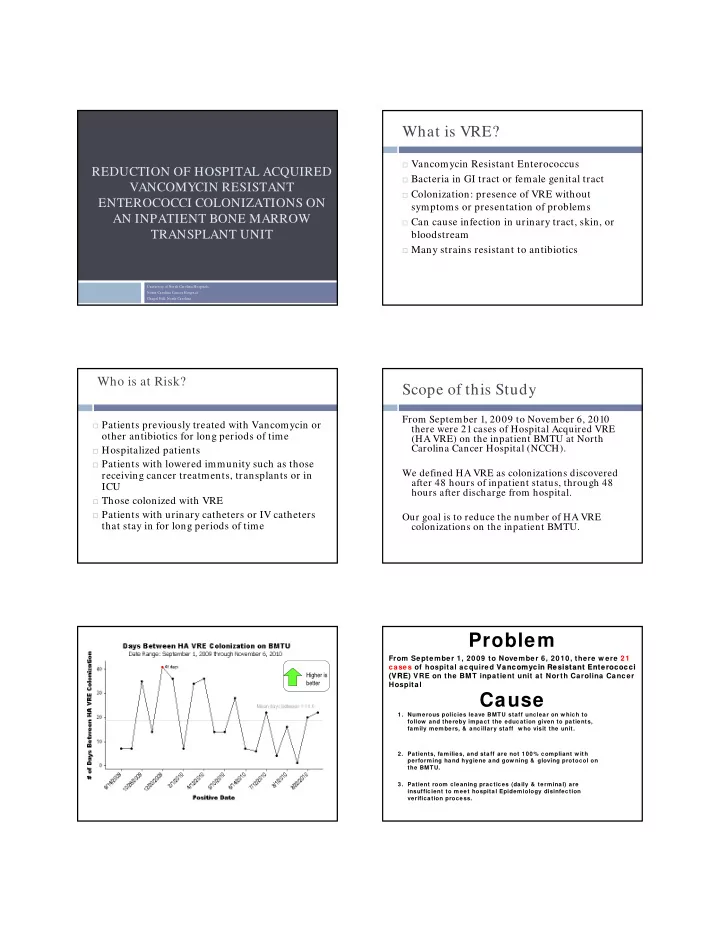
From September 1, 2009 to November 6, 2010 there were 21 cases of Hospital Acquired VRE (HA VRE) on the inpatient BMTU at North Carolina Cancer Hospital (NCCH). We defined HA VRE as colonizations discovered after 48 hours of inpatient status, through 48 hours after discharge from hospital. Our goal is to reduce the number of HA VRE colonizations on the inpatient BMTU.

Higher is better

From September 1, 2009 to November 6, 2010, there w ere 21 cases of hospital acquired Vancomy ncomycin R Resist stant En ant Enter terococ

  • cocci

ci (VRE) (VRE) VRE on the BMT inpatient unit at North Carolina Cancer Hospital

Problem Cause

  • 1. Numerous policies leave BMTU staff unclear on w hich to

follow and thereby impact the education given to patients, family members, & ancillary staff w ho visit the unit.

  • 2. Patients, families, and staff are not 100% compliant w ith

performing hand hygiene and gow ning & gloving protocol on the BMTU.

  • 3. Patient room cleaning practices (daily & terminal) are

insufficient to meet hospital Epidemiology disinfection verification process.

slide-2
SLIDE 2

Hand Hygiene Observation on entry to BMTU (2 pumps of Purell = Compliant) Hand Hygiene Observation on entry to BMTU (1 pump of Purell = Compliant) Hand Hygiene Observation at Patient Room (2 pumps of Purell = Compliant) Hand Hygiene Observation at Patient Room (1 pump of Purell = Compliant)

How well do we terminally clean rooms?

Causes Solution Detail Goal

The overall goal is to eliminate HA VRE’s

  • n BMTU

Incrementally we will increase from the current high of 41 days between HA VRE to 100 days.

  • 1. Numerous

policies leave BMTU staff unclear on w hich to follow

  • Conduct a literature review of current

hospital policies

  • Contact BMTUs at other institutions for

feedback

  • Adopt single policy
  • Completed
  • Completed
  • Completed
  • 2. Hand Hygiene and

Gow ning & Gloving compliance

  • Revise sign for lobby & create signs for

patient rooms

  • Develop script for teaching patients &

family member policy on admission

  • Create an observation result board to

monitor unit HH & GG compliance

  • Completed
  • Comp

Completed

  • Comp

Completed

  • 3. Patient room

cleaning practices are insufficient

  • Create a room cleaning job guide

for housekeeping & BMTU nurses

  • Share room cleaning observation

results with environmental services (EVS) & nursing staff

  • Use Tru-D to clean patient room
  • Completed

Completed

  • Completed

Solution

Implementation

 Adopted one clear BMTU specific Contact

Isolation Policy

 RNs performed VRE swabs  Improved signage  Created room cleaning job guidelines  Obtained permission to use Tru-D after

discharge cleaning on Contact Isolation Rooms

 Educated staff, patients and families

NEW SIGNAGE

S9

slide-3
SLIDE 3

Slide 12 S9 Capitalize each first letter except for 'and'

SSharf, 12/3/2011

slide-4
SLIDE 4

Soap Purell

Family Waiting Room

Hand Hygiene Policy

Tru-D What is Tru-D ?

 TRU-D is an automated mobile disinfection unit

that uses UV (UVC)* energy to disinfect surfaces by breaking down the DNA of bacteria, viruses and spores.

 Measures UV reflected from walls, ceilings, floors or

  • ther treated areas and calculates the operation

time to deliver the programmed lethal dose for pathogens

 UV sensors determines and targets highly-

shadowed areas to deliver measured dose of UV energy

 In studies, UV radiation was found to reduce

>99.9% of vegetative bacteria (e.g., MRSA, VRE) within 15-17 minutes and 99.84% for C. difficile spores within 50 minutes.

Tru-D Advantages

 Room decontamination is rapid  HVAC system does not need to be disabled and

the room does not need to be sealed

 Residue free and does not give rise to health and

safety concerns

 No consumable products

Tru-D Disadvantages

 Only done at terminal disinfection  All patients and staff must be removed from the

room/ area (about 20-45 min)

 Capital equipment costs are substantial at

$100,000 for device only!

 Does not remove dust, debris and stains

Nursing Staff Term inal Cleaning Responsibilities

 IV Poles and Pumps  Dynamaps  Bedside Commodes  Scale  Diaper Scale  Exercise Equipment  Wii Equipment  Otoscopes/ Stethoscopes

slide-5
SLIDE 5

Nursing Staff Term inal Cleaning Responsibilities

 Use Clorox wipes for all terminal cleans  All surfaces of the item cleaned should be

thoroughly wet with disinfectant and allowed to sit for at least one minute before being manually dried or wiped

 C-Diff rooms and any equipment items in the

room should be cleaned with a bleach and water solution on a daily basis and on discharge. This includes items on the EVS and Nursing Staff responsibility lists

Hand Hygiene Observation at Patient Room (1 pump of Purell = Compliant) BEFORE vs. AFTER

Compliant? Count Percent No 12 19.05% Yes 51 80.95% N 63 Compliant? Count Percent No 43 60.60% Yes 28 39.40% N 71 BEFORE AFTER Before: (Observation period range: Nov 18, 2010 through Nov 29, 2010) After: (Observation period range: Apr 05, 2011 through Apr 19, 2011) Compliant? Count Percent No 8 27.60% Yes 21 72.40% N 29

Gow ning & Gloving Observation on entry to Contact Precaution Rooms (Gow ning & Gloving = Compliant) BEFORE vs. AFTER

Before: (Observation period range: Nov 14, 2010 through Jan 4, 2011) Compliant? Count Percent No 1 2.63% Yes 37 97.37% N 38 After: (Observation period range: Apr 05, 2011 through Apr 19, 2011)

BEFORE AFTER

Gowning and Gloving Compliance

slide-6
SLIDE 6

Bedrails BedsideTable Sink SinkCounter Row Labels Analyze Improve II Row Labels Analyze Improve II Row Labels Analyze Improve II Row Labels Analyze Improve II 8 3 4 2 2 3 1 5 2 1 8 4 1 9 3 1 10 3 38.5% 40.0% 66.7% 66.7% 100.0% 100.0% 83.3% 50.0% BathroomFlushHandle BathroomToiletSeat BarNextToToilet ReclinerArmRest Row Labels Analyze Improve II Row Labels Analyze Improve II Row Labels Analyze Improve II Row Labels Analyze Improve II 7 2 4 2 12 4 8 3 1 6 4 1 9 4 1 1 2 1 5 3 46.2% 66.7% 69.2% 66.7% 7.7% 33.3% 38.5% 50.0% CallBell Phone DoorHandlesX4 Pillow Row Labels Analyze Improve II Row Labels Analyze Improve II Row Labels Analyze Improve II Row Labels Analyze Improve II 9 3 2 1 7 3 2 1 3 3 1 11 5 1 6 3 1 4 2 25.0% 50.0% 84.6% 83.3% 46.2% 50.0% 66.7% 100.0% Mattress RefridgeratorDoor Wii Dynamap Row Labels Analyze Improve II Row Labels Analyze Improve II Row Labels Analyze Improve II Row Labels Analyze Improve II 2 4 2 4 1 2 1 3 2 1 5 4 1 5 5 1 6 6 60.0% 100.0% 55.6% 66.7% 55.6% 83.3% 75.0% 100.0% CurtainPole IVPoleHandle Row Labels Analyze Improve II Row Labels Analyze Improve II 6 1 1 1 3 5 1 5 5 33.3% 100.0% 83.3% 83.3%

DAILY & TERMINAL ROOM CLEAN COMPARISON

Row Lables 0 = Non-Compliant 1 = Compliant

IMPACT

2 4 6 8 10 12 14 16 18 20 2009 2010 2011 number of VRE conversions

IMPACT

2011

Total Conversions = 12 Conversions after implementing change

2

IMPACT

20 40 60 80 100 120 140 160 8/23/10 to 1/24/11 4/29/11 to 6/5/11 6/20/11 to 9/5/11 9/5/11 to present days between conversions

Housewide Impact

 “2 Pumps” on soap & sanitizer dispensers  Roadshows  Infection Control

Process Changes

 Adopted one clear

policy

 Swabbing  New Signs  Education  Tru-D  Patients move to a

new room after 45 days

 Enhanced RN and

EVS cleaning guides

 Charge RN cleaning

responsibilities

slide-7
SLIDE 7

Compliance

 q Monthly Audits  Tru-D  Dashboard  Quarterly meetings

with EVS

Future Considerations

 Expand project  Recent policy change

Bridges and Barriers

 Stakeholder buy in  Manager support  Staff support  Teamwork  Interdisciplinary  Time  Unit Staffing  Negative Nellys  Resistance  Out of comfort zone

BRIDGES BARRIERS

Acknowledgements