Problem: Scaling Content Delivery Millions of clients server and - - PowerPoint PPT Presentation

problem scaling content delivery
SMART_READER_LITE
LIVE PREVIEW

Problem: Scaling Content Delivery Millions of clients server and - - PowerPoint PPT Presentation

10/22/2019 Problem: Scaling Content Delivery Millions of clients server and network meltdown 15-441/641: Content Delivery and Peer-to-Peer 15-441 Fall 2019 Profs Peter Steenkiste & Justine Sherry Fall 2019


slide-1
SLIDE 1

10/22/2019 1

15-441/641: Content Delivery and Peer-to-Peer

15-441 Fall 2019 Profs Peter Steenkiste & Justine Sherry Fall 2019 https://computer-networks.github.io/fa19/

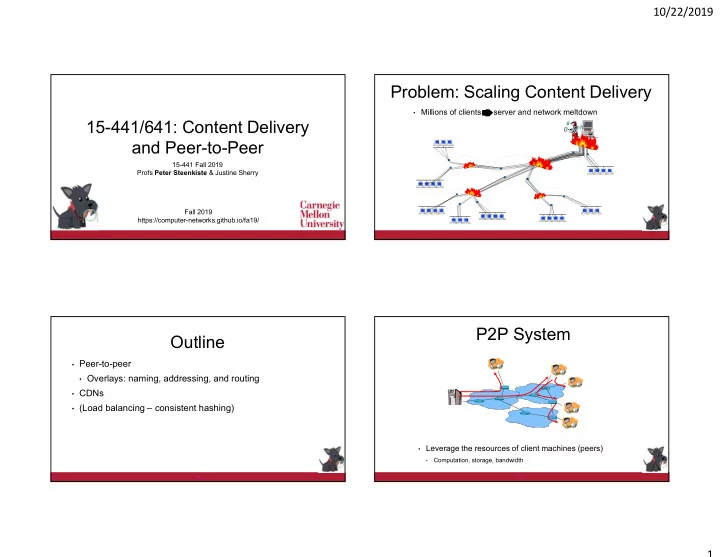
Problem: Scaling Content Delivery

  • Millions of clients  server and network meltdown

Outline

  • Peer-to-peer
  • Overlays: naming, addressing, and routing
  • CDNs
  • (Load balancing – consistent hashing)

3

4

P2P System

  • Leverage the resources of client machines (peers)
  • Computation, storage, bandwidth
slide-2
SLIDE 2

10/22/2019 2 P2P Definition

Distributed systems consisting of interconnected nodes able to self-organize into network topologies with the purpose of sharing resources such as content, CPU cycles, storage and bandwidth, capable of adapting to failures and accommodating transient populations of nodes while maintaining acceptable connectivity and performance, without requiring the intermediation or support of a global centralized server or authority.

– A Survey of Peer-To-Peer Content Distribution Technologies, Androutsellis-Theotokis and Spinellis

6

Why p2p?

  • Harness lots of spare capacity
  • 1 Big Fast Server: $10k/month++ versus 1000s .. 1000000s clients: $ ??
  • Capacity grows with the number of users!
  • Build very large-scale, self-managing systems
  • Same techniques useful for companies,
  • E.g. Akamai’s 14,000+ nodes, Google’s 100,000+ nodes
  • But: servers vs. arbitrary nodes, hard vs. soft state (backups vs caches), ….
  • Also: security, fairness, freeloading, ..
  • No single point of failure
  • Some nodes go down – others take over
  • … government shuts down nodes – peers in other countries are available

Key Idea: Network Overlay

  • A network overlay is a network that is layered on top of the Internet
  • Simplified picture: overlays use IP as their datalink layer
  • Overlays need the equivalent of all the functions IP networks need:
  • Naming and addressing
  • Routing
  • Bootstrapping
  • Security, error recovery, etc.

P2P Construction

CMU Clients Servers SPRINT AT&T Verizon

P2P Overlay Network

slide-3
SLIDE 3

10/22/2019 3

Names, addresses, and routing

The Internet

  • Endpoint: host
  • Name: hierarchical

domain name

  • Address: IP address of

node that has the content, plus content name

  • Routing: how to reach

host, e.g., BGP, … Content retrieval:

  • End-point: content
  • Name: identifies content you

are looking for

  • E.g., hash of file, key words
  • Address: the IP address of

node that has the content, plus content name

  • Routing: how to find the data

Common P2P Framework

10

Internet

N1 N2 N3 N6 N5 N4

Publish Key=“title” Value=MP3 data… Client Search Lookup(“title”)

?

Fetch Content New peer Join

11

What is (was) out there?

Central Flood Super- node flood Route Whole File Napster Gnutella Freenet Chunk Based BitTorrent KaZaA (bytes, not chunks) DHTs eDonkey 2000

12

Napster: Central Database

I have X, Y, and Z! Publish insert(X, 123.2.21.23) 123.2.21.23 Where is file A? Query Reply search(A)

  • ->

123.2.0.18 Fetch 123.2.0.18 Join: contact server

slide-4
SLIDE 4

10/22/2019 4

13

Napster: Discussion

  • Pros:
  • Simple
  • Search scope is O(1)
  • Controllable (pro or con?)
  • Cons:
  • Server maintains O(N) State
  • Server does all processing
  • Single point of failure

14

I have file A. I have file A.

Gnutella: Flooding

Where is file A? Query Reply Join: contact peers Publish: noop Fetch: direct p2p

15

Gnutella: Discussion

  • Pros:
  • Fully de-centralized
  • Search cost distributed
  • Processing @ each node permits powerful search semantics
  • Cons:
  • Search scope is O(N)
  • Search time is O(???)
  • Nodes leave often, network unstable
  • TTL-limited search works well for haystacks.
  • For scalability, does NOT search every node.
  • May have to re-issue query later

16

KaZaA: Query Flooding

  • First released in 2001 and also very popular
  • Join: on startup, client contacts a “supernode” ... may at some point

become one itself

  • Publish: send list of files to supernode
  • Search: send query to supernode, supernodes flood query amongst

themselves.

  • Fetch: get the file directly from peer(s); can fetch simultaneously

from multiple peers

slide-5
SLIDE 5

10/22/2019 5

17

KaZaA: Intelligent Query Flooding

“Super Nodes” Group of servers: Gnutella-style Flooding Napster-style Client-server Model

20

KaZaA: Discussion

  • Works better than Gnutella because of query consolidation
  • Several nodes may have requested file... How to tell?
  • Must be able to distinguish identical files
  • Same filename not necessarily same file...
  • Use Hash of file
  • Can fetch bytes [0..1000] from A, [1001...2000] from B
  • Pros: Tries to take into account node heterogeneity:
  • Bandwidth, computational resources, …
  • Cons: Still no guarantees on search scope or time
  • Challenge: want stable superpeers – good prediction
  • Must also be capable platforms

22

BitTorrent: Swarming

  • Started in 2001 to efficiently support flash crowds
  • Focus is on fetching, not searching
  • Publish: Run a tracker server.
  • Search: Find a tracker out-of-band for a file, e.g., Google
  • Join: contact central “tracker” server for list of peers.
  • Fetch: Download chunks of the file from your peers. Upload chunks you

have to them.

  • Comparison with earlier architectures:
  • Focus on fetching of “few large files”
  • Chunk based downloading
  • Anti-freeloading mechanisms

23

BitTorrent: Publish/Join

Tracker

slide-6
SLIDE 6

10/22/2019 6

24

BitTorrent: Fetch

26

BitTorrent: Summary

  • Pros:
  • Works reasonably well in practice
  • Gives peers incentive to share resources; avoids freeloaders
  • Cons:
  • Pareto Efficiency relative weak condition
  • Central tracker server needed to bootstrap swarm
  • (Tracker is a design choice, not a requirement, as you know from

your projects. Could easily combine with other approaches.)

27

When are p2p Useful?

  • Works well for caching and “soft-state”, read-only data
  • Works well! BitTorrent, KaZaA, etc., all use peers as caches for hot data
  • Difficult to extend to persistent data
  • Nodes come and go: need to create multiple copies for availability and

replicate more as nodes leave

  • Not appropriate for search engine styles searches
  • Complex intersection queries (“the” + “who”): billions of hits for each term alone
  • Sophisticated ranking: Must compare many results before returning a subset to

user

  • Need massive compute power

Outline

  • Peer-to-peer
  • Overlays: naming, addressing, and routing
  • CDNs
  • (Load balancing – consistent hashing)

28

slide-7
SLIDE 7

10/22/2019 7

End User Internet Host Server Last Mile Problem First Mile Problem Backbone Problem Peering Problem

Content Delivery: Possible Bottlenecks

Reminder: Caching with Forward Proxies

  • Cache documents close to clients

decrease latency

  • Typically done by ISPs or enterprises

reduce provider traffic load

  • CDNs proactively cache for the

content providers (their clients)

  • Typically cache at different levels

in the Internet hierarchy:

  • Last mile ISPs for low latency
  • Closer to core for broader

coverage

Clients Backbone ISP ISP-1 ISP-2 Server Forward proxies

31

Content Distribution Networks (CDNs)

  • The content providers are the CDN

customers. Content replication

  • CDN company installs hundreds of

CDN servers throughout Internet

  • Close to users
  • CDN replicates its customers’

content in CDN servers. When provider updates content, CDN updates servers

  • rigin server

in North America CDN distribution node CDN server in S. America CDN server in Europe CDN server in Asia

What is the CDN?

  • Edge Caches: work with ISP and networks everywhere to install

edge caches

  • Edge = close to customers
  • Content delivery: getting content to the edge caches
  • Content can be objects, video, or entire web sites
  • Mapping: find the “closest” edge server for each user and deliver

content from that server

  • Network proximity not the same as geographic proximity
  • Focus is on performance as observed by user (quality)

32

15-441 S'10

slide-8
SLIDE 8

10/22/2019 8

Potential Benefits

  • Very good scalability
  • Near infinite if deployed properly
  • Good economies at large scales
  • Infrastructure is shared efficiently by customers
  • Statistical multiplexing: hot sites use more resources
  • Can reduce latency – more predictable performance
  • Through mapping to closest server
  • Avoids congestion and long latencies
  • Can be extremely reliable
  • Very high degree of redundancy
  • Can mitigate some DoS attacks

33

Server Selection

  • Which server?

– Lowest load:

to balance load on servers

– Best performance: to improve client performance

  • Based on Geography? RTT?Throughput? Load?

– Any alive node:

to provide fault tolerance

  • How to direct clients to a particular server?

– As part of naming: DNS redirect – As part of application: HTTP redirect – As part of routing: anycast, cluster load balancing

16

Finding the “Closest Edge Cache – Example: Akamai DNS Redirect

  • Akamai creates new domain names for each client

e.g., a128.g.akamai.net for cnn.com

  • The CDN’s DNS servers are authoritative for the new domains
  • The client content provider modifies its embedded URLs (=

names) to reference the new domains – “Akamaize” content

e.g.: http://www.cnn.com/image-of-the-day.gif becomes

http:// a128.g.akamai.net/image-of-the-day.gif – name in the overlay

  • Requests now sent to CDN’s infrastructure…
  • Routing inside Akamai system identifies right replica to route to

IP takes care of rest once a replica has been selected (overlay!)

  • Generates and address: IP address of server + URI (tuple)
  • Effectively another layer of routing:

the path your connection takes is redirected using DNS.

slide-9
SLIDE 9

10/22/2019 9 Alternative Approaches

  • Routing based (IP anycast)

– Multiple CDN instances advertise the same IP address block – BGP will route packets to the closest one (fewest AS hops) – Pros: Transparent to clients, works when browsers cache failed addresses, circumvents many routing issues – Cons: Little control, complex, scalability, TCP can’t recover

  • Application based (HTTP redirects)

– Send request to origin HTTP server which redirects the HTTP request to a CDN instance closer to the client – Pros: Application-level, fine-grained control – Cons: Additional load and RTTs, hard to cache, availability concerns

17

Process Flow

  • 1. User wants to download distributed web content

1

XYZ

  • 2. User is directed through Akamai’s dynamic mapping to the

“closest” edge cache

Process Flow

1 2

XYZ

Process Flow

  • 3. Edge cache searches local hard drive for content

1 2 3

XYZ

slide-10
SLIDE 10

10/22/2019 10

Process Flow

1 2 3

XYZ

3a

  • 3b. If requested object is not on local hard drive, edge cache checks
  • ther edge caches in same region for object

3a

Process Flow

  • 3b. If requested object is not cached or not fresh, edge cache sends an

HTTP GET the origin server

1 2

3b

XYZ

3 3a 3a

  • 3c. Origin server delivers object to edge cache over optimized

connection

Process Flow

1 2

3b

XYZ

3

3c

3a 3a

  • 4. Edge server delivers content to end user

Process Flow

1 2

3b

XYZ

3

3c

3a 4 3a

slide-11
SLIDE 11

10/22/2019 11

Core Hierarchy Regions

XYZ

  • 1. User requests content and is mapped to optimal edge Akamai server

Core Hierarchy Regions

XYZ

  • 2. If content is not present in the region, it is requested from most optimal core region

Core Hierarchy Regions

XYZ

  • 3. Core region makes one request back to origin server

Core Hierarchy Regions

XYZ

  • 4. Core region can serve many edge regions with one request to origin server
slide-12
SLIDE 12

10/22/2019 12

Core CDN Features

Reduces traffic back to origin server

  • Reduces infrastructure needs of customer
  • Provides best protection against flash crowds
  • Especially important for large files (e.g. Operating System

updates or video files) Improved end-user response time

  • Core regions are well connected
  • Optimized connection speeds object delivery

Outline

  • Peer-to-peer
  • Overlays: naming, addressing, and routing
  • CDNs
  • (Load balancing – consistent hashing)
  • Not covered in course – slides FYI only

52

53

Distributing Load across Servers

  • Given document XYZ, we need to choose a server to use
  • E.g., in a data center
  • Suppose we use simple hashing: modulo n of a hash of the

name of the document

  • Number servers from 1…n
  • Place document XYZ on server (XYZ mod n)
  • What happens when a servers fails? n  n-1
  • Same if different people have different measures of n
  • Why might this be bad?

54

Consistent Hash: Goals

  • “view” = subset of all hash buckets that are candidate locations
  • Correspond to a real server
  • Desired features
  • Load – all hash buckets have a similar number of objects

assigned to them

  • Smoothness – little impact on hash bucket contents when

buckets are added/removed

  • Spread – small set of hash buckets that may hold an object

regardless of views

slide-13
SLIDE 13

10/22/2019 13

55

Consistent Hash – Example

  • Monotone  addition of bucket does not cause

movement between existing buckets

  • Spread & Load  small set of buckets that lie near
  • bject
  • Balance  no bucket is responsible for large number
  • f objects
  • Construction
  • Assign each of C hash buckets to

random points on mod 2n circle, where, hash key size = n.

  • Map object to random position on unit

interval

  • Hash of object = closest bucket

4 8 12 Bucket 14

56

Consistent Hashing: Ring

  • Use consistent has to map both keys and nodes to an m-bit identifier in the same (metric)

identifier space

  • For example, use SHA-1 hashes
  • Node identifier: SHA-1 hash of IP address
  • Key identifier: SHA-1 hash of key
  • Also need “rule” for assigning keys to nodes
  • For example: “closest”, higher, lower, ..

Key=“LetItBe” ID=60

SHA-1

IP=“198.10.10.1” ID=123

SHA-1

57

Rule: A key is stored at its successor: node with next higher or equal ID

N32 N90 N123 K20 K5 Circular 7-bit ID space

IP=“198.10.10.1”

K101 K60

Key=“LetItBe”

Consistent Hashing Example

58

Consistent Hashing Properties

  • Load balance: all nodes receive roughly the same number of keys
  • For N nodes and K keys, with high probability
  • Each node holds at most (1+)K/N keys
  • Provided that K is large compared to N
  • When server is added, it receives its initial work load from

“neighbors” on the ring

  • “Local” operation: no other servers are affected
  • Similar property when a server is removed
slide-14
SLIDE 14

10/22/2019 14

Finer Grain Load Balancing

  • Redirector knows all server IDs si
  • It can also track approximate “load” for more precise load

balancing

  • Need to define load and be able to track it
  • To balance load:
  • Wi = Hash(URL, ip of si) for all i
  • Sort Wi from high to low
  • Find first server with low enough load
  • Benefits and drawbacks?

59

Consistent Hashing Used in Many Contexts

  • Distribute load across servers in a data center
  • The redirector sits in data center
  • Finding storage cluster for an object in a CDN uses centralized

knowledge

  • Why?
  • Can use consistent hashing in the cluster
  • Consistent hashing can also be used in a distributed setting
  • P2P systems can use it find files (DHTs)

60