Production and Characterisation of Microbial Polymer of - - PowerPoint PPT Presentation

production and characterisation of microbial polymer of
SMART_READER_LITE
LIVE PREVIEW

Production and Characterisation of Microbial Polymer of - - PowerPoint PPT Presentation

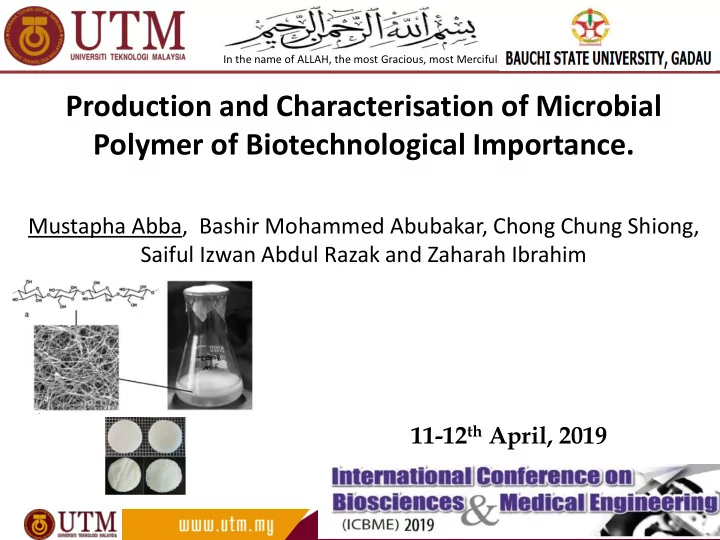
In the name of ALLAH, the most Gracious, most Merciful Production and Characterisation of Microbial Polymer of Biotechnological Importance. Mustapha Abba, Bashir Mohammed Abubakar, Chong Chung Shiong, Saiful Izwan Abdul Razak and Zaharah


slide-1
SLIDE 1

Production and Characterisation of Microbial Polymer of Biotechnological Importance.

Mustapha Abba, Bashir Mohammed Abubakar, Chong Chung Shiong, Saiful Izwan Abdul Razak and Zaharah Ibrahim 11-12th April, 2019

In the name of ALLAH, the most Gracious, most Merciful

slide-2
SLIDE 2
  • With the increase in environmental awareness and limitation of resources, it is

anticipated that renewable biopolymers will replace substantial fraction of synthetic and other natural polymers.

  • Cellulosic nanomaterials provides

a novel and sustainable platforms for the production of high performance biomaterials.

  • Nanocellulose is the most abundant, renewable, natural biosorbent, and

biocompatible polymer consisting of β 1-4 glycosidic linkage, frequently isolated from plants.

  • Acetobacter, Agrobacterium, and Pseudomonas reported to secrete nanocellulose

with promising properties and the same chemical structure to plant cellulose.

  • Bacterial nanocellulose (BNC) does not contain lignin, hemicellulose, protein and
  • ther components of animal origin which are commonly found in plant

nanocellulose.

  • .

Introduction/Background of the Study

slide-3
SLIDE 3

High value added extracellular product Properties Of BNC Transparent (optical) Pure and Free from Lignin, Pectin, and Hemicellulose Greater Tensile Strength High Crystallinity Index High Water Holding Capacity In situ Foldability Ultrafine Nanoscale Fibrous Network High degree of polymerisation

Why Bacterial Nanocellulose?

slide-4
SLIDE 4

 Novel material suitable for biofabrication in biomedical industries.

Applications of BNC in biomedical field

slide-5
SLIDE 5

To isolate and characterise nanocellulose producing bacterium To characterise BNC produced by the isolated bacterium. To evaluate the potentials of using BNC membranes biomedical applications

Objectives of Study

slide-6
SLIDE 6

Isolation and characterisation of nanocellulose producing bacterium from fruit waste samples

Isolation of the bacterium from fruit waste samples using different growth medium Screening for efficient nanocellulose producing bacteria Molecular identification

  • Genomic DNA isolation (Wizard kits)
  • Agarose gel electrophoresis
  • Nano drop analysis
  • PCR amplification (16S rRNA)
  • Gene sequence analysis (BLASTN)
  • Construction of the phylogenetic tree

by neighbour joining

Production and purification of BNC and its characterisation

BNC production under static culture condition using modified HS medium Purification of BNC using 0.1 M NaOH Drying and quantification (Freeze and Oven drying) Characterisation of BNC

  • FTIR
  • SEM
  • TGA/DTG
  • XRD

General flow chart

slide-7
SLIDE 7

Results and Discussion

slide-8
SLIDE 8

Fig 1: Pure colonies. Fig 3: Utilisation of Ethanol, lactate and acetate using Carr medium Biochemical test Results/Reaction Ethanol utilisation Positive Citrate utilization Negative Lactate utilization Positive Acetate utilization Positive Oxidase test Negative Catalase Positive Fig 2: BNC formation by the isolates a b Table 1: Biochemical characterisations Sphere pellets Gelatinous layer

  • Metabolic range in addition to BNC prod.

Isolation and Screening of Bacteria

slide-9
SLIDE 9

Molecular Identification

Fig 4 : Agarose gel electrophoresis: (a) Genomic DNA and (b) Amplified 16S rRNA gene and (c) Phylogenetic tree

  • DNA of good quality and high quantity
  • With high molecular weight
  • Promega kits

c

  • Gene sequence analysis of the 16S RNA-

Gluconacetobacter sp. –therefore named as Gluconacetobacter sp. BCZM 1.

slide-10
SLIDE 10

BNC Production and Purification

Fig 4: (a) BNC produced (static culture), (b) purified and (c) Dried BNC (freeze & oven)

a c a

  • The choice of drying method is equally important
  • It was aimed to maintain the purity,

structure and properties of the BNC

slide-11
SLIDE 11

Characterisation of BNC

SEM

  • Fig. 6: SEM images of the purified BNC
  • Fig. 7: FTIR analysis of the purified BNC
  • spectral 4000-400 cm -1
  • FTIR represents fingerprint with absorption peaks correspond to the frequencies of

vibration bond of an atoms that make up the materials.

  • Each materials has a unique combination of atoms.
  • The signature band at 2900 cm−1 attributing to C-H stretching vibration confirmed

characteristic of native cellulose (Cheng et al., 2009).

  • 3500-3100 cm−1 ( OH stretching)

FTIR

slide-12
SLIDE 12

Fig 9. (a) TGA and (b) DTG analysis of BNC samples

  • Thermally stable
  • Maximum degradation temperature

1. Lost of volatile component (moisture, solvent) 2. Decomposition of the materials 3. Inert residues

  • Residual mass in % when the char has

been burn off (oxidised)

Characterisation of BNC

Thermogravimetric Analysis (TGA)

BNC Sample Peak Temperature (Tmax °C) Residual Mass at 900 °C (%) Freeze Dried 268 70.96 Oven dried 340 74.89

slide-13
SLIDE 13

Conclusion and recommendation

 The isolated bacterium were identified as Gluconacetobacter sp. based on the 16S rRNA gene sequence analysis and therefore, named Gluconacetobacter sp. BCZM 1.  The characterized BNC produced were found to displayed significant future for biotechnological application  BNC production using bacteria could minimized nanocellulose production costs.  Genetic studies on Gluconacetobacter sp. BCZM 1. to fully enhence its BNC production process.  Future studies could further explore future potentials of BNC for biomedical applications.  Appropriate production steps should be taken into account to maintain BNC promising properties such as 3-D structure, thermostability and fibre network,

slide-14
SLIDE 14

Acknowledgement

  • Tetfund Nigeria.
  • Bauchi State University, Gadau, Nigeria.
  • My research supervisors
  • Universiti Teknologi Malaysia (UTM)
  • Faculty of Science (UTM)
  • Research University Grant (RUG) vote number (GUP17H51)
slide-15
SLIDE 15

For r li listeni ening ng……

JAZAKUMULLAHU KHAIRAN

kera rana na me mend ndenga engar……