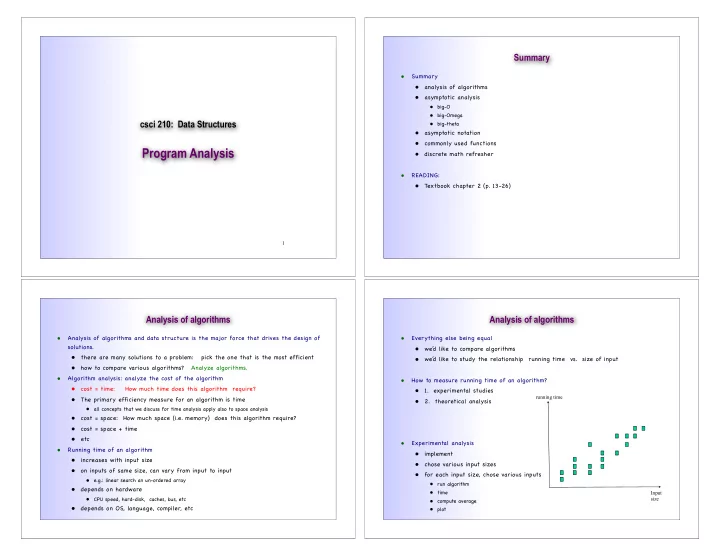
Program Analysis discrete math refresher READING: Textbook - - PowerPoint PPT Presentation

program analysis
SMART_READER_LITE
LIVE PREVIEW

Program Analysis discrete math refresher READING: Textbook - - PowerPoint PPT Presentation

Summary Summary analysis of algorithms asymptotic analysis big-O big-Omega csci 210: Data Structures big-theta asymptotic notation commonly used functions Program Analysis discrete math


slide-1
SLIDE 1

csci 210: Data Structures

Program Analysis

1

Summary

  • Summary
  • analysis of algorithms
  • asymptotic analysis
  • big-O
  • big-Omega
  • big-theta
  • asymptotic notation
  • commonly used functions
  • discrete math refresher
  • READING:
  • Textbook chapter 2 (p. 13-26)

Analysis of algorithms

  • Analysis of algorithms and data structure is the major force that drives the design of

solutions.

  • there are many solutions to a problem: pick the one that is the most efficient
  • how to compare various algorithms? Analyze algorithms.
  • Algorithm analysis: analyze the cost of the algorithm
  • cost = time: How much time does this algorithm require?
  • The primary efficiency measure for an algorithm is time
  • all concepts that we discuss for time analysis apply also to space analysis
  • cost = space: How much space (i.e. memory) does this algorithm require?
  • cost = space + time
  • etc
  • Running time of an algorithm
  • increases with input size
  • n inputs of same size, can vary from input to input
  • e.g.: linear search an un-ordered array
  • depends on hardware
  • CPU speed, hard-disk, caches, bus, etc
  • depends on OS, language, compiler, etc
  • Everything else being equal
  • we’d like to compare algorithms
  • we’d like to study the relationship running time vs. size of input
  • How to measure running time of an algorithm?
  • 1. experimental studies
  • 2. theoretical analysis
  • Experimental analysis
  • implement
  • chose various input sizes
  • for each input size, chose various inputs
  • run algorithm
  • time
  • compute average
  • plot

Analysis of algorithms

Input size running time

slide-2
SLIDE 2

Experimental analysis

  • Limitations
  • need to implement the algorithm
  • need to implement all algorithms that we want to compare
  • need many experiments
  • try several platforms
  • Advantages
  • find the best algorithm in practice
  • We would like to analyze algorithms without having to implement them
  • Basically, we would like to be able to look at two algorithms flowcharts and decide

which one is better

Input size running time

Theoretical analysis

  • RAM model of computation
  • Assume all operations cost the same
  • Assume all data fits in memory
  • Running time (efficiency) of an algorithm:
  • the number if operations executed by the algorithm
  • Does this reflect actual running time?
  • multiply nb. of instructions by processor speed
  • 1GHz processor ==> 10^9 instructions/second
  • Is this accurate?
  • Not all instructions take the same...
  • Various other effects.
  • Overall, it is a very good predictor of running time in most cases.

Terminology

  • Notation: n = size of the input to the problem
  • Running time:
  • number of operations/instructions executed on an input of size n
  • expressed as function of n: f(n)
  • For an input of size n, running time may be smaller on some inputs than on others
  • Best case running time:
  • the smallest number of operations on an input of size n
  • Worst-case running time:
  • the largest number of operations on an input of size n
  • For any n
  • best-case running time(n) <= running time(n) <= worst-case running time (n)
  • Ideally, want to compute average-case running time
  • need to know the distribution of the input
  • ften assume uniform distribution (all inputs are equally likely), but this may not

be realistic

Running time

  • Expressed as functions of n: f(n)
  • The most common functions for running times are the following:
  • constant time :
  • f(n) = c
  • logarithmic time
  • f(n) = lg n
  • linear time
  • f(n) = n
  • n lg n
  • f(n) = n lg n
  • quadratic
  • f(n) = n2
  • cubic
  • f(n) = n3
  • exponential
  • f(n) = an
slide-3
SLIDE 3

Constant running time

  • f(n) = c
  • Meaning: for any n, f(n) is a constant c
  • Elementary operations
  • arithmetic operations
  • boolean operations
  • assignment statement
  • function call
  • access to an array element a[i]
  • etc

Logarithmic running time

  • f(n) = lg c n
  • Logarithm definition:
  • x = log c n if and only of c x = n
  • by definition, log c 1 = 0
  • In algorithm analysis we use the ceiling to round up to an integer
  • the ceiling of x: the smallest integer >= x
  • e.g. ceil(log b n) is the number of times you can divide n by b until you get a

number <= 1

  • e.g.
  • ceil(log 2 8) = 3
  • ceil(log 2 10) = 4
  • Notation: lg n = log 2 n
  • Refresher: Logarithm rules
  • Note: computing lg n on your calculator
  • lg n = log 10 n / log 10 2

Exercises

Simplify these expressions

  • lg 2n =
  • lg (n/2) =
  • lg n3 =
  • lg 2n
  • log 4 n =
  • 2 lg n

Binary search

//return the index where key is found in a, or -1 if not found public static int binarySearch(int[] a, int key) {

int left = 0; int right = a.length-1; while (left <= right) {

int mid = left + (right-left)/2; if (key < a[mid]) right = mid-1; else if (key > a[mid]) left = mid+1; else return mid;

}

//not found return -1; }

  • running time:
  • best case: constant
  • worst-case: lg n

Why? input size halves at every iteration of the loop

slide-4
SLIDE 4

Linear running time

  • f(n) = n
  • Example:
  • doing one pass through an array of n elements
  • e.g.
  • finding min/max/average in an array
  • computing sum in an array
  • search an unordered array (worst-case)

int sum = 0 for (int i=0; i< a.length; i++) sum += a[i]

n-lg-n running time

  • f(n) = n lg n
  • grows faster than n (i.e. it is slower than n)
  • grows slower than n2
  • Examples
  • performing n binary searches in an ordered array
  • sorting

Quadratic time

  • f(n) = n2
  • appears in nested loops
  • enumerating all pairs of n elements
  • Example 1:

for (i=0; i<n; i++) for (j=0; j<n; j++) //do something

  • Example2:

//selection sort: for (i=0; i<n-1; i++) minIndex = index-of-smallest element in a[i..n-1] swap a[i] with a[minIndex]

  • running time:
  • index-of-smallest element in a[i..j] takes j-i+1 operations
  • n + (n-1) + (n-2) + (n-3) + ... + 3 + 2 + 1
  • this is n2

Math refresher

  • Lemma:
  • 1+ 2 + 3 + 4 + ..... + (n-2) + (n-1) + n = n(n+1)/2 (arithmetic sum)
  • Proof:
slide-5
SLIDE 5

Cubic running times

  • Cubic running time: f(n) = n3
  • Examples:
  • nested loops
  • Enumerate all triples of elements
  • Imagine cities on a map. Are there 3 cities that no two are not joined by a

road?

  • Solution: enumerate all subsets of 3 cities. There are n chose 3 different subsets, which is
  • rder n3.
  • In general, a polynomial running time: f(n) = nd, d>0

Exponential running time

  • Exponential running time: f(n) = an , a > 1
  • Examples:
  • running time of Tower of Hanoi (see later)
  • moving n disks from A to B requires at least 2n moves; which means it requires at least this

much time

  • Math refresher: exponent rules

Asymptotic analysis

  • Focus on the growth of rate of the running time, as a function of n
  • That is, ignore the constant factors and the lower-order terms
  • Focus on the big-picture
  • Example: we’ll say that 2n, 3n, 5n, 100n, 3n+10, n + lg n, are all linear
  • Why?
  • constants are not accurate anyways
  • perations are not equal
  • capture the dominant part of the running time
  • Notations:
  • Big-Oh:
  • express upper-bounds
  • Big-Omega:
  • express lower-bounds
  • Big-Theta:
  • express tight bounds (upper and lower bounds)

Big-Oh

  • Definition: f(n) is O(g(n)) if exists c >0 such that f(n) <= cg(n) for all n >= n0
  • Intuition:
  • big-oh represents an upper bound
  • when we say f is O(g) this means that
  • f <= g asymptotically
  • g is an upper bound for f
  • f stays below g as n goes to infinity
  • Examples:
  • 2n is O(n)
  • 100n is O(n)
  • 10n + 50 is O(n)
  • 3n + lg n is O(n)
  • lg n is O(log_10 n)
  • lg_10 n is O(lg n)
  • 5n4 + 3n3 + 2n2 + 7n + 100 is O(n4)
slide-6
SLIDE 6

Big-Oh

  • 2n2 + n lg n +n + 10
  • is O(n2 + n lg n)
  • is O(n3)
  • is O(n4)
  • isO(n2)
  • 3n + 5
  • is O(n10)
  • is O(n2)
  • is O(n+lg n)
  • Let’

s say you are 2 minutes away from the top and you don’t know that. You ask: How much further to the top?

  • Answer 1: at most 3 hours (True, but not that helpful)
  • Answer 2: just a few minutes.
  • When finding an upper bound, the goal is to find the best one possible.

Exercises

  • Using the definition, show the following:
  • 100n is O(n)
  • n is O(100n)
  • 15n+7 is O(n)
  • 15n+7 is O(n2)
  • 5n+4 is O(2n+3)
  • 4n2+9n+8 is O(n2)

22

Exercises

Write Big-Oh upper bounds for each of the following.

  • 10n - 2
  • 5n3 + 2n2 +10n +100
  • 5n2 + 3nlg n + 2n + 5
  • 20n3 + 10n lg n + 5
  • 3 n lgn + 2
  • 2n+2 + n3 + 20
  • 2n + 100 lg n

Big-Omega

  • Definition:
  • f(n) is Omega(g(n)) if exists c>0 such that f(n) >= cg(n) for all n >= n0
  • Intuition:
  • big-omega represents a lower bound
  • when we say f is Omega(g) this means that
  • f >= g asymptotically
  • g is a lower bound for f
  • f stays above g as n goes to infinity
  • Examples:
  • 3nlgn + 2n is Omega(n lg n)
  • 2n + 3 is Omega(n)
  • 4n2 +3n + 5 is Omega(n)
  • 4n2 +3n + 5 is Omega(n2)
  • O() and Omega() are symmetrical:
  • f(n) is g(n) <====> g(n) is Omega(f(n))
slide-7
SLIDE 7

Big-Theta

  • Definition:
  • f(n) is Theta(g(n)) if f(n) is O(g(n)) and f is Omega(g(n))
  • i.e. there are constants c’ and c’’ such that c’g(n) <= f(n) <= c”g(n)
  • Intuition:
  • f and g grow at the same rate, up to constant factors
  • Theta captures the order of growth
  • Examples:
  • 3n + lg n + 10 is O(n) and Omega(n) ==> is Theta(n)
  • 2n2 + n lg n + 5 is Theta(n2)
  • 3lgn +2 is Theta(lgn)

Asymptotic Analysis

  • Find tight bounds for the best-case and worst-case running times
  • Running time is Omega(best-case running time)
  • Running time is O(worst-case running time)
  • Example:
  • binary search is Theta(1) in the best case
  • binary search is Theta(lg n) in the worst case
  • binary search is Omega(1) and O(lg n)
  • Usually we are interested the worst-case running time
  • a Theta-bound for the worst-case running time
  • Example:
  • worst-case binary search is Theta(lg n)
  • worst-case linear search is Theta(n)
  • worst-case insertion sort is Theta(n^2)
  • worst-case bubble-sort is O(n^2)
  • worst-case find-min in an array is Theta(n)
  • It is correct to say worst-case binary search is O(lg n), but a Theta-bound is better

Asymptotic Analysis

  • Suppose we have two algorithms for a problem:
  • Algorithm A has a running time of O(n)
  • Algorithm B has a running time of O(n2)
  • Which is better?
  • Suppose we have two algorithms for a problem:
  • Algorithm A has a running time of Theta(n)
  • Algorithm B has a running time of Theta(n2)
  • Which is better?
  • rder classes of functions by their oder of growth
  • Theta(1) < Theta(lg n) < Theta(n) < Theta(nlgn) < Theta(n2) < Theta(n3) < Theta(2n)
  • Theta(n) is better than Theta(n2), etc
  • Cannot distinguish between algorithms in the same class
  • two algorithms that are Theta(n) worst-case are equivalent theoretically
  • optimization of constants can be done at implementation-time

Asymptotic Analysis

slide-8
SLIDE 8

Order of growth matters

  • Example:
  • Say n = 109 (1 billion elements)
  • 10 MHz computer ==> 1 instruction takes 10-7 seconds
  • Binary search would take
  • Theta(lg n) = lg 109 x 10-7 sec = 30 x 10-7 sec = 3 microsec
  • Sequential search would take
  • Theta(n)= 109 x 10-7 sec = 100 seconds
  • Finding all pairs of elements would take
  • Theta(n2) = (109)2 x 10⁻⁷ sec = 1011 seconds = 3170 years
  • Imagine Theta(n3)
  • Imagine Theta(2n)

Order of growth matters

n lg n n n lg n n^2 n^3 2^n 8 3 8 24 64 512 256 16 4 16 64 256 4,096 65,536 32 5 32 160 1,024 32,768

4,294,967,296

64 6 64 384 4,096 262,144

1.8 x 10^19

128 7 128 896 16,384 2,097,152

3.40 x 10^38

256 8 256 2.048 65,536

16,777,216

1.15 x 10^77

512 9 512 4,608 262,144

134,217,728

1.34 x 10^154

1024 10 1024 10242 20 1,048,576 109

  • Assume we have a 1 GHz computer.
  • This means an instruction takes 1 microsecond (10-9 seconds).
  • We have 3 algorithms:
  • A: 400n
  • B 2n2
  • C: 2n
  • What is the maximum input size that can be solved with each algorithm in:
  • 1 second
  • 1 minute
  • 1 hour

Running time (in microseconds)

1 sec 1 min 1 hour 400n 2n2 2n

Exercise

  • We have an array X containing a sequence of numbers. We want to compute another

array A such that A[i] represents the average X[0] + X[1] + ... X[i]/ (i+1).

  • A[0] = X[0]
  • A[1] = (X[0] + X[1])/ 2
  • A[2] = (X[0] + X[1] + X[2]) / 3
  • ...
  • The first i values of X are referred to as the i-prefix of X.

X[0] + ... X[i] is called prefix-sum, and A[i] prefix average.

  • Application: In Economics. Imagine that X[i] represents the return of a mutual fund

in year i. A[i] represents the average return over i years.

  • Write a function that creates, computes and returns the prefix averages.

double[] computePrefixAverage(double[] X)

  • Analyze your algorithm (worst-case running time).
slide-9
SLIDE 9

Asymptotic Analysis: Overview

  • Running time = number of instructions
  • RAM model of computation
  • Want the worst-case running time as a function of input size
  • Find the tight order of growth of the worst-case running time
  • a Theta-bound
  • Classification of growth rates

Theta(1) < Theta(lg n) < Theta(n) < Theta(nlgn) < Theta(n2) < Theta(n3) < Theta(2n)

  • At the algorithm design level, we want to find the most efficient algorithm in terms of

growth rate

  • We can optimize constants at the implementation step