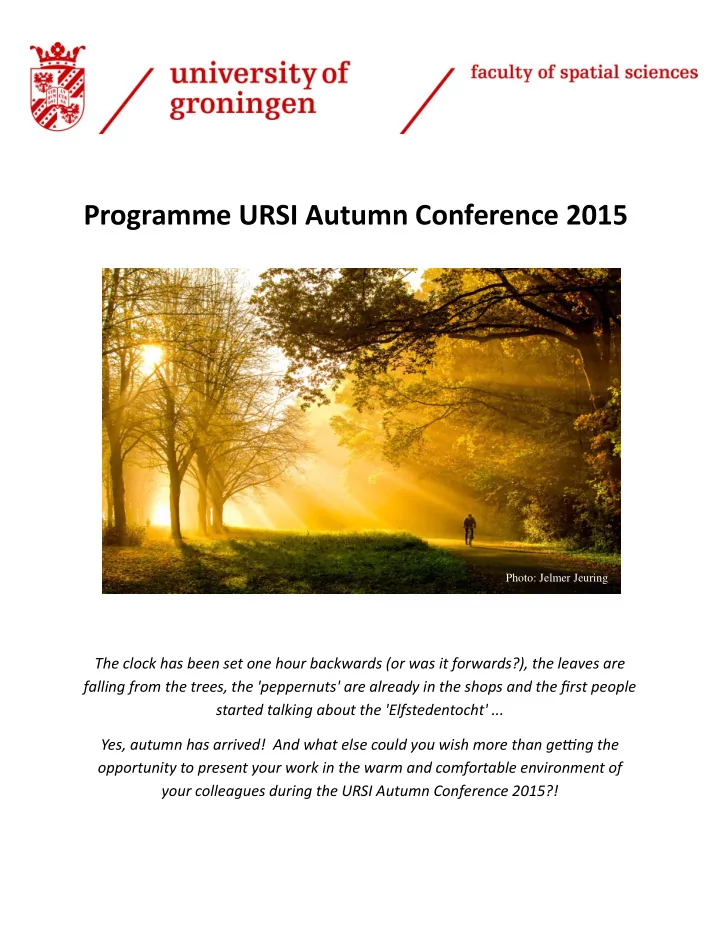
Programme URSI Autumn Conference 2015 Photo: Jelmer Jeuring The - - PDF document

programme ursi autumn conference 2015
SMART_READER_LITE
LIVE PREVIEW

Programme URSI Autumn Conference 2015 Photo: Jelmer Jeuring The - - PDF document

Programme URSI Autumn Conference 2015 Photo: Jelmer Jeuring The clock has been set one hour backwards (or was it forwards?), the leaves are falling from the trees, the 'peppernuts' are already in the shops and the fjrst people started talking


slide-1
SLIDE 1

Programme URSI Autumn Conference 2015

The clock has been set one hour backwards (or was it forwards?), the leaves are falling from the trees, the 'peppernuts' are already in the shops and the fjrst people started talking about the 'Elfstedentocht' ... Yes, autumn has arrived! And what else could you wish more than gettjng the

  • pportunity to present your work in the warm and comfortable environment of

your colleagues during the URSI Autumn Conference 2015?!

Photo: Jelmer Jeuring

slide-2
SLIDE 2

A short word from the organizers… In the short tjme in which we had to organize this conference, we wanted to change the structure a litule bit. We wanted to make it more interactjve and give the opportunity to also present work that is stjll under development. Therefore, in this URSI conference presenters can do a PPP (Plenary Paper Presentatjon) or a CCC (Collaboratjve Colleague Consult) session. A PPP is an ordinary presentatjon where we invite researchers to present work that is in a more mature stage, but stjll can use some critjcal and valuable comments to improve it even further. Afuer the presentatjon, an appointed discussant who has read the paper carefully will give some comments and also the rest of the audience can ask questjons and give feedback. The other

  • ptjon is a CCC and during this optjon the situatjon gets more interactjve. In smaller groups the

researcher can shortly present a research proposal, work in progress or even just an idea for a next paper. Afuer that, the group can discuss the work with the researcher and give suggestjons for further steps and improvement. The new structure is an experiment and we hope it will be a success. Enjoy the conference, Melanie and Jasper Locatjon Address: ‘Het Paleis’ Boterdiep 111 9712 LM Groningen The conference will be held in the ‘Erlenmeyer’ hall and there will be signs at the Paleis which direct you to this place.

slide-3
SLIDE 3

Overview of the programme 13.00 Walk in and tjme for cofgee and tea 13.30 Welcome Jasper en Melanie 13.35 News from the Graduate School Oscar Couwenberg 13.45 PPP: 13.45

Facilitatjng climate change actjon at a household level. Liliana González (discussant: Steven Forest)

14.10

Join the club: convergence in populatjon ageing across European NUTS 2 regions. Ilya Kashnitskiy (discussant: Gintare Morkute)

14.35

The environmental afgordances of an urban park: The relatjonships between design and older adults’ use of green spaces. Yang Zhang (discussant: Paul Plazier)

15.00

Promotjng regional growth and innovatjon: the relevance of related variety. Gloria Cicerone (discussant: Richard Rijnks)

15.25 Break 15.50 CCC round 1:

Access to Jobs and the School-to-Work Transitjon: A Decompositjon Approach Marten Middeldorp The Determinants of Setulement Intentjons of Multj-Ethnic Migrants in Northwest China Bo Zhang Valuatjon in combined infrastructure and regional development: "Pushing the envelope" Anne-Marel Hilbers

16.15 Short break 16.20 CCC round 2:

Rural Depopulatjng Territories in Mexico Liliana Castjllo-Rivero Rural village bonding in the era of mobilitjes. A quantjtatjve approach to clarify the varietjes and intensitjes of rural village bonding Joost Gieling Residents’ satjsfactjon with partjcipatjon in the Southern Ringroad Highway project-A partjcipatory session..! Marije Hamersma The role of alcohol in explaining convergence in mortality across European countries Sergi Trias-Llimós

16.45 Closing comments Oscar Couwenberg 17.00 Drinks

slide-4
SLIDE 4

Abstracts Plenary Paper presentatjons (PPP):

Liliana González Facilitatjng climate change actjon at a household level According to the Intergovernmental Panel on Climate Change (IPCC), climate change and climate change efgects are expected to result in more frequent and intense extreme weather events, along with gradual long- term changes that may increase pressure on already vulnerable systems. Case studies suggest that practjces that build climate change resilience will be successful depending on the extent to which the community is involved and their necessitjes, experiences, and expertjse are acknowledged. Additjonally, studies demonstrate that vulnerability to climate change varies amongst regions, communitjes and social groups. Research has indicated the overall importance of micro-scale actjon in the context of a changing climate is high, that is if households decide to take actjon to minimize the negatjve efgects of climate change and take advantage of its opportunitjes, it can lead to building up community resilience. This demonstrates the need to emphasize on lower scales such as local communitjes and households. Being a crucial unit of social foundatjon and linked to other actors at larger or smaller geographical scales, a household or 'home' is an important scale for understanding actjvitjes that connect individual behaviors and societal attjtudes and a scale to observe vulnerability and resilience. However, the relatjve low priority given to understanding the potentjal and limitatjons of households’ contributjon to build community climate change resilience may be associated with the gap of knowledge and data concerning households. There is limited understanding on such basic issues as beliefs and capacitjes that households have in respect to climate

  • change. Many policy approaches do not take into account household complexitjes such as their decision

making process, which is afgected by a range of factors such as livelihood concerns, like housing and job security, as well as cultural and social values and prioritjes. Failure to address these challenges can delay actjons that may reduce optjons for climate resilient communitjes and sustainable development in the future. The study aims to propose ways to facilitate household level actjon to increase resilience against current and future variatjons of environmental conditjons atuributed to climate change. This will be done by conductjng research in the state of Nuevo León, México, where there is a lack of informatjon on perceptjon, knowledge, and factors that infmuence climate change resilience practjces at a household level. The project is approached through qualitatjve data from surveys targeted at households and analyzes how climate processes are carried

  • ut from a household perspectjve. It also examines demographic difgerences, if any, in the perceptjon of

climate change and its efgects. This will assist in identjfying who is most concerned and prepared to deal with the possible efgects of climate change. By assessing the household scale, we can improve the development and implementatjon of climate policies at such level that lead to building climate change resilient communitjes. Ilya Kashnitsky Join the club: convergence in populatjon ageing across European NUTS 2 regions BACKGROUND The Cohesion Policy of European Union is reported to be successful, especially, when the disparitjes in

slide-5
SLIDE 5

economic output between East-European regions and the regions of older EU states are considered. Even though economic convergence took place, the role of Cohesion Policy may be overestjmated. Difgerent developments in populatjon ageing could have largely contributed to economic cohesion. OBJECTIVE The paper investjgates whether difgerences in populatjon ageing across European NUTS 2 regions became smaller during 2003-2012. We examine whether difgerences in the ratjo of the working to non-working age populatjon became smaller across regions. METHODS We use both sigma- and beta-convergence to uncover regularitjes in regional ageing dynamics. Beta- convergence examines whether regions with a high share of working age populatjon tend to lose their

  • advantage. Conditjonal modeling is used to test if groups of regions converge to difgerent levels, i.e. if there is

club convergence. We examine to what extent convergence is caused by migratjon, mortality, and cohort turnover. RESULTS Even though regions of Europe saw an increase in ageing disparitjes, e.g. no sigma-convergence, beta- convergence analysis indicates that convergence in ageing took place only in recent years; the prior lack of convergence is mainly explained by the demographic development of East-European regions. Conditjonal modeling confjrmed the existence of club convergence. CONCLUSIONS Divergent development of ageing in East-European regions contributed to faster economic convergence. Yet, since cohesion was not reached during the tjme of favorable populatjon dynamics, it would be even harder to reach in the coming decades of acceleratjng ageing. Yang Zhang The environmental afgordances of an urban park: The relatjonships between design and older adults’ use of green spaces Parks are important urban green space facilitjes which help older adults keep a healthy and actjve aging life by promotjng their physical actjvitjes and social interactjons. However, such spaces may not be utjlized and may not contribute to wellbeing, if they fail to meet the needs of older adults. To investjgate the relatjonships between design and older adults’ use of green spaces, we look at the concept of environmental afgordance, i.e. the propertjes of the environment taken with reference to an individual. This study draws on a combinatjon of 23 interviews and behavior mapping of three sites in an urban park in Xi’an, China. The interviews were interpreted to explore the interconnectjon between park afgordance and green space design. Interview data were supplemented by behavior mapping data which focused on the common patuerns of behavior that appear to be correlated with partjcular green space design. By developing a functjonal taxonomy of older visitors’ park environment, we identjfy the design features of the park which are facilitatjng or constraining park use. Finally, recommendatjons and guidelines are provided for green space planners and designers to create more livable green spaces for older residents in dense urban green areas. Gloria Cicerone Promotjng regional growth and innovatjon: the relevance of related variety This paper contributes to the empirical literature that aims at identjfying the forces promotjng innovatjon and afgectjng the growth potentjal of difgerent geographical areas. My main purpose is to investjgate the role that the sectoral compositjon of a regional economy plays in enhancing the rate of innovatjon and growth. In partjcular, the analysis aims to demonstrate that regions specializing in complementary sectors will

slide-6
SLIDE 6

experience higher rates of innovatjon and growth than regions specializing in sectors that do not complement each other. Such complementaritjes are captured by the notjon of related variety. First, following the methodological approach of Hidalgo et al., I draw the network of relatedness between products, or ‘product space’, of the Italian provinces. I use the export data by Italian province (NUTS 3) and sector (three-digit) to calculate the products’ proximity index, and the sofuware Gephi to build the network

  • map. I also calculate how dense is the product space around the areas where each Italian province has

specialized, that is the measure of related variety. Secondly, I test empirically whether related variety, among other factors, matuers for the innovatjve output in 103 Italian provinces covering the period 2006-2012. The results show that related variety might be crucial. That is, Italian provinces with a range of industries that are technologically related tend to show higher innovatjon rates, once I control for the usual suspects. Moreover, I fjnd evidence that related variety positjvely infmuences regional growth more than variety per se. Collaboratjve Colleague Consult (CCC) Round 1 Marten Middeldorp Access to Jobs and the School-to-Work Transitjon: A Decompositjon Approach The successfulness of the transitjon from school into working life is closely related to further career success. Periods of unemployment, labour market inactjvity and suboptjmal employment increase the chance of being unemployed or earning lower wages later in life. Access to jobs at the start of the career has proved an important determinant of early career success. School-leavers with good access to jobs earn higher wages and have lower chances of being unemployed. Although the school-to-work transitjon is becoming longer and less standardised, most research has adopted a simple defjnitjon of career entry success (e.g. being employed or not fjve years afuer graduatjng). In this paper, we study the efgect of job accessibility on the school-to work transitjons of recent higher educatjon graduates. We use a GIS to calculate a job accessibility index based on driving tjme that controls for commutjng tolerance and competjtjon from other workers. In a second step, we use sequence analysis to calculate labour market entry trajectories. We subsequently relate job accessibility and labour market entry trajectories to chance of employment, wage height and wage growth. Finally, we adopt a decompositjon approach to determine whether, depending on the level of job access, trajectories and individual characteristjcs have difgerent efgects on early career success. Bo Zhang The Determinants of Setulement Intentjons of Multj-Ethnic Migrants in Northwest China Against the background of rapid urbanizatjon and Western Development Campaign, a large-scale populatjon shifu is taking place within Northwest China. Many migrants within NWC are from difgerent ethnic backgrounds compared to East and Central regions because NWC is not only the homeland to the majority Han but also to many ethnic minoritjes, mainly Muslims and Tibetans. Three questjons are proposal as followed: 1. What determinants infmuence migrants’ setulement intentjon in Northwest China? 2.How does migrants’ ethnic background infmuence their setulement intentjon? 3. How does the social contexts of receiving society infmuence migrants’ setulement intentjon? This artjcle investjgates the determinants of migrants’ setulement intentjon by using the survey data conducted in three city/prefectures in Northwest China in 2013. Four strategies are presented: setuling in the city, returning home, moving to other citjes and

  • undecided. We analyse migrants’ setulement intentjon through a multj-nominal logit approach, together with
slide-7
SLIDE 7

some in-depth interviews and partjcipant observatjon. The results indicates that the preference of the city life, the length of contracts and the neighbourhood relatjon have negatjve impact on returning home. Comparing with couple and family migrants, the individual migrants tend to be rather setuling down than returning home. Additjonally, we focus on the strategy “moving to other citjes” because many migrants only assume the current city as a transfer hub and tend to move to other citjes especially to some East citjes. We also focus on the “undecided” optjon because the signifjcance of undecided choice in the determinants of city/prefectures indicates migrants’ hesitatjon and uncertainty about their future. The estjmatjon implies the signifjcance of migrants ethnic identjty and social contexts of difgerent city/prefectures. Han migrants seem less undecided about their setulement intentjon than the minority migrants. Migrants in Lanzhou and Linxia show more undecided rather than setuling down. Policy implicatjons are presented in the discussion to facilitate the minority migrants’ setulement. Anne Marel Hilbers Valuatjon in combined infrastructure and regional development: "Pushing the envelope" How can we explicate concrete tools and instjtutjonal designs that are aimed at reaching consensus on the data basis for valuatjon; a valuatjon which serves to underpin the alternatjve choice? Because a wide range of values at difgerent spatjal levels is relevant in a partjcipatory planning environment, it is important to specify the degree and nature of consensus in more detail. The data basis for valuatjon needs to be 'consensus based': those involved in the evaluatjon must agree that the efgect does matuer and therefore must be measured, and the partjcipants need to fjnd the way of measuring intelligible (Sijtsma, 2006). The suggested (SCBA) informatjon to decision-makers strongly loses strength when on any of these matuers is no consensus. There does not expressly need to be consensus on the fjnal weight of the various value elements related to each other; this requires politjcal debate and public discussion. This means that a shared understanding is needed before talking about prioritjzatjon, as scientjsts and decision-makers. So, what knowledge/value brings new insights for decision-makers and stakeholders? Collaboratjve Colleague Consult (CCC) Round 2 Liliana Castjllo-Rivero Rural Depopulatjng Territories in Mexico During the period 2000-2010 around 40% of Mexican rural municipalitjes were in a depopulatjon process. Those municipalitjes are scatuered throughout the highly diverse country, from the northern deserts to the southern tropical environments, with heterogeneous paths of development, human setulements, industrializatjon and urbanizatjon. From mid last century, rural depopulatjon has been a reality as a consequence of rural exodus towards developing urban territories or towards abroad of the natjonal frontjers. Nevertheless; the phenomenon was recently considered as a new one due its geographic extent and its intensity of manifestatjon (Canales, 2010, Ochoa, 2008). Despite this, the knowledge on the main characteristjcs and the difgerences betweendepopulated territories has not been fully assessed yet.Although there are valuable efgorts investjgatjng Mexican territories experimentjng high rates of outmigratjon(Aguilar et al. 2011; Galvan, 2008; García-Barrios, et al. 2009; Klooster, 2003; López, et al.,2005), they do not focus explicitly, on the depopulated

  • nes, given that territories with high rates of outmigratjon are not necessarily in a depopulatjon process.

Moreover, many of them are performed in territories exhibitjng an opposite situatjon from depopulatjon, such as those in which, facing adversity, the strategies of rural inhabitants, do not include abandoning, but rather, a diversifjcatjon of livelihood strategies, giving as a consequence the stability of rural populatjon. Some
slide-8
SLIDE 8
  • f those studies tend to generalize those features, even assertjng that the Mexican rurality is not being

abandoned. This paper aims to classify difgerent Mexican rural areas in depopulatjon process as to their main characteristjcs, similaritjes and difgerences among them in order to identjfy the spatjal systems in which they are embedded, and the role they play within them. The discussion will be supported by the presentatjon of a series of maps elaborated by using GIS techniques, and based on Census data. Joost Gieling Rural village bonding in the era of mobilitjes. A quantjtatjve approach to clarify the varietjes and intensitjes of rural village bonding As suggested in a number of recent papers, rural studies need to incorporate a mobilitjes framework in order to betuer grasp contemporary rural populatjon dynamics. In West-European rural areas, the village as a ‘residentjal village’ became popular among former urban dwellers, but also other diverse groups of people migrated to the rural, aturacted by its quietness and the nice preserved natural environment. Hence, villages have become more diversely populated in terms of lifestyles, mindsets, daily practjces. The increased frequency and diversity of rural mobilitjes enables contemporary rural residents to perform difgerent kinds of actjvitjes in the village as well as far beyond the village’s borders. As a result, an individual’s level of village bonding has changed dramatjcally in recent years. The close-knit village community with deeply rooted village bonds turned into a ‘community light’, where residents have difgerent levels of ‘local consciousness’. However, this does not mean that rural residents are not tjed to their residentjal environment anymore. Rather, the ‘traditjonal intense village bond’ seems to have been replaced by more selectjve forms of bonding with certain parts of village life. This suggests that ‘place’ stjll plays an integral role in the foundatjon of feelings of belonging. This paper aims to investjgate how contemporary rural residents are bonded to their villages in terms of form and intensity. The study employs a latent class analysis to classify people with difgerent levels of village bonding into difgerent types of rural residents. We will propose a classifjcatjon of rural residents fjrst by identjfying several forms of village bonding (social, functjonal, cultural and environmental), and second by showing that these forms create difgerent patuerns of village bonding in each group. As a result, it will be more clear how difgerent patuerns of village bonding are related to a more or less mobile lifestyle and for each group we can identjfy how they value their lives in the countryside in the ‘era of mobilitjes’. Marije Hamersma Residents’ satjsfactjon with partjcipatjon in the Southern Ringroad Highway project-A partjcipatory session..! Highway projects are ofuen controversial to a residentjal area; whereas they are initjated to increase accessibility, changes in the local residentjal environment cannot be avoided. There is much research stressing the importance of public partjcipatjon in enhancing acceptance of governmental projects in residentjal areas. Also in Dutch highway infrastructure planning the partjcipatjon of difgerent stakeholders, such as residents, by both more passive (informing) and actjve partjcipatjon strategies, increasingly gets atuentjon. Research of Hamersma et al (2015, forthcoming) among residents living in the vicinity of two highway adjustment projects in the Netherlands however showed that the majority of residents were not actjvely partjcipatjng nor satjsfjed with partjcipatjon in the planning process of those projects. This raises the questjon how partjcipatjon satjsfactjon among residents is formed. My idea is to shed more light on the forming of residents’ satjsfactjon with project team’s partjcipatjon efgorts, by analyzing motjvatjons of residents in the planning process of the Southern Ring Road highway adjustment project in Groningen, the Netherlands. These motjvatjons of residents could be grasped from interviews I recently held with 36 residents living in the vicinity of this project. At this moment I am analyzing the interview data and thinking about how to structure a potentjal paper.

slide-9
SLIDE 9

Some questjons I would like to discuss with you during the session:

  • Is the idea clear and relevant to you?
  • Do you have suggestjons with regard to (partjcipatjon) theory to frame or conceptualize the topic?
  • Do you recognize some of my (fjrst) fjndings? Do you miss some things?
  • How to present the results?
  • What could (not) be concluded based on the results?

Sergi Trias-Llimós The role of alcohol in explaining convergence in mortality across European countries Background European countries have a higher alcohol-atuributable mortality than many other countries worldwide. However, important difgerences across countries, but also between sexes and over tjme exist. That is, alcohol- atuributable mortality rates tend to be higher in Eastern European countries, and always greater for men than for women. For this reason, alcohol is postulated as a crucial factor to explain mortality difgerences between sexes, across countries and over tjme. Convergence in mortality across European countries is crucial informatjon for equity policies. It has been widely assessed, mainly from an historical perspectjve. However, the potentjal contributjon of difgerent factors remains unknown. Objectjve The objectjve of this paper is to assess the role of alcohol in the extent of convergence (divergence) in mortality between European countries. Methodology We will apply formal economic approaches to assess convergence: sigma- and beta-convergence. We will compare convergence in all-cause mortality and in all-cause mortality excluding alcohol-related deaths to assess the role of alcohol in mortality convergence across countries. To estjmate the contributjon of alcohol in mortality, associated single-decrement life tables will be applied. Relevance This research will contribute in the explanatjon of mortality variatjons across countries by means of quantjfying to what extent alcohol is contributjng to convergence in mortality in Europe. I will present the topic focusing on methodological aspects to assess convergence in mortality or cross- country variatjons over tjme.