Programming in C Spring Semester 2016 Programming and Data - - PDF document

programming in c
SMART_READER_LITE
LIVE PREVIEW

Programming in C Spring Semester 2016 Programming and Data - - PDF document

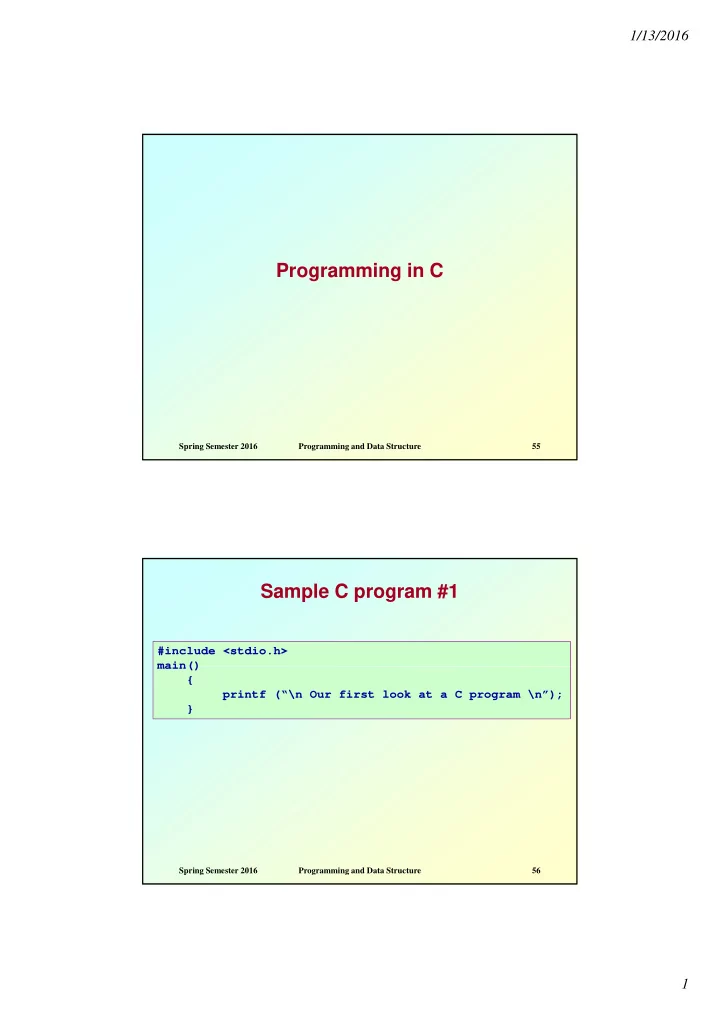
1/13/2016 Programming in C Spring Semester 2016 Programming and Data Structure 55 Sample C program #1 #include <stdio.h> main() main() { printf (\n Our first look at a C program \n); } Spring Semester 2016 Programming and


slide-1
SLIDE 1

1/13/2016 1

Programming in C

Spring Semester 2016 Programming and Data Structure 55

Sample C program #1

#include <stdio.h> main() main() { printf (“\n Our first look at a C program \n”); }

Spring Semester 2016 Programming and Data Structure 56

slide-2
SLIDE 2

1/13/2016 2

Sample C program #2

/* Compute the sum of two integers */ #include <stdio.h> main() { int a, b, c; a = 10; b = 20; c = a + b;

Spring Semester 2016 Programming and Data Structure 57

printf (“\n The sum of %d and %d is %d\n”, a,b,c); }

Sample C program #3

#include <stdio.h> /* FIND THE LARGEST OF THREE NUMBERS */ main() { int a, b, c; scanf (“%d %d %d”, &a, &b, &c); if ((a>b) && (a>c)) /* Composite condition check */ printf (“\n Largest is %d”, a); else

Spring Semester 2016 Programming and Data Structure 58

if (b>c) /* Simple condition check */ printf (“\n Largest is %d”, b); else printf (“\n Largest is %d”, c); }

slide-3
SLIDE 3

1/13/2016 3

Sample C program #4

#include <stdio.h> #define PI 3.1415926 /* Compute the area of a circle */ main() () { float radius, area; float myfunc (float radius); scanf (“%f”, &radius); area = myfunc (radius); printf (“\n Area is %f \n”, area); }

Spring Semester 2016 Programming and Data Structure 59

float myfunc (float r) { float a; a = PI * r * r; return (a); /* return result */ }

Introduction to C

  • C is a general-purpose, structured programming

language.

– Resembles other high-level structured programming languages, such as Pascal and Fortran-77. – Also contains additional features which allow it to be used at a lower level.

  • C can be used for applications programming as well

as for systems programming.

Spring Semester 2016 Programming and Data Structure 60

  • There are only 32 keywords and its strength lies in

its built-in functions.

  • C is highly portable, since it relegated much

computer-dependent features to its library functions.

slide-4
SLIDE 4

1/13/2016 4

History of C

  • Originally developed in the 1970’s by Dennis

Ritchie at AT&T Bell Laboratories.

– Outgrowth of two earlier languages BCPL and B.

  • Popularity became widespread by the mid 1980’s,

with the availability of compilers for various platforms.

  • Standardization has been carried out to make the

various C implementations compatible

Spring Semester 2016 Programming and Data Structure 61

various C implementations compatible.

– American National Standards Institute (ANSI) – GNU

Structure of a C program

  • Every C program consists of one or more

functions.

– One of the functions must be called main. – The program will always begin by executing the main function.

  • Each function must contain:

– A function heading, which consists of the function name followed by an optional list of

Spring Semester 2016 Programming and Data Structure 62

function name, followed by an optional list of arguments enclosed in parentheses. – A list of argument declarations. – A compound statement, which comprises the remainder of the function.

slide-5
SLIDE 5

1/13/2016 5

Contd.

  • Each compound statement is enclosed

within a pair of braces: ‘{‘ and ‘}’

– The braces may contain combinations of elementary statements and other compound statements.

  • Comments may appear anywhere in a

program, enclosed within delimiters ‘/*’ and ‘*/’

Spring Semester 2016 Programming and Data Structure 63

and ‘*/’.

– Example:

a = b + c; /* ADD TWO NUMBERS */

Example of a Function

/* Compute the sum of two integers */ #include <stdio.h> main() { int a, b, c; a = 10; b = 20; c = a + b;

Spring Semester 2016 Programming and Data Structure 64

; printf (“\n The sum of %d and %d is %d\n”, a,b,c); }

slide-6
SLIDE 6

1/13/2016 6

Desirable Programming Style

  • Clarity

– The program should be clearly written. It h ld b t f ll th l i – It should be easy to follow the program logic.

  • Meaningful variable names

– Make variable/constant names meaningful to enhance program clarity.

  • ‘area’ instead of ‘a’
  • ‘radius’ instead of ‘r’

Spring Semester 2016 Programming and Data Structure 65

  • Program documentation

– Insert comments in the program to make it easy to understand. – Never use too many comments.

Contd.

  • Program indentation

– Use proper indentation. St t f th h ld b i di t l i ibl – Structure of the program should be immediately visible.

Spring Semester 2016 Programming and Data Structure 66

slide-7
SLIDE 7

1/13/2016 7

Indentation Example #1 :: Good Style

#include <stdio.h> #define PI 3 1415926 float myfunc (float r) { #define PI 3.1415926 /* Compute the area of a circle */ main() { float radius, area; float myfunc (float radius); { float a; a = PI * r * r; return (a); /* return result */ }

Spring Semester 2016 Programming and Data Structure 67

scanf (“%f”, &radius); area = myfunc (radius); printf (“\n Area is %f \n”, area); }

Indentation Example #1 :: Bad Style

#include <stdio.h> #define PI 3 1415926 float myfunc (float r) { #define PI 3.1415926 /* Compute the area of a circle */ main() { float radius, area; float myfunc (float radius); scanf (“%f”, &radius); area = myfunc (radius); { float a; a = PI * r * r; return (a); /* return result */ }

Spring Semester 2016 Programming and Data Structure 68

printf (“\n Area is %f \n”, area); }

slide-8
SLIDE 8

1/13/2016 8

Indentation Example #2 :: Good Style

#include <stdio.h> /* FIND THE LARGEST OF THREE NUMBERS */ main() { int a, b, c; scanf (“%d %d %d”, &a, &b, &c); if ((a>b) && (a>c)) /* Composite condition check */ printf (“\n Largest is %d”, a); else

Spring Semester 2016 Programming and Data Structure 69

if (b>c) /* Simple condition check */ printf (“\n Largest is %d”, b); else printf (“\n Largest is %d”, c); }

Indentation Example #2 :: Bad Style

#include <stdio.h> /* FIND THE LARGEST OF THREE NUMBERS */ main() { int a, b, c; scanf (“%d %d %d”, &a, &b, &c); if ((a>b) && (a>c)) /* Composite condition check */ printf (“\n Largest is %d”, a); else

Spring Semester 2016 Programming and Data Structure 70

if (b>c) /* Simple condition check */ printf (“\n Largest is %d”, b); else printf (“\n Largest is %d”, c); }

slide-9
SLIDE 9

1/13/2016 9

The C Character Set

  • The C language alphabet:

– Uppercase letters ‘A’ to ‘Z’ – Lowercase letters ‘a’ to ‘z’ – Digits ‘0’ to ‘9’ – Certain special characters:

! # % ^ & * ( )

  • + = ~ [ ] \

Spring Semester 2016 Programming and Data Structure 71

_ [ ] | ; : ‘ “ { } , . < > / ? blank

Identifiers and Keywords

  • Identifiers

– Names given to various program elements (variables, constants, functions, etc.) – May consist of letters, digits and the underscore (‘_’) character, with no space between. – First character must be a letter. – An identifier can be arbitrary long

Spring Semester 2016 Programming and Data Structure 72

An identifier can be arbitrary long.

  • Some C compilers recognize only the first few

characters of the name (16 or 31).

– Case sensitive

  • ‘area’, ‘AREA’ and ‘Area’ are all different.
slide-10
SLIDE 10

1/13/2016 10

Contd.

  • Keywords

– Reserved words that have standard, predefined meanings in C. – Cannot be used as identifiers. – OK within comments. – Standard C keywords:

auto break case char const continue default do

Spring Semester 2016 Programming and Data Structure 73

double else enum extern float for goto if int long register return short signed sizeof static struct switch typedef union unsigned void volatile while

Valid and Invalid Identifiers

  • Valid identifiers

X

  • Invalid identifiers

10abc abc simple_interest a123 LIST stud_name Empl_1 E l 2 my-name “hello” simple interest (area) %rate double f

Spring Semester 2016 Programming and Data Structure 74

Empl_2 avg_empl_salary for

slide-11
SLIDE 11

1/13/2016 11

Data Types in C

int :: integer quantity

Typically occupies 4 bytes (32 bits) in memory.

char :: single character

Typically occupies 1 bye (8 bits) in memory.

float :: floating-point number (a number with a decimal point)

Typically occupies 4 bytes (32 bits) in memory.

Spring Semester 2016 Programming and Data Structure

double :: double-precision floating-point number

Typically occupies 8 bytes (64 bits) in memory.

75

Contd.

  • Some of the basic data types can be augmented

by using certain data type qualifiers: h t – short – long – signed – unsigned

  • Examples:

h i fl

Spring Semester 2016 Programming and Data Structure 76

short int flag; long int result; unsigned int count, age;

slide-12
SLIDE 12

1/13/2016 12

Some Examples of Data Types

  • int

0, 25, –156, 12345, –99820

  • char

‘a’, ‘A’, ‘*’, ‘/’, ‘ ’

  • float

23.54, –0.00345, 25.0 2 5E12 1 234e 5 E or e means “10 to the power of”

Spring Semester 2016 Programming and Data Structure 77

2.5E12, 1.234e–5

Constants

Constants Numeric Constants Character Constants

Spring Semester 2016 Programming and Data Structure 78

string single character floating- point integer

slide-13
SLIDE 13

1/13/2016 13

Integer Constants

  • Consists of a sequence of digits, with

possibly a plus or a minus sign before it.

– Embedded spaces, commas and non-digit characters are not permitted between digits.

  • Maximum and minimum values (for 32-bit

representations)

Maximum :: 2147483647 (231 1)

Spring Semester 2016 Programming and Data Structure 79

Maximum :: 2147483647 (231 – 1) Minimum :: – 2147483648 (– 231) <For 2’s complement representation>

Floating-point Constants

  • Can contain fractional parts.
  • Very large or very small numbers can be

Very large or very small numbers can be represented.

23000000 can be represented as 2.3e7

  • Two different notations:
  • 1. Decimal notation

25 0 0 0034 84 2 234

Spring Semester 2016 Programming and Data Structure 80

25.0, 0.0034, .84, -2.234

  • 2. Exponential (scientific) notation

3.45e23, 0.123e-12, 123E2

e means “10 to the power of”

slide-14
SLIDE 14

1/13/2016 14

Single Character Constants

  • Contains a single character enclosed

within a pair of single quote marks.

– Examples :: ‘2’, ‘+’, ‘Z’

  • Some special backslash characters

‘\n’ new line ‘\t’ horizontal tab ‘\’’ single quote

Spring Semester 2016 Programming and Data Structure 81

g q ‘\”’ double quote ‘\\’ backslash ‘\0’ null

String Constants

  • Sequence of characters enclosed in

double quotes.

– The characters may be letters, numbers, special characters and blank spaces.

  • Examples:

“nice”, “Good Morning”, “3+6”, “3”, “C”

  • Differences from character constants:

Spring Semester 2016 Programming and Data Structure 82

Differences from character constants:

– ‘C’ and “C” are not equivalent. – ‘C’ has an equivalent integer value while “C” does not.

slide-15
SLIDE 15

1/13/2016 15

Variables

  • It is a data name that can be used to store a

data value.

  • Unlike constants, a variable may take

different values in memory during execution.

  • Variable names follow the same naming

convention for identifiers.

E l t d 2 t

Spring Semester 2016 Programming and Data Structure 83

Examples :: temp, speed, name2, current, my_salary

Example

int a, b, c; char x; char x; a = 3; b = 50; c = a – b; x = ‘d’; b = 20;

Spring Semester 2016 Programming and Data Structure 84

a = a + 1; x = ‘G’;

slide-16
SLIDE 16

1/13/2016 16

Declaration of Variables

  • There are two purposes:

– It tells the compiler what the variable name is. – It specifies what type of data the variable will hold.

  • General syntax:

data-type variable-list;

  • Examples:

Spring Semester 2016 Programming and Data Structure 85

int velocity, distance; int a, b, c, d; float temp; char flag, option;

A First Look at Pointers

  • A variable is assigned a specific memory

location.

– For example a variable speed is assigned memory – For example, a variable speed is assigned memory location 1350. – Also assume that the memory location contains the data value 100. – When we use the name speed in an expression, it refers to the value 100 stored in the memory location

Spring Semester 2016 Programming and Data Structure 86

location.

distance = speed * time;

  • Thus every variable has an address in memory,

and its contents.

slide-17
SLIDE 17

1/13/2016 17

Contd.

  • In C terminology, in an expression

speed refers to the contents of the memory location. &speed refers to the address of the memory location.

  • Examples:

Spring Semester 2016 Programming and Data Structure 87

printf (“%f %f %f”, speed, time, distance); scanf (“%f %f”, &speed, &time);

An Example

#include <stdio.h> main() () { float speed, time, distance; scanf (“%f %f”, &speed, &time); distance = speed * time; printf (“\n The distance traversed is: \n”, distance); }

Spring Semester 2016 Programming and Data Structure 88