
SLIDE 1
18TH INTERNATIONAL CONFERENCE ON COMPOSITE MATERIALS
1 Introduction The local water slamming refers to the impact of a part of a ship hull on water for a brief duration during which high peak pressure acting on the hull can cause significant local structural damage [1]. von Kármán’s [2] work on water entry of a rigid v- shaped wedge with small deadrise angle β was generalized by Wagner [3] to include effects of water splash-up on the body. Zhao et al. [4] extended Wagner's solution to wedges of arbitrary deadrise angles, numerically solved problems by using a boundary integral equation method, ignored effects of the jet flow, and found that the variation of the hydrodynamic pressure on the rigid hull agreed well with that found experimentally implying that the jet flow does not significantly affect the pressure variation on a rigid wedge. Mei et al. [5] analytically (numerically) solved the general impact problems of cylinders and wedges of arbitrary deadrise angles by neglecting (considering) effects
- f the jet flow.
In practical slamming impact problems, the hull is curved as well as deformable, and its deformations affect the motion of the fluid and the hydroelastic pressure on the solid-fluid interface. Sun and Faltinsen [6] have considered hydroelastic effects in analyzing deformations of circular steel and aluminum shells by studying deformations of the fluid by the boundary element method (BEM) and those of shells by the modal analysis. Qin and Batra [7] have analyzed the slamming problem by using the {3, 2}-order plate theory for a sandwich wedge and Wagner's theory modified to account for wedge’s infinitesimal elastic deformations. The plate theory incorporates the transverse shear and the transverse normal deformations of the core, but not
- f the face sheets which were modeled as Kirchhoff
- plates. Here we analyze the local water slamming
problem for a curved deformable sandwich hull by using the {3, 3} theory for the face sheets and the
- core. Structural deformations are analyzed by the
finite element method (FEM) and those of the fluid by the BEM. The two are coupled by requiring the continuity of the pressure and the normal component
- f velocity at the water/hull interface.
2 Problem formulation and solution method 2.1 Problem formulation The material of the face sheets is assumed to be linear elastic and transversely isotropic with the fiber axis as the axis of transverse isotropy, and the material of the core taken to be linear elastic and
- isotropic. Infinitesimal deformations of each face
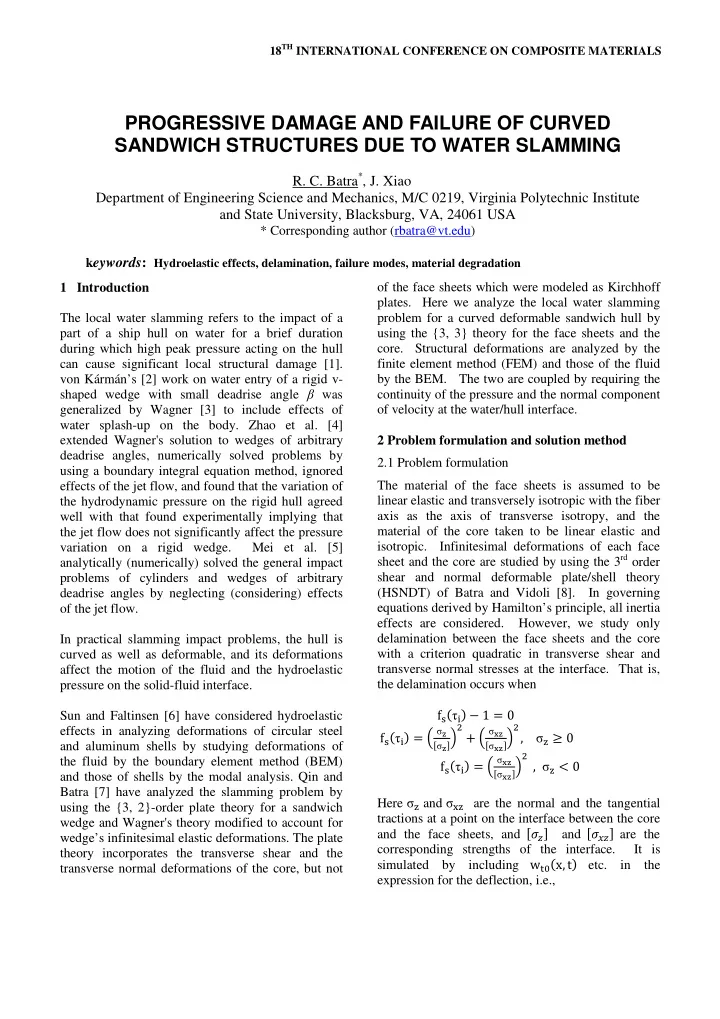
sheet and the core are studied by using the 3rd order shear and normal deformable plate/shell theory (HSNDT) of Batra and Vidoli [8]. In governing equations derived by Hamilton’s principle, all inertia effects are considered. However, we study only delamination between the face sheets and the core with a criterion quadratic in transverse shear and transverse normal stresses at the interface. That is, the delamination occurs when fs(τi) − 1 = 0 fs(τi) = σz
[σz] 2
+ σxz
[σxz] 2
, σz ≥ 0 fs(τi) = σxz
[σxz] 2
, σz < 0 Here σz and σxz are the normal and the tangential tractions at a point on the interface between the core and the face sheets, and [𝜏𝑨] and [𝜏𝑦𝑨] are the corresponding strengths of the interface. It is simulated by including wt0(x, t) etc. in the expression for the deflection, i.e.,
PROGRESSIVE DAMAGE AND FAILURE OF CURVED SANDWICH STRUCTURES DUE TO WATER SLAMMING
- R. C. Batra*, J. Xiao