SLIDE 1 1
Smart lessons on designing Enterprise level interventions promoting productivity and working conditions in SMEs
SCORE
- 1. What is the issue to be addressed?
Productivity growth has slowed in both developed and developing countries, this poses a big challenge for governments and policymakers as this slowdown hampers economic growth, and consequently employment generation and its implication on access to economic opportunities and productive inclusion. In this context SMEs are of particular relevance as they are one of the largest sources of job-creation in developing countries and as their productivity is considerably below that
- f large enterprises.
- 2. What type of intervention are we talking about?
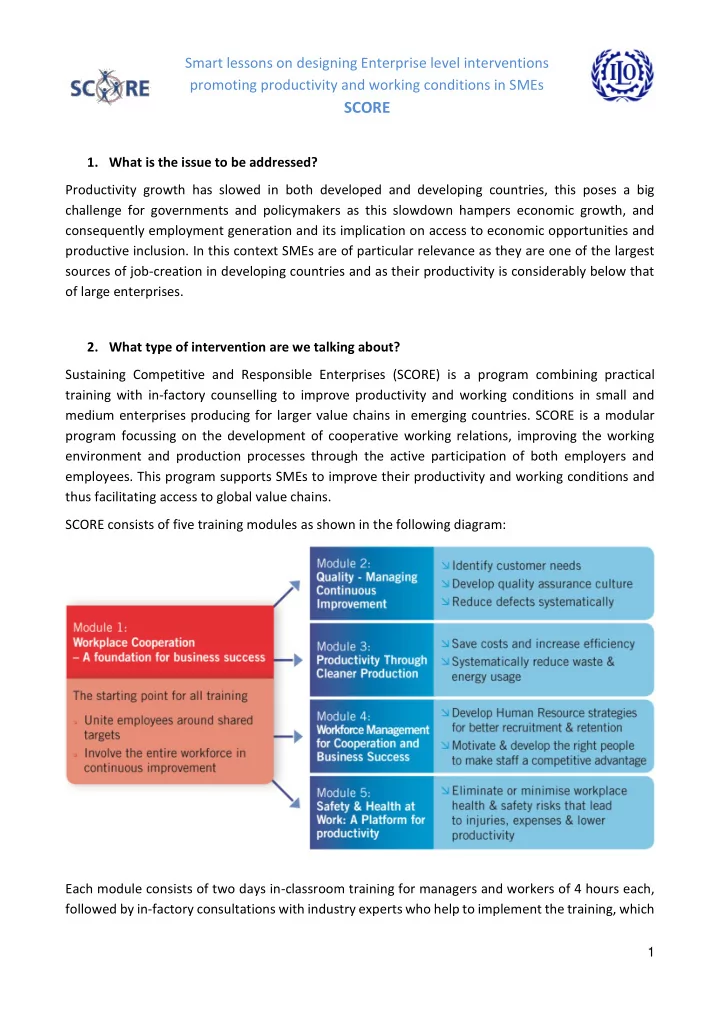
Sustaining Competitive and Responsible Enterprises (SCORE) is a program combining practical training with in-factory counselling to improve productivity and working conditions in small and medium enterprises producing for larger value chains in emerging countries. SCORE is a modular program focussing on the development of cooperative working relations, improving the working environment and production processes through the active participation of both employers and
- employees. This program supports SMEs to improve their productivity and working conditions and
thus facilitating access to global value chains. SCORE consists of five training modules as shown in the following diagram: Each module consists of two days in-classroom training for managers and workers of 4 hours each, followed by in-factory consultations with industry experts who help to implement the training, which
SLIDE 2 2
Smart lessons on designing Enterprise level interventions promoting productivity and working conditions in SMEs
SCORE
varies between 3 to 4 days. On average the cost per SME of implementing one SCORE module is USD 2,5001, though it ranges from USD 1,000 to USD 3,500. The modules are adapted to the needs and requests of the public or private counterparts, including the length of the training itself, as it was done during the implementation of SCORE in Indonesia and Vietnam. Some of the modules heavily rely on tools developed by “Kaizen”2 or “Lean Manufacturing”3. A key aspect of delivering SCORE is the training of local training providers for the replication of the SCORE methodology. Through the implementation of Training of Trainers (ToT) local trainers/BDS providers are transferred the SCORE methodology to in turn train other small and medium enterprises (Training of Entrepreneurs ToE). The following diagram describes the 5 steps of the SCORE’s implementation strategy. SCORE’s implementation strategy In Africa, Latin America and Asia, SCORE training has been delivered to over 800 SMEs that employ more than 200,000 workers. At the global level 60% of enterprises trained report costs savings due to SCORE, 79% report reductions in defects (by 29% on average), 61% report reduction in absenteeism (by 22% on average), and 67% report reduction in labour turn-over (by 42% on average). Moreover, most participating factories report improvement in the morale among employees, key to increasing employee engagement.
- 3. Successes and lessons for sustainability
The following factors and lessons have been identified as crucial for SCORE to continue responding to the needs and characteristics of SMEs in diverse geographical and institutional contexts, as well as for scaling up and ensuring its sustainability.
1 These costs refer to trainers’ fees for the implementation of the modules and exclude other additional costs such as
marketing, management and logistic arrangement for the training of trainers. The overall costs varies according to factors such as sector, size, country, number of modules and geographic location of the enterprise, among others. 2 Kaizen (Japanese for continuous improvement) is a practice in which employees at all levels work together to achieve regular and continuous improvements in manufacturing and administrative processes in the company/enterprise. 3 Lean manufacturing is a systematic method for the elimination of waste within a manufacturing, distribution and customer services processes. It is also referred as lean production.
SLIDE 3
3
Smart lessons on designing Enterprise level interventions promoting productivity and working conditions in SMEs
SCORE
Sectorial/cluster approach: For the implementation of the program in different countries, the program has worked through a sectorial/cluster approach, i.e. through industry associations and local training institutions in specific sectors or geographic areas. This has proven successful as it has: i) reduced costs in implementation by reaching SMEs in specific sectors and/or SMEs geographically near each other, allowing to reach a large share of SMEs; ii) reduced costs related to the program adaptation; and iii) increased dissemination of information on SCORE products across the sector/cluster by word-of-mouth. For example, in Vietnam and India, SCORE targeted specific sectors within geographic clusters. In Vietnam, the wood furniture manufacturing sector around Ho Chi Minh City was targeted (80 enterprises). While in India, the programme targeted the light metal and machine industry sectors in Chenai (50 enterprises). Cooperation with local sector industry associations helped to ensure that qualified and motivated firms were selected. In both countries, these targeted interventions helped to control costs and deliver positive results. In contrast, where sectors have not been targeted SCORE interventions have been more expensive to deliver and firm selection was often more challenging. In one country, government agencies suggested inappropriate firms and multiple sectors. Hence, many firms were not able to complete training due to poor selection and lack of motivation. Linkages to institutional frameworks and public policy: To scale up the program and ensure sustainability, the SCORE team identified the need to work hand in hand with governments and regional productivity institutions in order to embed SCORE into the national policy frameworks such as productivity policies, national development plans or policies to strengthen SMEs. Experiences of this type have been observed in Vietnam and Indonesia, where SCORE has been adopted as part of internal strategies of both the Ho Chi Minh City Chamber of Commerce and the Indonesian Ministry of Manpower. Embeddedness in public policy allows for better linkages between the micro (implementation of SCORE in SMEs) and the macro framework (policy) aimed at improving productivity and working conditions at the national level and/or sub-regional level, strengthening coherence, pertinence, scale and increasing its sustainability in the long run. However this also means that funds have to be available for the implementation of the programme, with the exception of Colombia and Indonesia, specific budget allocations by the SCORE partner institutions have been a challenge. Embedding the SCORE methodology in wider policy frameworks is a persistent challenge that requires the program to implement a strategy to engage policy makers through knowledge sharing, advocacy and the development of capacities to adapt and implement SCORE to local contexts without compromising quality and the main structure of the program.
SLIDE 4 4
Smart lessons on designing Enterprise level interventions promoting productivity and working conditions in SMEs
SCORE
Financial sustainability: SCOREs complexity, capacity to adapt to different typologies of SMEs and the “solid engineering” required to efficiently run the program at high quality standards, naturally implies relatively higher cost for its implementation. As mentioned above, the full cost for a single module for a single SME is on average USD 2,500, being USD 3,500 the maximum amount that has been paid by a single enterprise (in China). In general a purely market oriented approach (i.e. SMEs paying 100% of the cost of the program) does not work in these types of programs, even in industrialised countries, mainly because of the following reasons: i) SMEs lack the technical knowledge to assess their own needs, while at the same time, often BDS providers offer services that not necessarily respond to SMEs’ needs; ii) there is a lack of BDS providers with the technical capacity and knowledge to deliver the program; iii) enterprises’ staff that have been trained through the program can be poached by other enterprises, making investment risky and iv) the fact that even if SMEs do not pay for this service, they could access the knowledge through other SMEs in the same sector or region (non-excludability of the service) and hence eliminating the business-case for private providers to access this market. These factors constitute what is defined as market-failures in the provision of BDS to this segment of businesses. Therefore the need for a mixed-funding strategy, either through co-funding by donors, governments or private
- rganisations such as lead buyers, i.e. large international companies to which SMEs provide goods
and services. However, it is fundamental to find ways for SMEs to bear a proportion of the cost, such as through price-setting mechanism, allowing for: i) greater filtering of SMEs committed to the program, ii) developing co-responsibility among SME beneficiaries to the program, and iii) avoiding transferring the whole cost on the co-sponsor (i.e. government, donor, or private association). Experience shows that maximum contribution that can be expected from participants is 50% of the cost, although currently SCORE is obtaining on average 30% across the eight countries where the programme is present. Challenges in measuring and reporting results: SCORE is a flexible program that works with and adapts to different types of SMEs and country contexts. The uniqueness of each SME in terms of size, sector and potential for production, as well as the different country contexts (legal, policy, capacity etc.) in which the program is implemented, results in challenges to standardise the
- peration of the program. This results in challenges in measuring and reporting results. SCORE
relies on an ample battery of indicators (table 1). These indicators are not equally relevant to all firms given the variety of type of SMEs as well as their sectors, resulting in challenges in reporting and its comparability.
SLIDE 5 5
Smart lessons on designing Enterprise level interventions promoting productivity and working conditions in SMEs
SCORE
Table 1. SCORE Enterprise level- Indicators SCORE Enterprise level- Indicators Number of EIT (enterprise improvement team) meetings held Number of EIP (enterprise improvement projects) completed Number of gender-sensitive practices Number of employee suggestions received Number of grievances received Defect Rate (%) Energy usage per production unit (KwH) Absenteeism (%) Labor Turn-over (%) Number of accidents logged Average wage per employee (in national currency) Estimated cost-saving due to SCORE training (in national currency)
Depending on the sector, some indicators are more relevant than others and easier to quantify. For instance garments and automobile-part manufacturing can more easily count defects, and calculate on-time delivery rate per product, whereas in sectors such as tourism this is difficult to
- measure. Absenteeism, labour turnover and accidents depend heavily on the country’s labour
market context, e.g. how the contract and labour situation is in the country/enterprise, what constitutes an accident? How is absenteeism and labour turnover counted in the case of casual/temporary workers? Moreover the presentation of data encounters difficulties, such as for instance the average percentage rates which can be heavily skewed by a few factories with small actual figures but large percentage changes. Finally, as in other similar programs these indicators are self-reported by firms, this at times constitute a challenge in itself as many companies do not have the results tracking culture or lack understanding of the indicators.