SLIDE 1
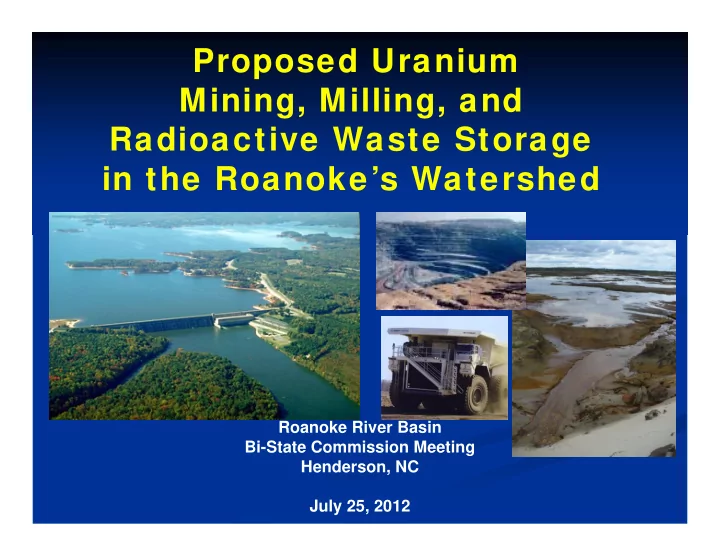
Proposed Uranium Mining, Milling, and Radioactive Waste Storage in the Roanoke’s Watershed
Roanoke River Basin Bi-State Commission Meeting Henderson, NC July 25, 2012
SLIDE 2
Roanoke River Basin Map
SLIDE 3
Downstream Water Intakes in Virginia
SLIDE 4
Downstream Water Intakes in North Carolina
SLIDE 5 Water Users Downstream of Coles Hill
VA Communities 76,121 residents NC Communities 344,638 residents Virginia Beach 770,000 residents
TOTAL: 1,190,759 residents
ADDITIONALLY: Raleigh, NC 403,892 residents* KLRWS Service Area in NC** 68,000 residents**
- *Raleigh, NC has requested an allocation from Kerr Reservoir
- **Based on 2008 estimates and does not include all service area
SLIDE 6 National Academy of Sciences Report, pages 124-25: The US Environmental Protection Agency Nov. 10, 2011 model, based on a site in Culpeper, VA ESTIMATES: The maximum estimated population’s dose living within 80 kilometers (50 miles) of the site was 200 person/rem/year, with a 1.4 per 1,000 chances of developing a latent cancer fatality. Did not address cancer risks for children, pregnant women unborn children, people with prior exposure and/or hereditary risks.
http://www.epa.gov/rpdweb00/docs/n eshaps/subpart-w/historical- rulemakings/subpart-w-risk.pdf
SLIDE 7
RRBA Research
RRBA has been the lead agency in the basin
for almost 67 year.
Our mission is to protect the natural resource
and support its wise development
RRBA has been researching implications of
lifting VA’s 30-year uranium ban on water quality and quantity in the basin
7 studies at a cost totaling $2.8 million The common denominator – risks are high and
consequences are unpredictable mainly due to VA’s climate
SLIDE 8
SLIDE 9
Tornado Cloud 5 miles from Coles Hill April 2011
SLIDE 10
SLIDE 11
Tropical Storm Lee, August 2011 Northern VA
SLIDE 12
Franklin County, VA Spring 2012
SLIDE 13
SLIDE 14 Coles Hill Project : Facts
Coles Hill Preliminary Economic Assessment (PEA), dated Dec. 2, 2010 filed with Canadian Securities Administrators, www.sedar.com
Coles Hill Project will produce 46 million lbs of yellowcake. VUI PEA,
First 20 years: estimated production 37 million lbs, VUI PEA, p. 109, Table 107
Last 15 years: ONLY 9 million lbs to be produce with 30% increase in costs of production
US EIA projects that US nuclear power plants will need app. 55 million lbs of yellowcake per year for the next 15 years
46 million lbs over the 35-year lifetime of the proposed mine and mill will meet only 10 months of US annual demand
SLIDE 15 Coles Hill Project: Questions
Walt Coles, Jr., CEO, Virginia Energy Resources, Inc., March 1, 2011:
for years '21 through '35, this is in here to show a commitment to the community that we're going to have a long mine life on this project. From an MPV perspective, the cost of mining and the profits that you would earn in years '21 through '35, it's insignificant. Once you get that far out in the future, it does not have an impact on MPV, but we wanted to, again, demonstrate that this is going to be a long life mining project.
Transcript of March 1, 2011 Webcast of Virginia Energy Resource, Inc. Presentation, p. 6 available for fee from Wall Street Energy Forum, http://www.analyst-conference.com/
SLIDE 16 Moran Report
In August 2011, RRBA commissioned Dr. Robert Moran, PhD, to perform a site-specific evaluation of the Coles Hill site
- Dr. Moran has 40 years of related experience at hundreds of mining,
natural resource, and industrial sites
The Moran Report focuses on water-related, technical issues.
The report findings are based on review of the original data and reports (1979 to 1984), and the recent, publicly-available, company documents (2007-2010), as well as Dr. Moran’s involvement in 1983 as a hydrogeological and water quality consultant to Marline and Union Carbide on many of the water-related activities at Coles Hill.
The objective of the Moran Report is to assist the public and regulators in making better-informed, long-term decisions, not to tell them what should be done.
SLIDE 17 Moran Report: Site Characteristics
Unlike most U.S. uranium mining sites, which occur in desert or semi- desert, sparsely-populated regions, the Coles Hill site is wet, with annual precipitation equal to about 42 inches.
Within a radius of 2 to 3 miles, Coles Hill has roughly 250 private wells, at least one dairy and numerous hay / forage fields
Over 1268 people reside within a 3-mile radius of the site.
3 “Class A” FEMA Flood Hazard Zones” -- a 1% annual chance of flooding and a 26% chance of flooding over a 30-year period.
Flood zones are contiguous with Mill and Whitehorn Creeks and the Banister River.
Springs and several acres of wetlands located within the bounds of the Coles Hill South Exploration Area.
SLIDE 18
Coles Hill Project Location, VUI PEA, p. 1
SLIDE 19
Sping on Coles Hill Site off South Meadows Road, page 7
SLIDE 20
South Meadows Road bordering the Coles Hill site, page 7
SLIDE 21
Flooding at Coles Hill. Year 2009
SLIDE 22
Flooding at Coles Hill. Year 1996
SLIDE 23 Moran Report: Wastes
Mining Waste/Waste Rock: contains uranium concentrations too low to be economically processed. Often discarded in huge piles, somewhere
- n the land surface, often near the pit perimeter.
When exposed air, explosive chemicals, other gases and bacteria, mineralized rocks chemically-react with the local waters forming in some cases acidic waters.
Several sources of mine rock release contaminants into the environment: the walls of the open pit, walls of the underground workings, waste rock piles, and road cuts.
The confirmed presence of sulfides in the Coles Hill rock raises the possibility that long-term, active water treatment may be required, in perpetuity.
SLIDE 24 Moran Report: Uranium Mill Tailings
The project as proposed may generate at least 28 million tons of solid uranium mill tailings and roughly the same amount of liquid waste
The solid wastes would remain on site forever, requiring maintenance forever
Uranium mill tailings would contain radionuclides, heavy metals and
The Coles Hill Preliminary Economic Assessment states that the Coles Hill site will host eight (8) “surface impoundments” up to 40 acres each that will hold over 19 million tons of solid waste, not including liquids
NRC allows above the grade waste storage where:
a ground-water close to the surface or not very well isolated
Too expensive or impractical
SLIDE 25 Source: VA Tech
http://www.research.vt.edu/r esmag/ColesHill/Figure2_low _res.jpeg
SLIDE 26 Moran Report: Water
Undiluted tailings liquids may contain 1160 to 1460 times the existing Safe Drinking Water Act standard for uranium. Undiluted tailings liquids may contain 2300 to 2900 times the allowable uranium concentrations when compared to the short-term Canadian aquatic life guidelines.
Numerous factors (i.e., natural permeability of the rock due to fractures and faults; increased fracturing due to mine blasting; open
- r leaking boreholes and blastholes; high permeability in the nearby
sediments; long-term degradation of tailings liners and other mine structures; and seismic activity) combine to provide long-term pathways for the migration of contaminants into local waters.
The Coles Hill project may use over 2,030 tons of explosive per year, releasing potentially-toxic concentrations of nitrate, ammonia, and
- ther organic compounds into the environment
SLIDE 27 Moran Report: Water
As proposed, the Coles Hill project would require over 5
billion gallons of water. During the start-up period, the project would use at least 525.6 million gallons per year.
It has been estimated that at least 136 million gallons of
ground water (mostly) would flow into the open pit, per
- year. This water would become contaminated with
numerous radioactive and non-radioactive contaminants. To allow mining, this contaminated water must be pumped
- ut of the pit and discharged to some undefined location.
CONCLUSION: Such a project would cause long-term, chronic degradation of water quality and increase water competition in the region.
SLIDE 28 Questions? CONTACT: Olga Kolotushkina Legislative and Regulatory Advisor
202-641-7835