PROSPECTS FOR A STRONG ARMS TRADE TREATY Ben Donaldson 27.10.2012 - - PDF document

prospects for a strong arms trade treaty ben donaldson 27
SMART_READER_LITE
LIVE PREVIEW

PROSPECTS FOR A STRONG ARMS TRADE TREATY Ben Donaldson 27.10.2012 - - PDF document

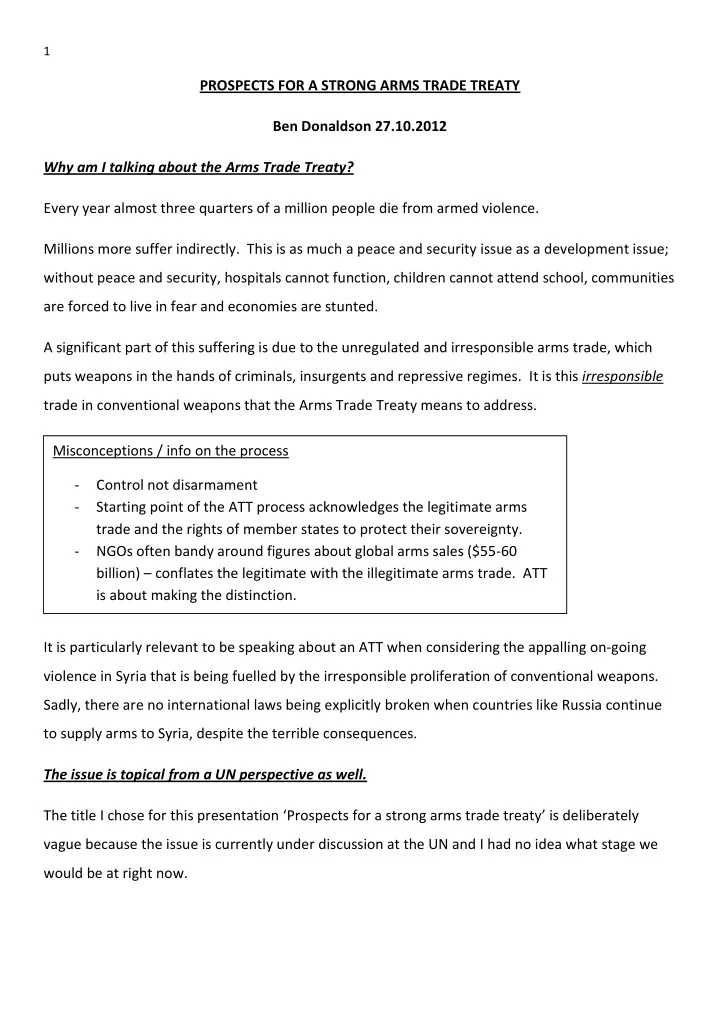
1 PROSPECTS FOR A STRONG ARMS TRADE TREATY Ben Donaldson 27.10.2012 Why am I talking about the Arms Trade Treaty? Every year almost three quarters of a million people die from armed violence. Millions more suffer indirectly. This is as much a


slide-1
SLIDE 1

1

PROSPECTS FOR A STRONG ARMS TRADE TREATY Ben Donaldson 27.10.2012 Why am I talking about the Arms Trade Treaty? Every year almost three quarters of a million people die from armed violence. Millions more suffer indirectly. This is as much a peace and security issue as a development issue; without peace and security, hospitals cannot function, children cannot attend school, communities are forced to live in fear and economies are stunted. A significant part of this suffering is due to the unregulated and irresponsible arms trade, which puts weapons in the hands of criminals, insurgents and repressive regimes. It is this irresponsible trade in conventional weapons that the Arms Trade Treaty means to address. It is particularly relevant to be speaking about an ATT when considering the appalling on-going violence in Syria that is being fuelled by the irresponsible proliferation of conventional weapons. Sadly, there are no international laws being explicitly broken when countries like Russia continue to supply arms to Syria, despite the terrible consequences. The issue is topical from a UN perspective as well. The title I chose for this presentation ‘Prospects for a strong arms trade treaty’ is deliberately vague because the issue is currently under discussion at the UN and I had no idea what stage we would be at right now. Misconceptions / info on the process

  • Control not disarmament
  • Starting point of the ATT process acknowledges the legitimate arms

trade and the rights of member states to protect their sovereignty.

  • NGOs often bandy around figures about global arms sales ($55-60

billion) – conflates the legitimate with the illegitimate arms trade. ATT is about making the distinction.

  • Currently NO international law governing sale of arms.
slide-2
SLIDE 2

2

We are currently at a real crossroads… over the next 2 weeks:

  • important decisions on the course of the arms trade treaty will be determined in the

first committee of the UN General Assembly

  • the US elections will take place, confirming whether we have a Republican or a

Democrat administration in the Whitehouse. We came close to getting an ATT at the UN Diplomatic Conference that took place in July 2012. This conference did not end up adopting a treaty, however... The creation of an ATT in the near future looks inevitable. The real debate is surrounds the shape

  • f the treaty and which states will sign up to it.

The presentation is split into three parts; firstly I will define and examine the significance of a strong ATT; secondly I will explain how the process has led us to where we are now, and lastly I will examine the prospects for a strong ATT moving forwards. A strong Arms Trade Treaty would:

  • cover the widest possible range of weapons, parts and components, including ammunition
  • apply to existing exports and defence contracts
  • stop arms being sold where there is a risk that they will be used in breach of international

humanitarian law (e.g. Syria)

  • prevent the diversion of arms to conflict zones, as has occurred in Somalia and Darfur, for

example

  • Given the impracticability of enforcement by an international body, the ATT must require

signatory states to build in strong and binding provisions on transparency and reporting. Crucial for national scrutiny + for parliaments and civil society to monitor implementation. What practical difference would a strong arms trade treaty make?

  • As mentioned above, states are currently able to supply arms to repressive regimes with
  • impunity. Whether or not the existence of a treaty would actually stop all irresponsible

transfers is a different matter, but recognising these practices as unacceptable in international law is an important first step.

slide-3
SLIDE 3

3

  • By requiring transparent export/import licences for all transfers of conventional weapons

and ammunition, it could halt spread of arms into conflict zones such as Somalia

  • By forcing member states to publish details of all arms transfers, it gives parliaments and

civil society a tool to hold their governments to account.

  • A strong ATT would make it much harder for arms smugglers to operate. Currently the

unregulated trade allows for smugglers to empower dictators in war-torn countries by supplying weapons that they could turn on their own people.

  • Earlier this year Russian arms smuggler Viktor Bout was found guilty of smuggling

weapons to some of the world's most treacherous areas, including Rwanda, Angola and the Congo

  • Was able to evade conviction for a long time because of a lack of regulation.
  • If ammunition was properly controlled, we would hope to see a reduction in the flow of

ammo into, for example, African conflict zones that are awash with AK 47s (more than 70m in the world causing a huge proportion of the world’s suffering).

  • Would require states to consider human rights implications of all transfers and justify their

positions. How did we get to this stage: on the cusp of a historical international treaty being agreed? It has been a long process. It took years of campaigning by NGOs including UNA-UK before the UN General Assembly voted with an overwhelming majority in 2006 to start work on a treaty to regulate the arms trade. (This was a new thing, we’d previously had other UN processes like the Programme of Action on Small and Light Weapons, with a limited focus, but never discussions about all forms of conventional weaponry, from guns, bullets, artillery to tanks, combat vehicles, combat aircraft, warships and missile systems) After 6 years of work, the process culminated last July with a Diplomatic Conference participated by all member states of the UN. In BKM’s words, the conference set out to “agree a robust, effective and legally binding arms trade treaty”. On the final morning of negotiations, agreement looked plausible, until the United States (followed by a handful of others, including Russia) derailed the process by asking for more time.

slide-4
SLIDE 4

4

These few states were able scupper the process because agreement depended on consensus – a much-criticised element of the ATT process. Despite the disappointing outcome of July’s conference, the vast majority of states were in favour

  • f adopting a strong treaty. And, as recent developments in the General Assembly suggest, the

adoption of an arms trade treaty in the fairly short term seems inevitable. Why did the July Conference end without agreement? The US delegation stated that they had no “core” objections to the draft text which had indeed been significantly weakened to meet their red lines. So why did the delaying tactics? The inability of states to agree a treaty at the July conference was widely reported as a failure. Yet closer scrutiny of the draft text on the verge of being signed you might start to view it instead as a narrow escape. In the quest for consensus, many provisions had been weakened so significantly that the treaty under discussion is a far cry from the robust and effective mechanism that the vast majority of member states and NGOs had hoped for. Let’s take a closer look at the draft text on the table at the end of the July conference since it will be used as a basis for future negotiations As it stands, there are three key weaknesses contained that need to be strengthened before adoption the treaty can be called ‘strong’:

  • US elections fast approaching, Obama loath to make any major international

commitment, especially one arousing strong, albeit ill-founded, objections from the country’s pro-gun lobby which has erroneously linked the ATT to both domestic gun use and disarmament.

  • agreement on a text – whether or not the US actually signs up to it – will be used by the

Republicans

  • US has diffused this tension by deferring any decision-making
  • US not alone in delaying negotiations (also Russia, Venezuela, Cuba and North Korea)
  • Gun sales to go up if Obama re-elected because of misplaced fear of gun control.

Perhaps gun retailers should be supporting Obama(!)

slide-5
SLIDE 5

5

  • 1. Scope. The draft does not provide for adequate regulation of ammunition or the export of

weapons in part or component form. It also exempts existing defence contracts (or defence corporation agreements as it calls them)

  • 2. Transparency. An effective treaty must include strong, binding provisions on transparency

and reporting, so that parliaments around the world can help scrutinise implementation.

  • 3. Perhaps most worrying of all, the provisions relating to preventing transfers from falling

into the hands of human rights abusers are so weak that some believe it would take an imminent genocide (with evidence to prove it), before they are activated. Had this watered-down ATT been adopted, we would now be dealing with the consequences of a lowest common denominator treaty unlikely to bring about the improvements we all desire. Every month that passes without a properly regulated arms trade is another month in which tyrants and criminals can acquire and abuse weapons with impunity. But given that it took decades to build the momentum and political will necessary for the ATT negotiations, there is no telling how long it would take to reopen discussions to improve an ineffective treaty. From this perspective, some positives can be drawn from the inconclusive July negotiations as it now gives the international community another chance to achieve a strong arms trade treaty. Which takes us up to the present Just last week, the UK along with Argentina, Australia, Costa Rica, Finland, Japan, Kenya, submitted a draft resolution at the GA’s first committee, calling for a further Diplomatic Conference on the Arms Trade Treaty to be held in March 2013. Significantly, the proposed title of the conference is the FINAL United Nations Conference on the Arms Trade Treaty, making it clear that those supporting the resolution are committed to finishing the job, rather than allow for an open-ended approach that could end with further postponement. Looking forward, there are two (possibly three) plausible scenarios here on in SCENARIO 1: Anticipated March conference (also consensus bound) agrees on a global treaty. SCENARIO 2: Anticipated March conference (also consensus bound) ends without agreement and treaty goes to a vote at the 68th Session of the GA.

slide-6
SLIDE 6

6

POSSIBLE SCENARIO 3: Anticipated March conference ends without agreement and treaty does not go to a vote at the GA. SCENARIO 1: Anticipated March conference (also consensus bound) agrees on a global treaty: Possible positives outcome from this route

  • If obstructive states yield some ground it could produce a new global baseline for

arms controls

  • Would be agreed by all arms exporters and all regimes (inc those with the worst

human rights records) Possible negative outcomes from this route

  • Unlikely to include ammunition
  • Unlikely to include legally binding provisions on reporting and transparency
  • Is likely to exempt existing defence contracts
  • Is likely to have weak provisions to prevent transfers where risk of human rights

abuse exists Prospects of getting a strong treaty from this route are unlikely, but if obstructive states give ground then a new global standard could be set. …however… It is entirely plausible that the conference will end without agreement

  • March conference based on consensus so every state effectively wields a veto

Letter from Alistair Burt MP (Minister for Counter Proliferation) dated 19 Oct to Sir Jeremy Greenstock, stated that the UK government favours this scenario and is hopeful that ‘with a small amount of additional work we can make the text more coherent and effective’. Good that the UK intend to take a strengthened text to the March conference. Arms Export Control Sub-Committee: Minister Burt and Jo Adamson (Head of Delegation), hopeful that consensus rule can be used to UK’s advantage – using the weight of the sentiments of the vast majority to get those obstructive states to yield some ground.

slide-7
SLIDE 7

7

  • One disgruntled state could derail negotiations
  • Republican administration in Whitehouse
  • difficult to weigh up all these variables

SCENARIO 2: If the March conference ends without disagreement and the treaty goes to a vote at the 68th session of the GA At the GA discussions need not be constricted by consensus and the weight of the vast majority of states that want to secure a strong treaty would be felt. This scenario is likely to produce a robust treaty but would give the chance for those states that abuse human rights to opt out. However, it could collect more signatures over time. What determines if this scenario plays out and the treaty will go to a vote at the next session of the GA? The UK and the 6 states mentioned earlier who are proposing the March conference, have included a clause in the draft resolution requesting the ATT to be listed on the draft agenda for the 68th session of the GA. This is significant. It seems to me that by doing this they are trying to ensure sufficient attention and time will be reserved at next year’s GA to take a strengthened version of the ATT to a vote. SCENARIO 3: Anticipated March conference ends without agreement and treaty does not go to a vote at the GA The examples of the Oslo Process on Cluster Munitions and Ottawa Process on Landmines could be followed and negotiations could be re-established between a coalition of the willing outside of the UN system. Those states that have long championed a robust ATT desperate for the process not to drag

  • n indefinitely…
  • …will be taking a cautionary glance at the UN negotiations on a Fissile Material Cut-
  • ff Treaty - hamstrung since 1996 by a lack of consensus
  • Trying to bill the March conference as ‘Final Conference’
  • Trying to ensure a vote at the GA next year
slide-8
SLIDE 8

8

Negatives:

  • As with a majority vote in the UN, states with bad human rights records would be able to
  • pt out.
  • A messy dual-track situation could come about where some states may continue down the

UN route whilst others discuss the matter outside the UN.

  • New rules of procedure would have to be devised and agreed on before negotiations could

take place. Positives

  • Would enable a strong treaty to be established without being subject to delays
  • Has proved to be effective in the past, with treaties collecting more signatures over time.

VERY DIFFICULT TO SPECULATE WHICH OF THESE THREE SCENARIOS WILL PLAY OUT. If I was pushed, I would suggest that we will get agreement at a March conference but it will be a text that is weaker than we have been aiming for. If no agreement reached in March, I would expect to see a UNGA vote. By 6 Nov, we will know the results of the US election and also know more about the March conference. What has UNA-UK been doing to campaign for a strong ATT? To try and ensure the UK Government, with all their sway as a permanent member of the security council, builds as much support as possible for a strong and robust ATT, UNA-UK has been:

  • Holding events in parliament to get parliamentarians on side
  • UNA Youth campaigning on this issue in universities across the country
  • Worked with London embassies of member states who have been broadly onside but

needed sureing up (Brazil, Mexico, SA, Nigeria)

  • Linking with UNAs to try and get them to lobby their governments
  • Working with partners Oxfam, Amnesty, Saferworld to raise awareness
slide-9
SLIDE 9

9

  • Trying to get as much coverage as possible in the media
  • UNA-UK and Sir Jeremy Greenstock working closely with FCO on the issue
  • Encouraging branch members to write to their MPs to make sure this issue is high on their

agenda

  • Check our website for all the details (www.una.org.uk)

To conclude The creation of a robust treaty without the weaknesses that we’ve discussed is not the ambition of NGOs and activists; it is the preferred outcome for the vast majority of UN Member States. A weak treaty risks institutionalising an unacceptably low regulatory standard for arms transfers and could be used to legitimise irresponsible arms transfers thereby giving legal protection to those selling weapons that fuel conflict and instability. While a treaty with broad participation is, of course, desirable, myself, and UNA-UK strongly feels that a robust treaty – even if not all states are willing to sign it in the short term – will prove far more effective in the long run than a universal treaty that states subscribe to but can subsequently ignore. THANKS FOR LISTENING If you want to keep up with the latest developments on the ATT then checkout:

  • UNA-UK’s website (www.una.org.uk) / twitter
  • Control Arms Coalition (www.controlarms.org)
  • Reaching Critical Will (Initiative from Womens International League for Peace and Freedom

– www.reachingcriticalwill.org)