
SLIDE 1
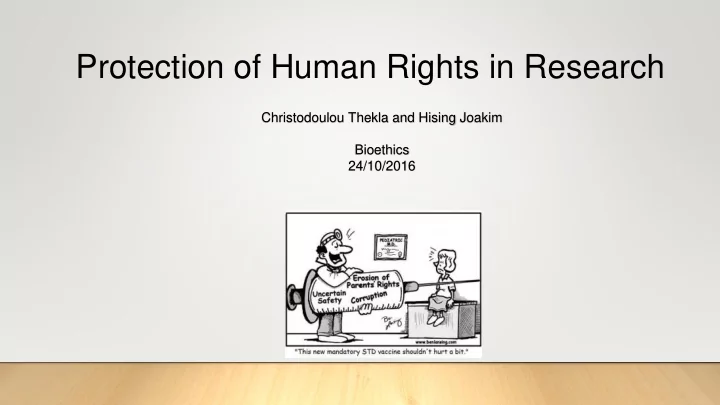
Protection of Human Rights in Research
Christodoulou Thekla and Hising Joakim Bioethics 24/10/2016
Protection of Human Rights in Research Christodoulou Thekla and - - PowerPoint PPT Presentation
Protection of Human Rights in Research Christodoulou Thekla and Hising Joakim Bioethics 24/10/2016 Overview What do we mean by protection and what do we protect? Historical background Ethical conflicts within known cases
Christodoulou Thekla and Hising Joakim Bioethics 24/10/2016
What do we mean by ”protection” and what do we protect? Historical background Ethical conflicts within known cases Discussion points
Chart flow for History of events:
1939-1945
1946
during WWII were tried separately from other war criminals because of their professional status as physicians and the horrendous and unique nature of their crimes. They were found guilty of “crimes against humanity”. 1947
research atrocities performed on Prisoners of war. This resulted in the Nuremberg Code, the first internationally recognized code of research ethics, issued by the Nazi War Crimes Tribunal.
Nazi Medical War Crimes (1939-1945)
forcing people to ingest poisons
A victim of a Nazi medical experiment is immersed in icy water at the Dachau concentration camp. SS doctor Sigmund Rascher
the experiment. Germany, 1942. Nazi physician Carl Clauberg (at left), who performed medical experiments on prisoners in Block 10 of the Auschwitz
Unethical and gruesome experiments
Survival of Axis alliance military personnel:
experiments
Development and testing of pharmaceuticals for German military/soldiers in the field:
experiments
experiments
Advance racial and ideological beliefs of the Nazi worldview:
experiments
Nuremberg code (1947): First modern ethical code
Free power of choice and sufficient knowledge of the research
Voluntary informed consent Likelihood of some good resulting Scientific Studies Animal model experimentation Based on prior research Unnecessary injury and suffering Avoidance of physical or psychological harm Humanitarian importance above anything else Benefits should
Proper experience of researcher Qualified investigators Freedom of liberty Right to withdraw consent Research must stop if harm is resulting Termination of studies
Newspaper of The New York Times, October 19, 1945, indicating the beginning of Nuremberg trials
Chart flow for History of events:
1932- 1972
1944- 1974
determine the effects of exposure to ionizing radiation on human health or to calibrate instruments designed to detect radiation. 1946- 1956
state school, Massachusetts: 19 boys who thought they were participating in a science club were fed radioactive milk by researchers who wanted to learn about the digestive system. 1963
human immune system’s response to cancer.
Jewish Chronic Disease Hospital study (1963)
process
various chronic diseases
forms
Chart flow for History of events:
The Belmont report (1979)
Outcome: Reasonable expectation of success
Outcome: Permits a conclusion to be drawn
(A) Defined boundaries between research and practice
(B) Consists of 3 basic principles
children, pregnant women, prisoners)
(C) Overall emphasis of the principles
Puffenberger et al 2004
Puffenberger et al 2004
Cases for discussion
A) Case poly-pharmaca: A medical doctor has observed good treatment effect in two different drugs and wants to try giving both drugs simultaneously to a group of his patients. However, there is a problem; the two drugs have never been combined before. Do you think the doctor should be allowed to give the drug combination to his patients? B) Modern case: Berlin patient Timothy Ray Brown, long known only as the "Berlin Patient" had HIV for 12 years before he became the first person in the world to be cured of the infection following a stem cell transplant in 2007.