Protein-Protein interactions Reducing the complexity Why are - - PDF document

protein protein interactions
SMART_READER_LITE
LIVE PREVIEW

Protein-Protein interactions Reducing the complexity Why are - - PDF document

12/3/2012 Protein-Protein interactions Reducing the complexity Why are protein-protein interactions important? Identify proteins in complexes. Identify proteins that are in a metabolic or signaling pathway. Identify members of a


slide-1
SLIDE 1

12/3/2012 1

Protein-Protein interactions

Reducing the complexity

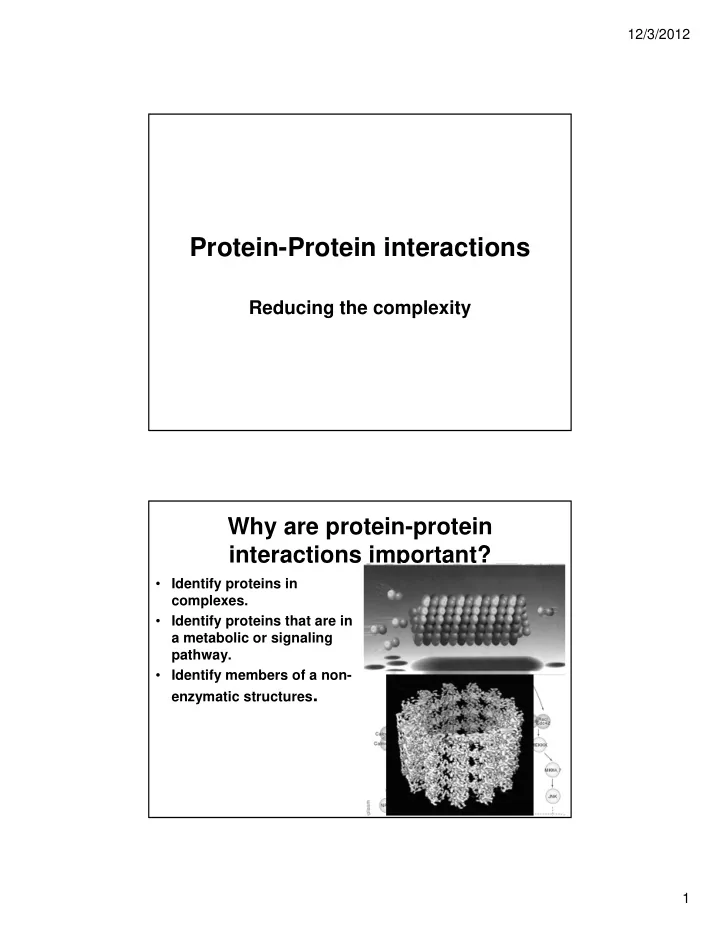
Why are protein-protein interactions important?

  • Identify proteins in

complexes.

  • Identify proteins that are in

a metabolic or signaling pathway.

  • Identify members of a non-

enzymatic structures.

slide-2
SLIDE 2

12/3/2012 2

Protein complexes

  • Protein complexes can be made up of

2-50 identical or different proteins (subunits).

  • Some proteins in complexes may not

have any apparent activity.

  • One protein subunit could have two

activities, one not related to the complex function.

Methods of studying protein- protein interactions.

  • Yeast two hybrid
  • Pull down or co-purification

– (co-immunoprecipitation)

  • Fluorescence Resonance Energy

Transfer (FRET)

slide-3
SLIDE 3

12/3/2012 3

Yeast Two Hybrid Analysis

  • Need a way to identify if two proteins are

near each other.

  • Many transcription promoters are

composed of two domains which can be separated.

– the binding domain – the activator domain

  • http://www.scq.ubc.ca/the-yeast-two-hybrid-assay-an-exercise-in-experimental-

eloquence/

How Does it Work ?

DNA

slide-4
SLIDE 4

12/3/2012 4

How Does it Work?

The process is usually performed with a single bait and it is probed with a genomic library of all the other proteins

Cytosolic and Membrane Proteins

Genome Res. 2003 13: 1744-1753 Cub = c-terminal domain of ubiquitin binding protein NubG = n-terminal domain of ubiquitin binding protein TF = transcription factor

slide-5
SLIDE 5

12/3/2012 5

Genomic scale screening

  • Use yeast mating types and put bait in
  • ne mating type and prey in the other.
  • Mixing methods

– Mix one prey or bait with the whole genome with the other plasmid. – Mix batches of genomic bait and prey molecules.

  • Sequence plasmids from surviving

colonies.

Problems

  • Many false positive and negatives.
  • Fusion structure may affect protein

interactions.

  • Proteins may not express well in yeast.
  • Transient interactions may be missed.
  • Rate of synthesis and degradation

might be rapid.

  • Difficulty with multiple subunit

proteins.

slide-6
SLIDE 6

12/3/2012 6

Co-purification/ Immuno-trapping

  • Based on the principle that interacting

proteins will stay together during purification.

  • Tag protein with antibody or affinity tag
  • Bind tag to column or plate.
  • Remove bound proteins and separate.
  • Sequence by LC/MS/MS.

Affinity tags/columns

– glutathione S-transferase

  • Binds to glutathione coupled

column

  • Removed with glutathione

– hexyl histidine

  • Binds to Ni+ chelating

column

  • Removed by addition of

imidazole

– calmodulin binding protein

  • Binds to calmodulin coupled

column

– protein A

  • Binds to antibody column
  • Removed by denaturation

– maltose binding protein

  • Binds to Maltose coupled

column

  • Removed with maltose

– FLAG

  • Binds to FLAG antibody

column

  • Removed by denaturation

– Strep II tag

  • Binds to Avidin coupled

column

  • Can be removed with

desthiobiotin

slide-7
SLIDE 7

12/3/2012 7

Fluorescence Resonance Energy Transfer

  • When a fluorescent molecule is excited it will emit

light as fluorescence.

  • If a second fluorescent molecule is present that

absorbs in the wavelength range of the emission

  • f the first fluorescent molecule it can absorb the

light and emit the energy at a second wavelength.

  • Alternatively a second molecule can absorb the

fluorescence and not emit the energy as light. This is called quenching.

FRET

  • Processes is highly distance dependent, drops off

by r-6.

– Efficiency of transfer = 1 - D+A/D – Efficiency of transfer = r0

6 /(r0 6 + r6)

– Quantum Yield = D – r0 represents the distance for 50% efficiency

  • The bait protein(s) is (are) tagged with one

fluorescent molecule.

  • The prey protein(s) is (are) tagged with a

complementary fluorescent molecule or quencher.

  • Look for change in fluorescence wavelength or
  • quenching. Should occur only when two proteins

are very close together (connected).

slide-8
SLIDE 8

12/3/2012 8

Donor Acceptor Pairs Used in FRET

Donor Acceptor Ro (Å)

  • Fluorescein

Tetramethylrhodamine 55

  • IAEDANS

Fluorescein 46

  • EDANS

DABCYL 33

  • Fluorescein

QSY-7 dye 61

  • BFP

GFP 35

  • CFP

YFP 50 Ro is the distance at which the efficiency of energy transfer is 50%