
Algorithms & Models of Computation
CS/ECE 374, Fall 2017
Proving Non-regularity
Lecture 6
Thursday, September 14, 2017
Sariel Har-Peled (UIUC) CS374 1 Fall 2017 1 / 22
Regular Languages, DFAs, NFAs
Theorem
Languages accepted by DFAs, NFAs, and regular expressions are the same. Question: Is every language a regular language? No. Each DFA M can be represented as a string over a finite alphabet Σ by appropriate encoding Hence number of regular languages is countably infinite Number of languages is uncountably infinite Hence there must be a non-regular language!
Sariel Har-Peled (UIUC) CS374 2 Fall 2017 2 / 22
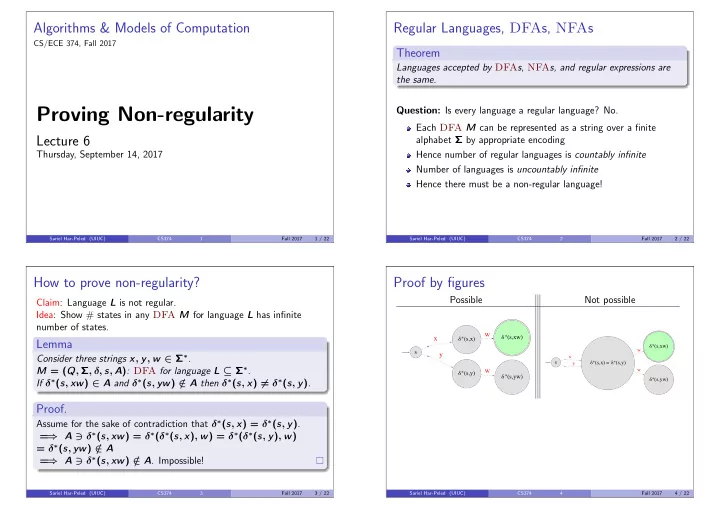
How to prove non-regularity?
Claim: Language L is not regular. Idea: Show # states in any DFA M for language L has infinite number of states.
Lemma
Consider three strings x, y, w ∈ Σ∗. M = (Q, Σ, δ, s, A): DFA for language L ⊆ Σ∗. If δ∗(s, xw) ∈ A and δ∗(s, yw) / ∈ A then δ∗(s, x) = δ∗(s, y).
Proof.
Assume for the sake of contradiction that δ∗(s, x) = δ∗(s, y). = ⇒ A ∋ δ∗(s, xw) = δ∗(δ∗(s, x), w) = δ∗(δ∗(s, y), w) = δ∗(s, yw) / ∈ A = ⇒ A ∋ δ∗(s, xw) / ∈ A. Impossible!
Sariel Har-Peled (UIUC) CS374 3 Fall 2017 3 / 22
Proof by figures
Possible Not possible
s δ*(s,xw) δ*(s,x)
x
δ*(s,y)
y w
δ*(s,yw)
w
s δ*(s,xw) δ*(s,x) = δ*(s,y)
x y w
δ*(s,yw)
w Sariel Har-Peled (UIUC) CS374 4 Fall 2017 4 / 22