PSK4U Abdelnour Sports Injuries PowerPoint Presentations Students - - PDF document

psk4u abdelnour sports injuries powerpoint presentations
SMART_READER_LITE
LIVE PREVIEW

PSK4U Abdelnour Sports Injuries PowerPoint Presentations Students - - PDF document

PSK4U Abdelnour Sports Injuries PowerPoint Presentations Students will create a PowerPoint presentation, while working with a partner. Pairs will focus upon teaching the class about a particular form of injury that have occurred in


slide-1
SLIDE 1

PSK4U – Abdelnour Sports Injuries – PowerPoint Presentations

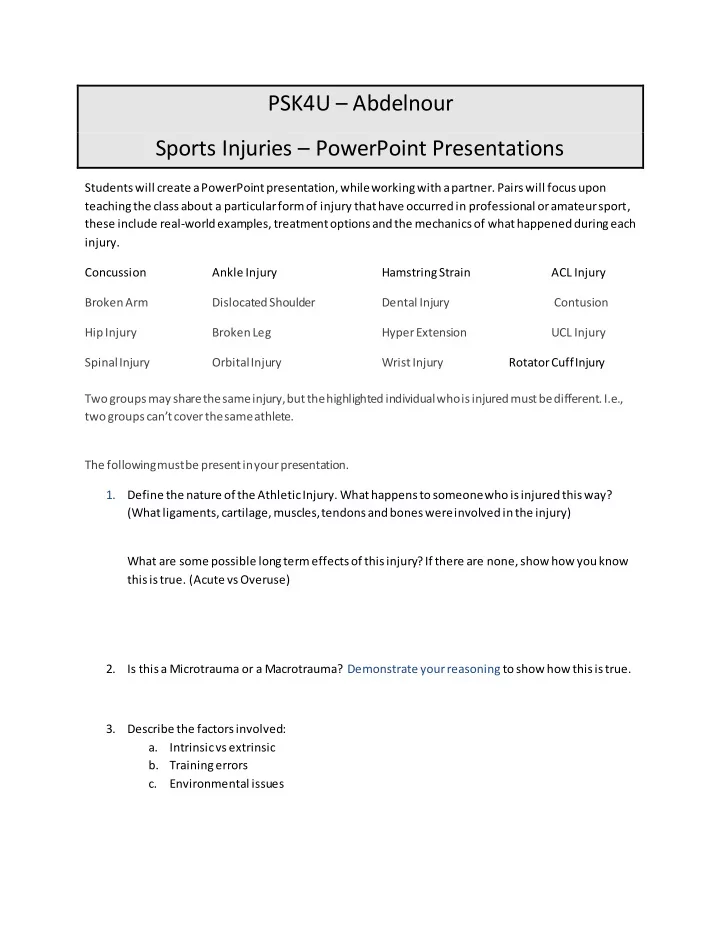
Students will create a PowerPoint presentation, while working with a partner. Pairs will focus upon teaching the class about a particular form of injury that have occurred in professional or amateur sport, these include real-world examples, treatment options and the mechanics of what happened during each injury. Concussion Ankle Injury Hamstring Strain ACL Injury Broken Arm Dislocated Shoulder Dental Injury Contusion Hip Injury Broken Leg Hyper Extension UCL Injury Spinal Injury Orbital Injury Wrist Injury Rotator Cuff Injury Two groups may share the same injury, but the highlighted individual who is injured must be different. I.e., two groups can’t cover the same athlete. The following must be present in your presentation.

  • 1. Define the nature of the Athletic Injury. What happens to someone who is injured this way?

(What ligaments, cartilage, muscles, tendons and bones were involved in the injury) What are some possible long term effects of this injury? If there are none, show how you know this is true. (Acute vs Overuse)

  • 2. Is this a Microtrauma or a Macrotrauma? Demonstrate your reasoning to show how this is true.
  • 3. Describe the factors involved:
  • a. Intrinsic vs extrinsic
  • b. Training errors
  • c. Environmental issues
slide-2
SLIDE 2
  • 4. Types of Injuries
  • a. Strain
  • b. Sprain
  • c. Contusion vs Fracture
  • d. Tear
  • e. Rupture
  • f. Dislocation
  • 5. Classification of Injury – Grades 1, 2, or 3. Show how you know this is true.
  • 6. Create a Treatment and Recovery Plan for the athlete. (Look at methods of rehab (ex. Physio,

athletic therapy, massage, surgery)

  • 7. Find a video or series of still images that show what happened to the athlete or a video that

discusses/explains/diagnoses the injury. During the presentation, explain what happened.

Warning: graphic images will likely be in your future

Family Guy (2000)

References McFarlane, S. (25 July 2000). Family Guy. S02, E20. Fuzzy Door Productions.

slide-3
SLIDE 3

Assessment Criteria Strand Does not meet Level 1 Level 1 Level 2 Level 3 Level 4 Knowledge & Understanding

Required content not covered in this presentation,

  • r was inaccurate or off

topic. Presentation covers content areas with inaccuracies and a lack

  • f thoroughness.

Presentation covers content areas. Inaccurate information is minimal. Presentation covers all required content areas. Covers all required

  • content. Information is

accurate, insightful and shows connection to further learning.

Thinking & Inquiry

Research is not apparent or does not related to the injury. Research shows limited understanding of the injury. Research shows some understanding of the injury. Research shows understanding of the injury Research shows great understanding of the injury and extends research to related issues. Citations not provided. Citations provided but not compliant with APA formatting rules. Citations provided with some adherence to APA formatting rules. Citations provided with attention to APA formatting rules. Diverse and adequate list of sources cited in adherence to APA formatting rules.

Application

No rehabilitation procedure, exercises and method of therapy provided. Created inappropriate rehabilitation procedures, exercises and methods of therapy for the specific injury. Basic knowledge of the rehabilitation process but did not go into specifics about the rehabilitation of that injury. Rehabilitation process for the specific injury includes general exercises and general method(s) of therapy Rehabilitation process for the specific injury includes specific exercises and specific method(s)s of therapy showing a deeper insight for the injury and associated treatment options

Communication

Does not use correct anatomical terminology Rarely uses correct anatomical terminology Sometimes uses correct anatomical terminology Often uses correct anatomical terminology Always or almost always uses correct anatomical terminology PowerPpoint is used in a way that doesn’t clearly present information or address audience PowerPoint is used to present information with limited effectiveness PowerPoint is used to present information with some effectiveness PowerPoint is used to present information effectively PowerPoint is used to present information with great effectiveness and engages audience