Psychiatric Emergency Room/Community Collaboration: Decreasing - - PDF document

psychiatric emergency room community collaboration
SMART_READER_LITE
LIVE PREVIEW

Psychiatric Emergency Room/Community Collaboration: Decreasing - - PDF document

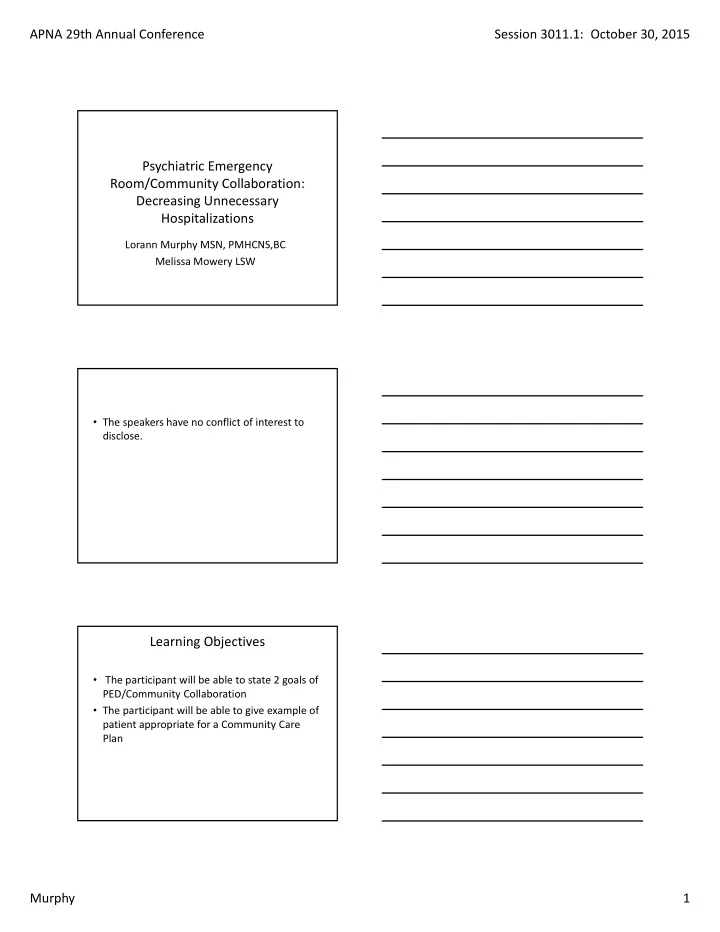
APNA 29th Annual Conference Session 3011.1: October 30, 2015 Psychiatric Emergency Room/Community Collaboration: Decreasing Unnecessary Hospitalizations Lorann Murphy MSN, PMHCNS,BC Melissa Mowery LSW The speakers have no conflict of interest


slide-1
SLIDE 1

APNA 29th Annual Conference Session 3011.1: October 30, 2015 Murphy 1 Psychiatric Emergency Room/Community Collaboration: Decreasing Unnecessary Hospitalizations

Lorann Murphy MSN, PMHCNS,BC Melissa Mowery LSW

  • The speakers have no conflict of interest to

disclose.

Learning Objectives

  • The participant will be able to state 2 goals of

PED/Community Collaboration

  • The participant will be able to give example of

patient appropriate for a Community Care Plan

slide-2
SLIDE 2

APNA 29th Annual Conference Session 3011.1: October 30, 2015 Murphy 2

  • The need for psychiatric inpatient beds has

increased over the past few years.

  • Inpatient units have been filled to capacity

thus increasing the amount of patients in communities waiting for a bed in a medical emergency room

  • Many sub acute patients are admitted due to

inadequate assessment or lack of understanding of psychiatric symptoms.

  • Admission of sub acute and high utilizers

increases the burden on hospitals, emergency rooms and nursing staff.

  • St. Vincent Charity Medical Center Psychiatric

Emergency Department(PED) is Northeast Ohio’s only resource that provides solely emergency psychiatric treatment for individuals in acute mental health crisis.

  • 1 of only 6 PED’s in the country
slide-3
SLIDE 3

APNA 29th Annual Conference Session 3011.1: October 30, 2015 Murphy 3

Services

  • Interdisciplinary assessment
  • Crisis stabilization
  • 23 hour observation
  • Discharge planning
  • Second opinion
  • Referrals
  • Community Care Plans

Crisis Intervention Specialist(CIS)

  • In a joint venture from Frontline Services

community mental health agency and St Vincent Charity hospital

  • Frontline services mobile crisis team member

joined PED in 2011 on a grant from the Sisters

  • f Charity foundation to provide services that

were missing for our patient population.

CIS provides

  • Link patients to outpatient resources in the community
  • Follow up with patient’s providers for continuity of care
  • Provide follow‐up phone calls to ensure that the

patient has engaged with outpatient resources

  • Create referral information for patients for follow‐up

care

  • Develops and monitors individualized services

plans(Community Care Plans)

slide-4
SLIDE 4

APNA 29th Annual Conference Session 3011.1: October 30, 2015 Murphy 4

Goals of the PED/CIS Partnership

  • Reduce average length of time for patients in the

PED

  • Reduce recidivism to PED
  • Improve linkage coordination for those being

discharged from the PED

  • Reduce the number of patients discharged to the

state psychiatric hospital

Patient Disposition

  • 50% of patients discharged to community

agency follow up

  • 1% are sent to crisis stabilization
  • 24% are given CD referral information
  • 25% are admitted

State Hospital Admissions

slide-5
SLIDE 5

APNA 29th Annual Conference Session 3011.1: October 30, 2015 Murphy 5

Community Care Plans

  • Developed for patients who are frequently over

utilizing emergency services

  • The CIS contacts the patient’s provider and family to

request a meeting to discuss the patient’s needs. The patient is also included in these meetings if able.

  • Why is the patient over utilizing emergency services?

What can we do to help the patient remain stable in the community and utilize appropriate services?

  • There were 7 Community Care Plans in 2011
  • There are currently 52 care plans in effect.
  • 70% (36) of the patients with community care

plans have not had visits to the PED in 2015

  • Of the 16 patients who had visits, 8 did not

have plans developed previous to 2015. Since developing their plan, 7 have not returned to the PED.

Community Care Plan Template

Demographic information Diagnosis List of Medication Allergies List of providers involved in plan and contact information Name of Community Agency and contact information

slide-6
SLIDE 6

APNA 29th Annual Conference Session 3011.1: October 30, 2015 Murphy 6

  • Patient's history
  • The proposed plan of care in community
  • The proposed plan of care in the Emergency

Room with follow up.

Example of a Community Care Plan

  • E.M. is a 48 year old male diagnosed with

Schizoaffective Disorder & Traumatic Brain Injury. The patient has been frequenting the PED as well as other facilities in the community in search of food and

  • shelter. The patient is a poor historian and struggled to

make his needs known to staff. The CIS was able to meet with the patient’s provider and put together a Community Care Plan in January 2013. The patient was aware of this plan, as well as the PED staff. After the Coordinated Care Plan was developed, the patient had only 13 visits in 2014. The patient has had only 1 visit thus far in 2015 and has remained stable in the community.”

slide-7
SLIDE 7

APNA 29th Annual Conference Session 3011.1: October 30, 2015 Murphy 7 Results from PED/CIS collaboration.

  • Decreased inappropriate admissions for high

utilizers

  • Allows linkage to appropriate outpatient

services

  • Helps prevent the need for rehospitalization

Questions?