
SLIDE 1 1
Public employee post-employment costs, a slow-motion disaster
October, 2019 John McCauley, CPA (retired), CPCU Mill Valley City Councilmember Larry Chu Larkspur City Councilmember An update to the 2011 MCCMC report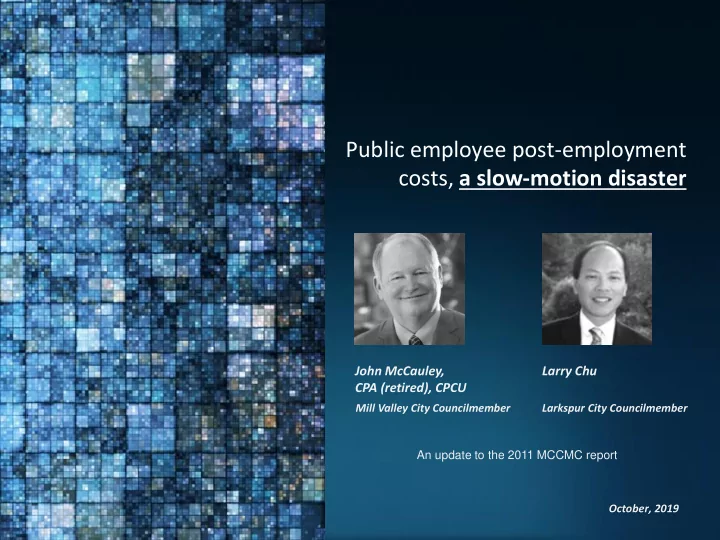
Public employee post-employment costs, a slow-motion disaster John - - PowerPoint PPT Presentation
Public employee post-employment costs, a slow-motion disaster John McCauley, Larry Chu CPA (retired), CPCU Mill Valley City Councilmember Larkspur City Councilmember An update to the 2011 MCCMC report October, 2019 1 Post-employment
Public employee post-employment costs, a slow-motion disaster
October, 2019 John McCauley, CPA (retired), CPCU Mill Valley City Councilmember Larry Chu Larkspur City Councilmember An update to the 2011 MCCMC report Post-employment benefits in Marin
Cities in Marin provide two post-employment benefits to employees A Pension benefit from , or MCERA in San Rafael A City specific “Other Post- Employment Benefits” (OPEB) for medical coverage
Post-employment benefits liabilities overview
Currently total liabilities for Marin Cities exceeds $401M 2019 2018 2002 1990
Stock market was high, pension benefits were expanded retroactively CalPERS assumptions weren’t met, resulting in a large shortfall in accumulated pension plan assets today Market declines in 2002 and 2018 are not the problem, benefit and funding levels are the issues Annualized average returns for the ten years ending 30, 2019: S&P 500: 14.70% Dow Jones: 15.03% Russell 2000: 13.45% Marin cities have a cumulative net pension liability to: CalPERS has finally addressed the problem…
…. by taking the following actions Discount rate being lowered to 7% Increased Mortality Assumptions Asset shortfall is being amortized faster Even if investments
news has to be absorbed first More conservative investment mix Actions substantially raising city’s Actuarially Determined Contribution (ADC), the amount owed to CalPERS by each city
We are now “paying the piper”, so how much is the upcoming bill?
Are these actions enough? A league of California cities study concludes*…
…. that some cities may not be able to support future cost without drastic actions Average California city spent of its General Fund budget on CalPERS pension costs FY 2006–07 8.3% FY 2017–18 11.2% FY 2024–25 15.8%
with 25% of cities spending more than 18%, and 10% anticipated to spend 21.5% or more* Some Marin cities have conducted actuarial studies that reach similar conclusions
CalPERS pension costs almost double8.3% 15.8%
Rising costs will crowd out city’s ability to provide services
What can be done?
? ? ? ? ?
Taxes and fees Benefits # of employees Use existing reserves or borrow to pay higher contributions Services provided to their residents Voter fatigue? California rule prohibits pension changes Small cities with lean staffs Lose needed rainy day funds Infrastructure fails, a long- term solution? Rising costs will crowd out city’s ability to provide services
What should cities do?
Develop a long-range plan Make OPEB obligations more sustainable Be more transparent about benefit costs
1 2 3
Develop a long-range plan
What should cities do?
1 Assume a recession, 12 since 1945 (average every 6 years) Each city’s revenues are different, Property tax and Prop 13, sales tax
Use the plan to address the projected shortfall There are no easy solutions
Develop a long-range plan
What should cities do?
1 Make smaller cuts now, put away some funds for pension costs so later cuts will be less dramatic? How? Choices with impacts explained in report 1. Pay more to CalPERS now 2. Create a 115 trust 3. Designate funds for future pension use
Pursue greater taxes and fees? Make less painful cuts in headcount now? Review the long range plan, have the hard discussions now and include your constituents: Taxpayers, Employees and Decision Makers
Make OPEB obligations more sustainable
What should cities do?
2 Unlike pension costs, cities may have more control over their OPEB obligations The level of benefits varies by city date and cities can do more to compare costs. In addition, those with costly plans vary as to the level of funding to date. Curtailment of this benefit for future employees when legally allowed and for agencies using the CalPERS medical benefit plan only to fund at the legally allowed minimum under the Public Employees’ Medical & Hospital Care Act (PEMHCA) We support all agencies fully funding the ADC for current employees so employees can better count on receiving the benefit when due and costs match services
We support specific disclosure of payroll and benefit costs so that citizens, employees and decision makers can see how tax dollars are spent
Be more transparent about benefit costs
What should cities do?
3
City financial statements are aggregated by function (e.g. Fire, Police, or Library) rather than by costs (e.g. payroll, benefits, and purchases)
How valuable is the pension/ OPEB benefit to our employees?
Given that public salaries and those in private industry are roughly at parity, understanding benefit differences can help inform about the voter fatigue issue.
Among all workers, only 4% have access to DB pension plans where investment risk remains entirely with the employer. Another 13% have access to both a DB pension and a 401K type DC plan. Some of the investment risk shifts to the employee, and the pension element has frequently become a smaller frozen part of the benefit. In Marin, all full‐time public employees enjoy full DB plans with no investment
highlights the risk of voters not supporting additional taxes to fund benefits.
Marin public employees do not generally pay or benefit from S.S.
Some perspective on the value of the pension
The average monthly Social Security payment in January 2019 was $1,461 per month The maximum possible benefit based on an annual salary of $132,900 in 2019 is $2,861 per month. Many citizens have little retirement savings Average 2018 Marin public employee pay is $87,638 per year
A Miscellaneous employee in Marin retiring after 40 years, and a 2.5% benefit factor, and the $87,638 “average” as final annual compensation would get $7,303 pension per month, 3.3 X the SSI benefit of $2,250 A Miscellaneous employee working 40 years with a 2.5% benefit factor and a $132,900 final annual salary, the SSI max, would get a $11,075 pension per month, almost 4X SSI benefit of $2,861
Debate between public sector pensions and private company
Where should the debate be focused? Salary Pension Social Security Difference $87,638 $7303 $2,250 $3.3X $132,900 $11,075 $2,861 $3.8X The debate between public sector pensions and private company post‐employment offerings should focus both on where investment risk lies (DB-DC?) as with the level of benefit offered
Pension costs will almost double over the next few years.
What should cities do?
Develop a long-range plan Make OPEB obligations more sustainable Be more transparent about benefit costs
1 2 3
Q&A