SLIDE 1
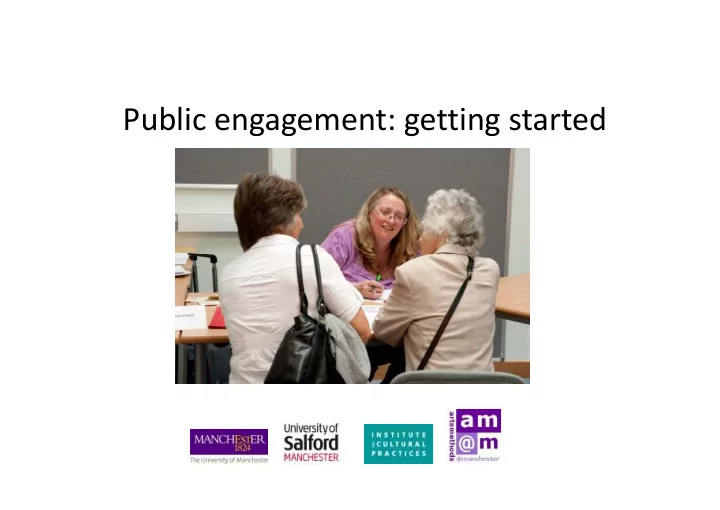
Public engagement: getting started
SLIDE 2
Afterlife of Heritage Research
http://heritageafterlife.wordpress.com Project Leader: kostas.arvanitis@manchester.ac.uk Project Coordinator: emily.mcintosh@manchester.ac.uk
Introduction
Project Coordinator: emily.mcintosh@manchester.ac.uk
SLIDE 3
Jargon: what’s in a word?
Why? Impact? How/When is it OK to use jargon?
SLIDE 4
What is public engagement?
SLIDE 5 What is public engagement?
Public engagement describes the many ways in which higher education institutions and their staff and students can connect and share their work with the public. Done well, it generates mutual benefit, with all parties learning from each other through sharing knowledge, expertise and each other through sharing knowledge, expertise and skills...
National Co-Ordinating Centre for Public Engagement, Manifesto 2010
SLIDE 6 Research
Applied Theoretical Collaborative Co-produced research
Knowledge Transfer
Outreach Public lectures Research dissemination
Info-tainment
Media Festivals National events
What does public engagement
Social Media
Blogs & microblogging Online forums & discussions Wisdom of the crowd Youtube lectures & demos
Learning
Professional development Lifelong learning Networking & sharing Schools liaison Widening participation Research dissemination
Knowledge Exchange
Influencing policy
Community
Student & staff volunteering Cultural & social partnerships Opening up spaces/facilities National events
public engagement look like?
SLIDE 7 The Onion
Source: The Wellcome Trust
SLIDE 8 Why engage the public with my research?
“The question should not be is our research any good, but what is it good for?”
Professor Chris Brink, VC, Newcastle University
“Don't assume because you find all your work fascinating that the public will - look for your common ground.”
Dr Alexis Kirke, University of Plymouth
SLIDE 9 What is reflective practice?
Schon – the process of critically refining one’s own craft or discipline through reflection. The process of considering
- ne’s own experiences in applying knowledge to practice
whilst being coached by professionals in the discipline. The “Reflective Practitioner” – a professional characteristic as well as a process? Moon – reflection itself is a mental process with purpose and/or outcome.
How does this apply to research? The process of self-reflection through regular writing and review as well as discussion with PhD colleagues and supervisor(s)/academics. Developing a vision/purpose for your work. Can be structured or unstructured. Reflection-on-action and reflection-in-action.
SLIDE 10
Who are your public?
Your expectations Their expectations
Key Issue
Their challenges Your challenges
Key Issue
SLIDE 11
What about your research might be interesting to the public?
Missing context? Ask for the bigger picture Jargon? Ask for clarity Only getting the “what”? Ask WIIFM? Don’t know why important? Ask why should I care?
SLIDE 12
How do I design an public engagement activity?
SLIDE 13
Learning styles
SLIDE 14
Disney creative strategy
SLIDE 15
Presentations
Prepare a 3 minute presentation to showcase the activity you have designed. What worked well? What could be improved?
SLIDE 16
Engaging skills
www.vitae.ac.uk/rdf
SLIDE 17
So what next?
Identify your potential partner (if you don’t have one confirmed) Attend second workshop on 28 February 2013 at Manchester Museum Work with your partner on finalising your proposal Work with your partner on finalising your proposal Submit your revised proposal by 12 March 2013 6-10 revised projects will be funded with up to £400