publicpolicies,socialnetworksandepidemicprocesses Social networks - - PowerPoint PPT Presentation

public policies social networks and epidemic processes
SMART_READER_LITE
LIVE PREVIEW

publicpolicies,socialnetworksandepidemicprocesses Social networks - - PowerPoint PPT Presentation

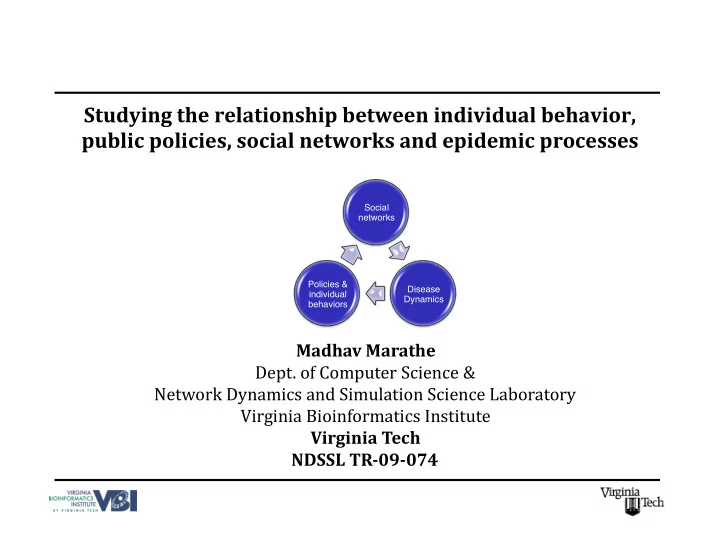
Studyingtherelationshipbetweenindividualbehavior, publicpolicies,socialnetworksandepidemicprocesses Social networks Policies & Disease individual Dynamics behaviors MadhavMarathe


slide-1
SLIDE 1

Madhav
Marathe
 Dept.
of
Computer
Science
&

 Network
Dynamics
and
Simulation
Science
Laboratory
 Virginia
Bioinformatics
Institute
 Virginia
Tech
 NDSSL
TR­09­074


Studying
the
relationship
between
individual
behavior,
 public
policies,
social
networks
and
epidemic
processes


Social networks Disease Dynamics Policies & individual behaviors

slide-2
SLIDE 2

Work
funded
in
part
by
NIGMS,
MIDAS

program,

CDC
Center
of
Excellence
 in
Medical
Informatics,
DTRA
,
NSF
HSD,
NECO,
NETS
and
OCI
programs


slide-3
SLIDE 3

Models
in
Mathematical/Computational
 Epidemiology 


Network Dynamics and Simulation Science Laboratory

Mathematical Models for Epidemiology Differential Equation Based [Hethcote: SIAM Review] ODE’s [Ross, McDonald, Hamer, Kermack, McKendrick Stochastic ODE’s [Bartlett, Bailey,, Brauer, Castillo-Chavez] Network-Based Modeling [Newman SIAM Review] Simple Random networks [Barabasi, Moore, Newman, Meyer, Vespignani] Realistic Social Networks [Eubank et al. Marathe, Longini et al. Ferguson et al.]

slide-4
SLIDE 4
  • 1. Create
a
synthetic
population

  • Sampling
Contingency
Tables,
Assignment
Problems


  • 2. 
Derive
a
social
contact
network
G

  • Assign
activities
(CART
Trees),
locations
(Gravity
models),


Construction
and
analysis
of
large
networks


  • 3. 
Create
a
model
of
disease
transmission

  • Design
probabilistic
timed
finite
state
automata
based
on
data

  • 4. 
Simulate
disease
spreads
over
G


  • Simulation
of
a
diffusion
process

  • 5. 
Study
effect
of
interventions:
co‐evolution
of
G,


behavior,
policy
and
disease
progression


  • Markov
decision
processes
(MDP)

and
n‐way
games


Simdemics:
High
resolution
network­based
modeling


Eubank,
Marathe
et
al.
Nature’04,
SODA,
Scientific
American,
DIMACS,
Longini
et
al.
PNAS
06,
Science
05,
 Ferguson
et
al.
Nature
05,
06.


slide-5
SLIDE 5

Step
1:
Synthetic
populations


  • Who,
where,
what,


when:
People


– Individuals

 – Household
structure
 – Statistically
identical
 to
U.S.
Census
 – Assigned
to
Home
and 
 Activity
Locations


Beckman et al. Transportation Science, NISS technical reports, Barrett et al. TRANSIMS technical reports

slide-6
SLIDE 6

Step
2:
Urban
dynamic
social
contact

network


  • Demographically
match
schedules

  • Assign
appropriate
locations
by


activity
and
distance


  • Determine
duration
of
interaction

  • Generate
social
network

slide-7
SLIDE 7

Network Dynamics and Simulation Science Laboratory

Social
Contact
Networks
are
not
easy
to
shatter


 Vaccinating (quarantining) high-degree people

Closing down high-degree locations

slide-8
SLIDE 8

Realistic
Social
Contact
network
differ
from
 “simple”
random
networks 


Clique


10000 20000 30000 40000 50000 60000 70000 80000 20 40 60 80 100 120 140 160 180 #infections Day Epicurves Orig 25% shuffled 50% shuffled 75% shuffled 100% shuffled

Portland
Network:


  • Cliques
within
same
age
group
(0‐19).


  • Simple
random
graph
models
cannot
produce
these
structures

slide-9
SLIDE 9

Disease
can
be
spread
from
one
 person
to
another.
 The
probability
of
transmission
 can
depend
on:
 ‐
type
of
disease
 ‐
duration
and
type
of
contact
 ‐
person’s
characteristics


‐
age,
health
state,
etc.


Step
3.
Within
Host
Disease
Models


Within
host
model:
 Probabilistic
timed
 transition
systems
(PTTS)


slide-10
SLIDE 10

Step
4:
Fast
Simulations
for
Disease
Spread


Distinguishing
 Features
 EpiSims
 (Nature’04)
 EpiSimdemics
 (SC’09)
 EpiFast
 (ICS’
2009)

 Solution
Method
 Discrete
Event
 Simulation
 Interaction‐Based
 Simulation
 Combinatorial +discrete
time
 Performance
180
 days
9M
hosts
&
 40
proc.

 ~40
hours
 2
hours
 Few
minutes
 Co­evolving
Social
 Network
 Can
work
 Works
Well
 Works
only
with
 restricted
form
 Disease
 transmission
 model
 Edge
as
well
 as
vertex
 based
 Edge
as
well
as
 vertex
based
(e.g.
 threshold

 functions)
 Edge
based,
 independence
of
 infecting
events


slide-11
SLIDE 11

Spatial and Temporal details on spread of disease at this scale and fidelity

Visualizing
the
spatio‐temporal
diffusion


slide-12
SLIDE 12

Step
5:
Study
Effects
of
Interventions 


  • Specifying
a
Situation
(Scenario)


– E.g.
How
to
represent
cascading
failures?


  • Kinds
of
Interventions


– PI:
Vaccines
and
Anti‐viral,
Anti‐biotic
 – NPI:
Social
distancing,
quarantining


  • Specifying
an
Intervention


– When,
where,
whom

&

how
much


  • Cost
Functions


– Human
suffering
averted
 – Time
gained
(delay
of
exponential
growth)
 – Resource
constraints


Mathematical
Model:
POMDP
&
n­way
games

slide-13
SLIDE 13

Interventions:
Partially
Observable
Markov
 Decision
Process
(POMDP)

Social networks Disease Dynamics Policies & individual behaviors

  • Behaviors
and
Disease
dynamics
can
be
cast
as


generalized
reaction
diffusion:
Leads
to
coupled
networks


  • Co‐evolving
dynamical
systems


slide-14
SLIDE 14

New
Network
Measures
and
an
application
to


  • ptimal
allocation
of

PI

slide-15
SLIDE 15

Network Dynamics and Simulation Science Laboratory

Vulnerability
and
Criticality
of
nodes 


  • V(i)
=
Vulnerability
of
a
node
i
=
probability
of


getting
infected,
if
the
disease
starts
at
a
random
 node


  • Criticality(v):
reduction
in

epidemic
size
when
the


node
is
vaccinated


  • V(i,
t)
=
Vulnerability
of
a
node
i
at
time
t=


probability
of
getting
infected
during
the
first
t
time
 steps


  • Depends
on

  • Initial
conditions

  • Transmission
probability

  • Network
structure
‐
not
a
first
order
property


Temporal
version:
probability
of


Blue
nodes
are
highly
critical
but
not
 very
vulnerable


slide-16
SLIDE 16

Network Dynamics and Simulation Science Laboratory

Vaccination
based
on
vulnerability
rank
order 


  • Contact
graph
on
Chicago,
~
8
million
people

  • Highly
vulnerable
nodes
are
also
most
critical
for
this
network

slide-17
SLIDE 17

Network Dynamics and Simulation Science Laboratory

Computing
vulnerability 


  • Monte‐carlo
samples:
each
sample
by
running
EpiFast

  • Vk(i):
probability
node
i
gets
infected
in
k
iterations

  • R(∞):
top
n
nodes
in
vulnerability
order,
V(i)

  • R(t):
top
n
nodes
in
temporal
vulnerability
order
V(i,t)


Change in ||Vk|| |R(∞) - R(t)|

slide-18
SLIDE 18

Network Dynamics and Simulation Science Laboratory

Correlation
with
static
graph
measures 


vulnerability vulnerability degree Clustering coefficient vulnerability centrality

Very little information from static graph measures

slide-19
SLIDE 19

Network Dynamics and Simulation Science Laboratory

Correlations
with
labels 


age Total contact time of a node vulnerability vulnerability

 Similar correlations at different transmission probabilities  Need better models for individual activities and contact duration

slide-20
SLIDE 20

An
illustrative
case
study:
allocating
and
 distributing
A/Vs
through
public
and
private
 stockpile 
 (Marathe
et
al.) 


slide-21
SLIDE 21

The
problem 


Price/ Inventory Demand Susceptibility Network Structure Disease Dynamics/ Prevalence

slide-22
SLIDE 22

The
Setup


  • Use
Simdemics
modeling
framework

  • All
modeling
assumptions
used
in
this
study
are
the
same
as
were
used


for
the
“MIDAS
medkit”
study

in
June
2008


– Exception
1:
Market
distribution
replaces
the
pre‐assignment
of
AV
kits
 based
on
income
 – Exception
2:
Self
Isolation
of
households
based
on
prevalence
and
sick
 member
 – Exception
3:
Disease
prevalence
used
as
a
mechanism
for
adaptation
 – Disease
model,
Reporting,
Diagnosis
and
Distribution
Models:
Same


  • New
River
Valley
population
size:
150K

  • The
total
stockpile
of
AV
is
15k

(10%
of
the
population
size).

  • The
price
of
the
AV
kit
can
vary
between
$50‐$150
(2008
study:
100$).

  • Total
household
budget
for
the
AV
is
1%
of
the
income.


  • The
private
stockpile
can
be
purchased
by
anyone
who
can
afford
it.

slide-23
SLIDE 23

Disease
Models 


  • Disease
Model:


– SEIR
model
is
used. 

 – Transmissibility
(prob.
of
transmission
in
every
minute
of
contact
between
 an
infectious
node
and
a
susceptible
node)
=
3E‐5
 – Incubation
and
infectious
period
durations
are
chosen
from
distributions,
 mean
=
1.9
and
4.1
days
respectively.

 – A/V
Efficacy:
Susceptible
nodes
are
87%
less
likely
to
get
infected;
infectious
 nodes
are
80%
less
likely
to
transmit
the
disease.
 – AV
treatment
and
prophylaxis
lasts
10
days.


slide-24
SLIDE 24

Reporting,
Diagonsing
and
Distribution
of
Public
 Stockpile 


  • Reporting

and
Diagnosis
Model:


– 2/3
of
the
infectious
are
symptomatic
and
report

to
the
hospital.
 – Remaining
1/3
of
the
infectious
are
asymptomatic
and
47%
less
likely
to
transmit.
 – Only
60%
of
those
who
report
to
the
hospital
get
diagnosed.


– Misdiagnosed:
not
sick
but
diagnosed
as
sick;
In
every
12
nodes
diagnosed
as
 sick
2
are
not
sick.


  • Distribution


– The
hospital
stockpile
is
distributed
to
only
those
diagnosed
as
 infected.
 – There
is
no
direct
cost
to
the
people
for
using
the
hospital
stockpile.


Network Dynamics and Simulation Science Laboratory

slide-25
SLIDE 25

Behavioral
models


  • [Isolation
based
on
Prevalence
:]
Once
the
prevalence
reaches
0.2%,


for
individuals
diagnosed
as
infected,
with
compliance
rate
40%,
the
 entire
household
is
isolated
at
home.


  • [Demand
based
on
Prevalence:]
Total
AV
supply
is
15k:
allocated


between
hospitals
and
market
 – Hospitals:
give
to
diagnosed
as
infected
 – Market:
sells
to
households
according
to
demand


  • Household
demand:


Increases
with
disease
prevalence
(xt)
 Increases
with
household
budget
(Bt,h);

decreases
with
price
(Pt)

 price
is
linear
in
remaining
supply
 β
reflects
risk
aversion
or
prevalence
elastic
demand
to
AV.


slide-26
SLIDE 26

Suggests
an
optimal
allocation
strategy 


  • Suggests
optimal
allocation


strategy
of
AVs
between
public
 and
private
stockpile


– Hospitals
(public
sector)
should
be
 given
priority
 – If
>
threshold,
the
remaining
 stockpile
be
distributed
via
market.


 – Private
stockpile
useful
for
 individuals
who
are
infectious
but
 not
symptomatic


  • Optimal
split
(40%
to
hospitals,


60%
to
the
market)

recovers
the
 cost
of
antiviral
manufacturing
if
 the
unit
cost
is

<
$42.


Network Dynamics and Simulation Science Laboratory

slide-27
SLIDE 27


Importance
of
behavioral
modeling 


Network Dynamics and Simulation Science Laboratory

  • Prevalence
elastic
demand:
Delays


 the
epidemic
by
about
a
month


  • Self
Isolation
triggered
by


Prevalence
and
sick
member:
 reduces
the
peak
of
the
epidemic

 and
reduces
the
overall
demand


slide-28
SLIDE 28


Inequitable
allocation
&
role
of
government 


  • Market
based
distribution
is
inherently


inequitable


– Prevalence
elastic
demand
creates
more
 inequitable
distribution
(due
to
price
 increase)


  • Provides
a
way
for
evaluating


government
subsidy
or
investment


– More
even
distribution

possible
if
price
 is
capped
or
mechanisms
are
provided
 for
reimbursing
 – The
price
range
determines
the
 investment
needed
by
the
government


Network Dynamics and Simulation Science Laboratory

slide-29
SLIDE 29

A
game
theoretic
view:
AV
purchase
game


  • Players:
households

  • Strategies:
{buy
antiviral,
not
to
buy}

  • Payoff:
F
(AV
cost,
expected
number
of


infected
household
members)


  • Information:
AV
supply
(split
between


hospital
and
market
stockpile)
and
 price,
disease
prevalence,
household
 budget.


Strategy Payment Infection count

buy $605.98 0.0769 not to buy $0 0.1692

slide-30
SLIDE 30

DIDAC IDACTIC TIC:
HPC
Services
Based

Epidemiological
 Planning
Environment 
 Analyst
can
focus
on
delivering
results
rather
than
 becoming
a
computing
expert


slide-31
SLIDE 31


Simple
User
Interface
to
Set
up
Experiments 


Highly
resolved
parameters


  • Population

  • Disease

  • Initial
conditions

  • Interventions


‐ 
Type
 ‐ 
Efficacy
 ‐ 
Compliance
 ‐ 
Timing
 ‐ 
Subpopulation


slide-32
SLIDE 32

Visual
Analytics
Support 


Network Dynamics and Simulation Science Laboratory

slide-33
SLIDE 33

Conclusions 


  • Start
towards
an
integrated
HPC‐based
policy
informatics


environment

to
support
computational
epidemiology
that
 goes
beyond
simply
agent‐based
disease
modeling


– Easy
to
use
by
SMEs,
highly
scalable
and
resolved

 – High
performance
computing
grids
&
web‐based
services
 – Deployed

and
used
successfully
(e.g.
during
recent
H1N1
response)
 – Flexible,
realistic
and
efficient
representation
of
individual
behavior
 and
public
policy


  • Presented
a
realistic
case
study
to
understand
public
health


and
economic
consequences
of
AV
allocations
via
public
and
 market
mechanisms


– 
suggests
a
split
between
public
and
market‐based
stockpile
that
is


  • ptimal
(in
terms
of

the
peak,
time
to
peak
and
cost)


– Individual
behaviors
play
a
crucial
role
–
prevalence
elastic
demand
 and
isolation
is
the
key.


slide-34
SLIDE 34

Summary:
3
take
home
points 


  • Point
1:
Seamless
access
to
powerful
computational
models
for
use
by


subject
matter
experts
(SMEs)
is
desirable
and
possible.


– Computing

and
modeling
advances
 – Diversity
of
interests
amongst
various
stakeholders
 – Yet
a
desire
and
need
to
share
information
and
data
during
crisis:
Social
Computing
 – Leads
to
a
qualitative
change
in
the
way
public
policies
are

supported


  • Point
2:
Models
and
data
sources
are
increasingly
complex
and
diverse:


Synthetic
Information
systems

provide
a
natural

and
scalable
way

for
 model
composition
and
analysis


– Unified
view
of
models
and
data
 – Use
of
context
based
modeling
and
reasoning
 – Interactive
simulations


  • Point
3:
In
realistic
situations,
individual
behavior,
social
networks,
public


policy
&
disease
dynamics
co‐evolve


– Representing
multiple
behavioral
models

&

multiple
network

(MTML)
is
now
 possible:
expressive,
easy
to
use
and
computationally
efficient