Public policy and Mori economic development 20-Aug-20 1 Aotearoa - - PowerPoint PPT Presentation

public policy and m ori economic development
SMART_READER_LITE
LIVE PREVIEW

Public policy and Mori economic development 20-Aug-20 1 Aotearoa - - PowerPoint PPT Presentation

Dr Jason Paul Mika e: j.p.mika@massey.ac.nz Fulbright Visiting Scholar Native Nations Institute Guest talk at the Politics of Public Policy in the United States course. Wednesday, Sep 18, 2019 11:00- 11:50am, Education Building, Room 349


slide-1
SLIDE 1

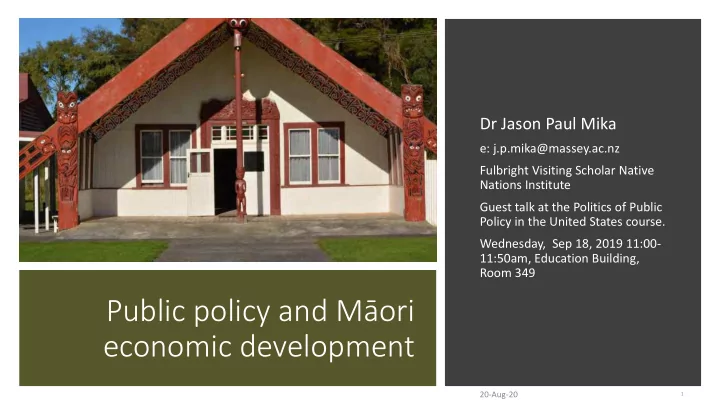
Public policy and Māori economic development

Dr Jason Paul Mika

e: j.p.mika@massey.ac.nz Fulbright Visiting Scholar Native Nations Institute Guest talk at the Politics of Public Policy in the United States course. Wednesday, Sep 18, 2019 11:00- 11:50am, Education Building, Room 349

20-Aug-20

1

slide-2
SLIDE 2

Overview

  • Aotearoa New Zealand, its history, people and

system of government

  • What is public policy?
  • What are policy priorites in New Zealand?
  • What is Māori economic development?
  • Is there a role for government in Māori

economic development?

  • Rationale for intervention: Enterprise assistance

policy and programmes

slide-3
SLIDE 3

Aotearoa New Zealand

20-Aug-20 3

slide-4
SLIDE 4

Aotearoa New Zealand

  • 1250-1350 settled by Māori
  • 1642 Dutch explorer Able Tasman visited
  • 1769 James Cook maps coastline
  • 1840 British and Māori sign Treaty of Waitangi
  • 4.79m people, GDP US$205b, HDI 0.917 (ranked 16)
  • 6,755 miles from Tucson - $1,500, 17 hour flight

20-Aug-20 4

slide-5
SLIDE 5

New Zealand’s system of Government

slide-6
SLIDE 6

House of Representatives

  • Mixed member proportional

representation (MMP) system

  • f electing members of

parliament (MPs) from 1996

  • 120 MPs in the House (71

electorate MPs, 49 ranked by party lists, with 3-year parliamentary term

  • Four Māori electoral seats

established in 1867, increasing to five in 1996 under MMP

  • 29 of 120 (24%) MPs are Māori

20-Aug-20 6

slide-7
SLIDE 7

Public policy

Public policy refers to the decisions and courses of action sanctioned by governments, but involve diverse stakeholders through cycle of power, politics and process (Hill, 2014).

20-Aug-20 7

Source: Victoria University of Wellington (2003)

slide-8
SLIDE 8

Policy issues in New Zealand

Government’s priorities

  • 1. An economy that is growing

and working for all of us

  • 2. Improving the wellbeing of

New Zealanders and their families

  • 3. Making New Zealand proud

(Roy Morgan, 2018) (Ardern, 2018)

slide-9
SLIDE 9

Māori economic development

20-Aug-20 9

Māori entrepreneur

Identity, indigenous entrepreneurial capabilities

Māori enterprise

Identity, definition and enterprise development

Māori economy

Identity, nature, measurement, development and growth

Māori development

Identity, self- determination, wellbeing, potential, freedom

slide-10
SLIDE 10

Māori people

  • In 2017, 734,200 Māori population
  • 86% of Māori live in the North Island
  • Median age of 24 years
  • 223,926 Māori in work
  • School completion 45% Māori (64% non-Māori)
  • Unemployed 10.4% Māori (4% non-Māori)
  • Income < $10,000, 24% Māori (18% non-Māori)
  • Renting: 50% Māori (28% non-Māori)
  • Internet access: 69% Māori (84% non-Māori)

20-Aug-20 10

slide-11
SLIDE 11

Treaty of Waitangi 6 February 1840

20-Aug-20 11

slide-12
SLIDE 12

Māori interests diminished

  • Suppression of

Rebellion Act 1863

  • Oyster Fisheries Act

1866

  • Maori Land Settlement

Act 1905

  • Native Land Act 1865
  • Tohunga Suppression

Act 1907

  • Protest movements and

court action lead to increasing provision of the Treaty in law, policy and practice

20-Aug-20 12

slide-13
SLIDE 13

Treaty settlements

  • Settling claims
  • Historical claims

before 21 September 1992

  • Contemporary claims

after 1992

  • Forms of redress
  • Historical account
  • Cultural redress
  • Commercial redress
  • 73 settlements enacted,

valued at NZ$2.2b (Fyers, 2018)

20-Aug-20 13

slide-14
SLIDE 14

Role of UN Declaration on the Rights of Indigenous Peoples

  • Adopted 13 September 2007
  • Affirms Indigenous human

rights

  • Enabling self-determined

economic development

  • Indigenous management of

indigenous resources

  • Indigenous ways of doing

business

  • Basis for more and better

enterprise assistance

  • Facilitates inter-indigenous

business and trade networks

20-Aug-20 14

slide-15
SLIDE 15

What is the Māori economy?

“the assets owned and income earned by Māori – including collectively-

  • wned trusts and

incorporations, Māori-

  • wned businesses (e.g.,

tourism, broadcasting, and the self-employed), service providers (especially in health and education), and the housing owned by Māori [and the] wages and salaries earned by Māori workers.”

(NZIER, 2003, p. 7)

20-Aug-20 15

slide-16
SLIDE 16

Māori economic development policy

20-Aug-20

Te Pūnaha Hīhiko Callaghan Inovation He kai kei aku ringa: Erere Living Standards: 4 Capitals

slide-17
SLIDE 17

National strategy: He kai kei aku ringa

20-Aug-20 17

slide-18
SLIDE 18

An intergenerational strategy for Māori economic development

“the vision of iwi, hapū and whānau for a future where economic growth can be realised as a conduit to the sustainability and wellbeing of whānau, lands, waterways, marae, language and future generations”

20-Aug-20 18

Sir Mason Durie

slide-19
SLIDE 19

Māori enterprises

20-Aug-20 19

slide-20
SLIDE 20

Māori entrepreneurship

A Māori entrepreneur is a person who identifies as Māori and engages in entrepreneurial activity according to a Māori world view, but integrates within this, elements of a Western world view.

20-Aug-20 20

slide-21
SLIDE 21

Is there a role for government in Māori economic development?

  • Political ideology
  • Non-neutral (hands-on) policy
  • Neutral (hands-off) policy
  • Private-public good elements
  • Policy intervention
  • Evidence of market failure
  • Benefits outweigh costs
  • Evidence intervention will work
slide-22
SLIDE 22

Why Indigenous policy matters?

20-Aug-20 22

slide-23
SLIDE 23

Enterprise assistance

Three roles of enterprise assistance in Māori entrepreneurship:

  • Satisfy firm-level

business needs

  • Build Māori

entrepreneurial capabilities

  • Enable Māori

enterprises to develop

20-Aug-20 23

slide-24
SLIDE 24

Design principles

1. Independence 2. Adaptability 3. Multiplicity 4. Customisation 5. Authenticity 6. Public-private 7. Validation 8. Subsidisation 9. Longtermism

  • 10. Social economy
  • 11. Specialisation
  • 12. Learning

1. Rationale

  • 2. Design
  • 3. Content
  • 4. Process
  • 5. Efficacy
slide-25
SLIDE 25

Discussion

20-Aug-20

25