Public Speaking & Presentation Skills for Nazarbayev Univ. Women - - PowerPoint PPT Presentation

public speaking amp presentation skills for nazarbayev
SMART_READER_LITE
LIVE PREVIEW

Public Speaking & Presentation Skills for Nazarbayev Univ. Women - - PowerPoint PPT Presentation

Public Speaking & Presentation Skills for Nazarbayev Univ. Women Elicia Blumberg Fear is normal Jan 2019 2 Why we are here Have a strategy Feel more confident Connect with audience Convey key messages Affect change


slide-1
SLIDE 1

Elicia Blumberg
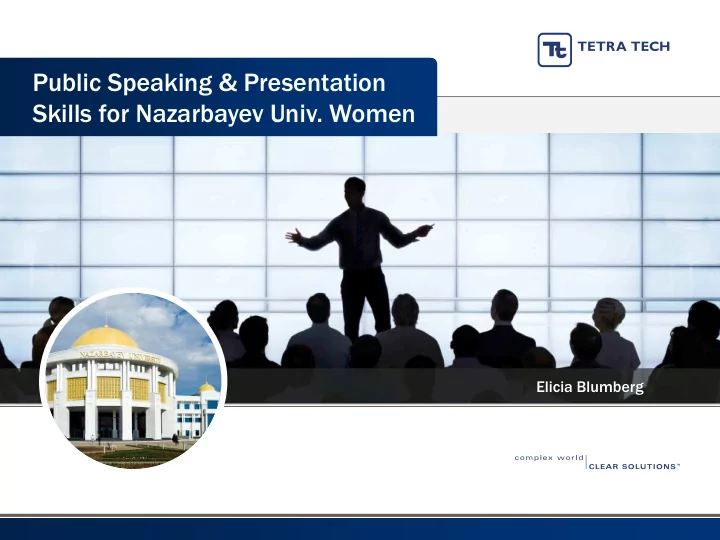
Public Speaking & Presentation Skills for Nazarbayev Univ. Women

slide-2
SLIDE 2

Fear is normal

2 Jan 2019

slide-3
SLIDE 3

Why we are here

  • Have a strategy
  • Feel more confident
  • Connect with audience
  • Convey key messages
  • Affect change

3 Jan 2019

slide-4
SLIDE 4
  • Remove d

e distractio ions ns. . Leave cellphones and computers to the side.

  • Th

This is a is a crit iticism- free zo

  • zone. We will offer ONLY encouraging,

respectful and helpful feedback to one another.

  • Try s

something ng n new. . This is in a safe space to get out of your comfort zone.

  • Be o
  • pen.
  • en. Everyone, no matter what level of presentation

proficiency, can always find something to learn.

  • Partic

icip ipate.

  • e. Your colleagues are depending on you!

Ground rules

4 Jan 2019

slide-5
SLIDE 5

Tim Time Sessi ssion T Title a and Desc scription Sp Speak eaker 11:0 1:00 - 11:1 1:15 Opening remarks and introductions Short presentation of the USAID Power the Future Regional Program and Gender Action Plan Welcoming the speaker - Elicia Blumberg Ayaulym Tleubaldy, USAID Power the Future Communications & Gender Specialist 11:1 1:15- 12:1 12:15 Effective communication skills as a tool for women’s leadership in the energy sector Elicia Blumberg, USAID Power the Future Training Specialist 12:15 15 - 12:30 30 Coffee break 12:3 12:30- 13 13:00 00 Practical exercise: Your elevator pitch 13 13:00 00- 13 13:30 30 Team Presentations and Feedback: Stop, Start, Continue 13 13:30 30- 13 13:40 40 Final Q&A 13 13:50 50 – 14:0 4:00 Closing remarks & Group photo

Schedule

5 Jan 2019

slide-6
SLIDE 6

Group brainstorm

  • Characteristics of a poor

presenter:

  • 1. X
  • 2. Y
  • 3. Z
  • Characteristics of a good

presenter:

  • 1. X
  • 2. Y
  • 3. Z

6 Jan 2019

slide-7
SLIDE 7

Group brainstorm

Why are public speaking skills important for women in technical fields?

7 Jan 2019

slide-8
SLIDE 8

Rule #1 of Public Speaking: Mind the Gap

Your self-perception How you appear to others

8 Jan 2019

slide-9
SLIDE 9

The 3 C’s of presenting (A. Hoffler)

How we give the audience information: the channel.

  • Posture
  • Eye contact
  • Pauses
  • Facial expressions
  • Gestures
  • Vocal variety
  • Movement/ room logistics

9 Jan 2019

Cond

  • ndui

uit

slide-10
SLIDE 10

The 3 C’s of presenting (A. Hoffler)

What do we have to say, and how do we present it?

  • Organization
  • Length
  • Emphasis
  • Repetition
  • Context
  • Applicability to audience
  • What will they remember?

10 Jan 2019

Cont

  • ntent

nt

slide-11
SLIDE 11

The 3 C’s of presenting (A. Hoffler)

We are talking to humans! There must be some emotion.

  • Stories
  • Humor
  • Powerful images
  • Probing questions
  • Common ground with your

audience

11 Jan 2019

Conne

  • nnection
  • n
slide-12
SLIDE 12

All three C’s are required for success

12 Jan 2019

Condu duit it Connectio ion Cont ntent nt

SWEET S SPO POT!

slide-13
SLIDE 13
  • Conduit= channel that transmits items of importance
  • Your conduit= your body and voice

The first “C”-- Conduit

13 Jan 2019

Conduit

slide-14
SLIDE 14

Desired audience interpretation

  • Confidence
  • Passion
  • Master of Logistics
  • Poise/ Posture
  • Pause
  • Eye contact

14 Jan 2019

slide-15
SLIDE 15

Body posture or poise

Quest stio ion: What does your body posture convey to your audience?

Jan 2019 15

slide-16
SLIDE 16

Group exercise: What do these poises say?

  • Hands clasped at chest
  • Hands in prayer position
  • Arms crossed at chest
  • Fig leaf
  • Hands in pockets
  • Hands on hips
  • Hands clasped behind back
  • What’s left???

16 Jan 2019

slide-17
SLIDE 17

Other physical attributes

Stop

  • Rocking
  • Fidgeting
  • Leaning
  • Grabbing lectern

Start

  • Plant feet firmly/ balanced
  • Return to resting position
  • Keep weight off of furniture
  • Use neutral posture

17 Jan 2019

slide-18
SLIDE 18

Speaking tips

  • Running sentences together
  • Using filler words (um, er,

like) or connector words (so, and)

  • Pausing! Honor punctuation.
  • Pause before you use them;

watch or listen to yourself to spot trouble areas.

18 Jan 2019

slide-19
SLIDE 19

All about your EYES

19 Jan 2019

slide-20
SLIDE 20

Passion

  • Facial expression
  • Gestures
  • Vocal variety

20 Jan 2019

slide-21
SLIDE 21

Facial expression

“Mind the gap” between your feelings….and your expression! P.S. Most people err by NOT showing enough emotion!

21 Jan 2019

slide-22
SLIDE 22

Gestures

22 Jan 2019

slide-23
SLIDE 23

Go big!!! And then rest.

23 Jan 2019

Analysis of politicians' body language Body language of leaders

slide-24
SLIDE 24

Gestures to avoid

24 Jan 2019

Crossed arms Arm flapping Tiny gestures Hint: V : Video eo y yoursel elf a and play b back a at 2x o

  • r 4
  • 4x. W

. What h happen ens???

slide-25
SLIDE 25

Your voice

  • Tone
  • Volume
  • Speed
  • Monotone or poly-tone?
  • Soft or loud?
  • Fast or slow? Pauses??

25 Jan 2019

slide-26
SLIDE 26

Master your logistics

  • Visit the room beforehand
  • Bring your own equipment
  • Test everything
  • Have backup
  • Start and end on time
  • Don’t talk about time
  • Move (towards, not away)
  • Have a glass of water!

26 Jan 2019

slide-27
SLIDE 27

What to do if there’s a glitch

FIX IX: Quie uietly r reso esolve iss issue

27 Jan 2019

FEATU TURE: E: Draw a attent entio ion t n to the p e problem em FORGET GET: Ig Igno nore t the iss e issue

slide-28
SLIDE 28

Personal appearance

  • Better to be overdressed

than under...

  • If they’re paying more

attention to your outfit than to your presentation, you may need a fashion consultant.

28 Jan 2019

slide-29
SLIDE 29

Summary: Your Conduit

  • Confidence-

Cont ntrol

  • Poise
  • Pause
  • Eye contact

29 Jan 2019

  • Passion-

En Energy

  • Facial expressions
  • Gestures
  • Vocal variety
  • Professionalism-

Logis istic ics

  • Use the space
  • Manage time
  • Handle the

unexpected

  • Personal

appearance

slide-30
SLIDE 30

Tips and tricks

  • Strive to be competent as
  • pposed to confident
  • Goal is to DISPLAY as opposed

to BECOME (that follows later)

  • Power poses:

https://blog.ted.com/10-examples-of- how-power-posing-can-work-to-boost-your- confidence/

30 Jan 2019

slide-31
SLIDE 31
  • What will your audience repeat, remember, act upon?
  • Interesting, creative and timely

The second “C”-- Content

31 Jan 2019

Conte tent

slide-32
SLIDE 32

What makes good content?

  • Simple– suited to audience
  • Memorable- what they

need to hear

  • Repeatable- this is your

measure of success

  • Segmented- see graph to

right

32 Jan 2019

slide-33
SLIDE 33

Process of content development

1.

  • 1. Why

hy are we speaking?

▪ What is the issue that sharing of information can help solve?

2.

  • 2. Who

ho we are speaking to?

▪ Their objective(s) ▪ What they need to hear

3.

  • 3. What

at we will say

▪ (Only after steps 1 & 2)

33 Jan 2019

slide-34
SLIDE 34
  • Why is this topic important?
  • What is the best/ worst outcome of giving the presentation?
  • Why is the audience there?
  • Why are you giving the presentation (as opposed to someone

else)?

  • What is it like to be in the audience (listening to you)?

▪ Anything you might need to do to better meet the needs of your audience?

Digging into the “Why”

34 Jan 2019

slide-35
SLIDE 35

Digging into the “Who”

  • Step 1: Who are the

subgroups?

  • Step 2: Mapping each

subgroup:

  • Job title
  • Seniority
  • Knowledge of topic
  • Attitude towards topic
  • Demographics
  • What resonates with this

sub-group?

  • What questions might they

have on the topic?

35 Jan 2019

slide-36
SLIDE 36

KAP Analysis

Knowle ledge Attitudes es Prac actice

36 Jan 2019

slide-37
SLIDE 37

KAP analysis walk through

What does your target audience know about the topic? Is the knowledge accurate? Where does the info come from? How does the sub-group feel about this topic? Support/ resist/ neutral/ concerns/ hopes/ fears/ social norms, etc.? What is the behavior they currently exhibit? What is the desired behavior?

37 Jan 2019

Knowle ledge Attitudes es Prac actice

slide-38
SLIDE 38

38 Jan 2019

slide-39
SLIDE 39

Speaker’s objectives

  • What do we want to happen

DURING the presentation?

  • What do we want to happen

AFTER the presentation? This is the “Call to Action”.

  • Mea

easur urable o e objec ectiv ives es:

  • Make decision
  • Sign up
  • Visit website
  • Approve request
  • Buy product
  • Participate in program
  • Adopt new technology
  • Change policies

39 Jan 2019

slide-40
SLIDE 40

Finally, the “What” of the presentation

  • What is ESSENTIAL?

▪ What is your presentation in one sentence? ▪ “If you don’t remember anything else I say, remember this.”

  • Structure:

▪ Time ▪ Alliteration (the 3 C’s) ▪ Acronym ▪ Questions ▪ Ordered list ▪ Component ▪ Pro/Con

40 Jan 2019

slide-41
SLIDE 41
  • Match the information to audience level- what do they need to

know?

  • Highlight what is important to the audience/ exclude what is

not

  • Verify your facts
  • Get their attention, give them a reason to listen, remove
  • bstacles

Tips for the “What”

41 Jan 2019

slide-42
SLIDE 42
  • Why

hy? Your objectives and theirs.

  • Who

ho? Target audience ID and analysis. Where are they in KAP spectrum?

  • What

at? Get your messages across in a way that is convincing to your audience.

Summary: Planning Your Presentation

42 Jan 2019

slide-43
SLIDE 43

How to start? Your opening block:

  • Tell a story
  • Amazing fact
  • Inspiring quote
  • Connect to current event
  • Ask a question
  • Telling everyone how

important you are

  • Overdo logistics
  • Apologizing (late)
  • What I’m NOT covering

43 Jan 2019

slide-44
SLIDE 44

Tips for managing the group

  • Take questions throughout

and at the end

  • Pause for understanding
  • Don’t allow hijacking by

dominant participants

  • Get everyone involved
  • Take breaks
  • Work the room
  • Manage the time

44 Jan 2019

slide-45
SLIDE 45

Tips for slides

  • Not too many words
  • Spell check/ fact check
  • Format
  • Visual images
  • For anything: in moderation
  • Break it up (remember human

attention span)

45 Jan 2019

slide-46
SLIDE 46

Great example from Tetra Tech presentation

46 Jan 2019

slide-47
SLIDE 47

OPEN B N BLOCK Attention Reas ason t to Lis isten Remove O Obst bstacle les C1: C : COND NDUIT Confidence Energy Master of Logistics C2: C : CONT NTENT NT Empathy Essential Entertaining C3: C : CONNE NNECTION Engagement Visuals Q&A CLOSE B BLOCK Summarize ze Call t l to Ac Action Wr Wrap U Up

Tips for finishing

47 Jan 2019

slide-48
SLIDE 48

1: 1: C CLAI AIM 2: A ACTIO TION 3: RES RESULT

Statemen ement o t of Per ersonal E Expe perien ence. The R Reques est. t. The R e Res esult t the e Action wil ill b brin ing. “I “I b bel elieve…” “I ha have f fou

  • und…”

“ I’v ’ve re reali lized….” .” “What I I am a asking y you t u to do is is….” o

  • r “Your m

mis ission, shou hould y you

  • u choo

choose t to

  • accept i

it…” …” “What y you w wil ill f fin ind is is…” “The he con consequences of

  • f

doi

  • ing (or

(or not d doi

  • ing) thi

his ar are…” No one e can d dispu pute t e this! What e exactly y you a u are asking ng th the a aud udience t to d do. Int ntended t to motivate a and nd in inspire y your au audie ience t to act. t.

A strong finish

48 Jan 2019

slide-49
SLIDE 49
  • If you started with a quote, finish with one that

ties in, or repeat earlier quote.

  • If you started with a story, finish that story.
  • If you began with a fact, bring people back to

that fact.

  • Repetition helps them to remember!!!

Final wrap up

49 Jan 2019

slide-50
SLIDE 50
  • Creating a link or bond with audience,
  • An association or relationship

The third “C”-- Connection

50 Jan 2019

Connect ction

slide-51
SLIDE 51

Ways to connect

  • Storytelling
  • Humor
  • Clear, understandable

language

  • Involving the audience
  • Using visuals
  • Engaging through Q&A

51 Jan 2019

slide-52
SLIDE 52
  • Time
  • Place
  • People
  • Series of events
  • Surprise
  • Relevance
  • Emotion
  • Structure- Ex.: monomyth or hero’s story

Storytelling

52 Jan 2019

slide-53
SLIDE 53
  • Your body and voice are your COND
  • CONDUIT. Practice posture,

gestures, eye contact, voice modulation and pausing.

  • The CONTENT

TENT should be tailored for your audience, and move them along the KAP chain (knowledge, attitudes, practices).

  • Ultimately we should CONN

CONNECT CT with the audience through humor, storytelling and dialog.

Summary of 3 C’s

53 Jan 2019

slide-54
SLIDE 54

Questions?

Let’s Break: See you in 15 minutes

54 Jan 2019

slide-55
SLIDE 55

Exercise: Your elevator speech

Imagine you are in an elevator with an important person whom you need to

  • impress. Using skills acquired, prepare a

speech about “what you do”.

  • Who are you in the elevator with?
  • What do you want to achieve?

This speech should last about one m e min inute. Pay attention to the 3 Cs’s. Rehearse your speech before presenting and adjust as necessary. We will share these with our colleagues for feedback.

55 Jan 2019

slide-56
SLIDE 56

Feedback Guidelines

Help your colleagues:

  • What would you recommend to

START doing?

  • To STOP or minimize?
  • To CONTINUE to do???

56 Jan 2019

slide-57
SLIDE 57

1. When we say Mind the Gap, what does that refer to? 2. What are the 3 C’s of presenting? 3. True or false: Conduit refers to wha hat you are saying. 4. Should we analyse the audience be befor

  • re developing the presentation? Why
  • r why not?

5. What does KAP stand for? 6. True or false: Presentations are NOT meant to change behavior. 7. What are the 2 segments that frame your content called? 8. True or false: For technical audiences, you should fill your slides with as much material as will possibly fit. 9. True or false: It is essential to connect with your audience.

  • 10. What is a power pose and why is it relevant for presentations?
  • 11. True or false: With pr

h pract ctice ce, every pe person can b beco come me an excellent pu public c sp spea eaker.

Final Quiz

57 Jan 2019

slide-58
SLIDE 58

Questions?? Thank you! Elicia.B .Blu lumberg@T @Tetra ratech.c h.com

  • m

58 Jan 2019