Pulmonary Anomalies BIOL 6505 Introduction to fetal medicine - PowerPoint PPT Presentation
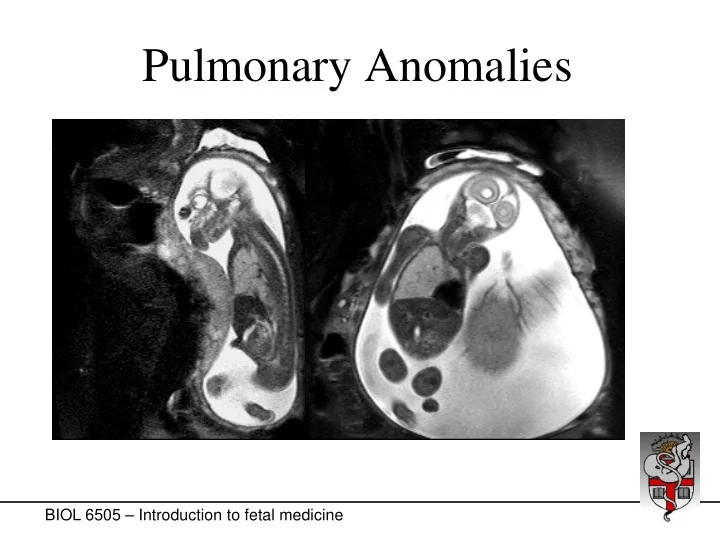
Pulmonary Anomalies BIOL 6505 Introduction to fetal medicine Mammalian Airway Differentiation BIOL 6505 Introduction to fetal medicine Pulmonary Development Five stages From foregut to tracheal bud (embryonic phase)
Pulmonary Anomalies BIOL 6505 – Introduction to fetal medicine
Mammalian Airway Differentiation BIOL 6505 – Introduction to fetal medicine
Pulmonary Development • Five stages • From foregut to tracheal bud (embryonic phase) • Pseudoglandular phase (6-16 wk) • Canalicular phase (16-26 wk) • Saccular phase (26-36 wk) • Alveolar phase (>36 wk) BIOL 6505 – Introduction to fetal medicine
Pulmonary Development • Two important periods • Branching morphogenesis • From foregut to tracheal bud (embryonic phase) • Pseudoglandular phase (6-16 wk) • Late gestation growth spurt • Canalicular to saccular stage (23-26 wk) BIOL 6505 – Introduction to fetal medicine
Pseudoglandular stage Saccular stage Alveolarization ~36 wks → 18 months 16-18 wks 26-36 wks BIOL 6505 – Introduction to fetal medicine
Pulmonary Development • Late gestation growth spurt • 22-26 weeks: type II cells secrete fluid • Alveoli fill up with lung fluid • Lung fluid causes alveolar stretch • Alveolar stretch stimulates lung growth + maturation • No stretch = no growth spurt STRETCH PTHrP-R PTHrP DNA synthesis cAMP PL synthesis SP synthesis TG incorporation TG uptake and release IGF-I, KGF,IL-6, IL-11 BIOL 6505 – Introduction to fetal medicine
Abnormal Lung Development • Main result: pulmonary hypoplasia • When normal lung development is impaired • Often associated with some lung immaturity • The fetus doesn ’ t need lungs! (Placenta) • Pulmonary problems are neonatal problems BIOL 6505 – Introduction to fetal medicine
Fetal Conditions Leading to Pulmonary Hypoplasia • Final common pathway: • Compression of lungs • Preventing alveolar stretch • Delayed or arrested lung growth/maturation Lungs Chest wall Thoracic cavity Amniotic fluid BIOL 6505 – Introduction to fetal medicine
Fetal Conditions Leading to Pulmonary Hypoplasia • Absent fetal breathing: • Muscular dystrophy-like syndromes • Neurological anomaly (no breathing motion) Lungs Chest wall Thoracic cavity Amniotic fluid BIOL 6505 – Introduction to fetal medicine
Fetal Conditions Leading to Pulmonary Hypoplasia • Extrinsic chest compression: • Chronic oligohydramnios/anhydramnios (no fluid) • Bilateral urinary obstruction, renal failure • Bilateral renal agenesis (Potter syndrome) • Chronic amniotic leak Lungs Chest wall Thoracic cavity Amniotic fluid BIOL 6505 – Introduction to fetal medicine
Fetal Conditions Leading to Pulmonary Hypoplasia • Intrinsic chest compression: • Chest mass • Congenital Cystic Lung Lesion Lungs Chest wall Thoracic cavity Amniotic fluid BIOL 6505 – Introduction to fetal medicine
Fetal Conditions Leading to Pulmonary Hypoplasia • Intrinsic chest compression: • Congenital Diaphragmatic Hernia Lungs Chest wall Thoracic cavity Amniotic fluid BIOL 6505 – Introduction to fetal medicine BIOL 5720 – Introduction to fetal medicine
Pulmonary Hypoplasia • Final common pathway: • Lung cannot expand • No alveolar stretch • No stimulus for late growth spurt • At 26-28 weeks BIOL 5720 – Introduction to fetal medicine
Congenital Diaphragmatic Hernia • Bochdalek: Posterolateral (most common) • Left >>Right • Morgagni: Anterior; less common, better Px • 1:2,500 births BIOL 5720 – Introduction to fetal medicine
Congenital Diaphragmatic Hernia • Poor prognostic indicators: • Early diagnosis (<25 weeks)? • Indicates prolonged lung compression • Stomach in the chest? • Polyhydramnios? • Liver in the chest • Lung-Head Ratio (LHR) • MRI volumetry BIOL 5720 – Introduction to fetal medicine
Congenital Diaphragmatic Hernia • Prognosis: • 1970s: >80% mortality at birth • Impetus for fetal intervention? • 1980s-90s: Improved postnatal care • 1990s: 60-70% survival • New century: > 75% survival • Severe subgroup: mortality still elevated • Who are they? BIOL 5720 – Introduction to fetal medicine
Congenital Pulmonary Airway Malformation (CPAM) • Cystic Adenomatoid Malformation (CCAM) • Pulmonary sequestration • Bronchogenic cyst • Common origin? • Abnormal tissue ‘ buds off ’ • Combinations • Hybrid lesions (contain > 1type) BIOL 6505 – Introduction to fetal medicine
Congenital Pulmonary Airway Malformation (CPAM) • Cystic Adenomatoid Malformation (CCAM) • Pulmonary sequestration Sequestration • Extralobar sequestration • Intralobar sequestration • Bronchogenic cyst Normal lung BIOL 6505 – Introduction to fetal medicine
Congenital Pulmonary Airway Malformation (CPAM) • In utero: • May become very large • Mass effect • Pulmonary hypoplasia • Hydrops (mediastinal shift) • “ Kink ” in vena cava • Impaired blood return • Cardiac failure BIOL 6505 – Introduction to fetal medicine
Congenital Pulmonary Airway Malformation (CPAM) • Natural evolution: • Phase of rapid growth (20-25 weeks) • 1980s: • CPAM grows → • causes pulmonary hypoplasia → • compresses mediastinum → • causes hydrops → • fetal death • Now: 70-80% regress partially or completely BIOL 6505 – Introduction to fetal medicine
Prenatal Treatment Options • Reasons to intervene before birth: • Is the fetus at risk of dying? • Is the newborn at risk? • Is there a long-term risk? BIOL 6505 – Introduction to fetal medicine
Prenatal Treatment Options • Is the fetus at risk of dying? • Pulmonary hypoplasia: not a fetal problem (Placenta!) • Complex genetic/chromosomal anomalies (including lung hypoplasia): little to offer • Growing chest mass: risk of mediastinal compression and hydrops (impaired venous return to the heart) BIOL 6505 – Introduction to fetal medicine
Prenatal Treatment Options • Is the fetus at risk of dying? • Only fetal reason to treat: if impending fetal hydrops • CCAM/Sequestration (rarely bronchogenic cyst) • If few, large (growing) cysts: puncture/drainage • If (semi)-solid: surgical resection? BIOL 6505 – Introduction to fetal medicine
Prenatal Treatment Options • Is the newborn at risk? • General purpose of prenatal intervention: • Prevent (or reverse) pulmonary hypoplasia • Treat the condition in utero, and allow enough time for the lungs to catch up • Only justifiable if extreme hypoplasia • But most lesions WILL regress by term BIOL 6505 – Introduction to fetal medicine
Postnatal Treatment Options • Is there a long-term risk? • Recurrent pulmonary infections • CCAM, intralobar sequestrations: communicating with airways (pores of Cohn) • Risk of malignancy (CCAM; others as well?) • Hybrid lesions (contain more than one type) • In general: elective, postnatal resection BIOL 6505 – Introduction to fetal medicine
Recommend
More recommend
Explore More Topics
Stay informed with curated content and fresh updates.