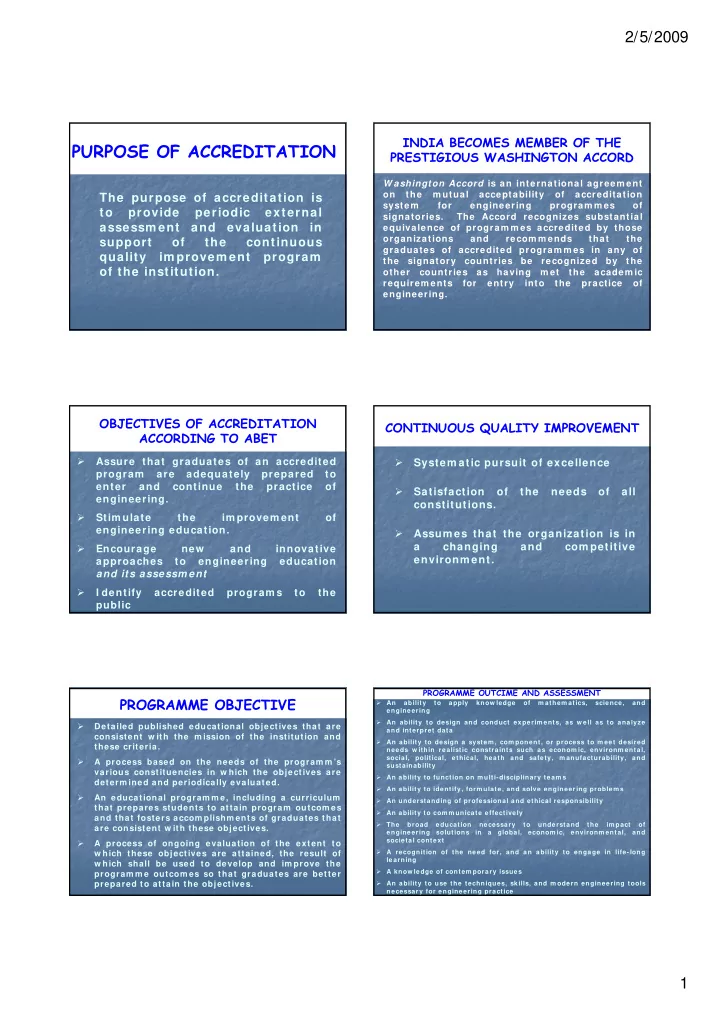
PURPOSE OF ACCREDITATION PRESTIGIOUS WASHINGTON ACCORD W ashington - - PDF document

purpose of accreditation
SMART_READER_LITE
LIVE PREVIEW

PURPOSE OF ACCREDITATION PRESTIGIOUS WASHINGTON ACCORD W ashington - - PDF document

2/5/2009 INDIA BECOMES MEMBER OF THE PURPOSE OF ACCREDITATION PRESTIGIOUS WASHINGTON ACCORD W ashington Accord is an international agreem ent on the m utual acceptability of accreditation The purpose of accreditation is system for


slide-1
SLIDE 1

2/5/2009 1

PURPOSE OF ACCREDITATION

The purpose of accreditation is to provide periodic external assessm ent and evaluation in assessm ent and evaluation in support

  • f

the continuous quality im provem ent program

  • f the institution.

INDIA BECOMES MEMBER OF THE PRESTIGIOUS WASHINGTON ACCORD

W ashington Accord is an international agreem ent

  • n

the m utual acceptability

  • f

accreditation system for engineering program m es

  • f

signatories. The Accord recognizes substantial equivalence of program m es accredited by those equivalence of program m es accredited by those

  • rganizations

and recom m ends that the graduates of accredited program m es in any

  • f

the signatory countries be recognized by the

  • ther

countries as having m et the academ ic requirem ents for entry into the practice

  • f

engineering.

OBJECTIVES OF ACCREDITATION ACCORDING TO ABET

  • Assure that graduates of an accredited

program are adequately prepared to enter and continue the practice

  • f

engineering.

  • Stim ulate

the im provem ent

  • f

engineering education.

  • Encourage

new and innovative approaches to engineering education and its assessm ent

  • I dentify

accredited program s to the public

CONTINUOUS QUALITY IMPROVEMENT

  • System atic pursuit of excellence
  • Satisfaction
  • f

the needs

  • f

all constitutions.

  • Assum es that the organization is in

a changing and com petitive environm ent.

PROGRAMME OBJECTIVE

  • Detailed published educational objectives that are

consistent w ith the m ission of the institution and these criteria.

  • A process based on the needs of the program m ’s

various constituencies in w hich the objectives are determ ined and periodically evaluated.

  • An educational program m e, including a curriculum

that prepares students to attain program outcom es and that fosters accom plishm ents of graduates that are consistent w ith these objectives.

  • A process of ongoing evaluation of the extent to

w hich these objectives are attained, the result of w hich shall be used to develop and im prove the program m e outcom es so that graduates are better prepared to attain the objectives. PROGRAMME OUTCIME AND ASSESSMENT

  • An

ability to apply know ledge

  • f

m athem atics, science, and engineering

  • An ability to design and conduct experim ents, as w ell as to analyze

and interpret data

  • An ability to design a system , com ponent, or process to m eet desired

needs w ithin realistic constraints such as econom ic, environm ental, social, political, ethical, heath and safety, m anufacturability, and sustainability

  • An ability to function on m ulti-disciplinary team s
  • An ability to identify, form ulate, and solve engineering problem s

y y, , g g p

  • An understanding of professional and ethical responsibility
  • An ability to com m unicate effectively
  • The

broad education necessary to understand the im pact

  • f

engineering solutions in a global, econom ic, environm ental, and societal context

  • A recognition of the need for, and an ability to engage in life-long

learning

  • A know ledge of contem porary issues
  • An ability to use the techniques, skills, and m odern engineering tools

necessary for engineering practice

slide-2
SLIDE 2

2/5/2009 2

SIGNATORIES OF THE WASHINGTON ACCORD The

  • rganizations
  • f

the follow ing countries have accepted the rights and responsibility as the signatories responsibility as the signatories defined by the Agreem ent, Rules and Procedures and transitional provisions collectively know n as W ashington Accord.

SI GNATORY SI GNATORY COUNTRY COUNTRY

The The I nstitution I nstitution of

  • f Engineers

Engineers (I E (I E Aust) Aust) Australia Australia Canadian Canadian Council Council of

  • f Professional

Professional Engineers Engineers (CCPE) (CCPE) Canada Canada The The I nstitution I nstitution of

  • f Engineers

Engineers of

  • f I reland

I reland I reland I reland The The I nstitution I nstitution

  • f
  • f

Professional Professional Engineers, Engineers, New New Zeeland Zeeland (I PENZ) (I PENZ) New Zealand New Zealand Th Th E i i E i i C il C il (E (E C) C) U i d Ki d U i d Ki d The The Engineering Engineering Council Council (Eng (Eng C) C) United Kingdom United Kingdom Accreditation Accreditation Board Board of

  • f Engineering

Engineering and and Technology Technology (ABET) (ABET) U.S.A. U.S.A. The The Engineering Engineering Council Council of

  • f South

South Africa Africa (ECSA) (ECSA) South Africa South Africa Hong Hong Kong Kong I nstitution I nstitution of

  • f Engineers

Engineers (HKI E) (HKI E) Hong Kong Hong Kong Japan Japan Accreditation Accreditation Board Board for for Engineering Engineering Education Education (JABEE) (JABEE) Japan Japan (Provisional (Provisional Signatory) Signatory)

SCOPE OF ACCORD

NBA feels that im pact of globalization in the present global scenario has necessitated trans-m igration of technologies, technicians and professionals to various countries at a m uch rapid pace than ever before. The difficulties faced by the technical professionals include non-recognition of degrees/ diplom as, quality

  • f education &

training and absence

  • f facilitating
  • f education &

training and absence

  • f facilitating

m echanism s for easy m obility

  • f

technical professionals. The m em bership of the W ashington accord w ould facilitate easy exchange

  • f

ideas, m obility of students and professionals at international levels. The accord w ould also act as a platform to share innovations, possibilities for collaboration in joint research, inform ation sharing and dissem ination w ith an overall objective of enhancing reputation and standards of technical education am ongst signatories.

BENEFITS OF ACCORD

  • I

w ill ensure quality in the technical education system in general by establishing or strengthening an

  • bjective

and transparent system

  • f

accreditation.

  • I t w ould facilitate com m on standards of education

and ensure m obility of students and faculty besides and ensure m obility of students and faculty, besides encouraging co-operation n the fields of research and training in areas of m utual interest.

  • Substantial parity and consistency in the processes

and procedures of accreditation could be obtained am ongst the signatories in satisfying the academ ic requirem ents for the practice of engineering at the professional level.

Contd….

BENEFITS OF ACCORD

  • I t would promote co-operation and collaboration in the

processes of regulation and maintenance of standards in technical academic programmes as well as in training and research areas.

  • I t w ould provide a forum to continue the dialogue to

pursue

  • ther

issues connected w ith the developm ent of technical education.

  • I t w ould give regular com m unication and sharing of

inform ation concerning their accreditation criteria, system s, procedures, m anuals, publications and list

  • f the accredited program m es.
  • The

accreditation decisions rendered by

  • ne

signatory are acceptable to the

  • ther

signatories and that those signatories w ill so indicate by publishing statem ents to that effect in an appropriate m anner.

Contd….

BENEFITS OF ACCORD

  • The criteria, policies and procedures used by the

signatories in accrediting engineering academ ic program s are com parable.

  • The signatories to the W ashington Accord shall be

g g authorities, agencies

  • r

institutions w hich are representative

  • f

the engineering profession and w hich are statutory pow ers

  • r

recognized professional authority for accrediting program s designed to satisfy the academ ic requirem ent for adm ission to the profession w ithin a defined territory or jurisdiction.

slide-3
SLIDE 3

2/5/2009 3

METHODOLOGY TO JOIN ACCORD

  • Applications for provisional status m ust confirm to

the guidelines approved from tim e to tim e by the signatories and m ust be subm itted in w riting to the secretariat, supported by nom inations from at least tw o of the signatories. Acceptance to provisional status requires a positive vote by tw o-thirds of the signatories. signatories.

  • During

the period

  • f

provisional status, the accreditation criteria, policies and procedures established by the applicant and the effectiveness w ith w hich they are im plem ented are subject to com prehensive review . The review shall follow the sam e general procedures used for m onitoring the perform ance of signatories.

Contd….

METHODOLOGY TO JOIN ACCORD

  • The
  • rganizations

holdings provisional status to signatory status requires the unanim ous approval of the existing signatories. W here such transfer is approved, recognition by the other signatories of the substantial equivalence of the engineering academ ic program s concerned shall becom e effective from the date

  • n

w hich the new signatory w as

  • riginally

adm itted to provisional status.

  • W here transfer from provisional status to signatory

status is not approved, but significant progress has been m ade tow ards m eeting the requirem ents, the signatories m ay, by unanim ously resolution, invite the

  • rganization

concerned to retain provisional status for a further period of tw o years. Any such resolution m ust be accom panied by a statem ent of the requirem ents to be satisfied by the relevant

  • rganization during that period and a schedule for

com pletion.

Contd….

METHODOLOGY TO JOIN ACCORD

  • Organizations

holding provisional status are required to accept the sam e com m itm ent to interaction and exchange as the signatories. They w ill receive copies of appropriate correspondence and reports and w ill be invited to send representatives to all general m eetings

  • f

the representatives to all general m eetings

  • f

the signatories. Representatives

  • f
  • rganizations

holding provisional status w ill have the right of audience and debate at such general m eetings but are not perm itted to vote.

PROGRAMME CRITERIA

Each program m e m ust satisfy applicable criteria. Program m e Criteria provide the specificity needed for interpretation

  • f

the basic level criteria as applicable to a given discipline. Requirem ents stipulated in the Program m e Criteria are lim ited to the areas Program m e Criteria are lim ited to the areas

  • f curricular topics and faculty qualifications.

I t should include one academ ic year of study beyond the basic level, and an engineering project and research activity resulting in a report that dem onstrates both m astery of the subject m atter and a high level

  • f

com m unication skills.

MAJOR CHANGES TO BE BOUGHT IN OUR PRESENT SYSTEM

1 . Changes in Regulations of Universities

  • Sem ester-w ise

registration in the beginning of each Sem ester

  • Flexibility in degree com pletion requirem ent
  • Flexibility

to substitute a course w ith another course from the groups

  • Abolition
  • f

external exam ination for Laboratories, Sessionals, Project w ork etc.

  • System to capture assessm ent records after each

I nternal Assessm ent.

  • Non-negotiable Academ ic Calendar
  • Pattern of question paper setting and evaluation

schem e that tests basic understanding not cram m ing and reproduction capabilities. MAJOR CHANGES TO BE BOUGHT IN OUR PRESENT SYSTEM

2 . Teaching Learning Process

  • Flexible Pace of learning
  • I ntegration of Theory w ith Practice
  • Dem onstration
  • f

Learning through design project and applications design, project and applications.

  • Sharpening learning through continuous

evaluation and quick feed back.

  • Ensure

safety as per

  • ccupational

and health standards in the laboratories.

slide-4
SLIDE 4

2/5/2009 4

MAJOR CHANGES TO BE BOUGHT IN OUR PRESENT SYSTEM

3 . Changes in Curriculum and Syllabus

  • The

curriculum m ust help building a professional engineer w ith desirable attributes through a m ix of courses

  • Building problem form ulation, analysis and solution

skills

  • Strong

Com m unication, group w orking and i l kill m anagerial skills.

  • I m parting

basic understanding

  • f

the core Professional Subjects.

  • Encouraging

research, innovation and entrepreneurship through projects.

  • Providing opportunity to specialize and w iden base

through Professional and Free electives respectively.

  • An ability to use the techniques, skills, and m odern

engineering tools necessary for engineering practice.

MAJOR CHANGES TO BE BOUGHT IN OUR PRESENT SYSTEM

4 . Credit Based System

Credit system perm its com pleting the degree requirem ents at flexible pace

  • ver space and tim e.

I t perm its to l d ’ i t t t explore and pursue one’s interest at a later stage and given freedom to a student to choose from a basket of courses.

MAJOR CHANGES TO BE BOUGHT IN OUR PRESENT SYSTEM

5 . Evaluation and Assessm ent

  • Adopting relative grading system
  • Continuous

evaluation through equally spaced class tests.

  • Testing and evaluation should be by the
  • Testing and evaluation should be by the

teacher w ho teaches.

  • I n-class

evaluation

  • f

all practical courses, project w ork, designs, and sessionals. Contd…..

MAJOR CHANGES TO BE BOUGHT IN OUR PRESENT SYSTEM

  • Schem e for Testing and evaluation of basic

understanding and analytical skills at the end term exam ination.

a) a) Class Tests Class Tests

: :

30 percentage points 30 percentage points b) b) Minor projects, designs Minor projects, designs

: :

20 percentage points 20 percentage points c) c) End Term Examination End Term Examination

: :

50 percentage points 50 percentage points TOTAL TOTAL

: :

100 percentage points 100 percentage points

Contd…..

MAJOR CHANGES TO BE BOUGHT IN OUR PRESENT SYSTEM

  • Although accreditation is voluntary as per

the international practice. All eligible program m es ( from w hich at least tw o batches have been graduates) should preferably seek accreditation by the NBA to get the benefit

  • f

the accord and to increase the percentage

  • f

accredited program m es, since currently

  • nly

about 3 5 % program m es in engineering are accredited.

  • All

institutions should have their

  • w n

quality assessm ent m echanism through establishm ent

  • f

I nternal Quality Assurance Cells and periodic self evaluation through self study reports.

MAJOR CHANGES TO BE BOUGHT IN OUR PRESENT SYSTEM

6 . Faculty

  • Ensure

availability

  • f

qualified and com petent faculty as per AI CTE norm s

  • Encourage m ore Ph.D’s /

M.Tech’s by

  • idi

fa ilitie fo e ea h i providing facilities for research in association w ith industries / R&D

  • rganizations / professional bodies and

governm ent agencies.

slide-5
SLIDE 5

2/5/2009 5

WASHINGTON ACCORD SIGNATORY ORGANIZATIONS

SL.NO. SL.NO. SI GNATORY ORGANI ZATI ON SI GNATORY ORGANI ZATI ON ENTRY YEAR ENTRY YEAR 1. 1. Accreditation Accreditation Board Board

  • f
  • f

Engineering Engineering and and Technology Technology ( ABET) , ( ABET) , USA USA 1 9 8 9 1 9 8 9 2. 2. Engineers Engineers Canada Canada 1 9 8 9 1 9 8 9 3. 3. Engineering Engineering Council Council of

  • f South

South Africa Africa ( ECSA) ( ECSA) 1 9 9 9 1 9 9 9 4. 4. Engineering Engineering Council Council UK UK ( ECUK) ( ECUK) 1 9 8 9 1 9 8 9 5. 5. Engineers Engineers Australia Australia 1 9 8 9 1 9 8 9 6. 6. Engineers Engineers I reland I reland 1 9 8 9 1 9 8 9 7. 7. The The Hong Hong Kong Kong I nstitution I nstitution of

  • f Engineers

Engineers 1 9 9 5 1 9 9 5 8. 8. The The I nstitution I nstitution of

  • f Engineers,

Engineers, Singapore Singapore 2 0 0 6 2 0 0 6 9. 9. I nstitution I nstitution

  • f
  • f

Professional Professional Engineers Engineers New New Zealand Zealand ( I PENZ) ( I PENZ) 1 9 8 9 1 9 8 9 10. 10. Japan Japan Accreditation Accreditation Board Board for for Engineering Engineering Education Education ( JABEE) ( JABEE) 2 0 0 5 2 0 0 5 11. 11. Accreditation Accreditation Board Board for for Engineering Engineering Education Education of

  • f Korea

Korea ( ABEEK) ( ABEEK) 2 0 0 7 2 0 0 7 12. 12. I EET I EET ( Chinese ( Chinese Taipei) Taipei) – – Taiw an Taiw an 2 0 0 7 2 0 0 7

WASHINGTON ACCORD PROVISIONAL MEMBER ORGANIZATIONS

SL.NO. SL.NO. PROVI SI ONAL MEMBER ORGANI SATI ONS PROVI SI ONAL MEMBER ORGANI SATI ONS ENTRY YEAR ENTRY YEAR 1. 1. National National Board Board of

  • f Accreditation,

Accreditation, I ndia I ndia 2 0 0 7 2 0 0 7 2. 2. The The I nstitution I nstitution

  • f
  • f

Engineers, Engineers, Sri Sri Lanka Lanka ( I ESL) ( I ESL) 2 0 0 7 2 0 0 7 3. 3. Russian Russian Association Association for for Engineering Engineering 2 0 0 7 2 0 0 7 Education Education ( RAEE) , ( RAEE) , Russia Russia 4. 4. Accreditation Accreditation Agency Agency for for Study Study Program s Program s in in Engineering, Engineering, I nform atics, I nform atics, Natural Natural Sciences Sciences and and Mathem atics Mathem atics ( ASI I N) , ( ASI I N) , Germ any Germ any 2 0 0 3 2 0 0 3 5. 5. Engineering Engineering Accreditation Accreditation Council Council

  • f
  • f

Malaysia Malaysia ( EAC, ( EAC, MALAYSI A) MALAYSI A) 2 0 0 3 2 0 0 3