Push-Pull FEL A New ERL Concept Andrew Hutton JLab Thomas - - PowerPoint PPT Presentation

push pull fel a new erl concept
SMART_READER_LITE
LIVE PREVIEW

Push-Pull FEL A New ERL Concept Andrew Hutton JLab Thomas - - PowerPoint PPT Presentation

Push-Pull FEL A New ERL Concept Andrew Hutton JLab Thomas Jefferson National Accelerator Facility Operated by the Southeastern Universities Research Association for the U.S. Department of Energy Drivers for a New Concept The ILC will use

slide-1
SLIDE 1

Thomas Jefferson National Accelerator Facility

Operated by the Southeastern Universities Research Association for the U.S. Department of Energy

Push-Pull FEL A New ERL Concept

Andrew Hutton JLab

slide-2
SLIDE 2

Drivers for a New Concept

Operated by the Southeastern Universities Research Association for the U.S. Department of Energy

Thomas Jefferson National Accelerator Facility

Page 2

  • The ILC will use superconducting technology
  • Many components of the X-FEL at DESY are similar
  • Most components of a superconducting accelerator are

being, or will be, industrialized for the ILC and the X-FEL

  • Cryomodules
  • Injector
  • RF power sources

Concept - design an FEL based on “cheap” ILC components

  • Modifies the design of the electron optics in favor of:
  • more cryomodules
  • more injectors
  • less beam transport
slide-3
SLIDE 3

New Concept - Electrons

Operated by the Southeastern Universities Research Association for the U.S. Department of Energy

Thomas Jefferson National Accelerator Facility

Page 3

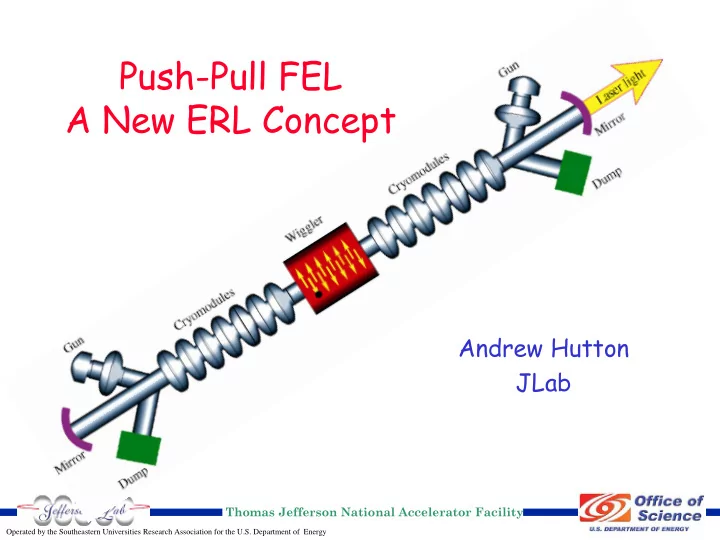
  • New concept uses two sets of superconducting cavities

with two identical electron beams going in opposite directions

  • Each set of superconducting cavities accelerates one

electron beam and decelerates the other beam

  • The energy used to accelerate one beam is recovered

and used for the other beam

  • The difference between this proposal and other energy-

recovery proposals is:

  • Each electron beam is accelerated by one structure and

decelerated by another

  • This is energy exchange rather than energy recovery
slide-4
SLIDE 4

Concept - Light

Operated by the Southeastern Universities Research Association for the U.S. Department of Energy

Thomas Jefferson National Accelerator Facility

Page 4

  • A further simplification can occur if the superconducting

cavities produce sufficient energy

  • The superconducting cavities can be contained within the
  • ptical resonator with the light pulses traversing them
  • This arrangement leads to an extremely compact layout

suitable for a university laboratory

slide-5
SLIDE 5

Conceptual Layout

Operated by the Southeastern Universities Research Association for the U.S. Department of Energy

Thomas Jefferson National Accelerator Facility

Page 5

CRYOCAVITY CRYOCAVITY

~30 meters The two cryomodules containing the superconducting cavities flank a wiggler that is used to produce coherent light The addition of a pair of mirrors outboard of the cryomodules completes the free Electron Laser (FEL) optical cavity On either end, there is a 10 MeV injector (gun + cryocavity) that can either be a copy of that used at the Jefferson Lab FEL or (better) an SRF gun The electron beams are brought onto the acceleration axis by a separator magnet, which also serves to bend the spent beam to a dump

slide-6
SLIDE 6

Illustration of the Concept

Operated by the Southeastern Universities Research Association for the U.S. Department of Energy

Thomas Jefferson National Accelerator Facility

Page 6

Animation by Tom Oren Animation by Tom Oren

slide-7
SLIDE 7

Energy Balance

Operated by the Southeastern Universities Research Association for the U.S. Department of Energy

Thomas Jefferson National Accelerator Facility

Page 7

  • RF energy in the cryomodules is recovered completely
  • RF energy given to the beam by the injector is partially

converted to FEL light and partially dissipated in the dump

  • The bend magnet needs to be carefully designed to

transport electrons with a large (~50%) energy spread to the dump with extremely small losses

  • Better alternative is to do energy compression
  • So the maximum FEL power that can be extracted is some

fraction (up to about 50%) of the power in the injector

slide-8
SLIDE 8

Example Parameter Set

Operated by the Southeastern Universities Research Association for the U.S. Department of Energy

Thomas Jefferson National Accelerator Facility

Page 8

  • An example of a parameter set has been calculated
  • Compared to design parameters of 10 kW JLab FEL
  • Design power output has been achieved, so parameters

are within the state of the art

  • The superconducting cavities are based on DESY X-FEL

prototypes

  • Cryomodule contains eight 9-cell superconducting

cavities operating at 23 MV/m for a total of 190 MV

  • The superconducting cavity in the injector is one of the

same cavities operating at less than 10 MV/m

  • Injection energy should be less than ~10 MV to avoid neutron

activation of the dump

slide-9
SLIDE 9

Parameter Example

Operated by the Southeastern Universities Research Association for the U.S. Department of Energy

Thomas Jefferson National Accelerator Facility

Page 9

Parameter 10 kW JLab FEL Push-Pull FEL Design Design Maximum Beam Energy 80 – 210 MeV 200 MeV Injector Beam Energy 10 MeV 10 MeV Beam Current 10 mA 2 x 0.5 mA Beam Power 800 – 2100 kW 2 x 100 kW Non-Recovered Beam Power 100 kW 2 x 5 kW RF Frequency 1500 MHz 1300 MHz FEL Repetition Rate 3.9 – 125 MHz RF Frequency/(4 – 384) 5.078 MHz RF Frequency/256 Optical Cavity Length 32 meter 29.539 meter Bunch Charge 135 pC @ 75 MHz 100 pC Energy Spread after Wiggler 10% of 210 MeV 2.5% of 200 MeV Energy Spread at Dump ~2% of 10 MeV 50% of 10 MeV FEL Output Power 10 kW in the Infrared 1 kW in the UV > 1 kW in the UV with bunch compression

slide-10
SLIDE 10

Light Output Estimated by Steve Benson (1)

Operated by the Southeastern Universities Research Association for the U.S. Department of Energy

Thomas Jefferson National Accelerator Facility

Page 10

  • The first case assumes that the electron bunches are not

compressed, which gives the most compact system

  • Since the energy is 200 MeV and the charge is 100 pC

the obvious application for the driver is for a UV laser

  • Undulator A from ANL, wiggler design that worked well

for the UV and for a 200 MeV beam was assumed

  • With this wiggler and a 2 psec FWHM bunch length there

is a gain of about 60% in the UV and the power estimated by the spreadsheet is a few hundred Watts

  • Since the bunch is so long, the spreadsheet assumption that there is a

single super-mode breaks down so the power may be much higher

slide-11
SLIDE 11

Long Bunch Characteristics

Operated by the Southeastern Universities Research Association for the U.S. Department of Energy

Thomas Jefferson National Accelerator Facility

Page 11

Courtesy of Steve Benson

Power vs. wavelength

100 200 300 400 500 0.0 0.1 0.2 0.3 0.4 0.5

Wavelength(µm) Power(W) Gain vs. Wavelength

0% 10% 20% 30% 40% 50% 60% 70% 80% 0.0 0.1 0.2 0.3 0.4 0.5

Wavelength (µm) Gain(%)

slide-12
SLIDE 12

Light Output Estimated by Steve Benson (2)

Operated by the Southeastern Universities Research Association for the U.S. Department of Energy

Thomas Jefferson National Accelerator Facility

Page 12

  • The second scheme assumes a buncher/debuncher system

which can bunch down to 1/3 of a psec FWHM

  • This gives very high gain of several hundred percent
  • The power is estimated to be more than 1 kW
  • This is high enough that the power limit will be the
  • ptics and not the electron beam
slide-13
SLIDE 13

Short Bunch Characteristics

Operated by the Southeastern Universities Research Association for the U.S. Department of Energy

Thomas Jefferson National Accelerator Facility

Page 13

Courtesy of Steve Benson

Power vs. wavelength

200 400 600 800 1000 1200 1400 1600 0.0 0.1 0.2 0.3 0.4 0.5

Wavelength(µm) Power(W) Gain vs. Wavelength

0% 50% 100% 150% 200% 250% 300% 350% 400% 450% 0.0 0.1 0.2 0.3 0.4 0.5

Wavelength (µm) Gain(%)

slide-14
SLIDE 14

Other Hardware

Operated by the Southeastern Universities Research Association for the U.S. Department of Energy

Thomas Jefferson National Accelerator Facility

Page 14

  • RF Power source
  • The klystron being developed at Cornell for the ERL

Light Source would be perfect for this application

  • Enough power for injectors and one cryomodule
  • RF Distribution and Low-Level RF control
  • The RF power distribution system and LLRF control

adopted for ILC is perfect for this application

  • Will act on fast ferrite tuners to apply power to

individual cavities

slide-15
SLIDE 15

Beam Optics by Dave Douglas (1)

Operated by the Southeastern Universities Research Association for the U.S. Department of Energy

Thomas Jefferson National Accelerator Facility

Page 15

  • The optics for the Push-Pull FEL will be based on a

quadrupole doublet at each Injector and two quadrupole doublets each side of the wiggler

  • The optics is designed to focus a round beam at the

cathode to a round beam at the center of the wiggler

  • Since a vertically focusing quadrupole for the accelerating

beam will be vertically defocusing for the decelerating beam and vice versa, the vertical beta functions for the accelerating beam will be identical to horizontal beta functions of the decelerating beam and vice versa

  • This design automatically provides well behaved optics for

both beams

  • It is well suited to the beam with nominal bunch length
slide-16
SLIDE 16

Beam Optics by Dave Douglas (2)

Operated by the Southeastern Universities Research Association for the U.S. Department of Energy

Thomas Jefferson National Accelerator Facility

Page 16

  • The output power can be considerably enhanced by using a

chicane to bunch the beams more tightly

  • In this case, the edge focusing of the chicane bends is

independent of the direction of the particle

  • This destroys the anti-symmetry of the simple focusing

scheme and requires the use of chicane magnets with carefully shaped poles

  • Still working on detailed layout
  • This will be the subject of a later paper
slide-17
SLIDE 17

Outstanding Questions

Operated by the Southeastern Universities Research Association for the U.S. Department of Energy

Thomas Jefferson National Accelerator Facility

Page 17

  • Drive laser rep rate (5 MHz) is not easy
  • Lasers like high rep rate or low rep rate
  • A few MHz is currently difficult
  • The most stable solution uses a single drive laser with a

splitter providing light to both guns

  • Needs precisely calibrated optical delay
  • Avoids problem of precisely synchronizing two separate lasers
  • Drive laser needs real work
  • Complete a detailed design
  • No obvious problem areas other than the laser
  • Integrate bunch compression/energy compression
slide-18
SLIDE 18

Summary

Operated by the Southeastern Universities Research Association for the U.S. Department of Energy

Thomas Jefferson National Accelerator Facility

Page 18

A new ERL concept is proposed

  • Small footprint and few tunable parameters
  • Optimal for a university laboratory setting
  • Uses components being developed for the ILC
  • Should become cheap and reliable

Design studies will continue Awaiting a User with deep pockets!

slide-19
SLIDE 19

Parameter Example

Operated by the Southeastern Universities Research Association for the U.S. Department of Energy

Thomas Jefferson National Accelerator Facility

Page 19

Parameter 10 kW JLab FEL Push-Pull FEL Design Design Maximum Beam Energy 80 – 210 MeV 200 MeV Injector Beam Energy 10 MeV 10 MeV Beam Current 10 mA 2 x 0.5 mA Beam Power 800 – 2100 kW 2 x 100 kW Non-Recovered Beam Power 100 kW 2 x 5 kW RF Frequency 1500 MHz 1300 MHz FEL Repetition Rate 3.9 – 125 MHz RF Frequency/(4 – 384) 5.078 MHz RF Frequency/256 Optical Cavity Length 32 meter 29.539 meter Bunch Charge 135 pC @ 75 MHz 100 pC Energy Spread after Wiggler 10% of 210 MeV 2.5% of 200 MeV Energy Spread at Dump ~2% of 10 MeV 50% of 10 MeV FEL Output Power 10 kW in the Infrared 1 kW in the UV > 1 kW in the UV with bunch compression