( ) = q enc = h = 0 E 2 rh E d A = 0 E dA 0 A coaxial - - PowerPoint PPT Presentation

q enc h 0 e 2 rh e d a 0 e da 0 a coaxial cable can be
SMART_READER_LITE
LIVE PREVIEW

( ) = q enc = h = 0 E 2 rh E d A = 0 E dA 0 A coaxial - - PowerPoint PPT Presentation

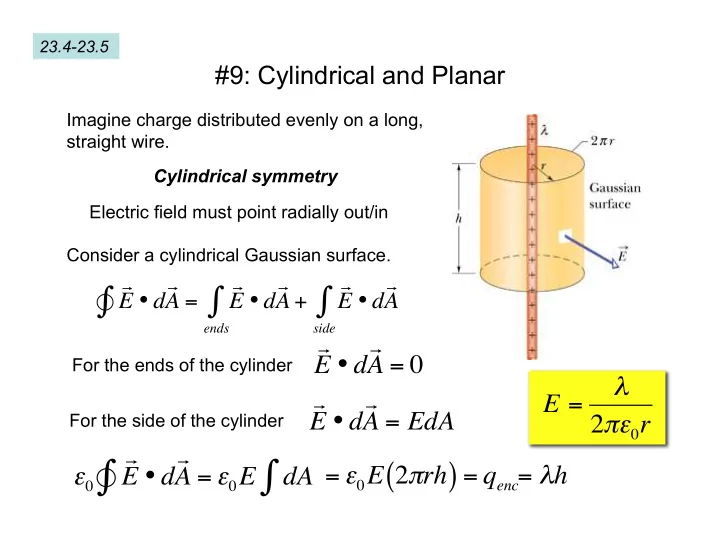
23.4-23.5 #9: Cylindrical and Planar Imagine charge distributed evenly on a long, straight wire. Cylindrical symmetry Electric field must point radially out/in Consider a cylindrical Gaussian surface. E


slide-1
SLIDE 1

#9: Cylindrical and Planar

Imagine charge distributed evenly on a long, straight wire.

 E • d  A

=  E • d  A

ends

+  E • d  A

side

E = λ 2πε0r

Consider a cylindrical Gaussian surface. Electric field must point radially out/in Cylindrical symmetry

 E • d  A = 0

For the ends of the cylinder For the side of the cylinder

 E • d  A = EdA ε0  E • d  A

= ε0E dA

= ε0E 2πrh

( ) = qenc= λh

23.4-23.5

slide-2
SLIDE 2

A. B.

  • λ

C.

D.

E.

A coaxial cable can be accurately modelled as a long thin wire surrounded by an insulating material, which is then surrounded by a thin conducting shell. The plot shows the electric field as the function of distance from the center of such a coaxial cable. If the linear charge density on the cental conductor is λ, what is the linear charge density on the external conductor?

slide-3
SLIDE 3

Insulating sheet

Consider a uniform distribution of charges in a large, flat insulating sheet Planar symmetry → electric field must point perpendicular to the sheet

 E • d  A

=  E • d  A

end−1

+  E • d  A

end−2

+  E • d  A

side

Consider a cylindrical Gaussian surface

 E • d  A = 0

For the sides of the cylinder

 E • d  A

= E dA

end−1

+ E dA

end−2

For the ends of the cylinder

 E • d  A = EdA

ε0  E • d  A

= 2EA = qenc = σA

E = σ 2ε0

slide-4
SLIDE 4

A. B. ε0 Es / 2 C. ε0 Es / 3 D. ε0 Es / 6 E.

  • σ2

The figure below shows three plastic sheets that are large, parallel, and uniformly charged. The components of the net electric field along an x axis through the sheets are also plotted. (a) What is σ1? (b) What is σ1+ σ2+ σ3

slide-5
SLIDE 5

Three thin non conducting sheets are shown below. What is charge density on sheet 1?

A. B. ε0E0 / 4 C. ε0E0 / 2 D. 3ε0E0 /4 E. ε0E0

+E0

  • E0
slide-6
SLIDE 6

+E0

  • E0

A. B. ε0E0 / 2 C.

  • ε0E0 / 2

D. ε0E0 E.

  • ε0E0

Three thin non conducting sheets are shown below. What is charge density on sheet 2?

slide-7
SLIDE 7

The figure below is a section of a conducting rod of radius R1 = 1.00 mm and length L = 10.0 m inside a thick-walled coaxial conducting cylindrical shell of radius R2 = 10.0R1 and the (same) length L. The net charge on the rod is Q1 = +3.4 pC that on the shell is Q2 = −2.0Q1. What is the magnitude and direction of the electric field at r =2.0R2 and r =5.0 R1?

slide-8
SLIDE 8

Two very long, thin, plastic rods lie in the z direction at (x=-a,y=0) and (x=+a,y=0). The rods carry a uniform charge density λ. Find an expression net electric field for points that lie on the y axis. At what point

  • n the y axis is the magnitude of the electric field a maximum?