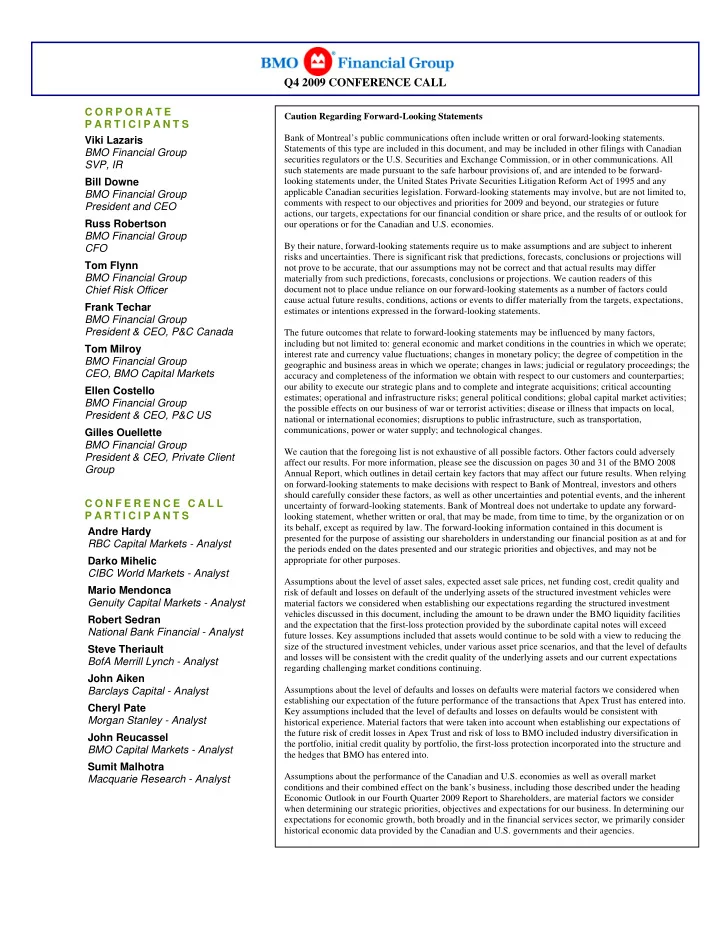
SLIDE 1 C O R P O R A T E P A R T I C I P A N T S Viki Lazaris BMO Financial Group SVP, IR Bill Downe BMO Financial Group President and CEO Russ Robertson BMO Financial Group CFO Tom Flynn BMO Financial Group Chief Risk Officer Frank Techar BMO Financial Group President & CEO, P&C Canada Tom Milroy BMO Financial Group CEO, BMO Capital Markets Ellen Costello BMO Financial Group President & CEO, P&C US Gilles Ouellette BMO Financial Group President & CEO, Private Client Group C O N F E R E N C E C A L L P A R T I C I P A N T S Andre Hardy RBC Capital Markets - Analyst Darko Mihelic CIBC World Markets - Analyst Mario Mendonca Genuity Capital Markets - Analyst Robert Sedran National Bank Financial - Analyst Steve Theriault BofA Merrill Lynch - Analyst John Aiken Barclays Capital - Analyst Cheryl Pate Morgan Stanley - Analyst John Reucassel BMO Capital Markets - Analyst Sumit Malhotra Macquarie Research - Analyst
Q4 2009 CONFERENCE CALL
Caution Regarding Forward-Looking Statements Bank of Montreal’s public communications often include written or oral forward-looking statements. Statements of this type are included in this document, and may be included in other filings with Canadian securities regulators or the U.S. Securities and Exchange Commission, or in other communications. All such statements are made pursuant to the safe harbour provisions of, and are intended to be forward- looking statements under, the United States Private Securities Litigation Reform Act of 1995 and any applicable Canadian securities legislation. Forward-looking statements may involve, but are not limited to, comments with respect to our objectives and priorities for 2009 and beyond, our strategies or future actions, our targets, expectations for our financial condition or share price, and the results of or outlook for
- ur operations or for the Canadian and U.S. economies.
By their nature, forward-looking statements require us to make assumptions and are subject to inherent risks and uncertainties. There is significant risk that predictions, forecasts, conclusions or projections will not prove to be accurate, that our assumptions may not be correct and that actual results may differ materially from such predictions, forecasts, conclusions or projections. We caution readers of this document not to place undue reliance on our forward-looking statements as a number of factors could cause actual future results, conditions, actions or events to differ materially from the targets, expectations, estimates or intentions expressed in the forward-looking statements. The future outcomes that relate to forward-looking statements may be influenced by many factors, including but not limited to: general economic and market conditions in the countries in which we operate; interest rate and currency value fluctuations; changes in monetary policy; the degree of competition in the geographic and business areas in which we operate; changes in laws; judicial or regulatory proceedings; the accuracy and completeness of the information we obtain with respect to our customers and counterparties;
- ur ability to execute our strategic plans and to complete and integrate acquisitions; critical accounting
estimates; operational and infrastructure risks; general political conditions; global capital market activities; the possible effects on our business of war or terrorist activities; disease or illness that impacts on local, national or international economies; disruptions to public infrastructure, such as transportation, communications, power or water supply; and technological changes. We caution that the foregoing list is not exhaustive of all possible factors. Other factors could adversely affect our results. For more information, please see the discussion on pages 30 and 31 of the BMO 2008 Annual Report, which outlines in detail certain key factors that may affect our future results. When relying
- n forward-looking statements to make decisions with respect to Bank of Montreal, investors and others
should carefully consider these factors, as well as other uncertainties and potential events, and the inherent uncertainty of forward-looking statements. Bank of Montreal does not undertake to update any forward- looking statement, whether written or oral, that may be made, from time to time, by the organization or on its behalf, except as required by law. The forward-looking information contained in this document is presented for the purpose of assisting our shareholders in understanding our financial position as at and for the periods ended on the dates presented and our strategic priorities and objectives, and may not be appropriate for other purposes. Assumptions about the level of asset sales, expected asset sale prices, net funding cost, credit quality and risk of default and losses on default of the underlying assets of the structured investment vehicles were material factors we considered when establishing our expectations regarding the structured investment vehicles discussed in this document, including the amount to be drawn under the BMO liquidity facilities and the expectation that the first-loss protection provided by the subordinate capital notes will exceed future losses. Key assumptions included that assets would continue to be sold with a view to reducing the size of the structured investment vehicles, under various asset price scenarios, and that the level of defaults and losses will be consistent with the credit quality of the underlying assets and our current expectations regarding challenging market conditions continuing. Assumptions about the level of defaults and losses on defaults were material factors we considered when establishing our expectation of the future performance of the transactions that Apex Trust has entered into. Key assumptions included that the level of defaults and losses on defaults would be consistent with historical experience. Material factors that were taken into account when establishing our expectations of the future risk of credit losses in Apex Trust and risk of loss to BMO included industry diversification in the portfolio, initial credit quality by portfolio, the first-loss protection incorporated into the structure and the hedges that BMO has entered into. Assumptions about the performance of the Canadian and U.S. economies as well as overall market conditions and their combined effect on the bank’s business, including those described under the heading Economic Outlook in our Fourth Quarter 2009 Report to Shareholders, are material factors we consider when determining our strategic priorities, objectives and expectations for our business. In determining our expectations for economic growth, both broadly and in the financial services sector, we primarily consider historical economic data provided by the Canadian and U.S. governments and their agencies.
SLIDE 2 Q4 09 - BMO Financial Group - Earnings Conference Call – November 24, 2009 P R E S E N T A T I O N Viki Lazaris - BMO Financial Group - SVP, IR Thank-you operator. Good afternoon, everyone, and thanks for joining us today. Our agenda for today's investor presentation is as follows. We will begin the call with remarks from Bill Downe, BMO's CEO, followed by presentations from Russ Robertson, the Bank's Chief Financial Officer, and Tom Flynn, our Chief Risk Officer. After their presentations, we will have a short question and answer period where we will take questions from pre- qualified analysts. To give everyone an opportunity to participate, please try to keep it to one or two questions and then re-queue. Also with us this afternoon to take questions are BMO's four business unit heads, Tom Milroy from BMO Capital Markets; Gilles Ouellette from the Private Client Group; Frank Techar, who heads up P&C Canada; and Ellen Costello from P&C US; as well as Barry Gilmour, Head of Technology and Operations. After the Q&A, each of our business unit heads will make some comments on what they will be concentrating on for 2010. At this time I would like to caution our listeners by stating the following on behalf of those speaking today. Forward- looking statements may be made during this call, and there are risks that actual results could differ materially from forecasts, projections or conclusions in the forward-looking statements. Certain material factors and assumptions were applied in drawing the conclusions or making the forecasts or projections in these forward-looking statements. You can find additional information about such material factors and assumptions and the material factors that could cause actual results to so differ in the caution regarding forward-looking statements set forth in our news release or
- n our investor relations website.
With that said, I will hand things over to Bill. Bill Downe - BMO Financial Group - President, CEO Thank you, Viki, and good afternoon. As noted, my comments may include forward-looking statements. Today, BMO reported strong fourth quarter financial results, highlighting a year of continued momentum. It is a reflection of the strength in our core businesses that has been emerging over a number of quarters, and it was achieved while we simultaneously dealt with issues resulting from the economic environment. This performance is attributable to success against the priorities that we established going back to 2007 and our strategy of differentiating BMO by striving for a consistently great customer experience. We're providing a value proposition that is clearly higher touch and rooted in listening to and guiding customers to make sense of their choices. Internally, we continue to focus on strengthening our leadership, renewing talent and simplifying our organization structure. Going into 2009, we were focused on closely managing our loan portfolio and credit provisions, prudently managing
- ur capital and liquidity position and continuing to reduce risks, both on and off balance sheet. With an eye to future
growth, we also focused on building our top line and striving to be the market leader in our businesses, aggressively managing expenses, while continuing to invest in strategic initiatives that benefit our customers. And above all, we set about delivering on a brand promise that has clear benefit for customers. In the process, we stood by our customers as the economy and markets faltered, and we reinforced our reputation as a consequence, and this has moved the Company forward.
2
SLIDE 3 Q4 09 - BMO Financial Group - Earnings Conference Call – November 24, 2009 We've built a personal and commercial franchise that sets the tone for the entire Company, serves as a beacon and reflects how we intend to compete across all our businesses. In the year, we opened 32 new or redeveloped branches and introduced more innovative customer products. And we made gains in customer loyalty. We are well positioned to continue growing and delivering value for shareholders and customers. Russ will review the financial results, but I would like to highlight some key numbers for you. Net income for the fourth quarter was $647 million with an ROE of 14%. Revenues increased a strong 6.3% from last year, while expenses declined 2.2%. Our pre-provision pre-tax earnings were $1.2 billion, up 22% from a year ago. Net income for the year was $1.8 billion, or $3.14 per share on a cash basis. On an adjusted basis, cash net income was $4.02 a share, and revenues increased 8.4% over 2008. Our provision for credit losses in Q4 came in at $386 million, in line with our expectations. U.S. gross impaired loans remained high, reflecting where we are in the cycle. We are actively managing our U.S. book and expect that as we go through 2010 and 2011, these levels will decline. Overall, we are confident about our position and expect to earn through our credit losses with significant upside
- pportunity. We expect to demonstrate once again in this cycle why we have a strong reputation for credit
management, and we believe this remains a core strength at BMO. Moving to slide five, we continue to maintain a strong balance sheet. The Tier 1 capital ratio was 12.2% at year-end, and our tangible common equity to risk-weighted asset ratio was 9.2%. Until there is regulatory certainty with respect to global capital standards, excess capital will weigh on ROE. That said, we don't apologize for building levels of capital that we consider prudent, given the uncertainties in the market over the past 18 months. The good news ahead is that we have flexibility around any new regulatory reform that may emerge, and equally important, we are well positioned to deploy capital for growth initiatives and take advantage of opportunities that
- arise. And we've done just that, acquiring businesses, hiring talent and building our presence in sectors and markets
where we see potential. Early last week, BMO Capital Markets announced a definitive agreement with Paloma Securities to hire its lending team and acquire assets used in the securities lending business of Paloma Securities. And earlier today, P&C Canada announced a definitive agreement to purchase the Diners Club North American business from Citigroup; A transaction that, on completion, will more than double BMO's corporate card revenue. The acquisition will immediately enhance our competitive position by putting us among the top commercial card issuers in North America. Let's turn now to the results of the operating groups. P&C Canada posted outstanding results in Q4, our fifth quarter in a row of strong performance. Momentum continued across all business segments, and the Group earned $394 million in the quarter, which was 22% ahead of the prior year and 11% higher than the third quarter. Revenue growth was 8% year-over-year, while expenses were down 1%, and our cash productivity ratio was 51.1%. 2009 was a year when businesses needed to know their banker would be there for them. We are sending a very strong signal to Canadian businesses that Canada's First Bank is here for them, and recently we announced that we are committing a minimum of $1 billion new net dollars to lend to Canada's small and medium-sized businesses, which are the backbone of our economy. In sum, P&C Canada had a great year in 2009. Revenue for the full year reached $5.3 billion, 8% ahead of 2008. Net income increased 15% to $1.4 billion. Cash productivity improved significantly by 220 basis points for the year. P&C in the US earned $29 million on a cash basis in the quarter, identical to Q3 and up from $18 million last year. Cash net income adjusted for the impact of credit costs and other items was $39 million, consistent with the past five quarters.
3
SLIDE 4 Q4 09 - BMO Financial Group - Earnings Conference Call – November 24, 2009 We benefited from improved loan spreads, deposit volume growth and gains on the sale of mortgages. Excluding the impact of credit costs, revenue in Q4 increased 5% year-over-year. However, nonperforming loans and the cost of managing them have increased and will continue to mute reported profitability. Deposits increased 8%, and margins improved 26 basis points to 3.26%. We maintained our number two ranking for retail deposit market share in our markets and improved our net promoter scores for both retail and commercial in
- 2009. And coming out of the recession, Harris is capitalizing on the weakened competitive environment and is adding
new customers and building revenue. The Private Client Group earned $110 million in Q4, delivering good revenue growth for the second consecutive
- quarter. On an adjusted basis, the Group's net income was up 8% from last year and 15% from Q3. Amid better
equity markets and a continued focus on attracting new client assets, PCG generated revenue growth of 5%
- sequentially. There is clear momentum in our insurance business, with BMO Life Assurance results exceeding our
- expectations. And the Globe and Mail ranked BMO Investorline best of the bank-owned brokerages in its 2009 online
brokerage rankings, a testament to our customer orientation, meeting their needs across multiple channels. And finally, BMO Capital Markets had a very solid quarter, benefiting from its diversified business mix and market
- pportunity. Earnings were flat compared to last year and down 16% from a very robust Q3 level. However, net
income of $289 million and revenue growth of 24% are very solid results and reflect sound execution of strategy, coupled with capitalizing on market opportunity. During the quarter, we received the Best FX Bank Canadian Dollar Award from FX Week in their annual rankings, as well as being named the Best Foreign Exchange Bank in Canada by European CEO magazine. And for the 29th consecutive year, we were ranked number one for investment research by Brendan Wood. With a strong performance in the last two quarters, BMO Capital Markets posted net income of $1.1 billion for the
- year. And while this level of earnings is not necessarily sustainable in the long run, the group is continuing to optimize
its business and achieve the right scale and appropriate risk-return profile. With a strong commitment to clients, our
- bjective is to generate high-quality earnings over the course of the business cycle with an ROE in the high teens.
And with that, I will turn it over to Russ. Russ Robertson - BMO Financial Group - CFO Thanks, Bill, and good afternoon. Some of my comments may be forward-looking. Please note the caution regarding forward-looking statements on slide one. On slide three, you can see the reported fourth-quarter earnings were $647 million, or $1.11 per share, compared to $1.06 last year. On a cash basis, earnings were $1.13 per share, and our Tier 1 capital ratio remains strong at 12.24%. Credit costs remain elevated, as expected, with specific provisions for credit losses of $386 million in the quarter. This was another clean quarter with no notable items, and our businesses continued their momentum and delivered strong results. Turning to slide four, revenue of $3 billion was up $11 million from our record third quarter revenue. The increase was largely driven by continued strong performance in P&C Canada and improved revenue in Corporate Services, primarily as a result of mark-to-market gains on hedging activities versus losses in Q3, as well as a lower negative carry on certain asset liability interest-rate positions. These increases were partially offset by lower revenue in BMO Capital Markets, as trading revenues were down from the extremely favorable conditions in the third quarter.
4
SLIDE 5 Q4 09 - BMO Financial Group - Earnings Conference Call – November 24, 2009 Year-over-year revenues increased 6%, with good growth from all operating groups offset by a reduction in Corporate
- Services. The weaker US dollar decreased revenue by $20 million for both comparative quarters.
Net interest income was $1.4 billion in the fourth quarter, up $33 million or 2% from a year ago. This increase was driven mainly by favorable prime rates relative to BA rates and actions to mitigate the impact of rising long-term funding costs in P&C Canada. Quarter-over-quarter, net interest income decreased $24 million or 2%, mainly due to a reduction in earning assets of $3 billion, reflecting the weaker US dollar. Earning assets declined in BMO Capital Markets and P&C US, partially
- ffset by growth in P&C Canada and Private Client Group.
Looking more specifically at margins, total bank margin was up two basis points year-over-year, driven by P&C Canada, and down one basis point quarter-over-quarter. In P&C Canada, net interest margin increased over both comparative quarters. Year-over-year margins were up 34 basis points, largely due to favorable prime rates relative to BA rates, actions to mitigate the impact of rising long-term funding costs, the effect of deposit growth outpacing loan growth and the securitization of low-margin mortgages. The quarter-over-quarter increase of five basis points can be attributed to actions to mitigate the impact of rising long- term funding costs and higher volumes in more profitable products, partially offset by lower mortgage refinancing fees. In P&C US, margins were up 26 basis points year-over-year due to strong deposit generation and 13 basis points
- ver the prior quarter due to higher lending spreads.
In Capital Markets, margins were down two basis points year-over-year, as reductions in interest-rate-sensitive businesses were partially offset by higher spreads in trading and corporate lending business. Quarter over quarter, margins declined by 21 basis points due to lower spreads. Corporate Services' net interest income improved relative to the third quarter, due in part to management actions and a more stable market environment. Turning to slide seven, year-over-year expenses decreased $39 million, or 2%, with decreases in each of the
- perating groups with the exception of PCG. Expenses in PCG were up only $2 million, as active expense
management helped to offset the $15 million increase from the addition of the BMO Life Assurance acquisition. The weaker US dollar accounted for approximately one-third of the year-over-year decrease, with the remainder due to lower salaries, a result of reduced staffing levels, as well as lower computer costs, professional fees and capital taxes. Expenses decreased $94 million or 5% quarter-over-quarter. Over half of the decrease was due to lower performance-based compensation, with the remainder due to lower computer costs, capital taxes, lower FDIC premiums and a weaker US dollar. We continue to focus on expense management and improving productivity across the Bank, and we are pleased with the continued progress we have made controlling core expenses. On slide 10, you will see that our risk-weighted assets were $167 billion at the end of Q4, down $4 billion over Q3 due to lower corporate and commercial volumes, partially offset by higher risk-weighted assets related to securitization. Our Tier 1 capital ratio was strong at 12.24% in the quarter, and is expected to remain strong through 2010. The tangible common equity to risk-weighted assets ratio also increased to 9.2%, which remains top-tier. Turning to slide 11, our liquidity position remains sound, as reflected by our cash and securities to total assets ratio and level of core deposits. And the Bank's 2010 term maturities are largely pre-funded. In conclusion, our results reflect another quarter of high quality earnings delivered by our businesses with strong capital and liquidity levels and good cost management. With that, I will turn things over to Tom.
5
SLIDE 6 Q4 09 - BMO Financial Group - Earnings Conference Call – November 24, 2009 Tom Flynn - BMO Financial Group - Chief Risk Officer Thanks, Russ, and good afternoon. Before I begin, I draw your attention to the caution regarding forward-looking statements. I'll start with slide three, where we provide a breakdown of our loan portfolio. The portfolio is well-diversified; 71% of loans are in Canada and 23% in the US. Within the Canadian portfolio, 62% of assets are consumer loans. Over 85%
- f these are secured. Our US portfolio mix is 43% consumer, with commercial and capital market loans making up
the larger portion. Slide four shows the details of our US loan portfolio that we have shown in the past few quarters. The US loan book is being effectively managed, and the parts of the portfolio most impacted by the downturn are not outsized relative to the overall balance sheet. The US consumer portfolios are relatively evenly spread across first mortgage, home equity and auto loans. As you would expect, the real estate related parts of this portfolio continue to be impacted by the state of the housing and employment markets. Our underwriting in this area was more conservative than the industry overall, and as a result,
- ur performance is better than peers.
The bottom of the page shows details on our commercial real estate and investor-owned mortgage portfolio. As you know, the US commercial real estate market is experiencing weakness that is expected to continue at least well into
- 2010. Our exposures here are not outsized, at just 2.5% of total loans and 11% of US loans.
The investor-owned mortgages are mostly confined to our Midwest footprint, are well diversified by property type and were underwritten prudently. This portfolio represents approximately 5% of US loans. The developer portfolio represents just 3% of US loans. We have been actively managing our exposure to this sector throughout the year and will continue to do so. Turning to slide five, the charts on the left show a segmentation of impaired loan formations, which were $735 million for the quarter. The majority of formations continued to come from the US, and these are broken out in the pie chart
- n the bottom left of the page. These formations were diversified across C&I, which was the largest category, real
estate related and financial institutions, where one loan accounted for the majority of formations. On the right-hand side of the page you see that gross impaired loan balances totaled $3.3 billion. We continue our practice of early recognition and active management of troubled loans. We believe this practice maximizes value for the Bank and works best for our customers. Slide six details our provision for credit loss by business group. The consolidated specific provision was $386 million, slightly higher than Q3 and consistent with our expectations and the quarterly average for the year. The P&C Canada consumer and commercial portfolios continue to perform well considering the environment. Provisions here were in line with last quarter. P&C US provisions were up from last quarter, both on the consumer and the commercial sides. This reflects the continued impact of the weak economy and real estate markets. Capital Market’s provisions continued to be dominated by US exposures and were in line with the quarterly average for the year. Turning to slide seven, you can see a segmentation of the specific provision by geography and portfolio. The Canadian provision was $124 million. Consumer and credit card loans continue to be the largest component of Canadian provisions. The US provision was $261 million, up from Q3. C&I subsectors represent the largest portion of this amount, with the balance split between consumer and real estate related exposures. To sum things up on the credit side, the Canadian portfolios are performing well given the environment, while US provisions are higher, given tougher conditions there. Provisions are expected to continue to be elevated into 2010,
6
SLIDE 7 Q4 09 - BMO Financial Group - Earnings Conference Call – November 24, 2009 given the lingering effects of the weak economy, the state of US real estate markets and high unemployment levels. We hope to see some improvement in the latter part of 2010 provided the economic recovery continues. Slide eight shows information on our consumer credit performance against peers in Canada and the US. In Canada, we continue to have leading performance. A high proportion of our consumer portfolio is secured and we have continued to maintain our disciplined approach to lending. On the US side, we have performed better than peers in all product categories, although provisions are higher here given the environment. That concludes my presentation, and we can now move to Q&A. Q U E S T I O N A N D A N S W E R Operator (Operator Instructions) Andre Hardy, RBC Capital Markets. Andre Hardy - RBC Capital Markets - Analyst I have two questions related to loan growth. The first is for Frank Techar. What would residential mortgage growth be if it weren't for the impact of exiting the broker network? And then in business lending, we've had sequential declines all year in balances. I understand demand is down and that is an industry trend, but a well-capitalized bank like BMO should be picking up market share. Can you give us a feel for what you feel is happening to your market share in business lending in Canada and the US? Frank Techar - BMO Financial Group - President & CEO, P&C Canada Relative to the mortgage business, we have seen growth in our core mortgage portfolio derived from our proprietary sales forces. I would characterize it as being in the low single-digit growth category. As you know, that is one of the things that we are focused on moving forward with respect to adding to the size of our sales force, and we are pretty confident that we can improve on that as we go into 2010. Relative to our business banking activities in Canada, you will note just for our total loan portfolio for P&C Canada, after two quarters of declines in loan growth as we started this year, we've now seen two quarters of increases in our average loans. So not only as a result of some changes, the management action that we've taken on the consumer side of the business, but also on the commercial side of the business, we are getting a bit more aggressive as we become more confident with respect to the economy. And our expectation is that we will be able to accelerate both consumer and commercial lending as we go into 2010. From a market-share perspective on the commercial side, we've seen our numbers be a bit volatile over the course of the year. But on average, we are up year-over-year from a share perspective, and we feel like we are well-positioned for 2010. Andre Hardy - RBC Capital Markets - Analyst
- Thanks. And presumably Tom Milroy, are you going to pick up on larger business lending?
7
SLIDE 8 Q4 09 - BMO Financial Group - Earnings Conference Call – November 24, 2009 Tom Milroy - BMO Financial Group - CEO, BMO Capital Markets Absolutely, Andre. What I would say was that our decline is a result of really just two things. One is, as we mentioned to you before, we have taken a number of actions around assets that we thought were non-core and that included loans where we didn't think we were getting an adequate return. So, some of the decline in our case is the result of that, probably 40%. 60% of the decline I would say relates to lesser demand. Net demand is just down or, alternatively, some of our customers are accessing the bond market for long-term funding. We really believe that we are not losing any market share; arguably, increasing it somewhat. But we are looking towards the latter part of 2010 to see what we believe as the economy recovers is the better outlook for that loan growth. Andre Hardy - RBC Capital Markets - Analyst
- Okay. So the cleanup, if you want to call it that, of the book is still not done, is that what you are saying?
Tom Milroy - BMO Financial Group - CEO, BMO Capital Markets Yes, and the loans obviously take a while to run off, and it is going to take a couple of years yet before we get that out
Andre Hardy - RBC Capital Markets - Analyst
Bill Downe - BMO Financial Group - President, CEO Andre, maybe we could just take a minute and let Ellen speak to the midmarket and commercial portfolio in the US, because I think there is some insight there as well. Ellen Costello - BMO Financial Group - President, CEO of P&C US Thank you, Bill. Andre, I think you may know that we've been working actively to grow the C&I portion of our business, both in the commercial mid-market and small business. And at the same time, we're de-emphasizing our real estate portfolio and that is amortizing. So a lot of those new originations are getting offset by that amortization. Also, continuing on with what Tom said, while we are acquiring new borrowing customers, they're not really utilizing the lines actively, given their confidence in the current environment. But we do expect as things improve that we will see further loan growth in those new acquired customers. Andre Hardy - RBC Capital Markets - Analyst Thank you. Operator Darko Mihelic, CIBC.
8
SLIDE 9 Q4 09 - BMO Financial Group - Earnings Conference Call – November 24, 2009 Darko Mihelic - CIBC WM - Analyst Thank you. A couple of questions. Maybe I'll start with the confusing one first. I have a question for Russ. It has to do with your slide deck, page 11, where you talk about diversified wholesale term funding mix. Russ, what are you trying to tell me with this slide? Russ Robertson - BMO Financial Group - CFO Just turning to the slide…one of the main points we are trying to point out is on the term debt maturities, the size of the maturities going forward, but in 2010 in particular, that we have pre-funded the majority of those maturities. So we are feeling quite good about the fact that we are not at risk in terms of how we are going to deal with those maturities. Darko Mihelic - CIBC WM - Analyst
- Okay. Can I assume then that you are well-positioned, I'm trying to figure out if you are positioned for a net interest
rate increase for wider margins or if it is the reverse. Is that how we should read into this slide? Because when I look at your supplemental on page 41, an interest rate increase does nothing for you on the earnings side, but it really hurts you if it were to decrease. So how should I read this slide? Should I make an interpretation off of this slide that if the rates go up, you should be booking higher margins on all new loans coming in? Russ Robertson - BMO Financial Group - CFO Yes, that would be my view, that in a higher interest rate margin environment, we would get higher margins. I don't know if Frank wanted to add to that all. Frank Techar - BMO Financial Group - President & CEO, P&C Canada Darko, just to confirm from a P&C perspective, rising interest rates would lead to expanding margins in our business. Darko Mihelic - CIBC WM - Analyst And presumably there must be some level of growth built into this. Maybe I can come back to that; I don't want to spend too much time on that. Another question I have is with respect to expenses. If I take the total compensation expense this year relative to the average number of employees in the year, I get a number of about $116,000 per employee. That would compare to about $108,000 for last year. So in other words, the actual total comparable expense per employee is up about 8%, which would actually mirror revenue growth. Am I thinking about these numbers correctly? How should I think about your expenses? Should they mirror revenue growth per employee, and should we think about more employee reductions into 2010?
9
SLIDE 10 Q4 09 - BMO Financial Group - Earnings Conference Call – November 24, 2009 Bill Downe – BMO Financial Group – President & CEO Darko, I thought you said your first question was going to be the confusing one. I will start on that. First of all, in 2009, there is severance in the number. And that may account for part of the calculation. I would have to rerun the calculation myself to tell you if it is exact, but I think it is a portion of it. Revenue does have an impact on variable compensation. But as you know, it depends on the business, because there are some businesses that are relatively balance sheet or capital-intensive, and even with a big move in revenue, you don't tend to get very much in the move in compensation. But I think that if you look at the core businesses where the front-line sales forces exist, that is where we've had good progress in the year and it is reflected in the compensation. But I think if you back out the severance number you will probably see there isn't that big a move in the year. Darko Mihelic - CIBC WM - Analyst
- Okay. And what about the outlook for number of employees for next year?
Bill Downe – BMO Financial Group – President & CEO We are keeping a very close eye on employment levels in all of the businesses. I think that is actually pretty common against all commercial enterprises in North America at this particular time. The increases that we've seen because of acquisition have pretty much been offset by streamlining of the back office and simplifying the sales process. So our
- bjective is to grow revenue with the same workforce if we can do that.
Darko Mihelic - CIBC WM - Analyst
- Great. And if I can just squeak one last question in for Tom. On page 13 of your report to shareholders, this quarter
you added in a sentence that said that you expect risk-weighted assets to increase in future years as a result of pending regulatory changes for 2010 and beyond. I'm just wondering if you have a number. So in other words, if I were to look at your Tier 1 capital ratio today and we were to simply fast track all of those Basel changes, what would the impact be to your Tier 1 ratio? And can you give us a sense of what that impact is? Tom Flynn - BMO Financial Group - Chief Risk Officer It is very hard to give a precise sense of that. I don't think we can give a precise sense sitting here today, because most of the changes won't kick in until the beginning of 2011, and the impact will be a function of what our book looks like at that time and where the rule changes ultimately settle in at. But from what we've seen thus far, most of the impact will be in the area of market risk and risk-weighted assets. And
- ur market risk and risk-weighted assets aren't that significant. They are about $6.5 billion on a base of $167 billion,
so they are under 5% of the total. And they could increase by a factor of two to three. So we are not expecting an increase in total from what we've seen so far that would exceed 10% of risk-weighted
- assets. But it is still really early days on this in terms of fully assessing the impact, and the Basel Committee is going
to be coming out with more guidance and proposals either later this year or early next.
10
SLIDE 11 Q4 09 - BMO Financial Group - Earnings Conference Call – November 24, 2009 Darko Mihelic - CIBC WM - Analyst Okay, great. That's helpful. Thank you. Operator Mario Mendonca, Genuity Capital Markets. Mario Mendonca - Genuity Capital Markets - Analyst Sort of along the same lines on capital, the credit risk RWA is down a little under $21 billion since Q1 '09, and I suspect a portion of this relates to what has happened to the US dollar relative to the Canadian dollar and also what has happened to loan demand. Could you help separate those two? Maybe break it out into the currency effect and declining loan demand. That's the first part of the question. Tom Flynn - BMO Financial Group - Chief Risk Officer I'll try. I don't have precise numbers for that period, but it would be a combination of currency impact and lower loan balances particularly in the corporate portfolio, which tend to be higher from a risk-weighting perspective; and with those two things offset with some negative credit migration in the portfolio. Mario Mendonca - Genuity Capital Markets - Analyst At some point, it would be helpful to have a sense for how much of those, and I understand you can't do it now, but maybe on a go-forward basis. The sort of related question is when you look out, if you just assume for the moment the currency is a non-issue or at least stable, do you have a sense for when you expect to see RWA growth resume? Because absent RWA growth, the capital ratios become unusually strong. They're awfully high if you sort of just roll forward the capital ratios out to 2011, the numbers become kind of strange. So maybe, Bill, if you could speak to capital deployment in an environment where the capital ratios look awfully strange. And I mean, I'm even taking into account this two to three times higher RWA related to market risk. Maybe, Bill, could you speak to capital deployment? Bill Downe - BMO Financial Group - President, CEO I'm happy to, Mario. I guess there are two issues that affect this, and neither one of them is determined at the present
- moment. The first one is, and I actually referenced this in my opening comment, that I think there is going to be some
clarity around capital standards for banks globally emerge, I'm hoping over the next 30 days. I think in Canada, we will probably have a much clearer idea perhaps than in some other regulatory regimes, because of the fact that we are essentially starting with very strong capital ratios. But knowing what the longer-term capital targets are going to be is very important. And we need to know also with respect to US banks, and I think there may be a little bit of a delay or there may be some time frame to get to new capital standards, which could be as long as a couple of years. So we would want to know a little bit more about those with respect to anything but small acquisitions. So I think that is a variable. The second one really relates to the opportunity for organic growth, which at this point in the cycle, if you believe, as we do, that we are coming out of recession, we should be able to grow market share in North America in all of our
11
SLIDE 12 Q4 09 - BMO Financial Group - Earnings Conference Call – November 24, 2009 businesses; in Personal & Commercial Banking in Canada, in Personal & Commercial Banking in the US, and to some extent in Capital Markets, which is really redeploying capital. As the non-relationship portfolio that Tom talked about runs off, we ought to be replacing it with assets that relate to new relationships with higher spreads. So I think there is an argument, a strong argument to be made that holding surplus capital going into 2010 is prudent. And that is based on a belief that in the mid-half of the year, it is much more likely than not that our commercial clients are going to start to think again about capital investment. Capital investment has been very low for 2.5 years, almost three years. And as you know, inventories are quite low. The pipelines are quite empty. So there is inevitably going to be a rebuilding of working capital, and then there is going to be capital investment. And particularly in commercial banking, I think we will have an opportunity to deploy some of that capital. So I think the simple answer is if we moved into the middle half of next year and we weren't seeing any pickup, and we had clarity around capital, then we probably would have too much capital. Mario Mendonca - Genuity Capital Markets - Analyst
- Helpful. And maybe just one final point, Tom if you could clarify about IFRS. They are contemplating having a lot of
what are currently off-balance-sheet vehicles on balance sheet. Given the position of strength BMO and the other Canadian banks are in, do you envision that having much of an effect? Tom Flynn - BMO Financial Group - Chief Risk Officer It's hard to say, because that is a long way out. International accounting standards aren't going to be adopted until the first quarter of fiscal 2012. So I think certainly my hope and expectation would be that there wouldn't be a very material impact on us at that time, if the off-balance-sheet items came on balance sheet, from a capital perspective. Mario Mendonca - Genuity Capital Markets - Analyst Thank you. Operator Robert Sedran, National Bank Financial. Robert Sedran - National Bank Financial - Analyst Bill, that was some good color on what you are expecting sort of into 2010. I just want to touch on, if I can, your medium-term targets, which call for a targeted EPS growth rate of 10% and an ROE of between 17% and 20%. Now, they seem to me pretty ambitious, and frankly, suggest that as we exit the crisis and exit the recession, that really nothing has changed, which I think even an optimist might have a little bit of difficulty arguing. So first, can you comment on that? And then second, can you help us understand how you get to a 10% consolidated EPS growth rate? Are their regular share buybacks assumed, are we assuming accretive capital deployment, or is that all just plain old organic growth?
12
SLIDE 13
Q4 09 - BMO Financial Group - Earnings Conference Call – November 24, 2009 Bill Downe - BMO Financial Group - President, CEO First of all, you are right to say are you anticipating a return to the world that perhaps we saw in 2005 and 2006. In fact, I think it is just the opposite. The returns that we ought to earn on the loan book and actually, on many of the loan products and operating products that we sell to commercial accounts ought to reflect a higher fundamental return. And there is a reduction in competition, non-bank competition in the market. The banking system is in essence re- intermediating more than $1 trillion of short-term financing. So I think that the prospects for good asset growth at better margins over the next couple of years are quite realistic. I do think there is an opportunity for accretive acquisitions over time. And the acquisitions that we've made in the last 18 months have been reflections of that. Everything from the insurance business to the announcement we made today with respect to the corporate card business, we've been able to move into market segments that are highly complementary to our existing base, but at prices that previously were not available. And acquisitions like these, whether it is AIG or Diners Club, would not have come close to being able to meet our hurdles. So I think that is another very positive impact. When I look at loan losses going forward, we've seen loan losses running well above expected loss. And just as you could point to the period in 2004/2005 and say that loan losses in the industry, which were running well below expected loss, would ultimately revert to the mean, we know that we will see an easing in impairments. Then we will see a reduction in the cost to carry of impaired loans, and then we will see that as provisions come down. I'm confident we will see some reversals on provisions already taken. So I think that without gilding the lily too much, Rob, I think that the environment for the fundamentals of banking over the next -- and I would say two to three years -- are going to be as good as we've seen in a decade. Robert Sedran - National Bank Financial - Analyst I guess if I can summarize, is it fair to say that you may be getting similar growth rates, but higher-quality earnings, so in effect the environment is better than it was when it was as good as it gets back in the middle of the decade? Really, it is actually going to be better for the banks going forward, because the profitability is of higher quality than it was? Bill Downe - BMO Financial Group - President, CEO You know, I think it was a stressful environment from our perspective, because we were working quite hard trying to stay within what we considered to be prudent standards. I think that is one of the reasons why we've seen our delinquency rates well below market. But it is in times like that, if you are making good quality decisions, you lose market share. And I think in the environment that we are looking at in the intermediate-term here, sound banking practices will be rewarded. I am not naive enough to believe that will last forever. I think the cycle ultimately will turn again. But the cost of capital replacement for so many institutions has been extremely high, and I think there has been a generation of bankers who have had an updated education. Robert Sedran - National Bank Financial - Analyst Thanks.
13
SLIDE 14 Q4 09 - BMO Financial Group - Earnings Conference Call – November 24, 2009 Operator Steve Theriault, Bank of America Merrill Lynch. Steve Theriault - BofA Merrill Lynch - Analyst Thanks very much. My first question refers to slide eight of Tom Flynn's presentation. Tom, I was surprised to see credit card loss rates up what looks like about 30 basis points versus the third quarter, when I would have thought card loss rates would be sort of flat to down. I find it especially surprising given that Canadian consumer credit losses are down a little bit from Q3, when I tend to think of card losses being more of a leading indicator for consumer losses in general. So can you talk a bit about the trends you're seeing in the cards business and reconcile increasing card losses with declining consumer losses? Tom Flynn - BMO Financial Group - Chief Risk Officer The numbers are up, as you've pointed out, and I think it is reflective of continuing to see some migration in the
- portfolios. Unemployment is still drifting up and retail losses are going to track unemployment. The card loss rate, as
you know, is very materially higher than the loss rates in the rest of the consumer portfolio, which is largely secured. So given the higher inherent loss rate in the business, the impact of unemployment and the lack of security, we are still seeing a bit of upward pressure there. Steve Theriault - BofA Merrill Lynch - Analyst It may be difficult to tell, but do you have a sense whether industry card losses would've also been trending up? I know you don't have the full CBA results for the quarter. Tom Flynn - BMO Financial Group - Chief Risk Officer We do though. On page eight, if you look at the graph, we show there a comparison of our losses against the
- industry. And really, we are trying to show a couple of points. The first is that our loss rate is quite significantly below
the industry average. This is CBA data, so it is not just the big banks. It is all of the card issuers in the country who report into the CBA. We are well below the peers. Our trend line, I would say, is generally tracking the peers to maybe having a slightly more moderate slope in the last
- quarter. So our performance directionally is very much consistent with what is going on in the industry.
Steve Theriault - BofA Merrill Lynch - Analyst That is to the end of July, right, in that chart? Tom Flynn - BMO Financial Group - Chief Risk Officer It is. Steve Theriault - BofA Merrill Lynch - Analyst So no reason to think it is any different for the quarter ended October?
14
SLIDE 15 Q4 09 - BMO Financial Group - Earnings Conference Call – November 24, 2009 Tom Flynn - BMO Financial Group - Chief Risk Officer It would be directionally fairly similar. Steve Theriault - BofA Merrill Lynch - Analyst
- Okay. Second question, for Frank Techar, if I may, on market share. We've seen some improvement in personal
lending, and what you would probably say is stabilization in deposit market share. Frank, do you feel like you've turned the corner going into 2010 after a bit of a choppy result in 2009? So what do you expect on the market share front in 2010 in your non-mortgage consumer businesses? Frank Techar - BMO Financial Group - President & CEO, P&C Canada Yes, I would expect to see market share increase in our consumer lending business. We are pretty confident of that, given the focus in some of the actions that we have re-engaged with. And I think I talked about that at investor day. There is no reason why we can't get back to the growth that we saw a year or so ago. On the deposit side, I think it is probably likely to be maybe a little more bumpy, from a results perspective. We
- bviously have an aspiration and a target to grow share. And the only tricky part is the high price deposits on the term
side of the business and how competitive that market is going forward. We feel really good about the growth that we are seeing in our retail operating deposits, in our core deposits for checking and savings accounts. And I'm pretty confident we are doing more than holding our own there. And we've got some good prospects. So the term business is one that we can see some fairly big swings on. So the
- bjective is hold where we are, not deteriorate, and as we go through 2010, our objective is to grow that share as
well. Steve Theriault - BofA Merrill Lynch - Analyst Slightly unrelated note, the efficiency ratio was quite phenomenal in the quarter. Could you comment on sustainability
- r would you care to hint at a more sustainable level going forward?
Frank Techar - BMO Financial Group - President & CEO, P&C Canada You know, we've been pretty open about talking about our strategy, which is focused on two things. One is customer experience, and the other is productivity. And I know there have been some questions over the last couple of years about what is possible from a productivity perspective. So I am happy that you recognize the number, 53.9 for the full year, is the first time we've been below 54 for a full year. So we are really happy and proud about it. And we've had a number of actions going against that. Obviously, top-line growth helps, but we've done a great job in managing our core expenses to allow us to continue to invest in our strategic agenda. For instance, we closed our in- store operation this year. We've simplified our management structure, as Bill indicated, and undertaken other initiatives to really manage those core expenses. My expectation is we've got some flow-through benefit coming in 2010. It is likely that we will see our expense levels increase in 2010, but I would suggest it is not going to be material, and we are going to be able to invest in our strategic agenda again as we go through the year. So more of the same, I guess, is what I would say looking forward for the next 12 months.
15
SLIDE 16 Q4 09 - BMO Financial Group - Earnings Conference Call – November 24, 2009 Bill Downe – BMO Financial Group – President and CEO
- Okay. Thanks very much for those questions, Steve. I am keeping an eye on the clock. If we could stick with one-part
questions, I think we could probably get the five people who are on the line with questions that I can see, give them the opportunity to ask a quick question. So operator, maybe we can move to the next question. Operator John Aiken, Barclays Capital. John Aiken - Barclays Capital - Analyst So this means I have to choose from my 10? Bill Downe – BMO Financial Group – President and CEO Yes it does, John. Pick your best one. John Aiken - Barclays Capital - Analyst Okay, actually for Tom, just wanted to discuss what was happening on the US commercial mortgage and commercial real estate side. We've seen some upticks obviously from the environment that is going on, and yet provisioning and the allowance for credit losses actually really haven't kept in stride, and we've got fairly low coverage ratios. Is this indicative of the fact that you think that pricing may have stabilized and there is very little risk on the secured portion
Tom Flynn - BMO Financial Group - Chief Risk Officer I would say not really. On the commercial side of the real estate market in the US, conditions are weak. Values have been falling, and are expected to continue to fall. When you look at the impact of that on our portfolio, it has really had two parts. The first part of that portfolio impacted was the developer portfolio. That is about $1.2 billion in size. And we've been taking pretty healthy provisions on that through the year, starting particularly in Q1 of this year. And we think that we are through most of the challenges that we will have in that part of the portfolio. Moving forward, with the weakness in commercial real estate, we are likely to have some higher loss level on the investor-owned part of the portfolio, which to date has held up reasonably well. And to a degree, within the commercial portfolio in the US, we think that we will have lower losses on the developer side and an uptick in investor-owned that will, to a reasonable degree, offset each other. So we will just have a change in mix. But the general expectation is that market is going to be weak and losses in that part of our portfolio will continue to be elevated. John Aiken - Barclays Capital - Analyst And does that dovetail into your overall thoughts on provisions, with if everything goes as well as planned, that you will see some easing in the latter part of 2010?
16
SLIDE 17 Q4 09 - BMO Financial Group - Earnings Conference Call – November 24, 2009 Tom Flynn - BMO Financial Group - Chief Risk Officer It does. We think that provisions will stay elevated for the first part of the year, and in the latter part, assuming that the recovery continues, we think that we will get relief in other parts of the portfolio. Although in the commercial real estate portfolio specifically, we are likely to continue to see some pressure. As I pointed out in my comments, that part of the portfolio is weaker, but it's only 2.5% of our loan portfolio in total, so it's not that large in that context. John Aiken - Barclays Capital - Analyst
Operator Cheryl Pate, Morgan Stanley. Cheryl Pate - Morgan Stanley - Analyst I wanted to talk a little bit about the trading number this quarter. I think it probably normalized a little bit faster than had been anticipated. If you could talk a little bit about the trajectory we saw over the course of the quarter, was there really a drop-off in October, or was the lower volume sort of a quarter-wide trend? Tom Milroy - BMO Financial Group - CEO, BMO Capital Markets Clearly, we saw throughout the quarter the market conditions change, and our trading revenues start to return to a more normalized level. And it really was across a number of the books. But obviously, we saw it in particular vis-à-vis the interest-rate-sensitive-trading book. And I think I would point out that it was down certainly from Q3, but at the level where we were, it certainly would be
- ne of the better quarters that we've had in the last number of years. So we still thought it was at a pretty good level.
Going forward, we are pretty confident that while we will be down on an annual basis obviously from this year, we would think that we would be certainly above where we saw ourselves in '08 and '06. I'm skipping '07 only because that was the year that we had the commodities losses which went through the trading revenue line. Cheryl Pate - Morgan Stanley - Analyst Right, so fourth quarter, is that a good way to look at a run-rate for the next couple quarters near term? Tom Milroy - BMO Financial Group - CEO, BMO Capital Markets Yes, I would range it, but yes, that number would certainly be in the range that I would look at. Operator John Reucassel, BMO Capital Markets.
17
SLIDE 18 Q4 09 - BMO Financial Group - Earnings Conference Call – November 24, 2009 John Reucassel - BMO Capital Markets - Analyst Just a question for Bill, back to the medium-term target ROE of 17% to 20%. I just want to be clear what that is, is that something you would expect to earn on average over the medium-term, or is that an aspirational target for the Group? Bill Downe - BMO Financial Group - President, CEO John, I'm not sure about the distinction you are making. I guess is the question how fast do we aspire to get there? John Reucassel - BMO Capital Markets - Analyst I guess the question is, if we looked over the medium term, could we expect some years to be 20% and some years to be 15%, to average as 17% to 20%, or are you really just trying to target the mid to high teens when the world gets to be better? Bill Downe - BMO Financial Group - President, CEO I think targeting the mid to high teens is the right way to think in terms of aspiration. Obviously, there are some business mix elements to that, and that all is also impacted by changes in capital treatment. But I think that if you had asked me eight months ago how optimistic I was about getting to that range, I would have said that I am quite confident, but it could take a considerable period of time, just because of adjustments in the
- portfolio. I think we've made good progress in adjustment on the portfolio. Obviously, capital markets from a return on
equity point of view, had a stronger year this year than we anticipated at the beginning. I think that there are still some reasonable quarters for capital markets from a return on equity that will give us the
- pportunity to continue to adjust the capital deployment. But thinking about a well-run bank, that range seems to me
like a sensible level to aspire to. John Reucassel - BMO Capital Markets - Analyst Okay, with the higher capital requirements and more normalized earnings, it looks like you would probably have to get higher ROEs out of the US business. If we look forward, what would you expect ROEs out of the US businesses to be? I guess we've seen kind of mid to high single digits ROE. When you think of the 17% to 20%, how much of that comes out of getting higher returns out of the US? Bill Downe - BMO Financial Group - President, CEO Well, we do have a very specific intent to increase the return on equity of our personal and commercial business in the United States. And we are pretty confident, given the changing competitive environment, that we will be able to move up certainly above the mid teens. With respect to our wholesale business in the United States, we've said before that the mix of non-interest revenue to net interest income in the US is much lower, because we are just really building up our debt and equity underwriting and our M&A business in the US, and we've made great progress in that regard. So I'm expecting stronger returns from the wholesale business in the US as well. So I do think the US is going to be an important contributor to the improvement.
18
SLIDE 19 Q4 09 - BMO Financial Group - Earnings Conference Call – November 24, 2009 The other element is that we are carrying very, very strong levels of Tier 1 capital right now. And while I do think global capital standards will rise, in a normalizing world, we will be able to grow the revenues and the book of the bank and use this capital. And I think that by reducing the excess capital in that way, we will also see enhanced return on equity. John Reucassel - BMO Capital Markets - Analyst
- Okay. I'll leave it there. Thanks, Bill.
Operator Sumit Malhotra, Macquarie Capital Markets. Sumit Malhotra - Macquarie Research - Analyst Good afternoon. Quick numbers one to start, for Tom Milroy and Russ Robertson. Just looking at page 10 of your supplement, BMO Capital Markets net interest margin on average earning assets. If you are shedding some of the lower-return, let's say non-core, non-relationship loan portfolio, and repricing has obviously been a very key word for banks this year, why has the NIM fallen so sharply in this segment? The trading net interest income has been flat, but we've seen the NIM come off about 30 basis points in the last two quarters. Anything quickly you can point me to there? Tom Milroy - BMO Financial Group - CEO, BMO Capital Markets Yes, it really has been in the margins and our trading and accrual books which have come in. And you will see that then combined with the lower asset balances and the lending book. The margins in the lending business have actually stood up pretty well. Sumit Malhotra - Macquarie Research - Analyst Sorry, Tom. I thought if we take a look at that ex of trading NII, I thought that would account for that. But is there more to the picture than just the trading NII? Tom Milroy - BMO Financial Group - CEO, BMO Capital Markets No. Sumit Malhotra - Macquarie Research - Analyst
- Okay. I'll follow up with you guys on that later on.
Tom Milroy - BMO Financial Group - CEO, BMO Capital Markets Because still when you look at the portfolio in total, as the assets related to loan strength which achieve a higher margin that is going to have an impact on the overall as well when you look at the combined pie.
19
SLIDE 20 Q4 09 - BMO Financial Group - Earnings Conference Call – November 24, 2009 Sumit Malhotra - Macquarie Research - Analyst Very quickly for Bill Downe, even after the share issuance impact had normalized in Q2 we've seen the share count up about 1% each of the last two quarters. So a bit of creep on the EPS number. Your recent press release talked about the fact that the normal course issuer bid had been accepted by OSFI, but prior to initiating any purchases you would still consult with the regulator. What exactly has to happen here for you to at least match off this share creep we've seen? Is it this new capital rules we are talking about in the next 30 days hopefully that will give you the go ahead from OSFI to at least match those issuances that we are seeing under options and ESOP? Bill Downe - BMO Financial Group - President, CEO Obviously, there is a process of informing the market that goes on as new standards are set. So we are more driven by our own desire to see what we are going to be looking for capital standards, not only in Canada, but in the United
- States. And so I think it is just the visibility around that.
I don't think there are any really fundamental issues around the normal course issuer bid. We have always had one in
- place. We renewed it. We have OSFI's approval, and as always, we'll consult before we do anything about it. But I
think your point is right. Sumit Malhotra - Macquarie Research - Analyst Thanks for your time. Bill Downe - BMO Financial Group - President, CEO You're very welcome. Thank you very much for your questions. I did say that we would do a quick turn around the room with some comments on outlook, with respect to areas of focus for the businesses in 2010. And maybe I can start with Frank Techar, and then we will go to Ellen and Gilles and Tom. Frank Techar - BMO Financial Group - President & CEO, P&C Canada
- Okay. Thanks, Bill. I touched on this a little bit in my answer to the last question. I think looking at 2010, I am
expecting more of the same and current trends to continue for the P&C business in Canada. My expectation would be we would see improving loan growth consistent with the start that we've had over the last couple of quarters, increasing loan growth on the consumer side, mortgage growth and on the business side as well. So I think we can expect to see more growth in all three of those categories into 2010. My expectation is we'll see strong deposit growth continue as customer preferences remain at or near their current
- levels. I don't think that will change until perhaps later in the year. So strong deposit growth continuing as well.
And we are anticipating that margins are going to hold for the first half of the year. And if interest rates do rise in the second half of the year, we will see our margins expand in P&C Canada as well. So our balance sheet should grow. We are pretty confident about our margin position and our ability to manage the mix of the portfolio, continue to price in the marketplace in a healthy way. And so pretty optimistic about the revenue side.
20
SLIDE 21 Q4 09 - BMO Financial Group - Earnings Conference Call – November 24, 2009 I touched on expenses as well already. I think we're going to see some flow-through benefits from some of the actions that we've taken, and we will be able to invest in our strategic agenda again in 2010 to put a little pressure on the competition. And my expectation would be credit losses are going to ease in the second half of the year as the economy continues to improve. So overall, I am optimistic for 2010. Our investment pace is going to continue, and my expectation is we will be able to continue to improve on our customer loyalty relative to the competition and our productivity relative to the competition. Bill Downe - BMO Financial Group - President, CEO Okay, thanks, Frank. A couple quick comments, Ellen. Ellen Costello - BMO Financial Group - President, CEO of P&C US Yes, a couple from me. We made some strong gains this year, and we expect the same to continue next year, as we still continue to see great market opportunity with our competitors being a little bit distracted. We will be very focused on acquisition of new clients and households, as well as loan growth and deposit growth, particularly in the personal side. We think the low rates and stabilizing home market prices will help bring new homebuyers in, and that will be a big focus for us. As well, we expect to see a return of borrowing on the home-equity side for the same reasons. We've been very active in our indirect auto business and expect that to continue as confidence returns, with further growth there. I spoke a little bit earlier about business banking. That has been a big focus of ours for customer acquisition. We are investing in stage two of our commercial mid-market expansion. The results there have just been excellent. And to give you an idea of how small business is off to a great start, two-thirds of our relationship managers closed new business transactions in the month of October. So we are making gains and we are taking advantage of the market
Bill Downe - BMO Financial Group - President, CEO
Gilles Ouellette - BMO Financial Group - President, CEO of Private Client Group Thanks, Bill. Just looking back over the last six months, we are starting to see some good momentum, not only in financial terms, as we've had some good results. Q3 revenues about 12% better than previous quarter and Q4 was 5%, and net income improved 24% in Q3 and 15% in Q4. But also in all the changes that we've made in 2009, I think have put us in a pretty good position for 2010. Some of the changes that we've made this year, we have taken pretty aggressive action to manage our discretionary expenses and our FTEs. We've launched a number of new products, including ETFs and RDSPs, where we currently have a 70% market share. We realigned the insurance business to PCG, made the acquisition of BMO Assurance, and we are very pleased with the results of the acquisition after six months. The BMO brand is clearly adding to the sales effort. But when you look forward, our revenues are dependent on four main things. They are dependent on the levels of the equity markets; they're dependent on the transaction volumes; and the interest-rate environment we operate in; and
21
SLIDE 22 Q4 09 - BMO Financial Group - Earnings Conference Call – November 24, 2009 now, also, the sales in our insurance business. And looking forward, we expect the equity markets should continue
- improving. So that should be good for our fee revenues and our transaction volumes.
We expect the low interest rate environment to persist for the year, so we don't expect our spread revenue to grow for the course of the year. We haven't counted on that. And -- but we do expect our insurance business to continue
- growing. Just now starting to see the benefit of the BMO brand; we expect that to continue. And we are going to be
continuing to focus on our costs going forward, because it is still a fairly tentative environment. Bill Downe - BMO Financial Group - President, CEO Thanks very much, Gilles. A few comments, Tom. Tom Milroy - BMO Financial Group - CEO, BMO Capital Markets Obviously, we had a very good year. And in addition to -- we've managed to grow our core businesses and at the same time manage down the reduction of both assets and capital and risk in our non-core businesses. Looking forward, we are optimistic about the current environment, and we believe we can deliver strong performance, albeit not at the levels of the last couple of quarters. In addition to having revenues increase across some of the businesses that didn't perform to their peak this year, others will go the other way. We think that the investments we made this year will clearly pay off during the course of 2010. Bill Downe - BMO Financial Group - President, CEO
- Great. Thank you very much. Well, let me reiterate what my colleagues have said. We are very pleased with the
sequential progression of our quarterly earnings in 2009. Going into fiscal 2010 and looking forward to 2011, we are very confident in the core businesses and the opportunities that lie ahead. We remain cautiously optimistic about the economic environment heading into 2010, but we know that if we continue to execute on our strategy and focus on our customers, we will be able to make the same kind of progress as we were able to demonstrate this year. I want to thank you again for joining us on the call. I apologize. I think we've gone a few minutes over where we intended to, but we look forward to speaking with you again in this forum after Q1. And operator, I think that is it for the call. Thank you.
22