SLIDE 1
Qn Answer Mk Comment
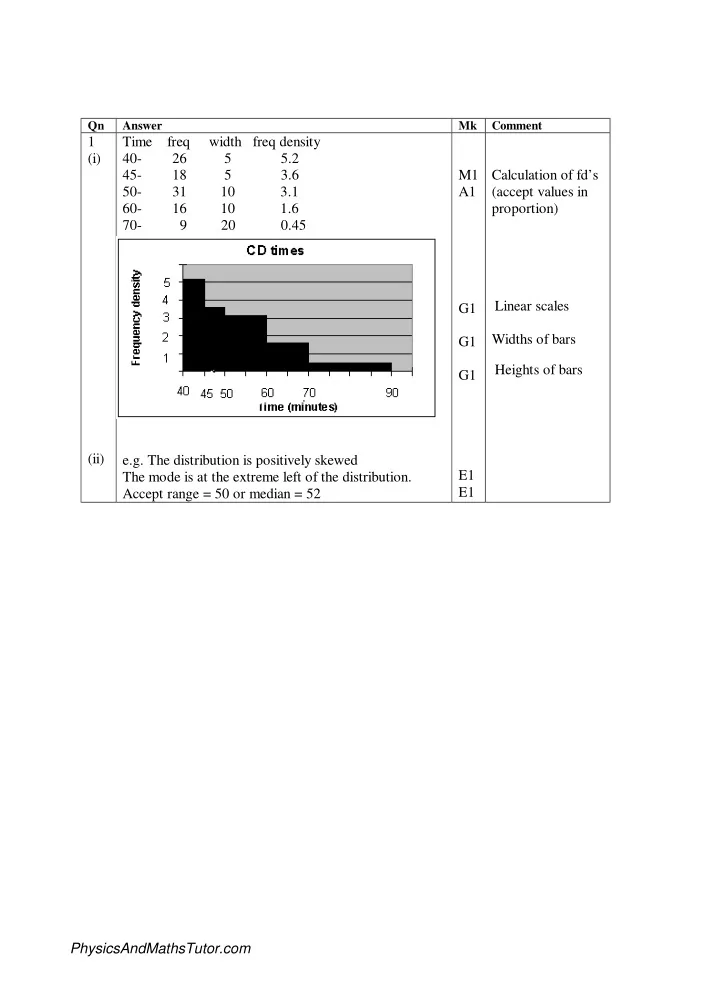
1 (i) (ii) Time freq width freq density 40- 26 5 5.2 45- 18 3.6 50- 31 3.1 60- 16 1.6 70- 9 5 10 10 20 0.45 e.g. The distribution is positively skewed The mode is at the extreme left of the distribution. Accept range = 50 or median = 52 M1 A1 G1 G1 G1 E1 E1 Calculation of fd’s (accept values in proportion)
Linear scales
Widths of bars
Heights of bars
PhysicsAndMathsTutor.com
SLIDE 2
2 (i) A B (ii) (iii) (iv) (v) (vi) Median distance = 88th value = 480 Lower Quartile = 44th value = 320 Upper Quartile = 132nd value = 680 Interquartile range = 680 – 320 = 360 0 320 480 680 1200 Frequency 20 44 54 32 19 Distance 0 < d ≤ 200 200 < d ≤ 400 400 < d ≤ 600 600 < d ≤ 800 800 < d ≤ 1000 1000 < d ≤ 1200 7 Mid (x) f fx 100 20 2000 300 44 13200 500 54 27000 700 32 22400 900 19 17100 1100 7 7700 176 89400 Estimate of mean = 507.95 Mid point of first class now 150 Total increase of 1000 New estimate of mean = 513.6 The point (0,0) would move to (100,0) M1 A1 B1 B1 M1 G1 G1 G1 M1 M1 M1 M1 A1 M1 A1 E1 E1 Within 5 cao ft Basic idea Linear 0 - 1200 Box including median (accurate) Correct classes Correct frequencies mid points fx 150 point (0,0) point (100,0) PhysicsAndMathsTutor.com
SLIDE 3 (i) 3 Positive
CAO [1] (ii) B1 Mean = 5.064 allow 5.1 with working 126.6/25 or 5.06 without SD = 1.324 allow 1.3 with working or 1.32 without B2 Allow B1 for RMSD = 1.297 or var =1.753
Also allow B1 for Sxx = 42.08
SC1 for both mean = 50.64 and SD = 13.24 (even if over-specified) [3] (iii)
x – 2s = 5.064 – 21.324 = 2.416
B1FT
x + 2s = 5.064 + 21.324 = 7.712
M1 A1FT So there is an outlier. E1 FT their mean and sd for x + 2s but withhold final E mark if their limits mean that there are no
For upper limit Incorrect statement such as 7.6 and 8.1 are outliers gets E0 Do not award E1 if calculation error in upper limit For use of quartiles and IQR Q1 = 3.95; Q3 = 6.0; IQR = 2.05 3.95 – 1.5(2.05) gets M1 Allow other sensible definitions of quartiles 6.0 + 1.5(2.05) gets M1 Limits 0.875 and 9.075 So there are no outliers NB do not penalise over-specification here as not the final answer but just used for comparison. FT from SC1 [4]
PhysicsAndMathsTutor.com
SLIDE 4
Question uest Answer Marks Guidance 4 (i) X ~ B(30, 0.85) M1 For 0.8529 × 0.151 = 0.0013466 P(X = 29) = × 0.8529 × 0.151 = 30 × 0.0013466 = 0.0404
30 29
M1 For × p29 × q1
30 29
A1 CAO [3] With p + q = 1 Allow 0.04 www If further working (EG P(X=29) –P(X=28)) give M2A0 (ii) M1 P(X = 30) = 0.8530 = 0.0076 P(X ≥ 29) = 0.0404 + 0.0076 = 0.0480 M1 Allow eg 0.04+0.0076=0.0476 Allow 0.05 with working A1 For 0.8530 For P(X = 29) + P(X = 30) 0) (not necessar correct, but both attempts at binomial, including coefficient in (i)) CAO [3] (iii) Expected number = 10 × 0.0480 = 0.480 M1 A1 For 10 × their (ii) FT their (ii) but if answer to (ii) leads to a whole number for (iii) give M1A0 provided (ii) between 0 and 1 Do not allow answer rounded to 0 or 1. [2]
PhysicsAndMathsTutor.com