QoS over Demand-assigned TDMA Satellite Network Mr. Srinivasan - - PDF document

qos over demand assigned tdma satellite network
SMART_READER_LITE
LIVE PREVIEW

QoS over Demand-assigned TDMA Satellite Network Mr. Srinivasan - - PDF document

QoS over Demand-assigned TDMA Satellite Network Mr. Srinivasan Sukumar Associate Professor Dr. H.S. Cheng Mr. Loh Yeow Meng Krishnappa R Subramanian Mr. Rusmin, Teddy Laboratories for Mr. Pang Yoke Kum Division of Communication Information


slide-1
SLIDE 1

QoS over Demand-assigned TDMA Satellite Network

  • Mr. Srinivasan Sukumar
  • Mr. Loh Yeow Meng
  • Mr. Rusmin, Teddy
  • Mr. Pang Yoke Kum

School of Engineering Temasek Polytechnic, Singapore Associate Professor Krishnappa R Subramanian Division of Communication Engineering Nanyang Technological University, Singapore

  • Dr. H.S. Cheng

Laboratories for Information Technology Agency for Science, Technology and Research, Singapore

Abstract Demand-assigned Time Division Multiple Access (DA-TDMA) is a type of satellite access technology that is superior compared to Frequency Division Multiple Access (FDMA) or Single Channel Per Carrier (SCPC) in terms of efficiency in satellite bandwidth usage. In DA-TDMA, satellite bandwidth is shared among the users at different sites based on allocation of time slots rather than frequency. Hence, all the earth stations of a DA-TDMA -based network will transmit at the same frequency, but not at the same

  • time. In a DA-TDMA -based network, each earth

station is usually allocated a fixed percentage of satellite bandwidth (time slots). Besides, there is a certain percentage of satellite bandwidth, which can be dynamically allocated to the earth stations, basing on users’ demands. As a result, higher efficiency in the use of satellite bandwidth can be

  • achieved. Due to their capability to dynamically

allocate satellite bandwidth based on demand, DA- TDMA -based satellite networks are more suitable to carry “bursty” traffic than FDMA or SCPC-based satellite networks. The efficiency of such satellite bandwidth usage is achieved at the expense of timing delay. This is particularly so, as the traffic is using dynamically assigned satellite bandwidth that imposes a certain amount of delay. Such delay is proportional to the propagation delay of a typical satellite link. Hence, it is important to investigate the effects of providing Quality of Service (QoS) over a DA-TDMA -based satellite network. This article proposes a Very Small Aperture Terminal (VSAT) satellite network architecture with DA-TDMA access to a C-Band satellite transponder that aims to provide Quality of Service for different

  • services. The space segment of this DA-TDMA -

based satellite network comprises a geostationary satellite, with the ground segment based on IPv4 and the Next Generation Internet Protocols, IPv6.

  • 1. Introduction

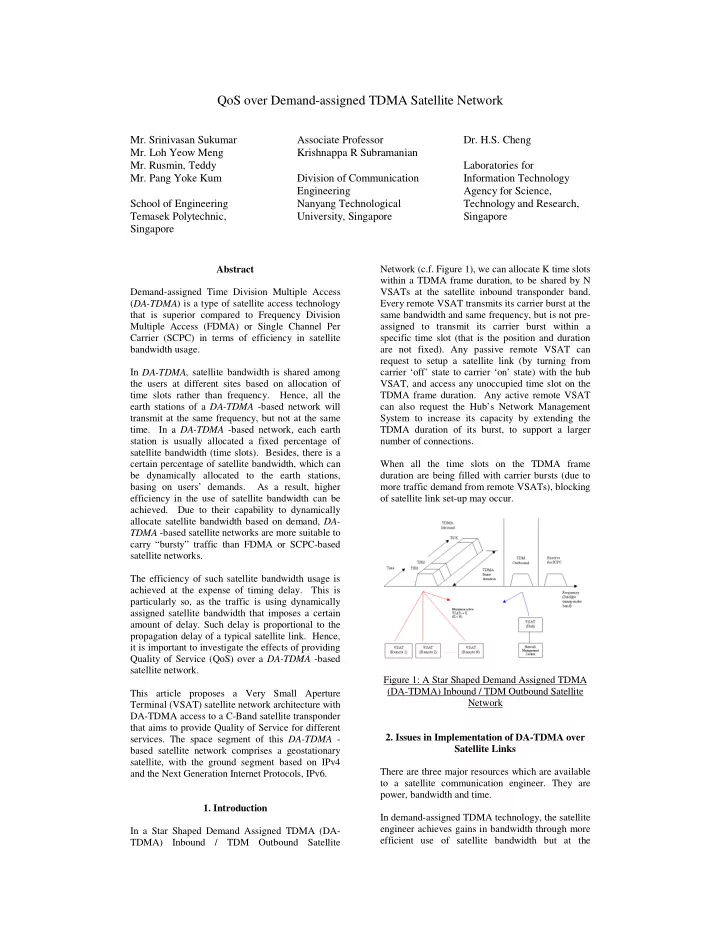
In a Star Shaped Demand Assigned TDMA (DA- TDMA) Inbound / TDM Outbound Satellite Network (c.f. Figure 1), we can allocate K time slots within a TDMA frame duration, to be shared by N VSATs at the satellite inbound transponder band. Every remote VSAT transmits its carrier burst at the same bandwidth and same frequency, but is not pre- assigned to transmit its carrier burst within a specific time slot (that is the position and duration are not fixed). Any passive remote VSAT can request to setup a satellite link (by turning from carrier ‘off’ state to carrier ‘on’ state) with the hub VSAT, and access any unoccupied time slot on the TDMA frame duration. Any active remote VSAT can also request the Hub’s Network Management System to increase its capacity by extending the TDMA duration of its burst, to support a larger number of connections. When all the time slots on the TDMA frame duration are being filled with carrier bursts (due to more traffic demand from remote VSATs), blocking

  • f satellite link set-up may occur.

Figure 1: A Star Shaped Demand Assigned TDMA (DA-TDMA) Inbound / TDM Outbound Satellite Network

  • 2. Issues in Implementation of DA-TDMA over

Satellite Links There are three major resources which are available to a satellite communication engineer. They are power, bandwidth and time. In demand-assigned TDMA technology, the satellite engineer achieves gains in bandwidth through more efficient use of satellite bandwidth but at the

slide-2
SLIDE 2

expense of timing delay. This delay have an impact

  • f the QoS on the various applications in which the

demand-assigned TDMA-based satellite network is

  • supporting. This project examines several issues of

using demand-assigned TDMA technology to interconnect geographically dispersed networks. These issues can be classified into timing-related and channel errors related issues. There are several timing-related issues involved in providing QoS over demand-assigned TDMA-based satellite networks. The first issue is an increase in burstiness of the traffic of any particular source. With real time traffic, an increase in burstiness has the greatest impact on the QoS. The main reason for this is because several earth stations share the same satellite channel and only one earth station is allowed to transmit or "burst" at any one time. The problem can be further aggravated by the less predictable nature of satellite bandwidth allocation compared to pure TDMA technology where the allocation of satellite bandwidth to each earth station is predetermined. In addition, if a transmitting source (at the application level) requests additional satellite bandwidth to be allocated dynamically, there will be an additional delay of twice the propagation delay of the satellite link as the additional time is required for requests to be made to the demand-assigned TDMA satellite modem that is assigning the satellite bandwidth, and also for the bandwidth to be assigned. Such requests will significantly increases the burstiness of the traffic. The second issue is the impact of the significantly increased delay on the performance of transport protocols, which require feedback mechanisms, for flow control. The third issue is the actual implementation of QoS, which uses commercial-off-the-shelf (COTS) products, over demand-assigned TDMA-based satellite networks.

  • 3. Main Considerations in Implementing a DA-

TDMA Satellite Network 1) Satellite bandwidth required to support a wide range of services [1]. 2) Choice of satellite modem. 3) A sufficient energy-per-bit-to-noise density ratio (Eb/No). 4) Internet Protocol used. (IPv4 and IPv6)

  • 4. The Project

The project was consists of two phases. Phase 1 involves the Infrastructure Construction. Phase 2 involves the Network Performance Measurement. Figure 2: Proposed Star Shaped DA-TDMA Satellite Network

  • 5. Phase 1 - DA-TDMA Infrastructure

Construction The project is currently at Phase 1. Thus far, the following infrastructure construction has been completed at Temasek Polytechnic. Figure 3: A DA-TDMA Satellite Loopback Network at Temasek Polytechnic

Ethernet (VLAN1) Ethernet (VLAN17) Ethernet (VLAN18) Ethernet (VLAN19) RF IN (at Hub) RF IN (at Remotes) RF OUT (at Hub) RF OUT (at Reotes)

slide-3
SLIDE 3

A satellite uplink test was successfully conducted. The DA-TDMA Satellite Loopback Network consists of the following: Outdoor units 1) Two 2.4m VSAT dishes. 2) Two Radio Frequency Transceivers (RFTs). 3) Two Solid-state Power Amplifiers (SSPAs). 4) Two feedhorns. Indoor units 1) Five satellite modems. 2) A Network Management System. 3) A Cisco switch. 4) A video conferencing server and video conferencing clients.

  • 6. Phase 2 – Network Performance Measurement

Tests on performance measurement will be carried

  • ut on the following:

1) Impact of Bandwidth on Demand (BoD) on QoS. 2) Impact of Satellite Propagation Delays on QoS. 3) Performance Evaluation for IPv4 and IPv6 Networks. 4) QoS for several applications

  • ver the DA-TDMA satellite network. They will be

done by adjusting different values of setting at different layers of the OSI Layer. a) QoS at Physical Layer (Layer 1) (Wireless Media) In order to prevent loss of connection between the Hub VSAT and the remote VSATs, all transmitting satellite modems have to ensure a sufficient transmit power level so that receiving modems can decode the bits correctly. Receiving system must monitor the Bit Error Rate (BER) and Eb/No values at the receiving modems in order to alert the transmitting party if the required QoS is being compromised. b) QoS at Link Layer (Layer 2) (DA-TDMA, SCPC) In order to prevent under utilising of satellite transponder bandwidth, allocation of the inbound (remote VSATs to Hub VSAT) transmission rate has to be chosen wisely. Transmission of short messages over high inbound transmission link will result in poor channel utilisation while transmission

  • f long messages over low inbound transmission

link will result in longer queuing delay at the transmitter. Therefore, a suitable inbound transmission rate has to be chosen to provide the required QoS for transmission of short and long messages. c) QoS at network layer (Layer 3) Tests under IPv4 and IPv6 platform will be

  • performed. Only the necessary routes will be added

to the routing table. d) QoS at Transport Layer (Layer 4) (TCP) For best performance, the buffer sizes on routers and switches have to be adjusted. e) QoS at Application Layer (Layer 7) (FTP, Video conferencing) For best performance, OS window size has to be adjusted.

  • 7. Schedule

Work accomplished 1. ODU and IDU set-ups at TP 2. Completed satellite loopback test at TP 3. Collected BER and Eb/No data at TP Work in progress 1. Set up modems at USM and UPM 2. Establish satellite links with USM and UPM 3. Set up IPv6 network 4. Measure network performance 5. Video conferencing 6. Set up Mobile IP system

  • 8. Conclusion

The infrastructure construction at Temasek Polytechnic was successfully set up. Currently, the project team is liaising with University Science of Malaysia (USM) and University Putra Malaysia (UPM) to establish satellite links. The BER and the Eb/No values were ascertained (c.f. Table 1) using the DA-TDMA Satellite Loopback Network at Temasek Polytechnic. The method on how the BER and Eb/No values were ascertained is shown in the following flow chart: Figure 4 : Flow Chart On Obtaining BER and Eb/No

slide-4
SLIDE 4

Eb/No BER 2.5 dB 1.0 E-02 3.4 dB 1.2 E-03 4.3 dB 4.5 E-05 5.3 dB 1.5 E-06 6.4 dB 2.5 E-08 7.2 dB 4.5 E-10 8.1 dB 3.5 E-12 9.0 dB <1 E-12 Table 1: Eb/No and BER readings (at 768 kbps, Viterbi ½) The performance measurement on providing QoS

  • ver

demand-assigned TDMA-based satellite networks and the impact of channel errors on the performance of a demand-assigned TDMA satellite network will be carried out within the above Eb/No

  • ranges. FTP and Video Conferencing applications

will be tested under IPv4 and IPv6 platforms. References 1. Hadjitheodosiou, M.H. Coakley, F.p., Evans, B.G., “Next Generation Multiservice VSAT Networks”, July 1997. http://www.isr.umd.edu/~michalis/El_Co mms.pdf 2. Snyder, M., Yu, V., Heissler, J., “Two New Media Access Control Schemes For Networked Satellite Communications”. http://www.mitre.org/support/papers/tech _papers_01/snyder_communications/snyd er_communications.pdf