
SLIDE 1
Quality Enhancement Plan
(QEP)
Think FSU: Improving Critical Thinking in the Disciplines
THE FLORIDA STATE UNIVERSITY
Quality Enhancement Plan (QEP) Think FSU: Improving Critical - - PowerPoint PPT Presentation
Quality Enhancement Plan (QEP) Think FSU: Improving Critical Thinking in the Disciplines THE FLORIDA STATE UNIVERSITY QEP Overall Goal To improve the ability of upper-division FSU students (juniors and seniors) to think critically in their
THE FLORIDA STATE UNIVERSITY
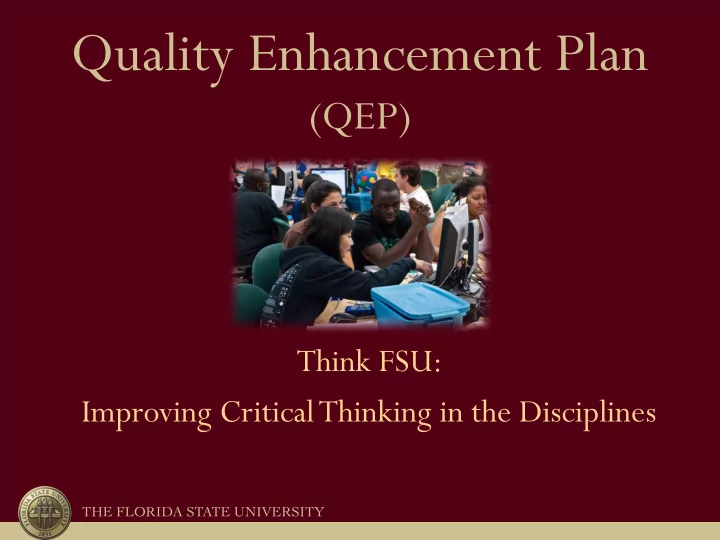
Studio Physics Students in Action
As a result of the QEP, upper-division undergraduates will have improved mastery of the skills associated with superior critical thinking; that is, they will be better able to
Ø Explain an issue/problem clearly and comprehensively Ø Select and use evidence/information effectively in conducting a comprehensive analysis of an issue/problem Ø Analyze contexts, assumptions, and perspectives when presenting a position
Ø Formulate a thesis/hypothesis that takes into account the complexity of an issue/problem and the variety of perspectives on this issue Ø Draw logical conclusions and implications from the analysis
1) The Faculty Fellows Program Designed to improve the critical thinking skills of upper-division undergraduates by improving the teaching and assessment of core courses in the major 2) Disciplinary CT Projects. Designed to improve the critical thinking skills of upper-division undergraduates by providing awards to degree programs that plan to develop and/or implement their own, discipline-specific critical thinking best teaching and learning practices
Thinking Dancers – A Contemporary Dance Technique Class Taught by Pilot Participant Tim Glenn
Photo by Diane Cahill Bedford
Relationship of QEP to Institutional Planning and Institutional Needs
Mandated Academic Learning Compacts)
division undergraduates see a need for a stronger academic challenge
students’ argument skills need improvement
GRE, LSAT and MCAT reflect decline compared to national averages)
“Nearly all employers surveyed (93%) say that ‘a demonstrated capacity to think critically, communicate clearly, and solve complex problems is more important than [a candidate’s] undergraduate major.”
(The Association f American Colleges and Universities, April 10, 2013)
Ø Faculty Fellows Pilot program, aimed at improving CT students learning in upper-division undergraduate courses, ran in Summer 2013 vFaculty and students from 11 different disciplines participated (Biology, Business, Geography, Communication Disorders, Music, Engineering, Religion, Interior Design, Art History, English, Dance, Public Safety) vFaculty participants developed strategies for teaching and assessing CT student learning in their summer courses vFaculty Participants participated in a scoring session using the Critical Thinking Assessment Test (CAT) as a pre-test to measure student learning in their courses Ø Faculty Workshop on use of CT VALUE Rubric for assessing student artifacts ; scheduled scheduled for May, 2014 Ø Hiring of the QEP Director, and other activities associated with establishing the QEP office, scheduled for Spring 2014
For years 1-5, the schedule includes several phases of implementation that include the following activities: Ø Implementation of the Faculty Fellows Program—including marketing, conducting workshops, and assessment Ø Implementation of the Disciplinary Critical Thinking Projects—including marketing, conducting workshops, and assessment Ø Establishing appropriate data collection intervals and conducting planned assessments.
Multiple strategies will be employed to measure the improvement in CT student learning and the overall effectiveness of the QEP.
Ø The AAC&U’s Critical Thinking VALUE Rubric (improvement in treated courses will measured by sampling student artifacts pre and post the CT intervention and scoring them using this rubric) Ø The Student Perception of Courses and Instructors (SPCI) (responses to #4, “This course challenged me to think critically,” will be documented) Ø National Survey of Student Engagement (NSSE) data (responses to the questions about the level of academic challenge in particular will be documented) Ø Faculty Survey of Student Engagement data (FSSE) data (responses to the questions relating to critical thinking skills will be documented)
use of the VALUE rubric from the Association of American Colleges & Universities (AAC&U)
Ø Strengthen student learning in one of the core areas required of every degree program (See State Mandated Academic Learning Compacts) ØCreate a campus environment that supports the improvement of critical thinking in the classroom ØEquip our graduates with a set of transferable critical thinking skills that will better prepare them for a rapidly changing world
Why should FSU do this: Students value critical thinking because even if they do not realize it they are using it in their everyday
impact the students and how the decisions we make will play out. When students are in their own respective organizations/classes, they use previous information they have gained to find new solutions as well as to create their own unique thoughts. What Students Think
Jean Tabares Student Government Association, Secretary of Academic Affairs
11