Quality of Life Outcomes: The Trial to Assess Chelation Therapy - - PowerPoint PPT Presentation

quality of life outcomes the trial to assess chelation
SMART_READER_LITE
LIVE PREVIEW

Quality of Life Outcomes: The Trial to Assess Chelation Therapy - - PowerPoint PPT Presentation

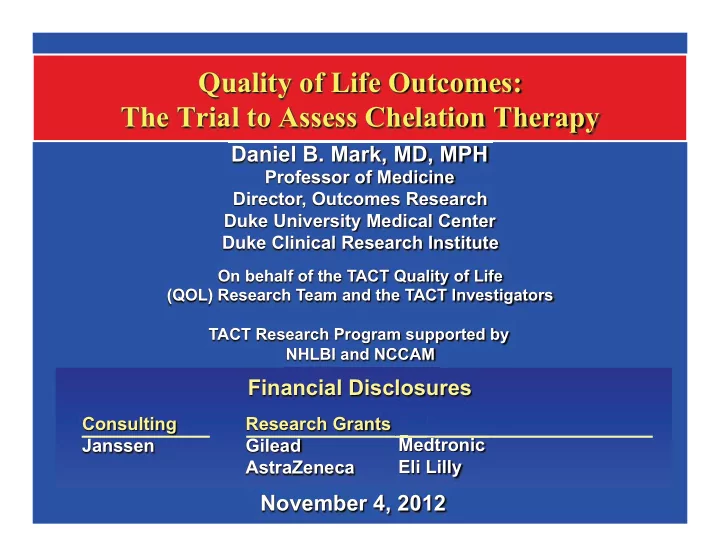
Quality of Life Outcomes: The Trial to Assess Chelation Therapy Daniel B. Mark, MD, MPH Professor of Medicine Director, Outcomes Research Duke University Medical Center Duke Clinical Research Institute e On behalf of the TACT Quality of Life


slide-1
SLIDE 1

Quality of Life Outcomes: The Trial to Assess Chelation Therapy

November 4, 2012 Daniel B. Mark, MD, MPH

Professor of Medicine Director, Outcomes Research Duke University Medical Center Duke Clinical Research Institute

Financial Disclosures

Consulting Janssen Research Grants Gilead AstraZeneca

2

Medtronic Eli Lilly e

On behalf of the TACT Quality of Life (QOL) Research Team and the TACT Investigators TACT Research Program supported by NHLBI and NCCAM

Embargoed for 6:02pm PT, Sunday, Nov. 4 LBCT-02- D. Mark - TACT QofL

slide-2
SLIDE 2

TACT : Background

  • Disodium ethylene diamine tetra acetic acid (EDTA) binds

divalent cations (e.g., lead, calcium) and permits renal excretion

  • Treatment of lead toxicity with EDTA in 1951
  • Report of treatment of angina in 1956 by Clarke with ↓ sx

From 1956 to the present: Use in atherosclerotic disease expanded Evolution of a standardized protocol that included disodium EDTA, ascorbate, B-vitamins, and other components Used clinically by chelation practitioners Chelation discouraged by traditional professional societies

slide-3
SLIDE 3

TACT: Design Overview

  • Age ≥50
  • MI ≥ 6 mos prior to randomization

1,708 post-MI pts

Mean study follow-up 55 mos 1° endpoint: composite of total mortality, recurrent MI, stroke, coronary revascularization, or hospitalization for unstable angina 2° endpoints incl.: quality of life outcomes 134 sites (US, CN)

Chelation + high-dose vitamins Chelation placebo + high-dose vitamins Chelation + vitamin placebo Chelation placebo + vitamin placebo

double-blind 2x2 trial

slide-4
SLIDE 4

TACT 1° Clinical Endpoint

Event Rate

0.0 0.1 0.2 0.3 0.4 0.5

Months since randomization

6 12 18 24 30 36 42 48 54 60

Hazard Ratio 95% CI P-value EDTA:Placebo 0.82 0.69,0.99 0.035

Placebo EDTA Chelation

Number at Risk EDTA Chelation

839 760 703 650 588 537 511 476 427 358 229

Placebo

869 776 701 638 566 515 475 429 384 322 205

death, MI, stroke, coronary revascularization, hospitalization for angina

slide-5
SLIDE 5

TACT Quality of Life Study: Primary Objective

  • To determine whether chelation therapy

significantly improves physical functioning and psychological well-being in stable CAD patients with a history of MI

slide-6
SLIDE 6

TACT QOL Study: Quality of Life (QOL) Methods Overview

  • 911 (53%) of 1708 main TACT pts randomly selected

for QOL substudy

  • QOL structured interviews at baseline, 6 mos, 12

mos, and 24 mos

  • All baseline questionnaires were collected by site

coordinators who were trained by DCRI Outcomes Group

  • Follow-up interviews were conducted via telephone

by DCRI Outcomes Group

  • 97% of expected QOL contacts collected
slide-7
SLIDE 7

TACT QOL Substudy: Primary QOL Outcome Measures

  • DASI - cardiac-related functional status.
  • Scores: 0 (worst) to 58 (best), reflect the ability of patients to

do physical activities without difficulty or assistance in 12 domains.

  • For an individual pt, a clinically significant change is >4 points.
  • MHI-5 - psychological well-being, including both

depression and anxiety.

  • Scores: normalized to 50+10.
  • A clinically significant change for an individual patient is

approximately > 2.5 points.

  • Other measures: SAQ (frequency, stability, QOL),

SF-36, EQ-5D

slide-8
SLIDE 8

TACT QOL: Analysis Methods

  • All primary comparisons by intention to treat
  • Follow-up QOL comparison p values adjusted for vitamin

group and baseline QOL scores

  • No adjustment was made in significance levels for multiple

comparisons.

slide-9
SLIDE 9

TACT QOL Baseline Characteristics

Placebo (n=460) 65 (58 to 72) 19% 8% 80% 12% 7% 2% 79% 9% 10% 2% <1% 35% Age (median) Female Race, nonwhite Current NYHA Class None I II III Current CCS Angina Class None I II III IV Diabetes Chelation (n=451) 64 (58 to 71) 19% 6% 80% 12% 7% 1% 79% 10% 7% 3% <1% 32%

slide-10
SLIDE 10

TACT QOL Outcomes DASI

p= 0.50 0.12 0.27 0.7 1.6 0.5 difference

24.6 29.1 29.4 27.1 23.5 27 26.3 25.1 10 20 30 40 50 Baseline 6 months 12 months 24 months Chelation Placebo

slide-11
SLIDE 11

TACT QOL Outcomes SF-36 MHI-5

Scaled to a norm of 50, SD 10

50 52.1 52.1 52.5 50.1 51.5 51 51.3 10 20 30 40 50 60 70 80 90 100 Baseline 6 months 12 months 24 months

Chelation Placebo

p= 0.50 0.08 0.07 0.4 1.2 1.3 difference

slide-12
SLIDE 12

TACT QOL Outcomes Seattle Angina Questionnaire – Anginal Frequency

Higher scores = less frequent angina

86.3 89.8 92.6 92.9 86 90.2 91.8 91.2 20 40 60 80 100 Baseline 6 months 12 months 24 months

Chelation Placebo

p= 0.31 0.99 0.29

  • 1.4 0.0 1.4

difference

slide-13
SLIDE 13

TACT QOL Outcomes Seattle Angina Questionnaire – Quality of Life

Higher scores = better quality of life

69.8 79.4 80.5 79.4 69.4 79.6 80.8 78.9 20 40 60 80 100 Baseline 6 months 12 months 24 months Chelation Placebo

p= 0.52 0.62 0.92

  • 1.1 -0.9 0.2

difference

slide-14
SLIDE 14

TACT QOL Outcomes: Subgroup Analyses

  • None of the prespecified subgroups showed a

treatment effect on QOL

  • Pts with angina sx at baseline showed a tx

effect at 1 year in favor of chelation therapy (4.99 points, p=0.019), but not at other time points or overall

  • No tx effect was seen in pts with heart failure

sx at baseline

slide-15
SLIDE 15

TACT QOL Outcomes: Caveats

  • Trial population was largely asymptomatic

at baseline (ceiling effect for some measures incl. anginal QOL)

  • QOL assessment follow-up was limited to

2 years, 1° clinical outcomes show continued divergence favoring chelation

  • ut to 5 years
slide-16
SLIDE 16

TACT QOL Outcomes: Summary

  • In a population of stable, predominantly

asymptomatic CAD patients with a history

  • f prior MI, the use of EDTA chelation

therapy did not produce a consistent sustained improvement in any domain of health-related quality of life.

slide-17
SLIDE 17
slide-18
SLIDE 18

TACT QOL Outcomes SF-36 Physical Component Summary

Scaled to a norm of 50, SD 10

42.8 44.7 45.6 44.7 41.7 43.1 43.6 43 20 40 60 80 100 Baseline 6 months 12 months 24 months CABG + MED MED Alone

p= 0.91 0.50 0.47

  • 0.1 0.4 0.5

difference

slide-19
SLIDE 19

TACT QOL Outcomes SF-36 Mental Component Summary

Scaled to a norm of 50, SD 10

50.7 53.2 53.2 53.5 50.4 53.1 52.6 52.3 20 40 60 80 100 Baseline 6 months 12 months 24 months Chelation Placebo

p= 0.57 0.71 0.26

  • 0.4 0.3 0.8

difference

slide-20
SLIDE 20

TACT QOL Outcomes EQ-5D Single Summary Index

Relative desirability of patients current health status

74.9 78.2 81 81.8 73.9 76.1 77.7 75.5 20 40 60 80 100 Baseline 6 months 12 months 24 months Chelation Placebo

p= 0.87 0.18 0.002 0.3 2.1 5.2 difference

slide-21
SLIDE 21

46.7% 46.2% 43.5% 44.0% 42.2% 36.9% 0% 20% 40% 60% 80% 100% 6 months 12 months 24 months Chelation Placebo

TACT QOL Outcomes: Clinically Significant Improvement in DASI from Baseline

p= 0.44 0.26 0.06