Quantum comets Dima Shepelyansky www.quantware.ups-tlse.fr/chirikov - - PowerPoint PPT Presentation

quantum comets
SMART_READER_LITE
LIVE PREVIEW

Quantum comets Dima Shepelyansky www.quantware.ups-tlse.fr/chirikov - - PowerPoint PPT Presentation

Quantum comets Dima Shepelyansky www.quantware.ups-tlse.fr/chirikov (1969-79) Chirikov standard map: p = p + K sin x , x = x + p (K=1.1) (1979) Quantum map (kicked rotator): p 2 / 2 e iK / cos = e i x


slide-1
SLIDE 1

Quantum comets

Dima Shepelyansky www.quantware.ups-tlse.fr/chirikov

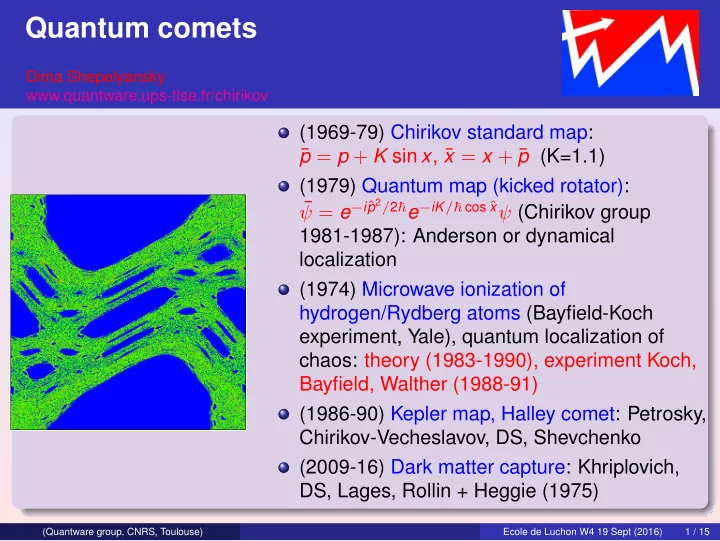
(1969-79) Chirikov standard map: ¯ p = p + K sin x, ¯ x = x + ¯ p (K=1.1) (1979) Quantum map (kicked rotator): ¯ ψ = e−iˆ

p2/2e−iK/ cos ˆ xψ (Chirikov group

1981-1987): Anderson or dynamical localization (1974) Microwave ionization of hydrogen/Rydberg atoms (Bayfield-Koch experiment, Yale), quantum localization of chaos: theory (1983-1990), experiment Koch, Bayfield, Walther (1988-91) (1986-90) Kepler map, Halley comet: Petrosky, Chirikov-Vecheslavov, DS, Shevchenko (2009-16) Dark matter capture: Khriplovich, DS, Lages, Rollin + Heggie (1975)

(Quantware group, CNRS, Toulouse) Ecole de Luchon W4 19 Sept (2016) 1 / 15

slide-2
SLIDE 2

Microwave ionization of hydrogen/Rydberg atoms

Bayfield, Koch PRL (1974) - experiments at Yale: Hydrogen principle quantum number n0 ≈ 66, microwave ω/2π = 9.9GHz, field amplitude ǫ ≈ 10V/cm being smaller than static ionization border ǫst ≈ 30V/cm; NI ≈ 76 photons are required for atom ionization Hamiltonian (in atomic units): H(p, r) = p2/2 − 1/|r| − ǫr cos ωt

Classical description/scaling :

ω0 = ωn03 ≈ 0.43, ǫ0 = ǫn04 ≈ 0.03 < 0.13 Right (1986): Ionization probability as a function of ω0 (numerics: dashed - classical; full - quantum) History of the problem: DS Scholarpedia (2012)

(Quantware group, CNRS, Toulouse) Ecole de Luchon W4 19 Sept (2016) 2 / 15

slide-3
SLIDE 3

Kepler map

variation of energy and phase on one orbital period Classical hydrogen atom in 1d (1983 - 1987) ¯ N = N + k sin φ ¯ φ = φ + 2πω(−2ω ¯ N)−3/2 N = −1/2ωn2 = E/ω is photon number, φ = ωt at perihelion; valid for distance at perihelion q = l2/2 < (1/ω)2/3 linearization of equation for phase near resonant values ¯ φ − φ = 2πm gives ¯ φ = φ + T ¯ N; T = 6πω2n05 Chirikov standard map with K = kT = ǫ0/ǫc; chaotic, diffisive ionization for ǫ0 > ǫc = 1/(49ω01/3); diffusion rate D = k2/2 “Kepler map” term coined in Phys. Rev. A 36, 3501 (1987)

(Quantware group, CNRS, Toulouse) Ecole de Luchon W4 19 Sept (2016) 3 / 15

slide-4
SLIDE 4

Quantum Kepler map and photonic localization

Classical hydrogen atom in 1d (1983 - 1987) Operator commutator [ ˆ N, ˆ φ] = −i in ¯ N = N + k sin φ, ¯ φ = φ + 2πω(−2ω ¯ N)−3/2

  • r ¯

ψ = e−i ˆ

H0 ˆ

Pe−ik cos ˆ

φψ

ˆ H0 = 2π[−2ω(N0 + ˆ Nφ)]−1/2, N0 = −1/(2ωn02) = −NI, ˆ Nφ = −i∂/∂φ. quantum localization of diffusion (like Anderson localization (1958) in disordered solids) ℓφ = D = k2/2 = 3.33ǫ2/ω10/3 fN ∝ exp(−2|N − N0|/ℓφ) Right: n0 = 100, ǫ0 = 0.04, ω0 = 3 (open circles - 1d Schrodinger eq., black circles - the quantum Kepler map, straight line - theory)

(Quantware group, CNRS, Toulouse) Ecole de Luchon W4 19 Sept (2016) 4 / 15

slide-5
SLIDE 5

Delocalization transition

ℓφ > NI = 1/(2ωn02) = n0/2ω0

  • r

ǫ0 > ǫq = ω7/6 /(6.6n0)1/2 = 0.4ω1/6ω0 Right: ionization threshold ǫ0 vs ω0 for Koch (1988) experiment at 36GHz (open circles), 45 ≤ n0 ≤ 80, nI = 90; quantum Kepler map (full circles); dashed/dotted curve - quantum/classical Kepler map theory; interaction time 100 microwave periods (no fit parameters). Physica A 163, 205 (1990) 1d Kepler map gives a good description of real ionization of 3d atom

(Quantware group, CNRS, Toulouse) Ecole de Luchon W4 19 Sept (2016) 5 / 15

slide-6
SLIDE 6

Kepler map for comets

Petrosky Phys. Lett. A (1986) a planet on a 2d circular orbit (radius rp = 1, planet velocity vp = 1) around a star at mass ratio µ = mp/M, comet perihelion distance q ≫ rp Comet dynamics is described by the Kepler map ¯ w = w + F sin x , ¯ x = x + w−3/2 w = v2 is comet rescaled energy; x is planet phase divided by 2π F ≈ 2µq−1/4 exp(−0.94q3/2) Petrosky (1986); Chirikov-Vecheslavov (BINP 1986) - (A&A 1989) kick function from 46 times at perehelion for Halley comet F-kick function for Halley comet from Chirikov-Vecheslavov: diffusive ionization in time tI ∼ TJ(2/F 2) ∼ 107years

(Quantware group, CNRS, Toulouse) Ecole de Luchon W4 19 Sept (2016) 6 / 15

slide-7
SLIDE 7

Chaotic Halley comet

Chirikov-Vecheslavov (1986-1989) Comet dynamics is described by the Halley (modified Kepler) map ¯ w = w + F(x) , ¯ x = x + w−3/2 Main contribution from Jupiter, Saturn Chaotic diffusion, average ionization time is approximately 107 years More about kick function: Rollin, Haag, Lages Phys. Let. A 379, 1017 (2015)

(Quantware group, CNRS, Toulouse) Ecole de Luchon W4 19 Sept (2016) 7 / 15

slide-8
SLIDE 8

Chaotic autoionization

  • f molecular Rydberg states

Rydberg electron interaction with charged rotation core rotating dipole + Coulomb interaction (atomic units) H = (px 2 + py 2)/2 − 1/r + d(x cos ωt + y sin ωt)/r 3 that is approximately H = (px 2 + py 2)/2 − [(x + d cos ωt)2 + (y + d sin ωt)2]−1/2 Exact Kramers-Henneberger transformation gives Hamiltonian of excited hydrogen atom in a circular polarized microwave field with effective ǫ = dω2 H = (px 2 + py 2)/2 − 1/r − ωm + dω2r cos ψ where ψ conjugated to momentum m is the polar angle between direction to electorn and field direction in the rotating frame. Conditions of applicability: d < acore < q = rmin = l2/2 < rω = 1/ω2/3; rω >> acore (core size) for ω ≪ 1/a3/2

core

  • Phys. Rev. Lett. 72, 1818 (1994)

(Quantware group, CNRS, Toulouse) Ecole de Luchon W4 19 Sept (2016) 8 / 15

slide-9
SLIDE 9

Kepler map for rotating dipole

¯ N = N + k sin φ , ¯ φ = φ + 2πω(−2ω ¯ N)−3/2 k ≈ 2.6dω1/3[1 + l2/2n2 + 1.09lω1/3] Chaotic diffusion, average ionization time is approximately tI ≈ N2

I /D ≈ 2/[(2n0ω2)k2]

D = k2/2 The map is approximate since the orbital momentum is only approximately concerved (e.g. Dvorak, Kribbel A&A 227, 264 (1990))

(Quantware group, CNRS, Toulouse) Ecole de Luchon W4 19 Sept (2016) 9 / 15

slide-10
SLIDE 10

Kepler map for rotating dipole

The phase space (En2

0, φ) for the rotating dipole d/n2 0 = 0.000625, ωn3 0 = 4,

l/n0 = 0.3, (a) - continuous equations, (b) - the Kepler map, initial energy is marked by arrow

(Quantware group, CNRS, Toulouse) Ecole de Luchon W4 19 Sept (2016) 10 / 15

slide-11
SLIDE 11

Kepler map for rotating quadrupole (planet/asteroid)

H = (px 2 + py 2)/2 − 0.5[(x − d sin ωt)2 + (y − d cos ωt)]−1/2 −0.5[(x + d sin ωt)2 + (y + d cos ωt)]−1/2 ¯ w = w + A sin 2φ , ¯ φ = φ + 2πω ¯ w−3/2 A ∼ d2ω2 ∼ ∆Qω2 (∆Q ∼ a2

core ∼ d2 being quadrupole

moment) Chaos border ∆Q/R2 > 1/(50ω03) where ∆Q is rotating part of the quadrupole of rigid body, ω0 is the ration between the quadrupole rotaion frequency and the satellite frequency. q < rω = 1/ω2/3 PRL 72, 1818 (1994))

(Quantware group, CNRS, Toulouse) Ecole de Luchon W4 19 Sept (2016) 11 / 15

slide-12
SLIDE 12

Capture of dark matter in the Solar system

Flow of dark matter particles (DMP): f(v) dv =

  • 54

π v2dv u3 exp

  • − 3

2 v2 u2

  • ;

ρg ≈ 4 · 10−25g/cm3, u ≈ 220km/s Dimension argument: ∆mp = ρgTd < σv >; < σv > ∼ √ 54π

G2 mp M u3

; ∆mp ∼ ρgTd √ 54π

G2 mp M u3

For Td ≈ 4.5 · 109years one gets ∆mp ∼ 1021g for Jupiter, density 6 · 10−22g/cm3 assuming rp volume. But in reality Td ∼ 107years is given by diffusion escape time as for Halley comet. From the Kepler map only DMP with |w| < F ≈ 5mpvp2/M are captured with q < rp. On infinity q = (vrd)2/2GM and q ∼ rp gives cross-section: σ ∼ πr 2

d ∼ 2πGMrp/v2 ∼ 2πr 2 p (vp/v)2 ∼ 2πr 2 p M/(5mp) ≫ πr 2 p

(also Heggie MNRAS (1975)) Typical capture/escape velocity v2 ∼ 5mpvp2/M; for Sun-Jupiter v ∼ 1km/s in agreement with numerics of A.Peter PRD (2009) Khriplovich, DS Int. J. Mod. Phys. D (2009)

(Quantware group, CNRS, Toulouse) Ecole de Luchon W4 19 Sept (2016) 12 / 15

slide-13
SLIDE 13

Captured mass of dark matter in the Solar system

Capture process continues during time Td ≈ 107years for Sun-Jupiter (Chirikov-Vecheslavov): ∆mp ∼ ρgTd √ 54π

G2 mp M u3

Td ∼ 1/D ∼ (M/mp)2 ∆mp ∼ ρgG2M3/mpu3 ∼ 10−14M DMP density in vicinity of Earth-Jupiter: ρEJ ∼ 5 · 10−29g/cm3 ≪ ρg ≈ 4 · 10−25g/cm3 BUT ρEJ ≫ ρgH ≈ 1.4 · 10−32g/cm3 (4000 times enhancement at u/vp = 17 for galactic density in one kick range 0 < |w| < wH = F) Global density enhancement is also possible at u/vp < 1. => SEE TALK of José Lages Lages, DS MNRAS Lett (2013)

(Quantware group, CNRS, Toulouse) Ecole de Luchon W4 19 Sept (2016) 13 / 15

slide-14
SLIDE 14

Quantum effects for dark matter in binaries?

DMP energy change in number of photons ¯ w = w + F(x) , ¯ x = x + ¯ w−3/2 ∆E = mdFv2

p , ∆Nφ = mdFv2 p Tp/2π = k

diffusion per period, localization: lφ ≈ D ≈ k2/2 < NI = mdv2

p Tp/4π

with vp = rpT/2π, v2

p = 2MG/rp

This gives md < (M/mp)2/[6c√rSrp] , rS = 2MG/c2 Schwarzschild radius This gives for Sun-Jupiter md < 2 · 10−16me This mass is too small and thus quantum effects are not important for DMP ALL THIS FROM 46 appearences of Halley comet

(Quantware group, CNRS, Toulouse) Ecole de Luchon W4 19 Sept (2016) 14 / 15

slide-15
SLIDE 15

Chaotic notes on resonant nonlinear interactions

  • f asteroids

Chirikov, DS Sov. J. Nucl. Phys. (1982) 3d ocsillator Hamiltonian H = (p2

x + p2 y + p2 z)/2 + (x2 + y2 +

z2)/2 + (x2y2 + x2z2 + y2z2)/2 Kolmogorov-Sinai entropy (max Lyapunov exponent, H → 0) h/H = hR = const measure of chaos at H → 0 about 50% + Mulansky, Ahnert, Pikovsky, DS J.

  • Stat. Phys. 145, 1256 (2011)

chaos measure µ ∼ ǫ, λ ∼ ǫ1/2

(Quantware group, CNRS, Toulouse) Ecole de Luchon W4 19 Sept (2016) 15 / 15