
SLIDE 1
10/06/19
1
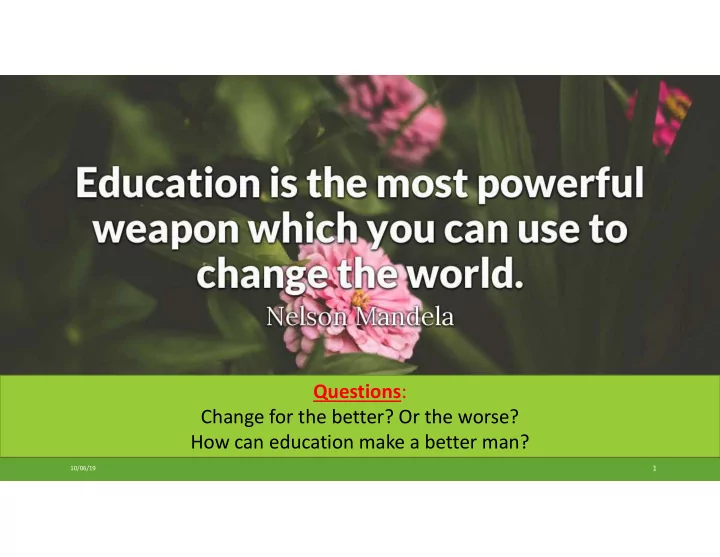
Questions: Change for the better? Or the worse? How can education make a better man?
Questions : Change for the better? Or the worse? How can education - - PowerPoint PPT Presentation
Questions : Change for the better? Or the worse? How can education make a better man? 10/06/19 1 Re-imagining Education VALUES-BASED STREAM EDUCATION PRESENTED BY: MARCUS LIM 10/06/19 2 Part 1: S.T.R.E.A.M. (Science Technology Robotics
10/06/19
1
Questions: Change for the better? Or the worse? How can education make a better man?
VALUES-BASED STREAM EDUCATION
10/06/19
2
PRESENTED BY: MARCUS LIM
(Science Technology Robotics Engineering Arts Math)
10/06/19
3
today need to prepare themselves for?
jobs that do not yet exist?
do so?
10/06/19
4
/ vehicles / machines / facilities)
machines, and jobs replaced by machines.
some key technologies brought about by the 4th Industrial Revolution. Examples:-
exchanges => access to knowledge and getting things done remotely
by today’s supercomputing power.
Keyboard.
10/06/19
5
Source: World Economic Forum
10/06/19
6
10/06/19
7
Sources: WEF; EMSI; Oxford Economic Forecasting; US Bureau of Labor Statistics; McKinsey analysis
10/06/19
8
10/06/19
9
Source: World Economic Forum
10/06/19
10
Source: Centre for Curriculum Redesign
10/06/19
11
10/06/19
12
10/06/19
13
Answers: https://sturiel.com/robotics/
10/06/19
14
10/06/19
15
10/06/19
16
10/06/19
17
10/06/19
18
10/06/19
19
10/06/19
20
10/06/19
21
10/06/19
22
Student A: Becomes an AI expert developing robots that transforms healthcare. Student B: Becomes an AI expert developing autonomous weapons for terrorists.
10/06/19
23
The Space Shuttle Challenger Explosion and the O-ring 7 crew members died October 29, 2018 / March 10, 2019 2 brand-new Boeing 737 Max crashes in 5 months raises questions 346 dead
10/06/19
24
Technologies Human Values
Question: How do students of today create future value through technologies, and in so doing improve their own socio-economic conditions as well as make the world better?
How do we educate students to have:
Wisdom
to know what is GOOD or BAD
Courage and Will-power
to do what is GOOD, and avoid what is BAD in the context of the 4th Industrial Revolution?
10/06/19
25
10/06/19
26
Think: Nike, McDonald´s, P & G, Levis, Apple, Google, BMW, Nestle, Coca Cola, IBM... What do these great brands have in common? They do not sell products. All of them sell universal values: eg. Friendship, Success, Youth, Freedom, Independence, Prestige, Security, Progress, Family junction, Back to Basics, Vanguard. Why: Because people do not buy products, people buy images. And which are the images with the greatest selling power?
Universal values.
10/06/19
27
What is valuable to human beings? What are Natural Goods? What are Moral Goods? Values are shaped throughout history by culture, religion, location, language, politics.. etc. A value is a universal value if it has the same value or worth for all, or almost all, people.
10/06/19
28
Basic characteristic: they are all human values. They are listed as priorities in the ideal life of any person
They have always been there, from the first symptom of human life existence and have been getting stronger in every civilization. The 4th Industry will require students to understand Universal Values if they want to succeed in the future. They have a definite advantage: they are free. Schools and companies do not have to pay any royalties for them, nor any commission. And they can produce socio-economic benefits to those that learn how to use them.
10/06/19
29
Examples:
10/06/19
30
https://en.wikipedia.o rg/wiki/Golden_Rule
10/06/19
31
10/06/19
32
Think: Country, Religion, Culture, Family, Politics etc.
10/06/19
33
10/06/19
34
10/06/19
35
Universal Values
10/06/19
36
10/06/19
37
10/06/19
38
Download: http://sturiel.com/Files/ADF/