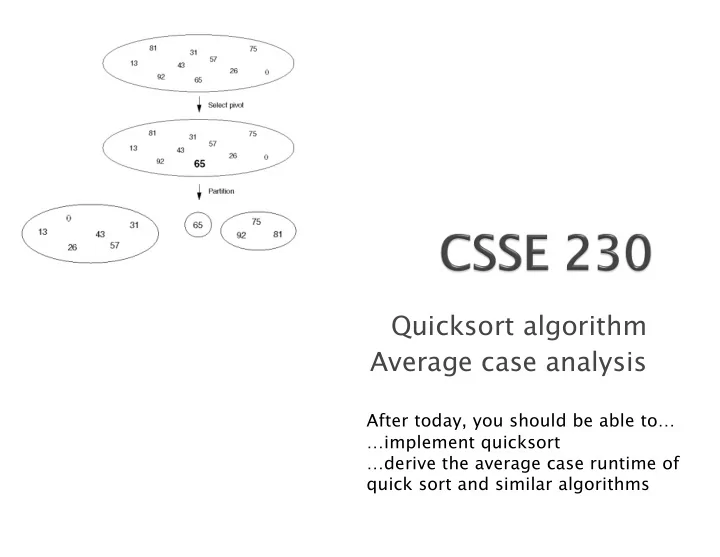
SLIDE 1
Quicksort algorithm Average case analysis
After today, you should be able to… …implement quicksort …derive the average case runtime of quick sort and similar algorithms
SLIDE 2
SLIDE 3
For any recurrence relation in in th the f form: 𝑈 𝑂 = 𝑏𝑈 𝑂 𝑐 + 𝜄 𝑂! , 𝑥𝑗𝑢ℎ 𝑏 ≥ 1, 𝑐 > 1 The solution is: 𝑈 𝑂 = 0 𝜄(𝑂"#$!%) 𝑗𝑔 𝑏 > 𝑐! 𝜄(𝑂!𝑚𝑝𝑂) 𝑗𝑔 𝑏 = 𝑐! 𝜄(𝑂!) 𝑗𝑔 𝑏 < 𝑐!
Theorem 7.5 in Weiss
Q1 Q1-3
SLIDE 4 } Side-by-side animations (now)
www.sorting-algorithms.com
} Others:
- Sounds of sorting (we’ll do next class)
- https://www.youtube.com/watch?v=kPRA0W1kECg
- Color wheel animations (later?)
https://www.youtube.com/watch?v=y9Ecb43qw98
SLIDE 5 http://www.xkcd.com/1185/
Stacksort connects to StackOverflow, searches for “sort a list”, and downloads and runs code snippets until the list is sorted. For real: https://gkoberger.github.io/stacksort/
SLIDE 6 } Invented by C.A.R. “Tony” Hoare in 1961 } Very widely used } Guiding principle:
- Like in basketball, it’s all
about planting a good pivot.
Image from http://www.ultimate-youth-basketball-guide.com/pivot-foot.html.
A quote from Tony Hoare: There are two ways of constructing a software design: One way is to make it so simple that there are obviously no deficiencies, and the other way is to make it so complicated that there are no obvious deficiencies. The first method is far more difficult.
SLIDE 7
SLIDE 8
Q4
SLIDE 9
// Assume min and max indices are low and high pivot = a[low] // will do better later… i = low+1, j = high while (true) { while (a[i] < pivot) { i++ } while (a[j] > pivot) { j–– } if (i >= j) break swap(a, i, j) } swap(a, low, j) // moves the pivot to the // correct place return j
Q5 Q5
SLIDE 10 } Let T(N) be the # of comparisons of array elements
needed to quicksort N elements.
} What is T(1)? } Otherwise T(N) is the sum of
- time for partition
- time to quicksort left part: T(NL)
- time to quicksort right part: T(NR)
} T(N) = N + T(NL) + T(NR) } What’s the best case? What’s the worst case? } Write and solve each now!
SLIDE 11 } T(N) = average # of comparisons of array
elements needed to quicksort N elements.
} What is T(0)? T(1)? } Otherwise T(N) is the sum of
aver erag age time to quicksort left part: T(NL)
aver erag age time to quicksort right part: T(NR)
} T(N) = N + T(NL) + T(NR)
SLIDE 12
} Harder than just a single case…
SLIDE 13
} We always need to make some kind of
“distribution” assumptions when we figure out Average case
}
Assume that when we execute k = partition(pivot, i, j), all positions i..j are equ equal ally likel ely places for the pivot to end up
} Thus NL is equally likely to have each of the
values 0, 1, 2, … N-1
} NL+NR = N-1; thus NR is also equally likely to have
each of the values 0, 1, 2, … N-1
} Thus T(NL)= T(NR) =
Q8 Q8
SLIDE 14 } T(N) = } Multiply both sides by N } Rewrite, substituting N-1 for N } Subtract the equations and forget the insignificant
(in terms of big-oh) -1:
} Can we rearrange so that we can telescope?
Q9 Q9-10 10
SLIDE 15 } NT(N) = (N+1)T(N-1) + 2N } Solve using telescoping and iteration:
- Divide both sides by N(N+1)
- Write formulas for T(N), T(N-1),T(N-2) …T(2).
- Add the terms and rearrange.
- Notice the familiar series
- Multiply both sides by N+1.
Q1 Q11-13 13
SLIDE 16 } Best, worst, average time for Quicksort } What causes the worst case? } We can guarantee we never hit the worst case
- How?
- But this makes quicksort slower than merge sort in
practice.
SLIDE 17 } Avoid the worst case
- Select pivot from the middle
- Randomly select pivot
- Me
Median of 3 pivot selection. (You’ll want this.)
- Median of k pivot selection
} "Switch over" to a simpler sorting method (insertion)
when the subarray size gets small Weiss's code does Median of 3 and switchover to insertion sort at 10.
- Linked from schedule page
Wh What does the official Java Quicksort do? See the source code! (Search for “OpenJDK collections”, “OpenJDK Arrays”, etc.)
SLIDE 18 Th The partition
- n cod
- de I gave you
- u has 2
2 bugs: 1. 1. It It can walk off the end of the array 2. 2. If If the chosen pivot is duplicated, it can go into an infinite re recurs rsion (st stack overflow) // Assume min and max indices are low and high pivot = a[low] // can do better i = low+1, j = high while (true) { while (a[i] < pivot) i++ while (a[j] > pivot) j-- if (i >= j) break swap(a, i, j) } swap(a, low, j) // moves the pivot to the // correct place return j