Quillens Lemma for affinoid enveloping algebras Konstantin Ardakov - - PDF document

quillen s lemma for affinoid enveloping algebras
SMART_READER_LITE
LIVE PREVIEW

Quillens Lemma for affinoid enveloping algebras Konstantin Ardakov - - PDF document

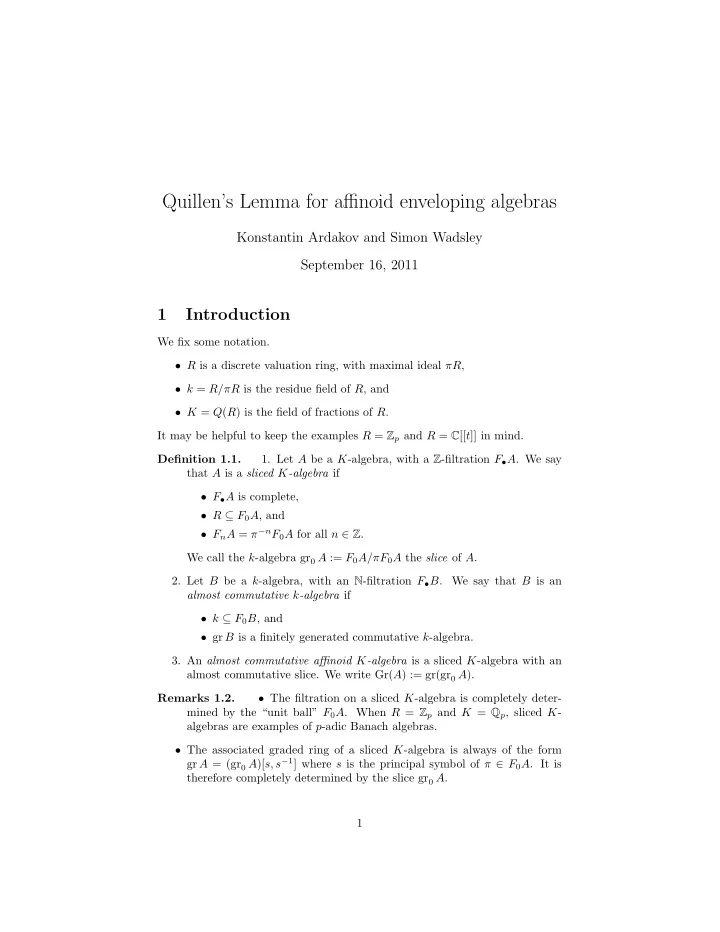
Quillens Lemma for affinoid enveloping algebras Konstantin Ardakov and Simon Wadsley September 16, 2011 1 Introduction We fix some notation. R is a discrete valuation ring, with maximal ideal R , k = R/R is the residue field of R


slide-1
SLIDE 1

Quillen’s Lemma for affinoid enveloping algebras

Konstantin Ardakov and Simon Wadsley September 16, 2011

1 Introduction

We fix some notation.

  • R is a discrete valuation ring, with maximal ideal πR,
  • k = R/πR is the residue field of R, and
  • K = Q(R) is the field of fractions of R.

It may be helpful to keep the examples R = Zp and R = C[[t]] in mind. Definition 1.1.

  • 1. Let A be a K-algebra, with a Z-filtration F•A. We say

that A is a sliced K-algebra if

  • F•A is complete,
  • R ⊆ F0A, and
  • FnA = π−nF0A for all n ∈ Z.

We call the k-algebra gr0 A := F0A/πF0A the slice of A.

  • 2. Let B be a k-algebra, with an N-filtration F•B. We say that B is an

almost commutative k-algebra if

  • k ⊆ F0B, and
  • gr B is a finitely generated commutative k-algebra.
  • 3. An almost commutative affinoid K-algebra is a sliced K-algebra with an

almost commutative slice. We write Gr(A) := gr(gr0 A). Remarks 1.2.

  • The filtration on a sliced K-algebra is completely deter-

mined by the “unit ball” F0A. When R = Zp and K = Qp, sliced K- algebras are examples of p-adic Banach algebras.

  • The associated graded ring of a sliced K-algebra is always of the form

gr A = (gr0 A)[s, s−1] where s is the principal symbol of π ∈ F0A. It is therefore completely determined by the slice gr0 A. 1

slide-2
SLIDE 2
  • To define an almost commutative affinoid K-algebra, one needs extra data
  • f an N-filtration on the slice gr0 A of a sliced K-algebra A.

Examples 1.3.

  • 1. Let g be an R-Lie algebra which is free of finite rank as

an R-module. Let F0A := U(g) := lim ← − U(g) πnU(g) be the π-adic completion of the R-enveloping algebra U(g) of g. Then A := U(g)K := F0A 1 π

  • becomes a sliced K-algebra with slice

gr0 A = U(g) πU(g) ∼ = U(gk), the enveloping algebra of the mod π reduction gk := g/πg of g. Since this last enveloping algebra is well-known to be almost commutative, we see that U(g)K is an almost commutative affinoid K-algebra. We call it an affinoid enveloping algebra.

  • 2. Let Am(R) = R[x1, . . . , xm; ∂1, . . . , ∂m] be the mth Weyl algebra over R;

thus Am(R) = Rx1, . . . , xm, y1, . . . , ym [xi, xj] = 0, [yi, yj] = 0, [yi, xj] = δij. We form

  • Am(R)K in the same way; thus
  • Am(R) = lim

← − Am(R) πnAm(R) is the π-adic completion of Am(R) and

  • Am(R)K =

Am(R) 1 π

  • is again an almost commutative affinoid K-algebra. We call it the mth-

affinoid Weyl algebra. Lemma 1.4. Let A be an almost commutative affinoid K-algebra. Then

  • 1. A is Noetherian.
  • 2. Every quotient of A is again almost commutative affinoid.
  • 3. If Gr(A) is a domain/has finite global dimension/is Auslander-regular/

· · · , then A also has the corresponding property. 2

slide-3
SLIDE 3

2 Motivation

  • Affinoid enveloping algebras

U(g)K arise as particular microlocalisations

  • f Iwasawa algebras.
  • Affinoid Weyl algebras
  • Am(R)K arise in Berthelot’s theory of arithmetic

differential operators.

  • The slice of the affinoid Weyl algebra is just the Weyl algebra Am(k) over

the residue field k of R. In particular, if k = Fp is the algebraic closure

  • f Fp then we can view this slice as the algebra of crystalline differential
  • perators on the affine m-space Am

k .

  • Crystalline differential operators were used by Bezrukavnikov, Mirkovic

and Rumynin to study representations of Lie algebras in prime character- istic.

  • Soibelman also constructed examples of almost commutative affinoid alge-

bras by π-adically completing quantized function algebras and quantized enveloping algebras. However, the main motivation comes from rigid analytic geometry.

3 Rigid analytic geometry

Let g = Rx, the one-dimensional Lie algebra over R. Then it is easy to see that Kx := U(g)K = ∞

  • a=0

λaxa ∈ K[[x]] : λa → 0 as a → ∞

  • is an algebra. It is known as the Tate algebra. Note that every f ∈ Kx can

be evaluated at any point ξ in the unit ball

  • K := {ξ ∈ K : |ξ| 1}.

Fact 3.1. Let GK := Gal(K/K) be the absolute Galois group of K. Evaluation at ξ ∈ oK induces a bijection between the GK-orbits on oK, and the maximal ideals in Kx:

  • K/GK

∼ =

− → MaxSpec Kx. Here are the classical definitions in the commutative theory. Definition 3.2.

  • 1. An affinoid algebra is a quotient of some Tate algebra

Kx1, . . . , xn := U(a)K for some abelian R-Lie algebra a = Rx1 ⊕ · · · ⊕ Rxn.

  • 2. A rigid analytic variety is MaxSpec(A) for some affinoid K-algebra A.

3

slide-4
SLIDE 4

Examples 3.3.

  • 1. The set of GK-orbits on the n-dimensional polydisc on

K

arises as the maximal ideal spectrum of the nth-Tate algebra Kx1, . . . , xn.

  • 2. The descending chain of Tate algebras

Kx ⊃ Kπx ⊃ Kπ2x ⊃ · · · corresponds to a cover of the full π-adic line K by closed balls of ever- increasing radius:

  • K ⊂ 1

π oK ⊂ 1 π2 oK ⊂ · · ·

  • 3. The “unit circle” {ξ ∈ K : |ξ| = 1}/GK is a rigid analytic variety, since

{ξ ∈ K : |ξ| = 1}/GK = MaxSpec Kx, x−1 = MaxSpec Kx, y xy − 1. It is open in the usual π-adic topology by the strict triangle inequality |a + b| max |a|, |b| which is always valid in the p-adic world. Remarks 3.4.

  • 1. Because the p-adic topology is totally disconnected, the

naive definition of analytic functions as those that locally have a power series expansion does not lead to a satisfying theory. Instead, John Tate defined in 1962 a very weak topology on p-adic spaces such as K/GK (actually, a Grothendieck topology) — and also a sheaf O of rigid analytic functions on these p-adic spaces, by using affinoid algebras. For example, O(oK/GK) = Kx and more generally, O(MaxSpec(A)) = A for an affinoid algebra A.

  • 2. An excellent introduction to this subject can be found in an expository

paper by Peter Schneider, available here: http://www.math.uni-muenster.de/u/pschnei/publ/pap/rigid.ps

  • 3. Now return to our original setting, where gR was an arbitrary R-Lie al-

gebra, free of rank n as an R-module. If x1, . . . , xn is a basis for g over R, then as a K-vector space we can still view the affinoid enveloping algebra U(g)K as an algebra of certain power series, this time in the non- commuting variables x1, . . . , xn:

  • U(g)K =

α∈Nn

λαxα : λα → 0 as |α| → ∞

  • .

It is tempting to therefore think of U(g)K as a rigid analytic quantization

  • f the polydisc on

K/GK.

4

slide-5
SLIDE 5
  • 4. More generally, the descending chain of affinoid enveloping algebras
  • U(g)K ⊃
  • U(πg)K ⊃
  • U(π2g)K ⊃ · · ·

should be viewed as a rigid analytic quantization of the closed balls

  • n

K ⊂ 1

π on

K ⊂ 1

π2 on

K ⊂ · · ·

  • f course, up to the action of the Galois group GK.
  • 5. We are currently trying to “quantize” rigid analytic symplectic spaces,

such as cotangent bundles of smooth rigid analytic varieties. To do this, we plan to use the affinoid Weyl algebra and its various deformations.

4 Simple modules

Recall “Quillen’s Lemma”, which is really a Theorem! Theorem 4.1 (Quillen, 1969). Let M be a simple module over an almost com- mutative k-algebra A and let ϕ : M → M be an A-linear endomorphism. Then ϕ is algebraic over k. Corollary 4.2. Every simple U(gk)-module has a central character. It is natural to try to prove a direct analogue of Quillen’s Lemma in the affinoid world. Thus we make the following Conjecture 4.3. Let M be a simple module over an almost commutative affi- noid K-algebra A and let ϕ : M → M be an A-linear endomorphism. Then ϕ is algebraic over K. Here is our main result, which has already been improved during the Work- shop! Thanks are due to Michel Van den Bergh and Lance Small for several very helpful remarks. Theorem 4.4. Suppose that Gr(A) is Gorenstein. Then the conjecture holds. To explain some of the ideas involved in the proof of this result, let us begin by recalling Quillen’s original argument. Proof of Theorem 4.1. Give M some good filtration over A[ϕ], and view gr M as a finitely generated (gr A)[ϕ]-module. By the Generic Flatness Lemma, we may find some non-zero element f ∈ k[ϕ] such that (gr M)f = gr(Mf) is free as a module over k[ϕ]f. It follows that Mf is also free over k[ϕ]f. But k[ϕ]f acts invertibly on M by Schur’s Lemma so k[ϕ]f ∼ = k[ϕ, t]/tf − 1 has to be a field. By the Nullstellensatz, this can only happen if ϕ is algebraic over k. Definition 4.5. Let A, M be as in Conjecture 4.2. 5

slide-6
SLIDE 6
  • 1. An F0A-lattice in M is a finitely generated F0A-submodule N of M such

that M = NK.

  • 2. For any F0A-lattice N in M, let

BN := {b ∈ K(ϕ) : bN ⊆ N} be its normalizer in K(ϕ). Remarks 4.6.

  • BN is always an order in the commutative field K(ϕ), and

BN/πBN acts faithfully on N/πN.

  • If we’re lucky and BN/πBN happens to be a field, then we can run

Quillen’s proof “on the slice” to deduce that BN/πBN is algebraic over k.

  • Because gr0 A is strongly Noetherian, it follows that BN/πBN is finite

dimensional over k.

  • This is enough to deduce that K(ϕ) is finite dimensional over K.

We won’t be so lucky in general. So we hope to improve matters by changing the lattice N. Definition 4.7. We say that N is a regular ϕ-lattice if BN is a discrete valuation ring. This is a slightly weaker condition than what we had considered before, but in fact it suffices: the same proof shows that if M has a regular ϕ-lattice, then ϕ must be algebraic over K.

5 Finding a regular ϕ-lattice

Here is our strategy:

  • Microlocalise M to make gr0 M finite length.
  • Use this condition to find a microlocal regular ϕ-lattice.
  • Use dimension theory over Auslander-Gorenstein rings to lift this microlo-

cal regular ϕ-lattice back to M. Let us assume for simplicity that gr0 A is commutative. After microlocalis- ing, we may assume that Q is a sliced K-algebra with commutative Noetherian semilocal slice and that V is a simple Q-module with slice gr0 V of finite length. By the functoriality of microlocalisaton, V is still a K(ϕ)-module.

  • Fix some F0Q-lattice L0 in V .
  • Let L = {F0Q-lattices L ⊆ V : L ⊆ L0 but L πL0}. We search for a

microlocal regular ϕ-lattice in L. 6

slide-7
SLIDE 7
  • Let P = {BL : L ∈ L}, defined in a similar way.

Here are the main steps of our proof: Theorem 5.1. P has a maximal element. Theorem 5.2. If B ∈ P is maximal, then it must be a discrete valuation ring. So the corresponding F0Q-lattice in V is a regular ϕ-lattice. Sketch proof of Theorem 5.1. Use Zorn’s Lemma. Let (Bα)α∈A be a chain in P and for each α ∈ A let Lα ∈ L be the largest Bα − F0Q subbimodule of L0. Then α β ⇒ Bα ⊆ Bβ ⇒ BαLβ ⊆ Lβ ⇒ Lβ ⊆ Lα, so (Lα)α∈A is a descending chain.

  • Since gr0 V has finite length and F0Q is π-adically complete,

L∞ :=

  • α∈A

Lα is again a lattice in L. Therefore B∞ := BL∞ ∈ P. We claim that B∞ is an upper bound for the chain (Bα) in P. To see this, let α ∈ A; then β α ⇒ BαL∞ ⊆ BαLβ ⊆ BβLβ ⊆ Lβ so BαL∞ ⊆

  • βα

Lβ = L∞ for all α ∈ A, whence

α∈A Bα ⊆ B∞.

More details can be found in Section 8 of our preprint, available here: http://arxiv.org/abs/1102.2606 7