Quiz: Types A. What is the static type of: int f(int x, float y) { - - PowerPoint PPT Presentation

quiz types
SMART_READER_LITE
LIVE PREVIEW

Quiz: Types A. What is the static type of: int f(int x, float y) { - - PowerPoint PPT Presentation

Quiz: Types A. What is the static type of: int f(int x, float y) { return x y; } B. What are the values of the static type? C. What are the operations of this type? Oberon Types Rules (Phase I Checks) Numeric types The INTEGER and REAL types


slide-1
SLIDE 1

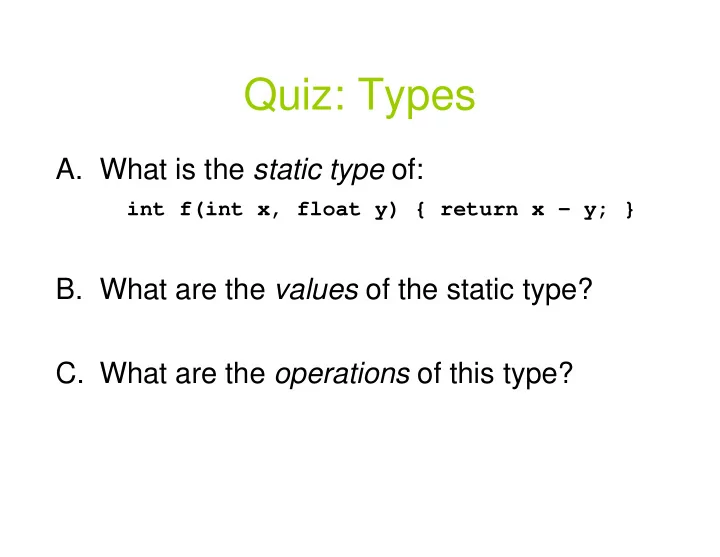
Quiz: Types

  • A. What is the static type of:

int f(int x, float y) { return x – y; }

  • B. What are the values of the static type?
  • C. What are the operations of this type?
slide-2
SLIDE 2

Oberon Types Rules (Phase I Checks)

Numeric types The INTEGER and REAL types Same types Variables a and b with types Ta and Tb are of the same type if

  • 1. Ta and Tb are both denoted by the same type identifier

Type inclusion Numeric types include (the values of) smaller numeric types according to the following hierarchy: REAL >= INTEGER Assignment compatible An expression e of type Te is assignment compatible with a variable v of type Tv if one of the following conditions hold:

  • 1. Te and Tv are the same type;
  • 2. Te and Tv are numeric types and Tv includes Te;
slide-3
SLIDE 3

Expression Compatibility

Operator | first operand second operand result type

  • + - *

| numeric numeric smallest numeric | type including | both operands / | numeric numeric REAL DIV MOD | INTEGER INTEGER INTEGER OR & ~ | BOOLEAN BOOLEAN BOOLEAN = # < | numeric numeric BOOLEAN = # | BOOLEAN BOOLEAN BOOLEAN

slide-4
SLIDE 4

So many operators, so many rules!

  • Take one check at a time (not whole phase)
  • Take one grammar rule at a time (E Op E)
  • Take one type at a time (INTEGER)

Experiences with early pieces lends insight to later ones, making them easier. At each step, compiler should be runnable, and hence testable and gradeable. The following is an incremental development process

slide-5
SLIDE 5

Syntax-Directed Type Checking

First, map abstract syntax in specification to concrete syntax in grammar file

Detect a type conflict in an expression -- that is, expressions of X OP Y where the types of either X

  • r Y are incompatible with OP.

Maps to

Expr ::= Expr:e1 Op:op Expr:e2 {: RESULT = BinaryExpr.action(e1, op, e2); :}

Why not “compatible”? Why not “compatible”?

slide-6
SLIDE 6

Design Pattern: Singleton

  • Known that there will be only value of the class
  • Methods and fields are declared static, no “new”:

class BinaryExpression extends Syntax { static STO action(STO e1, int op, STO e2) { … } } It’s common to name class in lower case (e.g., binaryExpression) so that it looks like a value (since it kind of is a singleton value)

Design Patterns: Elements of Reusable Object-Oriented Software, by Erich Gamma, Richard Helm, Ralph Johnson, and John Vlissides, Addison-Wesley, 1994. TypeValues is a singleton, too TypeValues is a singleton, too Where did this signature come from? Where are the types? Where did this signature come from? Where are the types?

slide-7
SLIDE 7

Simplified Grammar, Oberon Semantics

P ::= D ';' S D ::= D ';' D D ::= ID ':' T T ::= integer | real | boolean E ::= ID | INTLIT | REALLIT | BOOLLIT E ::= E '+' E E ::= E '<' E S ::= S ';' S S ::= ID ':=' E S ::= IF E THEN S

slide-8
SLIDE 8

Implementing E + E check

Expr ::= Expr:e1 Op:op Expr:e2 {: RESULT = BinaryExpr.action(e1, op, e2); :}

Operator | first operand second operand result type

  • + - *

| numeric numeric smallest numeric | type including | both operands

One at a time: only INTEGER, only ‘+’

INTEGER INTEGER INTEGER

slide-9
SLIDE 9

We’re “coding to the spec”

  • Write the code so that it sounds like the spec

– Terminology – Structure – Reading code out loud should sound a bit like reading the spec – Easier to trace back/forward between code/spec

  • This is basically “top down” design/coding

– The code you write won’t be runnable right away – Still have to write the code that makes this code run

slide-10
SLIDE 10

BinaryExpr.action – integer/+ only

ExprSTO action(STO a, String op, STO b) { // In BinaryExpr ExprSTO result = new ExprSTO(); /* don't know type yet */ /* also has no name; give it fake one */ /* t1, t2, ... use static class field for counter */ if (!BinaryExpr.elaborate(result, a, op, b))

  • beron.stopCodeGeneration(); // don’t have to do this, but would for real

return result; } boolean elaborate(ExprSTO result, STO a, int op, STO b) { if (a.type.code == Type.INT && b.type.code == Type.INT) { result.type = a.type; return true; } else { /* reportError automatically prints line number */

  • beron.reportError("Add operand type mismatch (%S + %S)",

a.type.typeName(), b.type.typeName()); result.type = Type.INT; return false; } } if (a.isInt() && b.isInt()) { result.putType(TypeValues.integerType);

result.putType(ErrorType.computeTypeOnError( TypeValues.integerType));
slide-11
SLIDE 11

BinaryExpr.action – Ints, all Ops

  • “a.isInt() && b.isInt()” works for a few Ops, others?
  • The general concept is “expression compatibility”, which also

computes a “result type” …

OpSTO opSTO = (OpSTO) symTab.lookup(op);

if (!BinaryExpr.elaborate(result, a, opSTO, b)) { ... } boolean elaborate(ExprSTO result, STO a, OpSTO op, STO b) { if (op.compatible(a, b)) { // a, b in ParamList later result.putType(op.resultType(a, b)); return true; } else // compute error type ... }

Bodies of new operations merely contain code that they replaced – better modularity and abstraction! (Still int/+, but now easily expandable to others)

Boolean compatible(ExprSTO a, ExprSTO b) { return (a.isInt() && b.isInt()); // copy/pasted } // in OpSTO (temporarily) Boolean compatible(ExprSTO a, ExprSTO b) { return (a.isInt() && b.isInt()); // copy/pasted } // in OpSTO (temporarily)

This is called “access” in your compiler This is called “access” in your compiler

slide-12
SLIDE 12

Design Pattern: Façade

  • Layer of abstraction that provides a

convenient, high-level “one stop” interface to a complex set of functionality

  • In our case, BinaryExpression is a façade for

type elaboration, checking, error reporting, and code generation