( R , < ) is a complete ordered set. Density of the rationals. - - PDF document

r is a complete ordered set density of the rationals
SMART_READER_LITE
LIVE PREVIEW

( R , < ) is a complete ordered set. Density of the rationals. - - PDF document

1 5/6/2010 Dedekind Cuts ( ) A Dedekind cut (D-cut) (aka lower-D-cut ) is a nonempty set A Q so that (i) ( , a ) := { q Q : q < a } A


slide-1
SLIDE 1

1ילרגטנאוילמסטיניפנאובשח

הרזח 5/6/2010

Dedekind Cuts (דניקדדיכתח)

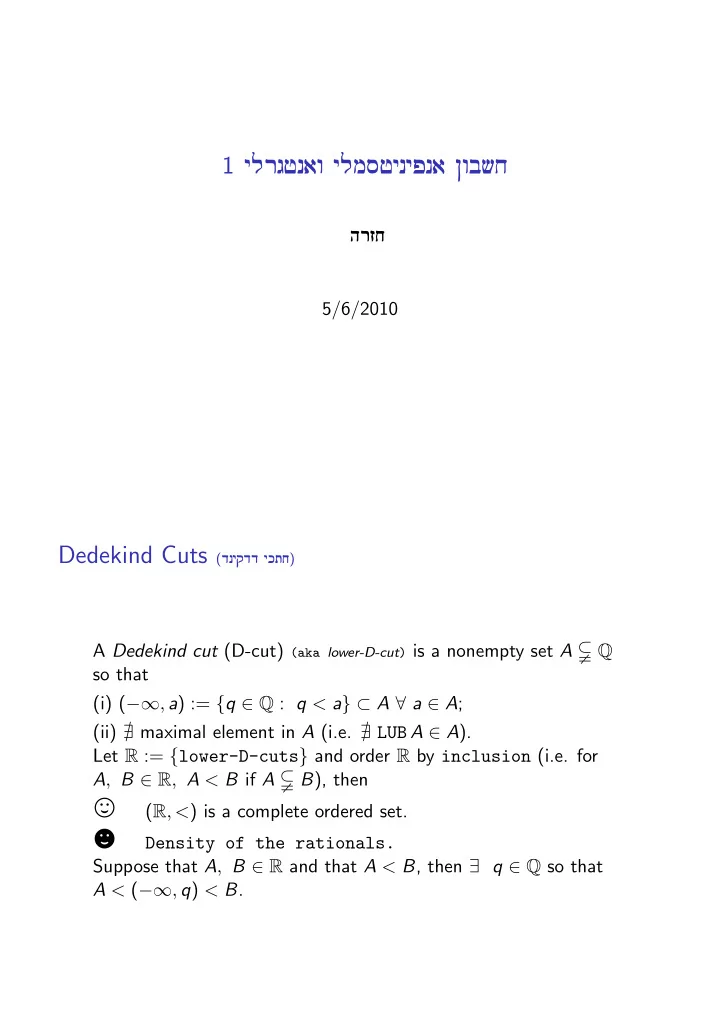
A Dedekind cut (D-cut) (aka lower-D-cut) is a nonempty set A Q so that (i) (−∞, a) := {q ∈ Q : q < a} ⊂ A ∀ a ∈ A; (ii) ∄ maximal element in A (i.e. ∄ LUB A ∈ A). Let R := {lower-D-cuts} and order R by inclusion (i.e. for A, B ∈ R, A < B if A B), then

  • (R, <) is a complete ordered set.
  • Density of the rationals.

Suppose that A, B ∈ R and that A < B, then ∃ q ∈ Q so that A < (−∞, q) < B.

slide-2
SLIDE 2

Decimal representation (תינורשעהגצה) of lower-D-cuts

Decimal representation is a map π : R → Z × DN where D := {digits} = {0, 1, 2, 3, 4, 5, 6, 7, 8, 9} defined by π(A) = (N; d1, d2, . . . ) where max {a ∈ A : 10na ∈ Z} = N +

n

  • k=1

dk 10k

∀ n ≥ 1.

  • π : R → Z × {a ∈ DN : #{k ≥ 1 : ak ≥ 1} = ∞} is a set

correspondence (bijection).

  • Cantor’s Theorem

A non trivial interval in R is uncountably infinite.

Addition in R

Let A, B ∈ R be cuts. Define A + B := {a + b : a ∈ A, b ∈ B},

then,

  • A + B is a cut;
  • neutral element for addition: 0∗ := (−∞, 0);
  • negative of D-cut A: −A := {−b : b ∈ A↑} which is is also a

cut, where; A↑ :=

  • (a, ∞)

A = (−∞, a), a ∈ Q, Q \ A A irrational;

  • A + (−A) = 0∗.
slide-3
SLIDE 3

Positivity and order in R

A D-cut is positive if A > 0∗ (i.e.

A (−∞, 0) or 0 ∈ A).

Let Rpos := {positive D-cuts},

then,

  • ∀ A ∈ R, either A = 0∗, A ∈ Rpos or −A ∈ Rpos;
  • if A, B ∈ Rpos, then A + B ∈ Rpos;
  • let A, B ∈ R, then A < B iff B + (−A) ∈ Rpos.

Absolute value

The absolute value of the D-cut A is |A| ∈ Rpos defined by |A| =      A = 0, A A ∈ Rpos, −A − A ∈ Rpos. In particular (!) |(−∞, a)| = (−∞, |a|).

slide-4
SLIDE 4

Multiplication

We first define multiplication on Rpos. Define the positive part of the positive D-cut A by A+ := A ∩ (0, ∞), then A = (−∞, 0] ∪ A+. For A, B ∈ Rpos, define AB := (−∞, 0] ∪ {xy : x ∈ A+, y ∈ B+} and for A, B ∈ R define A · B :=      A = 0 or B = 0, |A||B| A, B ∈ Rpos or − A, −B ∈ Rpos −|A||B| else.

  • Dedekind’s theorem

(R, +, ·) is a complete ordered field with respect to Rpos.

Archimedean ordered fields

The ordered field (F, +, ·) is called archimedean if ∀ x > 0, ∃ n ∈ N such that nx := x + · · · + x

  • n times

> 1; (i.e. there are no ‘‘infinitesimals").

  • A complete, ordered field (F, +, ·) is archimedean.
slide-5
SLIDE 5

Non-archimedean ordered field

Let (F, +, ·) be the field of rational functions} on R equipped with regular addition and multiplication of functions. Define the “positive elements” of F by Fpos := {R = P

Q ∈ F : ∃ t > 0 so that Q(x) = 0 & R(x) > 0 ∀ x ∈ (0, t)}.

  • Fpos is an ordering for (F, +, ·);
  • F is not archimedean with respect to Fpos.

The complex numbers (יבכורמהירפסמה)

Define the complex numbers by C = R( √ −1) := {x + √ −1y : x, y ∈ R}, with addition and multiplication to satisfy the normal laws of arithmetic.

  • (C, +·) is a field;
  • there is no ordering for (C, +·)
slide-6
SLIDE 6

General existence of real roots

∀ a ∈ Rpos n ∈ N, ∃ !

n√a ∈ Rpos such that(n√a)n = a.

Proof

n√a := LUB A where A := {x ∈ Rpos : xn < a}.

Limit of a sequence

Suppose bn ∈ R (n ∈ N). We say that bn tends to (לאוש) B ∈ R as n → ∞ written bn → B ∈ R as n → ∞;

  • r bn −

n→∞ B

if ∀ ǫ > 0, ∃ nǫ such that |bn − B| < ǫ ∀ n ≥ nǫ. Example If an ≤ an+1 and {an : n ≥ 1} is bounded, then an − →

n→∞ LUB {an : n ≥ 1}.

slide-7
SLIDE 7

Conditions for convergence

¶ Comparison Suppose that an ≥ 0, an → 0 as n → ∞ and that M > 0, bn ∈ R, |bn| ≤ Man ∀ n ≥ 1, then bn → 0 as n → ∞. ¶ Absolute value proposition an → L as n → ∞ iff |an − L| → 0 as n → ∞ and in this case |an| → |L|. ¶ Sandwich principle Suppose that an ≤ xn ≤ bn ∀ n ≥ 1 and that an → L, bn → L as n → ∞, then xn − →

n→∞ L.

Divergence to ∞

We say that the sequence (x1, x2, . . . ) diverges (תרדבתמ) to ∞ (as n → ∞) if for each M > 0, ∃ NM such that xn > M ∀ n ≥ NM (and write this xn → ∞).

  • Let (x1, x2, . . . ) be an increasing sequence, then either

(x1, x2, . . . ) is convergent, or xn → ∞. Examples

n

  • k=1

1 k −

n→∞ ∞, n

  • k=0

1 2k −

n→∞ 2.

slide-8
SLIDE 8

Arithmetic of limits

Suppose that an → a and bn → b as n → ∞, then an + bn → a + b as n → ∞; (1) anbn → ab as n → ∞; (2) and in case b = 0: an bn → a b as n → ∞; (3)

Accumulation points

Let E ⊂ R. A point x ∈ R is called an accumulation point of E if ∀ ǫ > 0, # E ∩ (x − ǫ, x + ǫ) = ∞.

  • The following are equivalent for E ⊂ R and x ∈ R:

(i) x is an accumulation point of E; (ii) ∀ ǫ > 0, ∃ y ∈ E ∩ (x − ǫ, x + ǫ), y = x; (iii) ∃ (z1, z2, . . . ) ∈ E N such that zk = zℓ ∀ k = ℓ & zn − →

n→∞ x.

  • Bolzano-Weierstrass theorem

(accumulation points)

If E is an infinite, bounded set, then E ′ = ∅. The proof of the Bolzano-Weierstrass theorem uses:

  • Cantor’s Lemma

(or the Chinese box theorem)

A nested sequence of non-empty, closed intervals in R has a non-empty intersection.

slide-9
SLIDE 9

Proof of the Bolzano-Weierstrass theorem

Suppose that E ⊂ I a closed, finite interval. For I = [a, b], write I − := [a, a+b

2 ] and I + := [ a+b 2 , b];

I = I − ∪ I + whence ∃ I1 = I ± with # E ∩ I1 = ∞; Similarly ∃ I2 = I ±

1 with # E ∩ I2 = ∞;

continuing, get closed intervals In ⊃ In+1 so that

  • In+1 = I ±

n and # E ∩ In = ∞ ∀ n ≥ 1.

Since |In| = |I|

2n −

n→∞ 0, by Cantor’s lemma, ∞ n=1 In = {Z} for

some Z ∈ R. Z ∈ E ′.

  • Limit points

Let E ⊂ R. A point x ∈ R is called a limit point (לובגתדוקנ) of E if ∃ yn ∈ E (n ≥ 1) such that yn → x. Closure

(רוגס) of E:

{limit points of E} =: E.

  • E = E ∪ E ′

A set is closed if E = E.

  • A closed subset of R which is bounded above (below) has

a maximal (minimal) element.

slide-10
SLIDE 10

Subsequences

An integer subsequence

(ימלשלשהרדיסתת) is an infinite subset

K ⊂ N, K = {n1, n2, . . . } arranged in increasing order n1 < n2 < · · · → ∞. A subsequence of the sequence {a1, a2, . . . } is a sequence of form {an1, an2, . . . } where nk → ∞ is an integer subsequence.

  • Bolzano-Weierstrass Theorem

(convergent subsequences)

Every bounded sequence has a convergent subsequence.

Partial limits of a sequence

The partial limit set

(ייקלחהתולובגתצובק) PL(a1, a2, . . . ) of the

bounded sequence (a1, a2, . . . ) is PL(a1, a2, . . . ) := {a ∈ R : ∃ nk → ∞, ank − →

k→∞ a} = ∅.

  • For (a1, a2, . . . ) a bounded sequence,

#PL(a1, a2, . . . ) = 1 ⇐ ⇒ ∃ limn→∞ an.

  • Let (a1, a2, . . . ) be a bounded sequence, then

PL(a1, a2, . . . ) is closed and bounded.

slide-11
SLIDE 11

Upper and lower limits

The upper limit (וילעלובג) of the bounded sequence (a1, a2, . . . ) is lim

n→∞ an := max PL(a1, a2, . . . )

and the lower limit (ותחתלובג) of the sequence (a1, a2, . . . ) is lim

n→∞

an := min PL(a1, a2, . . . ).

  • (a1, a2, . . . ) converges iff limn→∞ an = limn→∞ an.
  • Let a = (a1, a2, . . . ) be a bounded sequence, then

(i) ∀ α < limn→∞ an, ∃ Nα such that an > α ∀ n > Nα; (ii) ∀ β > limn→∞ an, K ≥ 1, ∃ N > K such that aN < β; (i) ∀ ω > limn→∞ an, ∃ Nω such that an < ω ∀ n > Nω; (ii) ∀ ξ < limn→∞ an, K ≥ 1, ∃ N > K such that aN > ξ;

Cauchy sequences

Or how to prove a sequence converges without knowing the limit. A sequence (a1, a2, . . . ) is called a Cauchy sequence if ∀ ǫ > 0, ∃ Nǫ ≥ 1 such that |an − an′| < ǫ ∀ n, n′ ≥ Nǫ.

  • Cauchy’s Theorem

A sequence converges ⇐ ⇒ it is a Cauchy sequence.

slide-12
SLIDE 12

Newton’s approximation of √ 2 ∈ R

i.e. construction of rational sequences yn − →

n→∞

√ 2. Given y > 0 define f (y) := y

2 + 1 y ∈ R.

For y0 > 0, y2

0 > 2, define yn

(n ≥ 1) by yn+1 := f (yn) (n ≥ 0). It follows that yn > 0, y2

n ≥ 2 ∀ n ≥ 0 and that

y0 ≥ y1 ≥ · · · ≥ yn ≥ yn+1 ≥ . . . . The set A := {yn : n ≥ 0} is bounded below and yn → z := inf A = √ 2.

Continued fractions

Let x ∈ (0, 1], then ∃ a ∈ N, X ∈ [0, 1) such that x =

1 a+X .

¶1 Let x ∈ (0, 1), then x ∈ Q ⇐ ⇒ ∃ n ≥ 1, a1, . . . , an ∈ N such that x = 1| |a1 + 1| |a2 + · · · + 1| |an := 1 a1 +

1 a2+...+ 1

an

. ¶2 Let x ∈ (0, 1) \ Q, then ∃ a1(x), . . . , an(x), · · · ∈ N & X1(x), . . . , Xn(x), · · · ∈ (0, 1) \ Q such that x = 1| |a1(x)+ 1| |a2(x)+· · ·+ 1| |an(x) +Xn := 1 a1(x) +

1 a2(x)+...+

1 an(x)+Xn

.

slide-13
SLIDE 13

Continued fractions

¶3 For a ∈ N, x ∈ R define va(x) :=

1 a+x then for

a1, . . . , an ∈ N, x ∈ R 1| |a1 + 1| |a2 + · · · + 1| |an + y = va1 ◦ · · · ◦ van(y) =: va1,...,an(y); and |v′

a| ≤ 1, |v′ a,b| ≤ 1

  • 4. Whence |v′

a1,...,an| ≤ 1 2n−1 and by MST

|va1,...,an(x) − va1,...,an(y)| ≤

1 2n−1 ∀ x, y ∈ [0, 1].

Convergence of continued fractions

  • Convergence of continued fractions

(i) ∀ x ∈ (0, 1) \ Q, 1| |a1(x) + 1| |a2(x) + · · · + 1| |an(x) − →

n→∞ x;

(ii) if A1, . . . , An, · · · ∈ N, then ∃ lim

n→∞

1| |A1 + 1| |A2 + · · · + 1| |An =: α ∈ [0, 1] \ Q & An = an(α).

slide-14
SLIDE 14

Proof ideas

Proof of (i) | 1| |a1(x) + 1| |a2(x) + · · · + 1| |an(x) − x| = |va1,...,an(0) − va1,...,an(Xn)| ≤

1 2n−1 .

(ii) sketch Write αn := 1| |A1 + 1| |A2 + · · · + 1| |An , then |αn − αn+k| = |vA1,...,An(0) − vA1,...,An(vAn+1,...,An+k(0))| ≤ 1 2n−1 .

Convergence of Averages

¶1 Convergence of arithmetic means Suppose that xn − →

n→∞ L, then

1 n

n

  • k=1

xk − →

n→∞ L.

¶2 Convergence of geometric means Suppose that xn > 0 and xn − →

n→∞ L > 0, then

(

n

  • k=1

xk)

1 n −

n→∞ L.

slide-15
SLIDE 15

Ratio theorem

  • D’Alembert’s ratio theorem

Suppose that an > 0 (n ∈ N) and that an+1

an

− →

n→∞ L, then

a

1 n

n −

n→∞ L.

  • Corollaries

(i) n

1 n −

n→∞ 1;

(ii) 2n

n

1

n −

n→∞ 4.

Proposition e ∃ lim

n→∞( n+1 n )n =: e ∈ (2, 3).

Series

The series ∞

k=1 ak converges if

∃ limn→∞ n

k=1 ak =: ∞ k=1 ak ∈ R.

  • If ∞

k=1 ak converges, then

(i) ∀ N ≥ 1 so does ∞

k=N ak and

(ii) ∞

k=N ak −

N→∞ 0.

slide-16
SLIDE 16

Series with non-negative terms

Write ∞

k=1 ak < ∞ for ∞ k=1 ak converges; and

k=1 ak = ∞ for ∞ k=1 ak diverges.

  • Comparison of positive term series

Suppose that an, bn ≥ 0 (n ≥ 1) and that M > 0, N ≥ 1 are such that an ≤ Mbn ∀ n ≥ N. If ∞

n=1 bn < ∞ , then ∞ n=1 an < ∞.

Absolute convergence of series (ירוטלשטלחהבתוסנכתה)

The series ∞

n=1 an is said to converge absolutely (טלחהבסנכתמרוטה) if

n=1 |an| < ∞.

  • If ∞

n=1 |an| < ∞ , then ∞ n=1 an converges .

Proof (s1, s2, . . . ) is a Cauchy sequence where sn := n

j=1 aj.

  • Convergence of exponential series)

For x ∈ R, the series ∞

k=0 xk k! converges absolutely;

(1 + x

n)n

− →

n→∞ ∞

  • n=0

xn n!

∀ x ∈ R. (e) whence e = limn→∞(1 + 1

n)n = ∞ n=0 1 n! and

  • e /

∈ Q. Proof 0 < e −

q

  • j=0

1 j! ≤ 4 9 1 q!.

slide-17
SLIDE 17

Tests for convergence of series

¶1 Cauchy’s Root test Suppose that an ≥ 0. 1) If lim supn→∞ a

1 n

n < 1, then ∞ n=1 an < ∞.

2) If lim supn→∞ a

1 n

n > 1, then an 0.

¶2 D’Alembert’s ratio theorem

(lim version). Suppose

that an > 0 for large n ∈ N. (i) lim supn→∞ a

1 n

n ≤ lim supn→∞ an+1 an ;

(ii) lim infn→∞ a

1 n

n ≥ lim infn→∞ an+1 an .

¶3 Cauchy’s condensation test Suppose that an ≥ an+1 ↓ 0 and let b ∈ N, b ≥ 2, then

  • n=1

an < ∞ ⇔

  • n=1

bnabn < ∞. ¶4 Leibnitz’s Theorem Suppose that an ≥ an+1 ↓ 0, then the series ∞

n=1 an(−1)n+1 converges and 0 < ∞ n=1 an(−1)n+1 < a1.

Power series and radius of convergence

Cauchy-Hadamard Theorem Let an ∈ R (n ≥ 0) and set R := 1 lim n |an| ∈ [0, ∞]. a) If |x| < R, then the series ∞

n=1 anxn converges absolutely,

and b) if |x| > R, then the series ∞

n=1 anxn diverges.

The series ∞

n=1 anxn is known as a power series and R is known

as its radius of convergence. It defines a R-valued function on (−R, R).

slide-18
SLIDE 18

Real powers of positive real numbers

  • Theorem exp

∃ an increasing bijection exp : R → R+ so that exp(1) = e and exp(x + y) = exp(x) exp(y) ∀ x, y ∈ R. (‡) Theorem exp follows from

  • Theorem log ∃ an increasing bijection log : R+ → R so

that log(e) = 1 and log(xy) = log(x) + log(y) ∀ x, y ∈ R+. (†)

Powers and logs

Define for a > 0 ar := exp(r log(a)) ∀ r ∈ R.

  • For a, b > 0, r, s ∈ R

(i) (ab)r = arbr, (ii) ar+s = aras, (iii) (ar)s = ars.

  • Exponential continuity proposition

(i) If xn − →

n→∞ t ∈ R, then exp(xn) −

n→∞ exp(t).

(ii) If an > 0 and an − →

n→∞ a > 0, then log(an) −

n→∞ log(a).

Suppose that a > 0, t ∈ R and xn ∈ R. (iii) If xn − →

n→∞ t ∈ R, an > 0 and an −

n→∞ a > 0, then axn n

− →

n→∞ at.

  • Theorem e

ex =

  • n=0

xn n! ∀ x ∈ R.

slide-19
SLIDE 19

Limits of functions

Let f : (a, b) → R and suppose that A ⊂ (a, b), c ∈ A′. We say that f (x)

Heine

− →

x→c, x∈A L if

xn ∈ A, xn → c = ⇒ f (xn) → L. We say that f (x)

Cauchy

− →

x→c, x∈A L if

∀ ǫ > 0, ∃ δ > 0 such that |f (x)−L| < ǫ whenever x ∈ A, |x−c| < δ. Equivalence Theorem Let f : (a, b) → R and suppose that A ⊂ (a, b), c ∈ A′, then f (x)

Heine

− →

x→c, x∈A L

⇐ ⇒ f (x)

Cauchy

− →

x→c, x∈A L.

  • (1 + x)

1 x

− →

x→0, x∈R+ e.

Cauchy’s condition

Let A ⊂ (a, b) and suppose c ∈ A′. The function f : (a, b) → R, satisfies Cauchy’s condition at c along A if ∀ ǫ > 0, ∃ δ > 0 such that |f (x)−f (y)| < ǫ whenever x ∈ (c−δ, c+δ)∩A. Proposition For f : (a, b) → R, A ⊂ (a, b) and c ∈ A′: ∃ limx→c, x∈A f (x) iff f : (a, b) → R, satisfies Cauchy’s condition at c along A.

slide-20
SLIDE 20

Continuous functions

The function f : (a, b) → R is continuous at c ∈ (a, b) if f (x) − →

x→c f (c);

The function f : (a, b) → R is continuous on A ⊂ (a, b) if it is continuous at every c ∈ A. The elementary functions (as in the list–rational, trigonometric, exponential, logarithmic functions) are continuous

  • n their domains of definition.

Discontinuous examples

¶1The “salt and pepper function” Let D : R → R be defined by D(x) =

  • 1

x ∈ Q, x / ∈ Q. This function is continuous nowhere. ¶2The “salad cream function” e : R → R defined by e(x) =      x = 0,

1 q

x = p

q, p ∈ Z \ {0}, q ∈ N, gcd(p, q) = 1,

x / ∈ Q, Proposition e is continuous at c iff c ∈ (R \ Q) ∪ {0}.

slide-21
SLIDE 21

Continuity of series

Theorem (General continuity of series) Suppose that un : [a, b] → R are continuous, and that

  • n=1

sup

x∈[a,b]

|un(x)| < ∞ then (i) the series U(t) := ∞

n=1 un(t) converges absolutely ∀ t ∈ [a, b];

(ii) the function U : [a, b] → R is continuous. Proof of (ii) ∀ N ≥ 1, t ∈ [a, b] |U(t) − U(Z)| ≤ |

N

  • n=1

un(t) −

N

  • n=1

un(Z)| + 2

  • n=N+1

sup

x∈[a,b]

|un(x)|.

EXAMPLES

¶1 Power series A power series is continuous on its open interval

  • f convergence.

¶2 Takagi-Rudin type functions Let x := min {|x − 2n| : n ∈ Z}, then x → x is continuous. A Takagi-Rudin type function is a function of form x → Ta,d(x) =

  • n=1

andnx where 0 < a < 1, d > 1 For 0 < a < 1, d > 1, Ta,d is continuous on R. ¶3 Weierstrass’ functions The Weierstrass functions have form wa,b(x) := ∞

n=1 sin(bnπx) an

for a > 1 and b > 0. Again by the Continuity of series theorem, wa,b is continuous on R ∀ a > 1, b > 0.

slide-22
SLIDE 22

Intermediate values

  • Cauchy’s Intermediate value theorem

(IVT) (תפשמ יינבהרע)

The continuous image of an interval is an interval. Onto propositions The following functions are bijections: (1) sin : [− π

2 , π 2 ] → [−1, 1];

(2) cos : [0, π] → [−1, 1]; (3) tan : (− π

2 , π 2 ) → R.

Corollary Every polynomial of odd degree has a real zero. IVT was needed in the construction of the Non-archimedean

  • rdered field.

Continuity of inverse and composition functions

Theorem Suppose that I ⊂ R is a bounded, closed interval and that f : I → R is continuous and strictly monotone, then f : I → f (I) is a bijection and f −1 : f (I) → I is continuous. Corollary The following functions are continuous:

  • arcsin : [−1, 1] → [− π

2 , π 2 ];

  • arccos : [−1, 1] → [0, π];
  • arctan : R → (− π

2 , π 2 ).

Theorem (Continuity of composition of functions) Suppose that I, J ⊂ R are intervals, and that f : I → J, g : J → R. Let x ∈ I. If f is continuous at x and g is continuous at f (x), then g ◦ f is continuous at x.

slide-23
SLIDE 23

Intermediate value property (IVP)

Say that f : (a, b) → R has the IVP if f (J) is an interval ∀ intervals J ⊂ (a, b) ¶1 Let f (x) =

  • sin 1

x

x = 0, x = 0, then f is continuous on R \ {0}; not continuous at 0, and has the IVP. ¶2 Here x = ∞

n=1 an 2n ∈ [0, 1] in binary expansion.

(i) F : [0, 1] → R defined by F(x) := limn→∞ 1

n

n

k=1 ak.

(ii) G : [0, 1] → R defined by G(x) :=

  • limn→∞

n

k=1 2ak−1 k

if this is finite; else. Both functions are continuous nowhere and have the IVP as the image of every nontrivial interval is [0, 1] under F and R under G.

Monotone functions

¶1 one sided limits Suppose that f : (a, b) → R is monotone and that c ∈ (a, b), then ∃ lim

x→c± f (x) =: f (c±).

¶2 continuity of monotone functions Suppose that f : (a, b) → R is monotone and that c ∈ (a, b), then f is continuous at c iff f (c−) = f (c+). ¶3 IVP of monotone functions Suppose that I ⊂ R is a bounded interval and that f : I → R is monotone, then f is continuous ⇔ f (I) is an interval.

slide-24
SLIDE 24

Monotone functions

¶4 continuity points of monotone functions Suppose that I ⊂ R is an open interval and that f : I → R is monotone, then {x ∈ I : f discontinuous at x} f is at most countable. ¶Example Define f : (0, 1) → R by f (x) :=

  • q=1

⌊qx⌋ 2q

where ⌊x⌋ = max {n ∈ Z : n ≤ x}. Claim This function f is continuous at irrational points of (0, 1) and discontinuous at rational points of (0, 1).

Continuous functions on closed, bounded intervals

Weierstrass’ Theorems Suppose that I ⊂ R is a interval, that f : I → R is continuous on I and that A ⊂ I is a closed, bounded set, then f (A) is closed and bounded. Consequently, f is bounded on A, and has maximal and minimal values.

slide-25
SLIDE 25

Uniform continuity

Definition Suppose that A ⊂ R and that f : A → R. Say that f is uniformly continuous on A if ∀ǫ > 0, ∃ δ > 0 such that x, y ∈ A, |x − y| < δ = ⇒ |f (x) − f (y)| < ǫ. Proposition The function f : A → R is uniformly continuous on A iff LUB {|f (x) − f (y)| : x, y ∈ A, |x − y| < t} − →

t→0+ 0.

Motivated by the above proposition, define the modulus of continuity of a function f : A → R by ωf ,A(t) := LUB {|f (x) − f (y)| : x, y ∈ A, |x − y| < t} ≤ ∞ where we set LUB A = ∞ for A not bounded above. It follows (as above) that f : A → R is uniformly continuous on A iff ωf ,A(t) − →

t→0+ 0.

The function f : A → R is called Lipschitz continuous in case ∃ M > 0 so that ωf ,A(t) ≤ Mt (t > 0).

Continuity on a closed, bounded set

¶1 Cantor’s Theorem Suppose that A ⊂ R is closed and bounded. If f : A → R is continuous on A, then uniformly continuous on A. ¶2 If J is a bounded interval then f : J → R is uniformly continuous ⇐ ⇒ f has a continuous extension to J.

slide-26
SLIDE 26

Tangents and Differentials

The function f : (a, b) → R is said to be differentiable at (בהריזג) x ∈ (a, b) if ∃ f ′(x) ∈ R such that f (x + h) − f (x) h − →

h→0, h=0 f ′(x).

The number f ′(x) ∈ R is known as the derivative (תרזגנ) of f at x. ¶ Routine Theorem on arithmetical operations Suppose that u, v : (a, b) → R are differentiable at c ∈ (a, b), then u + v and uv are also differentiable at c with (u + v)′(c) = u′(c) + v′(c), (a) (uv)′(c) = u′(c)v(c) + v′(c)u(c). In case v′(c) = 0, u

v is differentiable at c with

( u

v )′(c) = u′(c)v(c)−u(c)v′(c) v(c)2

. (b)

Examples that continuity differentiability

¶1 f (x) := |x|, x ∈ R. ¶2 f : R → R defined by f (x) =

  • x sin 1

x

x = 0, x = 0.

  • In both examples, f is differentiable at every x = 0.
slide-27
SLIDE 27

A continuous, nowhere differentiable function

  • Rudin’s function T(x) = ∞

n=1( 3 4)n4nx is

continuous, but nowhere differentiable where x is the minimum distance to an even integer. Proof sketch of non differentiability at Z ∈ R. For N ∈ N define δN(Z) = ±

1 2·4N so that there is no integer

strictly between 4NZ and 4N(Z + δN) = 4NZ ± 1

  • 2. This ensures

that |4N(Z + δN) − 4NZ| = 1 2 whence |T(Z + δN) − T(Z)| > 3N 2 |δN|.

Compositions and inverses

¶1 Derivative of composition (chain rule) Suppose that I, J ⊂ R are open intervals and that f : I → J, g : J → R. If f is differentiable at a ∈ I and g is differentiable at f (a), then g ◦ f is differentiable at a with (g ◦ f )′(a) = g′(f (a)) · f ′(a). ¶2 Derivative of inverse function Let I = (a, b), let f : I → R be continuous and strictly monotone and let f −1 : f (I) → I be the inverse function. If x ∈ (a, b) and f is differentiable at x with f ′(x) = 0, then f −1 is differentiable at f (x) with f −1′(f (x)) =

1 f ′(x).

slide-28
SLIDE 28

Complex valued functions

A complex function f = u + √−1v : (a, b) → C is called differentiable at x ∈ (a, b) if both its real and its imaginary parts u, v are differentiable at x. In this case f ′(x) := u′(x) + √ −1v′(x) = lim

h→0, h=0

f (x + h) − f (x) h . For W ∈ C define EW : R → C by EW (x) := exp[Wx] where exp[a + √−1b] := ea cos b + √−1ea sin b. ¶1 EW is differentiable on R and E ′

W = WEW .

¶2 Corollary: differential equations and complex numbers Suppose that b0, . . . , bN ∈ R and that W = s + √−1t ∈ C satisfies N

k=0 bkW k = 0, then N k=0 bkf (k) ≡ 0 for

f (x) = esx cos(tx), f (x) = esx sin(tx).

Example: a discontinuous derivative

Define f : R → R by f (x) :=

  • x2 cos 1

x

x = 0 x = 0, then f ′(x) :=

  • sin 1

x + 2x cos 1 x

x = 0 x = 0, The derivative at x = 0 is calculated directly from the definition:

f (x)−f (0) x

= x cos 1

x

− →

x→0, x=0 0 = f ′(0),

and the derivative at x = 0 is calculated using the chain rule. Leibnitz’s theorem Suppose that u, v : (a, b) → R are n-times differentiable on (a, b), then so is uv and (uv)(n) =

n

  • k=0

n k

  • u(k)v(n−k).