(radio-mode) AGN feedback in semi- analytics Nikos Fanidakis - - PowerPoint PPT Presentation

radio mode agn feedback in semi analytics
SMART_READER_LITE
LIVE PREVIEW

(radio-mode) AGN feedback in semi- analytics Nikos Fanidakis - - PowerPoint PPT Presentation

(radio-mode) AGN feedback in semi- analytics Nikos Fanidakis Quenching & Quiescence With: Andrea Macci (MPIA), Alvaro Orsi (PUC), Salvo Cielo (MPIA), George Mountrichas (NOA), Antonis Georgakakis (MPE), Carlton Baugh (Durham), Mirko


slide-1
SLIDE 1

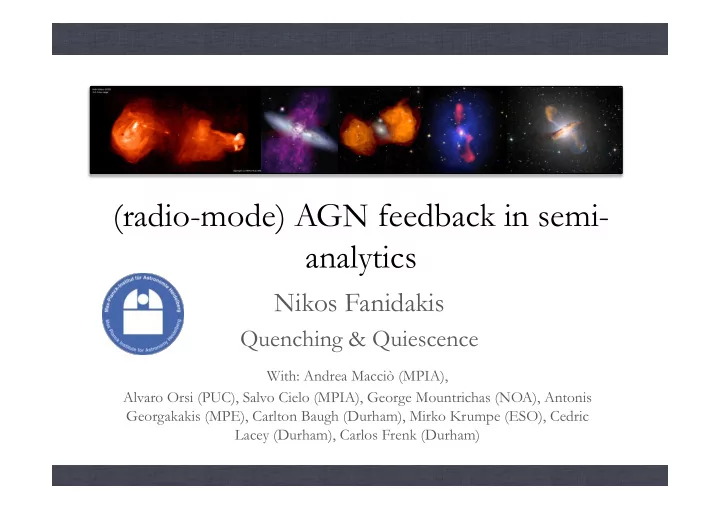
(radio-mode) AGN feedback in semi- analytics

Nikos Fanidakis

Quenching & Quiescence

With: Andrea Macciò (MPIA), Alvaro Orsi (PUC), Salvo Cielo (MPIA), George Mountrichas (NOA), Antonis Georgakakis (MPE), Carlton Baugh (Durham), Mirko Krumpe (ESO), Cedric Lacey (Durham), Carlos Frenk (Durham)

slide-2
SLIDE 2

Nikos Fanidakis – Marseille 12.06.2014

Motivation for introducing AGN feedback

AGN feedback Stellar feedback Maximum galaxy formation efficiency

Nikos Fanidakis – ITP Zurich 4.3.2014 Nikos Fanidakis – Q&Q 15.07.2014

Log10(Mhalo/M!) Log10(Mstellar/Mhalo)

Moster et al. (2010)

slide-3
SLIDE 3

Standard AGN feedback scheme in semi-analytics

τ cool >> τ ff τ cool ~ τ ff

Mhalo~1011.5M!!

blue% red%

Only gas in quasi- hydrostatic equilibrium can be efficiently heated by the central AGN.

Rapid-cooling regime Static-halo regime

rcool=r(τcool=τH)! rcool!

“Radio mode” AGN feedback

Nikos Fanidakis – ITP Zurich 4.3.2014 Nikos Fanidakis – Q&Q 15.07.2014

" Gas in >1011.5M! haloes is in quasi-hydrostatic equilibrium. " Outflows (jets?) driven by the central AGN heat the halo and supress the cooling of gas. See Croton et al (2006); Bower et al. (2006); Monaco et al. (2007); Somerville et al (2008); Lagos et al. (2008)

slide-4
SLIDE 4

! MBH ∝ MBH fhotVvir

3 ⇒ Ljet = 0.1 !

MBHc2 !! mcool = ! mcool − Ljet 0.5Vvir

2

Implementation in SAMs

MUNICH model (Croton et al. 2006): Ljet = fjetLEdd, fjet ~ 0.04 GALFORM model (Bower et al 2006):

Cooling in massive haloes is suppressed if:

Ljet ≥ Lcool ⇒ ! MBH = Lcool εrc2

Nikos Fanidakis – ITP Zurich 4.3.2014 Nikos Fanidakis – Q&Q 15.07.2014

Typical accretion rates are below 1-10% of the Eddington accretion rate.

See also Rachel Somerville’s (2008) model and MORGANA model (Monaco et al. 2007)

slide-5
SLIDE 5

Effect on gas cooling

Croton et al. (2006)

Average cooling rate Cooling flow suppression is most efficient in massive haloes at late epochs.

Nikos Fanidakis – ITP Zurich 4.3.2014 Nikos Fanidakis – Q&Q 15.07.2014

! mheat ∝ MBHVvir

slide-6
SLIDE 6

z = 0 Moster et al. (2011)

AGN feedback is necessary for reproducing the correct stellar mass in massive haloes!

Effect on stellar mass

w/o AGN feedback with AGN feedback

Nikos Fanidakis – ITP Zurich 4.3.2014 Nikos Fanidakis – Q&Q 15.07.2014

GALFORM

slide-7
SLIDE 7

Croton et al. (2006)

The paucity of galaxies

in the bright end of the LF.

The colour bimodality

  • f galaxies.

With AGN feedback we reproduce

See also: Monaco et al. (2007), Lagos et al. (2008), Somerville et al. (2008) Nikos Fanidakis – ITP Zurich 4.3.2014 Nikos Fanidakis – Q&Q 15.07.2014

slide-8
SLIDE 8

Bower et al. (2006)

With AGN feedback we reproduce

Bower et al. 2006

Nikos Fanidakis – ITP Zurich 4.3.2014 Nikos Fanidakis – Q&Q 15.07.2014 See also: Monaco et al. (2007), Lagos et al. (2008), Somerville et al. (2008)

The paucity of galaxies

in the bright end of the LF.

The colour bimodality

  • f galaxies.
slide-9
SLIDE 9

t3 t2 t1 Quasar t1 t2 t3

  • 2. Galaxy mergers
  • 1. Disk instabilities

Dark matter Hot gas Cold gas/Stars

Starburst (quasar) mode

! MBH = ΔMacc fqtdyn

NF et al. (2011, 2012) See also: Malbon et al. (2007), Marulli et al (2008), Somerville et al (2008), Hirschmann et al (2012)

Linking feedback to AGN: BH growth in GALFORM

Hot-halo (radio) mode

Mhalo > 1011.5M!!

! MBH = Lcool εrc2

We trace the evolution of BH mass, spin and accretion rate from z>>20 to z=0

Nikos Fanidakis – ITP Zurich 4.3.2014 Nikos Fanidakis – Q&Q 15.07.2014

slide-10
SLIDE 10

Linking feedback to AGN: Modelling the accretion flow

DM halo hot halo AGN Central engine jet!

BH!

accretion disk

R H

Blandford – Znajek mechanism for Jet formation:

Ljet ∝(H / R)2M BH

2 α 2, with Ljet ADAF ~10 −100Ljet TD

Thin disk luminous disks

! m = ! M / ! MEdd < 0.01

ADAF under-luminous disks

Ldisk

ADAF =εADAFLdisk TD , εADAF = 0.01− 0.1

(NF et al 2011)%

Nikos Fanidakis – ITP Zurich 4.3.2014 Nikos Fanidakis – Q&Q 15.07.2014

slide-11
SLIDE 11

Linking feedback to AGN: Luminosity functions

NF et al. (2013a)

Optical LF

NF et al. (2012) Log10(Φ(LHX)) [Mpc-3 dex-1]

X-ray LF

Hot-Haloes Starbursts

Nikos Fanidakis – ITP Zurich 4.3.2014 Nikos Fanidakis – Q&Q 15.07.2014

z = 1 Super-Eddington

slide-12
SLIDE 12

The model predicts a bimodal distribution of AGN on the BV — stellar mass plane.

NF & Georgakakis (in prep)

Effects of feedback on AGN: The AGN colour bimodality

Contours = galaxies

Nikos Fanidakis – ITP Zurich 4.3.2014 Nikos Fanidakis – Q&Q 15.07.2014

Blue cloud: star forming and rich in gas galaxies

Red cloud: Red and poor in gas galaxies

slide-13
SLIDE 13

Red cloud: Red and poor in gas galaxies

The model predicts a bimodal distribution of AGN on the BV — stellar mass plane. Effects of feedback on AGN: The AGN colour bimodality

Contours = galaxies Points = AGN

Nikos Fanidakis – ITP Zurich 4.3.2014 Nikos Fanidakis – Q&Q 15.07.2014

NF & Georgakakis (in prep)

Blue cloud: star forming and rich in gas galaxies

slide-14
SLIDE 14

Effects of feedback on AGN: The clustering of moderate luminosity AGN

NF+(2013a)

Hot-halo accretion is essential for reproducing the halo mass of moderate luminosity AGN!

Lxray = 1042-1044 erg/sec!

Nikos Fanidakis – ITP Zurich 4.3.2014 Nikos Fanidakis – Q&Q 15.07.2014

slide-15
SLIDE 15

most massive halo

2QZ survey

Croom et al. (2004)

See also: Ross et al. (2009), White et al. (2012), Shen et al. (2013)

NF+(2013b)

Effects of feedback on AGN: The clustering of Quasars The AGN feedback shapes the halo environment of luminous Quasars!

Luminous Quasars

Nikos Fanidakis – ITP Zurich 4.3.2014 Nikos Fanidakis – Q&Q 15.07.2014

slide-16
SLIDE 16

accretion disk

R H

jet!

L jet ∝(H /R)2Bφ

2MBH ˙

m a2

Blandford & Znajek 1977

BH!

Effects of feedback on AGN: The Radio Galaxy Luminosity Function Radio LF dominated by rapidly rotating BHs accreting in the hot-halo mode!

NF +(2011) Nikos Fanidakis – ITP Zurich 4.3.2014 Nikos Fanidakis – Q&Q 15.07.2014

slide-17
SLIDE 17

z = 2! NF (PhD thesis)

Effects of feedback on AGN: The clustering of Radio Galaxies

Millennium simulation z = 2! Radio galaxies trace the peaks of the Dark-Matter distribution The dependence of BH parameters on the environment creates the right conditions for reproducing the clustering of Radio Galaxies

Nikos Fanidakis – ITP Zurich 4.3.2014 Nikos Fanidakis – Q&Q 15.07.2014

See also: Wake et al. (2008); Donoso et al. (2008)

slide-18
SLIDE 18

With a phenomenological calculation for the accretion rate that is linked to AGN feedback we get: 1. The correct evolution of AGN 2. The colour bimodality of AGN 3. The clustering of moderate luminosity AGN and luminous Quasars 4. The abundance & clustering of Radio Galaxies

Summary Take away message: AGN feedback & associated growth mode crucial for reproducing key AGN properties

Nikos Fanidakis – ITP Zurich 4.3.2014 Nikos Fanidakis – Q&Q 15.07.2014