
INF1100 Lectures, Chapter 8: Random Numbers and Simple Games
Hans Petter Langtangen
Simula Research Laboratory University of Oslo, Dept. of Informatics
October 30, 2011
Random numbers are used to simulate uncertain events
Some problems in science and technology are desrcribed by ”exact” mathematics, leading to ”precise” results Examples: throwing a ball, an oscillating system Some problems appear physically uncertain Examples: rolling a die, molecular motion Can we roll a die on a computer? Yes, by using random numbers to mimic the uncertainty of the experiment Random numbers make it possible to simulate physical systems with uncertainty, in input data or the process Random numbers are essential for programming games
Drawing random numbers
Python has a random module for drawing random numbers
random.random() draws random numbers in [0, 1): >>> import random >>> random.random() 0.81550546885338104 >>> random.random() 0.44913326809029852 >>> random.random() 0.88320653116367454
The sequence of random numbers is produced by a deterministic algorithm – the numbers just appear random
Distribution of random numbers
random.random() generates random numbers that are uniformly
distributed in the interval [0, 1)
random.uniform(a, b) generates random numbers uniformly
distributed in [a, b) ”Uniformly distributed” means that if we generate a large set
- f numbers, no part of [a, b) gets more numbers than others
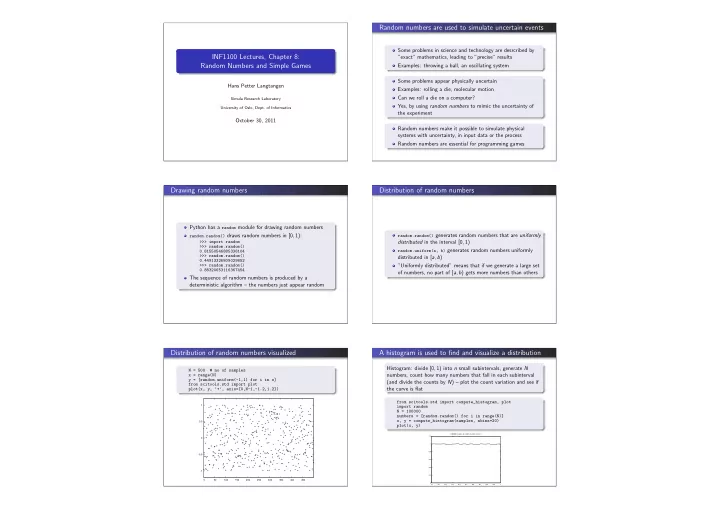
Distribution of random numbers visualized
N = 500 # no of samples x = range(N) y = [random.uniform(-1,1) for i in x] from scitools.std import plot plot(x, y, ’+’, axis=[0,N-1,-1.2,1.2])
- 1
- 0.5
A histogram is used to find and visualize a distribution
Histogram: divide [0, 1) into n small subintervals, generate N numbers, count how many numbers that fall in each subinterval (and divide the counts by N) – plot the count variation and see if the curve is flat
from scitools.std import compute_histogram, plot import random N = 100000 numbers = [random.random() for i in range(N)] x, y = compute_histogram(samples, nbins=20) plot(x, y)
0.2 0.4 0.6 0.8 1 1.2 0.1 0.2 0.3 0.4 0.5 0.6 0.7 0.8 0.9 1 1000000 samples of uniform numbers on (0,1)