SLIDE 1
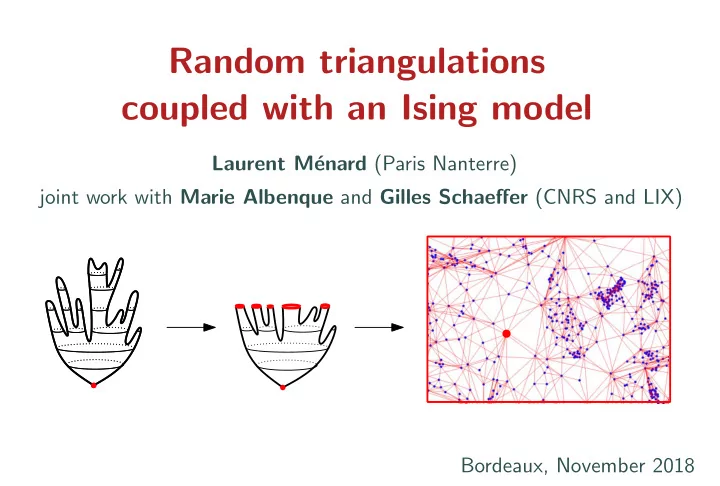
Random triangulations coupled with an Ising model
Laurent M´ enard (Paris Nanterre) joint work with Marie Albenque and Gilles Schaeffer (CNRS and LIX) Bordeaux, November 2018
SLIDE 2 Outline
- 1. Introduction: 2DQG and planar maps
- 2. Local weak topology
- 3. Adding matter: Ising model
- 4. Combinatorics of triangulations with spins
- 5. Local limit of triangulations with spins
SLIDE 3
2D Quantum Gravity?
[Polyakov 81] ”We have to develop an art of handling sums over random surfaces. These sums replace the old fashioned (and extremely useful) sums over random paths.”
SLIDE 4
2D Quantum Gravity?
[Polyakov 81] ”We have to develop an art of handling sums over random surfaces. These sums replace the old fashioned (and extremely useful) sums over random paths.” Sums over random paths: Feynman path integrals. Well understood question: Pick a, b ∈ R2, what does a random path γ : [0, 1] → R2 chosen ”uniformly at random” between all paths from a to b look like?
SLIDE 5
2D Quantum Gravity?
[Polyakov 81] ”We have to develop an art of handling sums over random surfaces. These sums replace the old fashioned (and extremely useful) sums over random paths.” Sums over random paths: Feynman path integrals. Well understood question: Pick a, b ∈ R2, what does a random path γ : [0, 1] → R2 chosen ”uniformly at random” between all paths from a to b look like? Brownian motion!
SLIDE 6
2D Quantum Gravity?
[Polyakov 81] ”We have to develop an art of handling sums over random surfaces. These sums replace the old fashioned (and extremely useful) sums over random paths.” Sums over random paths: Feynman path integrals. Well understood question: Pick a, b ∈ R2, what does a random path γ : [0, 1] → R2 chosen ”uniformly at random” between all paths from a to b look like? Brownian motion! Not so well understood question: What does a random metric on S2 distributed ”uniformly” look like? Brownian surface?
SLIDE 7
2D Quantum Gravity?
[Polyakov 81] ”We have to develop an art of handling sums over random surfaces. These sums replace the old fashioned (and extremely useful) sums over random paths.” Sums over random paths: Feynman path integrals. Well understood question: Pick a, b ∈ R2, what does a random path γ : [0, 1] → R2 chosen ”uniformly at random” between all paths from a to b look like? Brownian motion! Not so well understood question: What does a random metric on S2 distributed ”uniformly” look like? Brownian surface? First idea: try discrete metric spaces (Donsker)
SLIDE 8
Planar Maps as discrete planar metric spaces
Definition: A planar map is a proper embedding of a finite connected graph into the two-dimensional sphere (considered up to orientation-preserving homeomorphisms of the sphere).
SLIDE 9
Planar Maps as discrete planar metric spaces
Definition: A planar map is a proper embedding of a finite connected graph into the two-dimensional sphere (considered up to orientation-preserving homeomorphisms of the sphere). = = =
SLIDE 10
Planar Maps as discrete planar metric spaces
Definition: A planar map is a proper embedding of a finite connected graph into the two-dimensional sphere (considered up to orientation-preserving homeomorphisms of the sphere). faces: connected components of the complement of edges p-angulation: each face is bounded by p edges = = =
SLIDE 11
Planar Maps as discrete planar metric spaces
Definition: A planar map is a proper embedding of a finite connected graph into the two-dimensional sphere (considered up to orientation-preserving homeomorphisms of the sphere). faces: connected components of the complement of edges p-angulation: each face is bounded by p edges
SLIDE 12
Planar Maps as discrete planar metric spaces
Definition: A planar map is a proper embedding of a finite connected graph into the two-dimensional sphere (considered up to orientation-preserving homeomorphisms of the sphere). faces: connected components of the complement of edges p-angulation: each face is bounded by p edges
SLIDE 13
Planar Maps as discrete planar metric spaces
Definition: A planar map is a proper embedding of a finite connected graph into the two-dimensional sphere (considered up to orientation-preserving homeomorphisms of the sphere). faces: connected components of the complement of edges p-angulation: each face is bounded by p edges This is a triangulation
SLIDE 14 Planar Maps as discrete planar metric spaces
Definition: A planar map is a proper embedding of a finite connected graph into the two-dimensional sphere (considered up to orientation-preserving homeomorphisms of the sphere). M Planar Map:
- V (M) := set of vertices of M
- dgr := graph distance on V (M)
- (V (M), dgr) is a (finite) metric space
In blue, distances from 1 1 1 1 1 1 1 2
SLIDE 15 Planar Maps as discrete planar metric spaces
Definition: A planar map is a proper embedding of a finite connected graph into the two-dimensional sphere (considered up to orientation-preserving homeomorphisms of the sphere). M Planar Map:
- V (M) := set of vertices of M
- dgr := graph distance on V (M)
- (V (M), dgr) is a (finite) metric space
In blue, distances from 1 1 1 1 1 1 1 2 Rooted map: mark an oriented edge of the map
SLIDE 16
”Classical” large random triangulations
Take a triangulation of size n uniformly at random. What does it look like if n is large ? Two points of view: global/local, continuous/discrete Euler relation in a triangulation: number of edges / vertices / faces linked
SLIDE 17 ”Classical” large random triangulations
Take a triangulation of size n uniformly at random. What does it look like if n is large ? Two points of view: global/local, continuous/discrete Global : Rescale distances to keep diameter bounded [Le Gall 13, Miermont 13]: converges to the Brownian map.
- Gromov-Hausdorff topology
- Continuous metric space
- Homeomorphic to the sphere
- Hausdorff dimension 4
- Universality
Euler relation in a triangulation: number of edges / vertices / faces linked
SLIDE 18
”Classical” large random triangulations
Take a triangulation of size n uniformly at random. What does it look like if n is large ? Two points of view: global/local, continuous/discrete Local : Don’t rescale distances and look at neighborhoods of the root Euler relation in a triangulation: number of edges / vertices / faces linked
SLIDE 19 ”Classical” large random triangulations
Take a triangulation of size n uniformly at random. What does it look like if n is large ? Two points of view: global/local, continuous/discrete Local : Don’t rescale distances and look at neighborhoods of the root [Angel – Schramm 03, Krikun 05]: Converges to the Uniform Infinite Planar Triangulation
- Local topology
- Metric balls of radius R grow like R4
- ”Universality” of the exponent 4.
Euler relation in a triangulation: number of edges / vertices / faces linked
SLIDE 20
Local Topology for planar maps
Mf := {finite rooted planar maps}. Definition: The local topology on Mf is induced by the distance: dloc(m, m′) := (1 + max{r ≥ 0 : Br(m) = Br(m′)})−1 where Br(m) is the graph made of all the vertices and edges of m which are within distance r from the root.
SLIDE 21 Local Topology for planar maps
Mf := {finite rooted planar maps}. Definition: The local topology on Mf is induced by the distance: dloc(m, m′) := (1 + max{r ≥ 0 : Br(m) = Br(m′)})−1 where Br(m) is the graph made of all the vertices and edges of m which are within distance r from the root.
- (M, dloc): closure of (Mf, dloc). It is a Polish space
(complete and separable).
- M∞ := M \ Mf set of infinite planar maps.
SLIDE 22
Local convergence: simple examples
1 2 n Root = 0
SLIDE 23
Local convergence: simple examples
1 2 n − → (Z+, 0) Root = 0
SLIDE 24
Local convergence: simple examples
1 2 n − → (Z+, 0) Root = 0 1 2 n Uniformly chosen root
SLIDE 25
Local convergence: simple examples
1 2 n − → (Z+, 0) Root = 0 1 2 n Uniformly chosen root
SLIDE 26
Local convergence: simple examples
1 2 n − → (Z+, 0) Root = 0 1 2 n − → (Z, 0) Uniformly chosen root
SLIDE 27
Local convergence: simple examples
1 2 n − → (Z+, 0) 1 2 n − → (Z, 0) Root = 0 1 2 n − → (Z, 0) Uniformly chosen root Root does not matter
SLIDE 28 Local convergence: simple examples
1 2 n − → (Z+, 0) 1 2 n − → (Z, 0) n n − →
+, 0
1 2 n − → (Z, 0) Uniformly chosen root Root does not matter
SLIDE 29 Local convergence: simple examples
1 2 n − → (Z+, 0) 1 2 n − → (Z, 0) n n − →
+, 0
1 2 n − → (Z, 0) Uniformly chosen root Root does not matter n n − →
- Z2, 0
- Uniformly chosen root
SLIDE 30 Local convergence: more complicated examples
Uniform plane rooted trees with n vertices:
n = 1 n = 2 n = 4 n = 3 1/2 1/2 1/5 1/5 1/5 1/5 1/5
SLIDE 31 Local convergence: more complicated examples
Uniform plane rooted trees with n vertices:
n = 1 n = 2 n = 4 n = 3 1/2 1/2 1/5 1/5 1/5 1/5 1/5 n = 1000 n = 500
SLIDE 32 Local convergence: more complicated examples
Uniform plane rooted trees with n vertices:
n = 1 n = 2 n = 4 n = 3 1/2 1/2 1/5 1/5 1/5 1/5 1/5 n = 1000 n = 500
The limit is a probability distribution on infinite trees with one infinite branch.
SLIDE 33 Local convergence of uniform triangulations
Theorem [Angel – Schramm, ’03] As n → ∞, the uniform distribution on triangulations of size n converges weakly to a probability measure called the Uniform Infinite Planar Triangulation (or UIPT) for the local topology.
Courtesy of Timothy Budd Courtesy of Igor Kortchemski
SLIDE 34 Local convergence of uniform triangulations
Theorem [Angel – Schramm, ’03] As n → ∞, the uniform distribution on triangulations of size n converges weakly to a probability measure called the Uniform Infinite Planar Triangulation (or UIPT) for the local topology. Some properties of the UIPT:
- Volume (nb. of vertices) and perimeters of balls known to some extent.
For example E [|Br(T∞)|] ∼ 2 7r4 [Angel ’04, Curien – Le Gall ’12]
- Simple random Walk is recurrent [Gurel-Gurevich and Nachmias ’13]
- The UIPT has almost surely one end [Angel – Schramm, ’03]
- Volume of hulls explicit [M. 16]
- ”Uniqueness” of geodesic rays and horofunctions [Curien – M. 18]
- Bond and site percolation well understood [Angel, Angel–Curien, M.–Nolin]
SLIDE 35 Local convergence of uniform triangulations
Theorem [Angel – Schramm, ’03] As n → ∞, the uniform distribution on triangulations of size n converges weakly to a probability measure called the Uniform Infinite Planar Triangulation (or UIPT) for the local topology. Some properties of the UIPT:
- Volume (nb. of vertices) and perimeters of balls known to some extent.
For example E [|Br(T∞)|] ∼ 2 7r4 [Angel ’04, Curien – Le Gall ’12]
- Simple random Walk is recurrent [Gurel-Gurevich and Nachmias ’13]
Universality: we expect the same behavior for slightly different models (e.g. quadrangulations, triangulations without loops, ...)
- The UIPT has almost surely one end [Angel – Schramm, ’03]
- Volume of hulls explicit [M. 16]
- ”Uniqueness” of geodesic rays and horofunctions [Curien – M. 18]
- Bond and site percolation well understood [Angel, Angel–Curien, M.–Nolin]
SLIDE 36
Adding matter: Ising model on triangulations
How does Ising model influence the underlying map?
SLIDE 37 Adding matter: Ising model on triangulations
How does Ising model influence the underlying map? First, Ising model on a finite deterministic graph: G = (V, E) finite graph Spin configuration on G: σ : V → {−1, +1}.
− + + − − −
SLIDE 38 Adding matter: Ising model on triangulations
How does Ising model influence the underlying map? First, Ising model on a finite deterministic graph: G = (V, E) finite graph Spin configuration on G: σ : V → {−1, +1}.
− + + − − −
Ising model on G: take a random spin configuration with probability P(σ) ∝ e− β
2
β > 0: inverse temperature.
SLIDE 39 Adding matter: Ising model on triangulations
How does Ising model influence the underlying map? First, Ising model on a finite deterministic graph: G = (V, E) finite graph Spin configuration on G: σ : V → {−1, +1}.
− + + − − −
Ising model on G: take a random spin configuration with probability P(σ) ∝ e− β
2
β > 0: inverse temperature. Combinatorial formulation: P(σ) ∝ νm(σ) with m(σ) = number of monochromatic edges and ν = eβ. m(σ) = 4 m(σ) = 4
SLIDE 40
Adding matter: Ising model on triangulations
Tn = {rooted planar triangulations with 3n edges}. Random triangulation in Tn with probability ∝ νm(T,σ) ?
SLIDE 41 Adding matter: Ising model on triangulations
Tn = {rooted planar triangulations with 3n edges}. Generating series of Ising-weighted triangulations: Q(ν, t) =
νm(T,σ)te(T ). Random triangulation in Tn with probability ∝ νm(T,σ) ?
SLIDE 42 Adding matter: Ising model on triangulations
Tn = {rooted planar triangulations with 3n edges}. Generating series of Ising-weighted triangulations: Q(ν, t) =
νm(T,σ)te(T ). Theorem [Bernardi – Bousquet-M´ elou 11] For every ν the series Q(ν, t) is algebraic, has ρν > 0 as unique dominant singularity and satisfies [t3n]Q(ν, t) ∼
n→∞
νc n−7/3
if ν = νc := 1 +
1 √ 7,
κ ρ−n
ν
n−5/2 if ν = νc. This suggests an unusual behavior of the underlying maps for ν = νc. Random triangulation in Tn with probability ∝ νm(T,σ) ? See also [Boulatov – Kazakov 1987], [Bousquet-M´ elou – Schaeffer 03] and [Bouttier – Di Francesco – Guitter 04].
SLIDE 43 Adding matter: the model and Watabiki’s predictions
Pν
n
νm(T,σ) [t3n]Q(ν, t). Probability measure on triangulations of Tn with a spin configuration:
SLIDE 44 Adding matter: the model and Watabiki’s predictions
Counting exponent: coeff [tn] of generating series of (decorated) maps ∼ κρ−nn−α Central charge c: α = 25 − c +
12 Hausdorff dimension: [Watabiki 93] DH = 2 √25 − c + √49 − c √25 − c + √1 − c Pν
n
νm(T,σ) [t3n]Q(ν, t). Probability measure on triangulations of Tn with a spin configuration:
SLIDE 45 Adding matter: the model and Watabiki’s predictions
Counting exponent: coeff [tn] of generating series of (decorated) maps ∼ κρ−nn−α Central charge c: α = 25 − c +
12 Hausdorff dimension: [Watabiki 93]
- α = 5/2 gives DH = 4
- α = 7/3 gives DH = 7+
√ 97 4
≈ 4.21 DH = 2 √25 − c + √49 − c √25 − c + √1 − c Pν
n
νm(T,σ) [t3n]Q(ν, t). Probability measure on triangulations of Tn with a spin configuration:
SLIDE 46 Local Topology for planar maps : balls
Definition: The local topology on Tf is induced by the distance: dloc(T, T ′) := (1 + max{r ≥ 0 : Br(T) = Br(T ′)})−1 where Br(T) is the submap (with spins) of T composed by the faces
- f T with a vertex at distance < r from the root.
SLIDE 47 Local Topology for planar maps : balls
Definition: The local topology on Tf is induced by the distance:
1 1 1 1 1 2 2 2 2 2 2 3 3 2 4 4 4 4 4 4 4 5 5 2 2 2 2 2 3 3 3 3 1 3 3 4 4 4 4 4 4 4 4 4
dloc(T, T ′) := (1 + max{r ≥ 0 : Br(T) = Br(T ′)})−1 where Br(T) is the submap (with spins) of T composed by the faces
- f T with a vertex at distance < r from the root.
SLIDE 48 Local Topology for planar maps : balls
Definition: The local topology on Tf is induced by the distance:
1 1 1 1 1 2 2 2 2 2 2 3 3 2 4 4 4 4 4 4 4 5 5 2 2 2 2 2 3 3 3 3 1 3 3 4 4 4 4 4 4 4 4 4
dloc(T, T ′) := (1 + max{r ≥ 0 : Br(T) = Br(T ′)})−1 where Br(T) is the submap (with spins) of T composed by the faces
- f T with a vertex at distance < r from the root.
SLIDE 49 Local Topology for planar maps : balls
Definition: The local topology on Tf is induced by the distance:
1 1 1 1 1 2 2 2 2 2 2 3 3 2 4 4 4 4 4 4 4 5 5 2 2 2 2 2 3 3 3 3 1 3 3 4 4 4 4 4 4 4 4 4
dloc(T, T ′) := (1 + max{r ≥ 0 : Br(T) = Br(T ′)})−1 where Br(T) is the submap (with spins) of T composed by the faces
- f T with a vertex at distance < r from the root.
SLIDE 50 Local Topology for planar maps : balls
Definition: The local topology on Tf is induced by the distance:
1 1 1 1 1 2 2 2 2 2 2 3 3 2 4 4 4 4 4 4 4 5 5 2 2 2 2 2 3 3 3 3 1 3 3 4 4 4 4 4 4 4 4 4
dloc(T, T ′) := (1 + max{r ≥ 0 : Br(T) = Br(T ′)})−1 where Br(T) is the submap (with spins) of T composed by the faces
- f T with a vertex at distance < r from the root.
SLIDE 51 Local Topology for planar maps : balls
Definition: The local topology on Tf is induced by the distance:
1 1 1 1 1 2 2 2 2 2 2 3 3 2 4 4 4 4 4 4 4 5 5 2 2 2 2 2 3 3 3 3 1 3 3 4 4 4 4 4 4 4 4 4
dloc(T, T ′) := (1 + max{r ≥ 0 : Br(T) = Br(T ′)})−1 where Br(T) is the submap (with spins) of T composed by the faces
- f T with a vertex at distance < r from the root.
SLIDE 52 Local Topology for planar maps : balls
Definition: The local topology on Tf is induced by the distance: dloc(T, T ′) := (1 + max{r ≥ 0 : Br(T) = Br(T ′)})−1 where Br(T) is the submap (with spins) of T composed by the faces
- f T with a vertex at distance < r from the root.
r T Br(T) simple cycles
- (T , dloc): closure of (Tf, dloc).
It is a Polish space.
- T∞ := T \ Tf set of infinite planar
triangulations.
SLIDE 53 Weak convergence for the local topology
Portemanteau theorem + Levy – Prokhorov metric: A sequence of measures measures (Pn) on Tf converge weakly to a measure P on T∞ if: Pn
- {(T, v) ∈ Tf : Br(T, v) = ∆}
- −
→
n→∞ P
- {T ∈ T∞ : Br(T) = ∆}
- .
- 1. For every r > 0 and every possible r-ball ∆
SLIDE 54 Weak convergence for the local topology
Portemanteau theorem + Levy – Prokhorov metric: A sequence of measures measures (Pn) on Tf converge weakly to a measure P on T∞ if: Pn
- {(T, v) ∈ Tf : Br(T, v) = ∆}
- −
→
n→∞ P
degree n
- 1. For every r > 0 and every possible r-ball ∆
Problem: not sufficient since the space (T , dloc) is not compact! Ex:
SLIDE 55 Weak convergence for the local topology
Portemanteau theorem + Levy – Prokhorov metric: A sequence of measures measures (Pn) on Tf converge weakly to a measure P on T∞ if: Pn
- {(T, v) ∈ Tf : Br(T, v) = ∆}
- −
→
n→∞ P
- {T ∈ T∞ : Br(T) = ∆}
- .
- 2. No loss of mass at the limit: Tightness of (Pn), or
the measure P defined by the limits in 1. is a probability measure.
- 1. For every r > 0 and every possible r-ball ∆
∀r > 0,
P
- {T ∈ T∞ : Br(T) = ∆}
- = 1.
- Vertex degrees are tight (at finite distance from the root)
SLIDE 56
Local convergence and generating series
Need to evaluate, for every possible ball ∆ (here, one boundary to keep it simple) Pn ∆ ???
SLIDE 57 Local convergence and generating series
Need to evaluate, for every possible ball ∆ (here, one boundary to keep it simple) Pn ∆ ???
spins given by a word ω
SLIDE 58 Local convergence and generating series
Need to evaluate, for every possible ball ∆ (here, one boundary to keep it simple) Pn ∆ ???
spins given by a word ω = νm(∆)−m(ω) [t3n−e(∆)+|ω|]Zω(ν, t) [t3n]Q(ν, t) Zω(ν, t) := generating series of triangulations with simple boundary ω
SLIDE 59 Local convergence and generating series
Theorem [Albenque – M. – Schaeffer 18+] For every ω and ν, the series t|ω|Zω(ν, t) is algebraic, has ρν = t3
ν as
unique dominant singularity and satisfies Need to evaluate, for every possible ball ∆ (here, one boundary to keep it simple) Pn ∆ ???
spins given by a word ω = νm(∆)−m(ω) [t3n−e(∆)+|ω|]Zω(ν, t) [t3n]Q(ν, t) Zω(ν, t) := generating series of triangulations with simple boundary ω [t3n]t|ω|Zω(ν, t) ∼
n→∞
νc n−7/3
if ν = νc := 1 +
1 √ 7,
κω(ν) ρ−n
ν
n−5/2 if ν = νc.
SLIDE 60 Triangulations with simple boundary
To get exact asymptotics we need, as series in t3,
- 1. algebraicity,
- 2. no other dominant singularity than ρν.
Fix a word ω, with injections from and into triangulations of the sphere: [t3n]t|ω|Zω = Θ
ν n−α
, with α = 5/2 of 7/3 depending on ν.
SLIDE 61 Triangulations with simple boundary
= +
a Zω
+ Z⊖ω +
Zaω1 ·Zaω2
× ν1←
− ω =− → ω t
Tutte’s equation (or peeling equation, or loop equation... ): To get exact asymptotics we need, as series in t3,
- 1. algebraicity,
- 2. no other dominant singularity than ρν.
Fix a word ω, with injections from and into triangulations of the sphere: [t3n]t|ω|Zω = Θ
ν n−α
, with α = 5/2 of 7/3 depending on ν.
SLIDE 62 Triangulations with simple boundary
= +
a Zω
+ Z⊖ω +
Zaω1 ·Zaω2
× ν1←
− ω =− → ω t
Tutte’s equation (or peeling equation, or loop equation... ): Double induction on |ω| and number of ⊖’s: enough to prove 1. and 2. for the tpZ⊕p’s To get exact asymptotics we need, as series in t3,
- 1. algebraicity,
- 2. no other dominant singularity than ρν.
Fix a word ω, with injections from and into triangulations of the sphere: [t3n]t|ω|Zω = Θ
ν n−α
, with α = 5/2 of 7/3 depending on ν.
SLIDE 63 Positive boundary conditions: two catalytic variables
= +
Z⊕pxp = + νtx2+ +νt x (A(x))2
SLIDE 64 Positive boundary conditions: two catalytic variables
= +
- Peeling equation at interface ⊖–⊕:
= +
Z⊕pxp = + νtx2+ +νt x (A(x))2 S(x, y) :=
Z⊕p⊖qxpyq +
SLIDE 65 Positive boundary conditions: two catalytic variables
= +
- Peeling equation at interface ⊖–⊕:
= +
Z⊕pxp = + νtx2+ +νt x (A(x))2 S(x, y) :=
Z⊕p⊖qxpyq + νt x
SLIDE 66 Positive boundary conditions: two catalytic variables
= +
- Peeling equation at interface ⊖–⊕:
= +
Z⊕pxp = + νtx2+ +νt x (A(x))2 S(x, y) :=
Z⊕p⊖qxpyq + νt x
= txy+ t x
y
xS(x, y)A(x) + t y S(x, y)A(y)
SLIDE 67
From two catalytic variables to one: Tutte’s invariants
Kernel method: equation for S reads K(x, y) · S(x, y) = R(x, y) K(x, y) = 1 − t x − t y − t xA(x) − t y A(y). where
SLIDE 68 From two catalytic variables to one: Tutte’s invariants
Kernel method: equation for S reads K(x, y) · S(x, y) = R(x, y) K(x, y) = 1 − t x − t y − t xA(x) − t y A(y). where
- 1. Find two series Y1 and Y2 in Q(x)[[t]] such that K(x, Yi/t) = 0.
SLIDE 69 From two catalytic variables to one: Tutte’s invariants
Kernel method: equation for S reads K(x, y) · S(x, y) = R(x, y) K(x, y) = 1 − t x − t y − t xA(x) − t y A(y). where
- 1. Find two series Y1 and Y2 in Q(x)[[t]] such that K(x, Yi/t) = 0.
It gives
1 Y1 (A(Y1/t) + 1) = 1 Y2 (A(Y2/t) + 1).
SLIDE 70 From two catalytic variables to one: Tutte’s invariants
Kernel method: equation for S reads K(x, y) · S(x, y) = R(x, y) K(x, y) = 1 − t x − t y − t xA(x) − t y A(y). where
- 1. Find two series Y1 and Y2 in Q(x)[[t]] such that K(x, Yi/t) = 0.
It gives
1 Y1 (A(Y1/t) + 1) = 1 Y2 (A(Y2/t) + 1).
I(y) := 1
y (A(y/t) + 1) is called an invariant.
SLIDE 71 From two catalytic variables to one: Tutte’s invariants
Kernel method: equation for S reads K(x, y) · S(x, y) = R(x, y) K(x, y) = 1 − t x − t y − t xA(x) − t y A(y). where
- 1. Find two series Y1 and Y2 in Q(x)[[t]] such that K(x, Yi/t) = 0.
It gives
1 Y1 (A(Y1/t) + 1) = 1 Y2 (A(Y2/t) + 1).
I(y) := 1
y (A(y/t) + 1) is called an invariant.
- 2. Work a bit with the help of R(x, Yi/t) = 0 to get a second invariant
J(y) depending only on t, Z⊕(t), y and A(y/t).
SLIDE 72 From two catalytic variables to one: Tutte’s invariants
Kernel method: equation for S reads K(x, y) · S(x, y) = R(x, y) K(x, y) = 1 − t x − t y − t xA(x) − t y A(y). where
- 1. Find two series Y1 and Y2 in Q(x)[[t]] such that K(x, Yi/t) = 0.
It gives
1 Y1 (A(Y1/t) + 1) = 1 Y2 (A(Y2/t) + 1).
I(y) := 1
y (A(y/t) + 1) is called an invariant.
- 2. Work a bit with the help of R(x, Yi/t) = 0 to get a second invariant
J(y) depending only on t, Z⊕(t), y and A(y/t).
- 3. Prove that J(y) = C0(t) + C1(t)I(y) + C2(t)I2(y) with Ci’s explicit
polynomials in t, Z⊕(t) and Z⊕2(t). Equation with one catalytic variable for A(y) with Z⊕ and Z⊕2 !
SLIDE 73 Explicit solution for positive boundary conditions
2t2ν(1 − ν) A(y) y − Z⊕
y , Z⊕, Z⊕2, t, y
- Equation with one catalytic variable reads:
[Bousquet-M´ elou – Jehanne 06] gives algebraicity and strategy to solve this kind of equation.
SLIDE 74 Explicit solution for positive boundary conditions
2t2ν(1 − ν) A(y) y − Z⊕
y , Z⊕, Z⊕2, t, y
- Equation with one catalytic variable reads:
[Bousquet-M´ elou – Jehanne 06] gives algebraicity and strategy to solve this kind of equation. Much easier: [Bernardi – Bousquet M´ elou 11] gives us Z⊕ and Z⊕2!
SLIDE 75 Explicit solution for positive boundary conditions
2t2ν(1 − ν) A(y) y − Z⊕
y , Z⊕, Z⊕2, t, y
- Equation with one catalytic variable reads:
[Bousquet-M´ elou – Jehanne 06] gives algebraicity and strategy to solve this kind of equation. Much easier: [Bernardi – Bousquet M´ elou 11] gives us Z⊕ and Z⊕2!
t3 = U P1(µ, U) 4(1 − 2U)2(1 + µ)3 y = V P2(µ, U, V ) (1 − 2U)(1 + µ)2(1 − V )2 t3A(t, ty) = V P3(µ, U, V ) 4(1 − 2U)2(1 + µ)3(1 − V )3
Maple: rational (and Lagrangian) parametrization ! with ν = 1+µ
1−µ and
Pi’s explicit polynomials.
SLIDE 76 Going back to local convergence
Pn (Br(T, v) = ∆) = νm(∆)−m(∂∆) [t3n−e(∆)+|∂∆|] k
i=1 Zωi(ν, t)
→
n→∞
k
Zωi(ν, tν)
k
νm(∆)−m(∂∆) t|∆|−|ω|
ν
κωj κ t|ωj|
ν
Zωj(ν, tν) .
- 1. Fix r ≥ 0 and take ∆ a r-ball with boundary spins ∂∆ = (ω1, . . . , ωk):
SLIDE 77 Going back to local convergence
Pn (Br(T, v) = ∆) = νm(∆)−m(∂∆) [t3n−e(∆)+|∂∆|] k
i=1 Zωi(ν, t)
→
n→∞
k
Zωi(ν, tν)
k
νm(∆)−m(∂∆) t|∆|−|ω|
ν
κωj κ t|ωj|
ν
Zωj(ν, tν) .
- 2. Remains to prove tightness.
- 1. Fix r ≥ 0 and take ∆ a r-ball with boundary spins ∂∆ = (ω1, . . . , ωk):
SLIDE 78 Going back to local convergence
Pn (Br(T, v) = ∆) = νm(∆)−m(∂∆) [t3n−e(∆)+|∂∆|] k
i=1 Zωi(ν, t)
→
n→∞
k
Zωi(ν, tν)
k
νm(∆)−m(∂∆) t|∆|−|ω|
ν
κωj κ t|ωj|
ν
Zωj(ν, tν) .
- 2. Remains to prove tightness.
- 1. Fix r ≥ 0 and take ∆ a r-ball with boundary spins ∂∆ = (ω1, . . . , ωk):
- Maps are uniformly rooted:
tightness of root degree is enough
SLIDE 79 Going back to local convergence
Pn (Br(T, v) = ∆) = νm(∆)−m(∂∆) [t3n−e(∆)+|∂∆|] k
i=1 Zωi(ν, t)
→
n→∞
k
Zωi(ν, tν)
k
νm(∆)−m(∂∆) t|∆|−|ω|
ν
κωj κ t|ωj|
ν
Zωj(ν, tν) .
- 2. Remains to prove tightness.
- 1. Fix r ≥ 0 and take ∆ a r-ball with boundary spins ∂∆ = (ω1, . . . , ωk):
- Maps are uniformly rooted:
tightness of root degree is enough
- We show that expected degree at the root
under Pn is bounded with n
SLIDE 80 A simple tightness argument
Pn (δ ∈ e) =
3n
P (δ ∈ e|deg(δ) = k) · Pn (deg(δ) = k) ≥
3n
k 2 · 3nPn (deg(δ) = k) = 1 6nEn [deg(δ)] Mark a uniform edge conditionally on the triangulation We want to study the degree of the root vertex δ:
SLIDE 81 A simple tightness argument
Pn (δ ∈ e) =
3n
P (δ ∈ e|deg(δ) = k) · Pn (deg(δ) = k) ≥
3n
k 2 · 3nPn (deg(δ) = k) = 1 6nEn [deg(δ)] Pn (δ ∈ e) ≤ max 1 ν , 1 2 [t3n+2](Z4 + Z2
2 + Z2 1 + Z2 1Z2 + Z1Z3)
3n [t3n]Z = O(1/n) Mark a uniform edge conditionally on the triangulation We want to study the degree of the root vertex δ: Cut open the marked edge and the root:
SLIDE 82 A simple tightness argument
Pn (δ ∈ e) =
3n
P (δ ∈ e|deg(δ) = k) · Pn (deg(δ) = k) ≥
3n
k 2 · 3nPn (deg(δ) = k) = 1 6nEn [deg(δ)] Pn (δ ∈ e) ≤ max 1 ν , 1 2 [t3n+2](Z4 + Z2
2 + Z2 1 + Z2 1Z2 + Z1Z3)
3n [t3n]Z = O(1/n) Mark a uniform edge conditionally on the triangulation We want to study the degree of the root vertex δ: Cut open the marked edge and the root: En [deg(δ)] = O(1).
SLIDE 83 The story so far
What we know:
- Convergence in law for the local toplogy.
- The limiting random triangulation has one end a.s.
SLIDE 84 The story so far
What we know:
- Convergence in law for the local toplogy.
- The limiting random triangulation has one end a.s.
- A spatial Markov property.
- Some links with Boltzmann triangulations.
SLIDE 85 The story so far
What we know:
- Convergence in law for the local toplogy.
- The limiting random triangulation has one end a.s.
- A spatial Markov property.
- Some links with Boltzmann triangulations.
- Recurrence of SRW (vertex degrees have exponential tails)
- Cluster properties.
In progress:
SLIDE 86 The story so far
What we know:
- Convergence in law for the local toplogy.
- The limiting random triangulation has one end a.s.
What we would like to know:
- Singularity with respect to the UIPT?
- Volume growth?
- A spatial Markov property.
- Some links with Boltzmann triangulations.
- Recurrence of SRW (vertex degrees have exponential tails)
- Cluster properties.
In progress:
SLIDE 87 The story so far
What we know:
- Convergence in law for the local toplogy.
- The limiting random triangulation has one end a.s.
What we would like to know:
- Singularity with respect to the UIPT?
- Volume growth?
- At least volume growth = 4 at νc?
- A spatial Markov property.
- Some links with Boltzmann triangulations.
- Recurrence of SRW (vertex degrees have exponential tails)
- Cluster properties.
In progress:
SLIDE 88 Summer school Random trees and graphs July 1 to 5, 2019 in Marseille France
- Org. M. Albenque, J. Bettinelli, J. Ru´
e and L.Menard
Thank you for your attention!
Summer school Random walks and models of complex networks July 8 to 19, 2019 in Nice
- Org. B. Reed and D. Mitsche