Rasmus and the Vagabond By Astrid Lindgren N.B . This is a good - - PDF document

rasmus and the vagabond by astrid lindgren n b this is a
SMART_READER_LITE
LIVE PREVIEW

Rasmus and the Vagabond By Astrid Lindgren N.B . This is a good - - PDF document

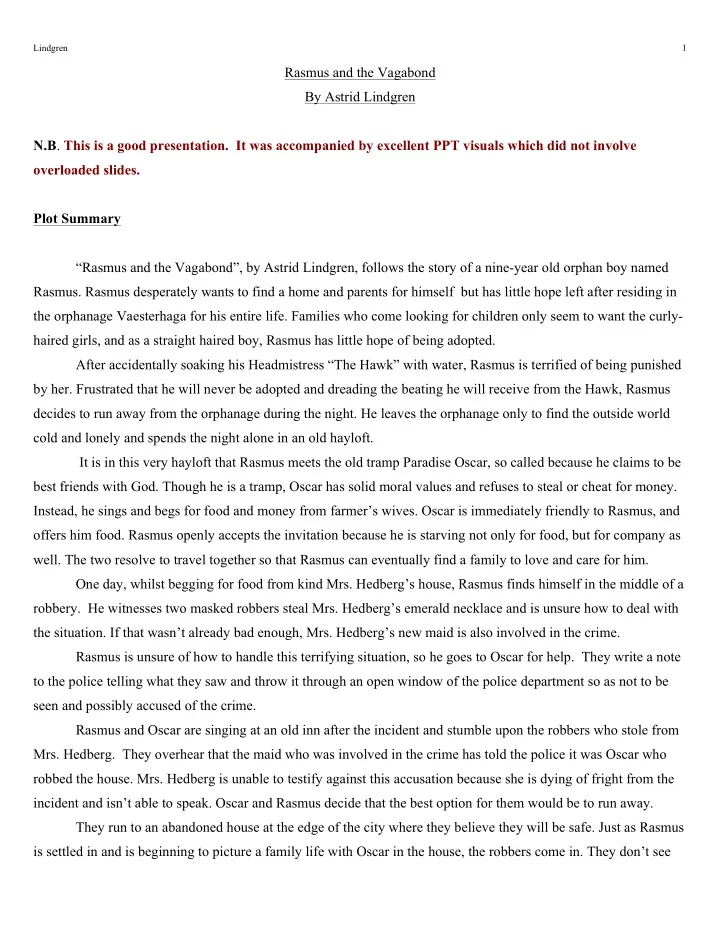
Lindgren 1 Rasmus and the Vagabond By Astrid Lindgren N.B . This is a good presentation. It was accompanied by excellent PPT visuals which did not involve overloaded slides. Plot Summary Rasmus and the Vagabond, by Astrid Lindgren,


slide-1
SLIDE 1

Lindgren 1

Rasmus and the Vagabond By Astrid Lindgren N.B. This is a good presentation. It was accompanied by excellent PPT visuals which did not involve

  • verloaded slides.

Plot Summary “Rasmus and the Vagabond”, by Astrid Lindgren, follows the story of a nine-year old orphan boy named

  • Rasmus. Rasmus desperately wants to find a home and parents for himself but has little hope left after residing in

the orphanage Vaesterhaga for his entire life. Families who come looking for children only seem to want the curly- haired girls, and as a straight haired boy, Rasmus has little hope of being adopted. After accidentally soaking his Headmistress “The Hawk” with water, Rasmus is terrified of being punished by her. Frustrated that he will never be adopted and dreading the beating he will receive from the Hawk, Rasmus decides to run away from the orphanage during the night. He leaves the orphanage only to find the outside world cold and lonely and spends the night alone in an old hayloft. It is in this very hayloft that Rasmus meets the old tramp Paradise Oscar, so called because he claims to be best friends with God. Though he is a tramp, Oscar has solid moral values and refuses to steal or cheat for money. Instead, he sings and begs for food and money from farmer’s wives. Oscar is immediately friendly to Rasmus, and

  • ffers him food. Rasmus openly accepts the invitation because he is starving not only for food, but for company as
  • well. The two resolve to travel together so that Rasmus can eventually find a family to love and care for him.

One day, whilst begging for food from kind Mrs. Hedberg’s house, Rasmus finds himself in the middle of a

  • robbery. He witnesses two masked robbers steal Mrs. Hedberg’s emerald necklace and is unsure how to deal with

the situation. If that wasn’t already bad enough, Mrs. Hedberg’s new maid is also involved in the crime. Rasmus is unsure of how to handle this terrifying situation, so he goes to Oscar for help. They write a note to the police telling what they saw and throw it through an open window of the police department so as not to be seen and possibly accused of the crime. Rasmus and Oscar are singing at an old inn after the incident and stumble upon the robbers who stole from

  • Mrs. Hedberg. They overhear that the maid who was involved in the crime has told the police it was Oscar who

robbed the house. Mrs. Hedberg is unable to testify against this accusation because she is dying of fright from the incident and isn’t able to speak. Oscar and Rasmus decide that the best option for them would be to run away. They run to an abandoned house at the edge of the city where they believe they will be safe. Just as Rasmus is settled in and is beginning to picture a family life with Oscar in the house, the robbers come in. They don’t see

slide-2
SLIDE 2

Lindgren 2

Oscar and Rasmus sleeping in the corner and proceed to hide the money and the necklace they stole underneath the

  • floorboards. As soon as the robbers leave, the two tramps put the money in their backpack to return it to the police
  • station. As Oscar and Rasmus are exiting, the robbers re-enter the house and begin to chase after Rasmus. The

latter separates from Oscar, and after a thrilling chase, manages to trick the robber and escape from his clutches. Rasmus runs back to the old house only to find Oscar and the other robber in a fight over the money and

  • jewels. With the help of the newly brave Rasmus, Oscar manages to get away with the loot.

When Oscar attempts to return the money to the police, he is accused of the crime and taken to jail. Meanwhile, Rasmus is captured yet again by the robbers and is held prisoner. The robbers free Oscar in exchange for the loot. As they are retrieving the money, the police come and discover the real thieves in the operation and arrest

  • them. Oscar and Rasmus are set free. They go to a farmhouse where they are greeted warmly and fed. The couple

decides that they want to adopt Rasmus. This offer seems to be everything the boy ever dreamed of, but Rasmus soon discovers that all he wants is to be with Oscar. He leaves the farm in order to be a tramp with Oscar and this makes him happy despite the fact that he knows they will never be wealthy. Oscar takes Rasmus to his home where he has a wife, and it turns out that he was never a tramp after all. They all live happily ever after. Character Analysis The main protagonist in the story is Rasmus. He is an innocent young orphan who craves attention and love but feels that he doesn’t deserve it. Because he has lived in an orphanage his entire life, his relationships with adults are different from those of a normal child. The plot of the book is driven by his desire to find a loving family since the boy has never truly been loved before. At the beginning of the book Rasmus wants to be adopted by a rich, handsome couple. Through his adventures with Oscar, however, he discovers that it isn’t the money that will make him happy. All he needs is someone to love him. He finds this person to be Oscar himself. Though Rasmus is very timid and afraid of the unknown, Oscar makes him feel protected and safe from the world. Oscar makes the perfect companion for Rasmus because the former is very kid-like and uneducated. This helps to quell Rasmus’ instinctive fear of adults, as he does not see Oscar as a grown-up but rather as a companion. Rasmus doesn’t really know exactly what he wants, but towards the end of the book is willing to try new things in order to find out what lifestyle is suitable for him. This lifestyle turns out to be that of his companion, Paradise Oscar. Oscar’s character remains unchanged throughout the novel, and his main function is to guide Rasmus in his journey of self-discovery.

slide-3
SLIDE 3

Lindgren 3

Oscar has very strong morals and would never lie or cheat to get food, no matter how hungry he is. He knows what is just and unjust in the world and has a passion for music. He is very lazy, but knows exactly how much work he has to do to get food and shelter. Oscar is a very child-like character; he is uneducated and very

  • lazy. It is because of these child like qualities that he makes a good companion for Rasmus, who is unused to

attention from adults. He serves as a good moral guide for Rasmus because he is unconcerned with the material aspects of life. This shows Rasmus that it doesn’t matter whether a family is rich or poor; the important thing is that they are happy and healthy. Oscar’s positive qualities are contrasted with those of the antagonist in the story, the robbers

  • Mr. Lif and Mr. Liander.

These characters are stock villains who are rich and greedy for money. They are completely driven by greed and will stop at nothing to get what they desire. They steal from an old woman and even imprison Rasmus for a

  • time. These characters serve to contrast with and emphasize the good qualities found in Oscar.

Structure Analysis Pippi Longstocking is written in such a way that every chapter is a new adventure whereas this story follows a fluid plot line throughout. The plot is consistent throughout the novel, complete with character change and growth. The initial conflict occurs when Rasmus decides that he must run away from the orphanage. Though he is running from the punishment he will receive at school, he really goes so that he may find a family to love him. The rising action occurs when Rasmus begins his journey with Oscar and witnesses the robbery in Mrs. Hedberg’s house. The plot escalates from there until the climax where Rasmus must save Oscar from the robbers. The character of Rasmus is forced to deal with a much more serious situation than a boy of his age should, and as a result his character changes. He becomes braver and surer of himself, and his bond with Oscar strengthens. The plot is then resolved when the two tramps escape the clutches of the robbers. The story has a utopian ending typical of children’s novels. Rasmus finds Oscar to be a fitting parent for him and is swept away into a perfect family life. Themes The main themes presented in this novel revolve around the concepts of money and class structure. Both money and class structure are presented as irrelevant to a person's happiness.

slide-4
SLIDE 4

Lindgren 4

Rasmus constantly imagines an alternate world in which a rich family adopts him, but money is not his main concern. Even from the beginning of the novel, he appreciates the beauty of life rather than riches. When he is picking nettles for the chickens one day, for example, he discovers a five-cent coin and a shell. Rasmus is just as excited, if not more excited, to find the shell as he is the money. Rasmus rejects the wealthy farm family in order to live with the poorer Oscar. In this case, the boy is presented with a clear choice of living a life of riches with the family or living the life of a vagabond with Oscar. Even though the riches tempt him, he still chooses to live with Oscar because of the love he feels for him. In this way, Rasmus chooses love over money. The other main theme, the rejection of the class system, is also present throughout the novel. Despite the fact that Oscar is a tramp, the author makes it clear that God will accept him and everyone else who is morally virtuous regardless of their status in society. When Oscar and Rasmus first meet, Oscar says: “God approves of tramps […]. When He has gone to so much trouble to put the world together He wants to have everything in it […]. How would it look if there were everything except tramps?” (page number?) Although Oscar is not in fact a true tramp, his words illustrate an important theme of the book, namely, that God will accept anyone regardless of their position in society. Connections to Works Covered in Class Although “Pippi Longstocking”, and “Rasmus and the Vagabond” are both about orphans, Pippi’s world and Rasmus’ world are completely different. Pippi lives in a world of imagination whereas Rasmus lives in more

  • f a real world. This key difference is most likely due to the difference in age groups that the books are intended
  • for. Pippi is more for the young child, and Rasmus is targeted more for nine to twelve year olds. The books differ

in the treatment of several key elements: danger, weapons, the fantastic, and the need for parents. The concept of danger in Pippi is not relevant whereas in Rasmus’s world, it is a constant threat. Pippi can get herself into any sort of dangerous situation, and the reader never really worries that she will injure herself because she always seems to be able to spring back to life. Lindgren does not want the child reader to feel unsafe in any way while reading “Pippi Longstocking”. In Rasmus’ case, the treatment of danger is different because the novel is intended for a slightly older reader. For example, when Rasmus is being chased by the robber’s, there is a possibility that they will capture and imprison him, which instills fear in the reader's mind. Rasmus gets himself into dangerous situations, but as

  • pposed to what occurs in “Pippi Longstocking”, he may not come out unscathed. The difference in the treatment
  • f danger in these two novels is also shown in the way the two main characters treat weapons.
slide-5
SLIDE 5

Lindgren 5

Pippi Longstocking gives away daggers and runs around with a pirate’s sword, but when Rasmus encounters a gun, he is scared to death. The reader knows that somehow or other, Pippi will not get hurt. When the gun is presented in Rasmus, there are a few situations in which either Oscar or Rasmus is in danger of being shot. This difference in the treatment of weapons is possible because Pippi lives in a world of the fantastic, whereas Rasmus can only imagine an alternate reality to his own. The two characters differ in one main and obvious quality. Rasmus’ main motive is the desire for parental love, whereas this is never really a concern for the independent Pippi. In this way, Rasmus is more of a realistic child than Pippi; Pippi is only able to behave this way because she lives in a world of the fantastic. Although the books differ in these elements, the key themes in each are very similar. The treatment of money in each book suggests that money is not very important as long as you are having fun and have companions. Pippi has a seemingly limitless amount of money, but this is never really of major concern to her. She clearly values having fun over material wealth. Because Rasmus is poorer, money is important to him, but only because it provides him with basic needs. Throughout the book he never desires money for any sort of material need other than food and shelter. Although he dreams of having rich parents, he discovers that it is parental love he craves, rather than money. Both stories also follow a typical theme in children’s literature in which the character gets exactly what he

  • r she wants by the end of the book. Rasmus ends up with a loving family, and Pippi decides she wants to live the

life of a pirate. Despite the fact that both stories have happy endings, Lindgren clearly had set age groups in mind when she wrote these novels. The author probably thought that an older child reader was more equipped to handle the problems that Rasmus faces, but a younger child should not have to deal with those kind of issues at that point in their life. Although they live in completely different worlds, however, the children both have strong moral values. This sends the message that a reader of any age should know the difference between right and wrong. This is very solid work! 83%

  • 1. Paginate and double space your work.
  • 2. Avoid the use of "and" or "of" in quick succession in the same sentence. That is redundant.
  • 3. Avoid repeating the same ideas.